
John 4:26
in John 4Jesus answered, “I who speak to you am He.”
BSB
The same verse in ASV and KJV ▾
ASV
Jesus saith unto her, I that speak unto thee am he.
KJV
Jesus saith unto her, I that speak unto thee am he.
⋯
This verse in John 4
Commentary
19 notes on this verseNot to untutored or wholly ignorant souls doth Christ reveal Himself, bat shines upon and appears the rather to those who are more ready to desire to learn, and travailing with the beginning of the faith in simple words, press forward to the knowledge of what is more perfect. Such an one as this was the woman of Samaria also shown to us, giving her mind more grossly than she ought to the truly Divine ideas, but not entirely removed from the desire of understanding somewhat.
This site's exposition
He will explain everything
on John 4:25-26
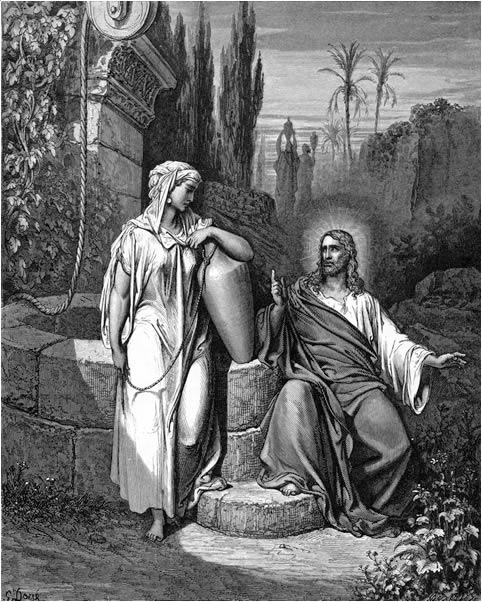
The Samaritans looked for a coming teacher they called the Taheb, the restorer promised in Deuteronomy 18:15. Jesus tells her outright that He is the one she is waiting for. He says it first to a Samaritan woman at a well.
This site's exposition
I who speak to you am He
Adam Clarke notes that Jesus never spoke so directly of Himself to His own countrymen, nor to the disciples until near His death. John Wesley links that reserve to the Jews' hope of an earthly kingdom, and Clarke cites Bishop Pearce, that Samaritans would not disturb His ministry early. Cyril of Alexandria sees a learner ready for it.
The record, by era
The Church Fathers5 voices
Then, "The woman saith unto Him, I know that Messias will come, who is called Christ: when He then is come, He will tell us all things. Jesus saith unto her, I that speak with thee am He." She called her husband; he is made the head of the woman, and Christ is made the head of the man. Now is the woman constituted in faith, and ruled, as about to live rightly. After she heard this, "I that speak with thee am He," what further could she say, when the Lord Jesus willed to manifest Himself to the woman, to whom He had said, "Believe me?"
A commentator
Ephrem the SyrianCOMMENTARY ON TATIAN'S DIATESSARON 12.18 · Written before 373.
proposed
"And if you are a king, how is it that you are asking me for water?" It was not in this way that he first made reference about himself to her, but rather first as a Jew, and then as a prophet, and thereafter as …
The woman was made dizzy by His discourse, and fainted at the sublimity of what He said, and, in her trouble, hear what she saith: "I know that Messias cometh, which is called Christ: when He is come, He will tell us all things. Jesus saith unto her, I am that speak unto thee." And whence came the Samaritans to expect the coming of Christ, seeing that they received Moses only? From the writings of Moses themselves. For even in the beginning He revealed the Son. "Let Us make man in Our Image, after Our Likeness" was said to the Son. It was He who talked with Abraham in the tent. And Jacob prophesying concerning Him said, "A ruler shall not fail from Judah, nor a leader from his thighs, until He come for whom it is reserved, and He is the expectation of nations." And Moses himself saith, "The Lord thy God will raise up unto you a Prophet of your brethren like unto me, unto Him shall ye hearken." And the circumstances attending the serpent, and the rod of Moses, and Isaac, and the sheep, and many other things they who chose might select as proclaiming His coming.
"And why, pray," saith one, "did not Christ lead on the woman by these means? why did He instance the serpent to Nicodemus, and mention prophecy to Nathanael, but to her say nothing of the kind? For what reason, and why?" Because they were men, and were versed in these things, she a poor ignorant woman unpracticed in the Scriptures. Wherefore He doth not speak to her from them, but draweth her on by the "water" and by prophecy, and bringeth her to make mention of Christ and then revealeth Himself; which had He at first told the woman when she had not questioned Him, He would have seemed to her to trifle and talk idly, while as it is by bringing her little by little to mention Him, at a fitting time He revealed Himself.
To the Jews, who continually said, "How long dost Thou make us to doubt? tell us if Thou art the Christ," to them He gave no clear answer, but to this woman He said plainly, that HE IS. For the woman was more fair-minded than the Jews; they did not enquire to learn, but always to mock at Him, for had they desired to learn, the teaching which was by His words, and by the Scriptures, and by His miracles would have been sufficient. The woman, on the contrary, said what she said from an impartial judgment and a simple mind, as is plain from what she did afterwards; for she both heard and believed, and netted others also, and in every circumstance we may observe the carefulness and faith of the woman.
11 more voices on this verse
The Medieval Church3 voices
"Jesus says to her: I am he, who speaks with you." Similarly the Lord responded to the blind man below in chapter 9, when the blind man asked who the Son of God was in whom he ought to believe; the Lord responded: "You have …
And so Jesus says: I who speak to you am he, i.e., I am the Christ: "Wisdom goes to meet those who desire her, so she may first reveal herself to them" (Wis 6:14), and below (14:21): "I will love him, and reveal myself to …
When, thus, the very course of the conversation demanded it, the Lord already reveals Himself to her (the Samaritan woman). If He had said from the very beginning that Christ is I, He would not have convinced the woman, and might even have appeared somewhat …
The Puritans and the Awakening2 voices
Jesus saith - Hasting to satisfy her desire before his disciples came. l am He - Our Lord did not speak this so plainly to the Jews who were so full of the Messiah's temporal kingdom.
Jesus saith unto her,.... Upon her making mention of the Messiah, of his coming, and of his work, he took the opportunity of making himself known unto her: I that speak unto thee am he; the Messiah; see Isa 52:
The Nineteenth Century5 voices
Jesus saith unto her, I - am he - Our Lord never spoke in such direct terms concerning himself to his own countrymen; nor even to his own disciples, till a little before his death. The reason given by Bishop Pearce is the following: The woman being alone when Jesus said it, and being a Samaritan, he had no reason to apprehend that the Samaritans, if they knew his claim, would disturb his ministry before the time of his suffering came; which seems to have been the reason why he concealed it so long from his own countrymen.
A commentator
Jamieson, Fausset & Brown1802–1910
Commentary Critical and Explanatory on the Whole Bible (1871)
He had magnified them to the woman, and yet to themselves He is to the last far more reserved than to her--proving rather than plainly telling them He was the Christ. But what would not have been safe among them was safe enough with her, whose simplicity at this stage of the conversation appears from the sequel to have become perfect.
A commentator
J.C. Ryle1816–1900
Expository Thoughts on the Gospels: John (lightly modernized text, Grace Gems edition) (1869)
proposed
Conversation With a Samaritan Woman But he had to pass through Samaria. Now he came to a Samaritan town called Sychar, near the plot of land that Jacob had given to his son Joseph. Jacob’s well was there, so Jesus, since he was tired from the journey, sat right down beside the well. It was about noon. A Samaritan woman came to draw water. Jesus said to her, "Give me some water to drink." (For his disciples had gone off into the town to buy supplies.)
A commentator
J.C. Ryle1816–1900
Expository Thoughts on the Gospels: John (lightly modernized text, Grace Gems edition) (1869)
proposed
Conversation With a Samaritan Woman But he had to pass through Samaria. Now he came to a Samaritan town called Sychar, near the plot of land that Jacob had given to his son Joseph. Jacob’s well was there, so Jesus, since he was tired from the journey, sat right down beside the well. It was about noon. A Samaritan woman came to draw water. Jesus said to her, "Give me some water to drink." (For his disciples had gone off into the town to buy supplies.) So the Samaritan woman said to him, "How can you—a Jew—ask me, a Samaritan woman, for water to drink?" (For Jews use nothing in common with Samaritans.) Jesus answered her, "If you had known the gift of God and who it is who said to you, ‘Give me some water to drink,’ you would have asked him, and he would have given you living water." "Sir," the woman said to him, "you have no bucket and the well is deep; where then do you get this living water? Surely you’re not greater than our ancestor Jacob, are you? For he gave us this well and drank from it himself, along with his sons and his livestock." Jesus replied, "Everyone who drinks some of this water will be thirsty again. But whoever drinks some of the water that I will give him will never be thirsty again, but the water that I will give him will become in him a fountain of water springing up to eternal life." The woman said to him, "Sir, give me this water, so that I will not be thirsty or have to come here to draw water." He said to her, "Go call your husband and come back here." The woman replied, "I have no husband." Jesus said to her, "Right you are when you said, ‘I have no husband,’ for you have had five husbands and the man you are living with now is not your husband. This you said truthfully!" The woman said to him, "Sir, I see that you are a prophet.
A commentator
Albert Barnes1798–1870
Notes, Explanatory and Practical, on the Old and New Testaments (1832-1869)
proposed
I that speak onto thee am - he I am the Messiah. This was the first time that he openly professed it. He did not do it yet to the Jews, for it would have excited envy and opposition. But nothing could be apprehended in Samaria; and as the woman seemed reluctant to listen to him as a prophet, and professed her willingness to listen to the Messiah, he openly declared that he was the Christ, that by some means he might save her soul. From this we may learn: 1. The great wisdom of the Lord Jesus in leading the thoughts along to the subject of practical personal religion. 2. His knowledge of the heart and of the life. He must be therefore divine. 3. He gave evidence here that he was the Messiah. This was the design of John in writing this gospel. He has therefore recorded this narrative, which was omitted by the other evangelists. 4. We see our duty. It is to seize on all occasions to lead sinners to the belief that Jesus is the Christ, and to make use of all topics of conversation to teach them the nature of religion. There never was a model of so much wisdom in this as the Saviour, and we shall be successful only as we diligently study his character. 5. We see the nature of religion. It does not consist merely in external forms. It is pure, spiritual, active - an ever-bubbling fountain. It is the worship of a pure and holy God, where the heart is offered, and where the desires of an humble soul are breathed out; for salvation.
Modern Voices1 voice
In John 4, Jesus' encounter with the Samaritan woman is itself a Purim-style reversal the rejected becomes chosen, the overlooked becomes entrusted, and the outsider becomes the first to hear a clear declaration of Messiah.
The words behind it
9 Greek wordsEvery Greek word of this verse in the order it stands, with what it means and the door to its own study. The last column counts the times a word stands in the whole Bible: the rarer the word, the more the places it appears belong together.
| Greek | Sound | Meaning | Word study | In the Bible |
|---|---|---|---|---|
| λέγει | legei | Says | G3004 → | 1325 times |
| αὐτῇ | autea | to her | G846 → | 5565 times |
| ὁ | ho | <the> | G3588 → | 19766 times |
| Ἰησοῦς· | iesous | Jesus; | G2424 → | 908 times |
| ἐγώ | ego | I myself | G1473 → | 839 times |
| εἰμι, | eimi | am [He], | G1510 → | 2333 times |
| ὁ | ho | who | G3588 → | 19766 times |
| λαλῶν | lalon | is speaking | G2980 → | 294 times |
| σοι. | soi | to you. | G4771 → | 2973 times |
λέγειSays
legeiG3004 →1325 times
αὐτῇto her
auteaG846 →5565 times
ὁ<the>
hoG3588 →19766 times
Ἰησοῦς·Jesus;
iesousG2424 →908 times
ἐγώI myself
egoG1473 →839 times
εἰμι,am [He],
eimiG1510 →2333 times
ὁwho
hoG3588 →19766 times
λαλῶνis speaking
lalonG2980 →294 times
σοι.to you.
soiG4771 →2973 times
A shaded row is a word that stands 400 times or fewer in the Bible.
The walk
8 stopsEach card is a verse this one points to, and under it the verses that one points to in turn. Where several paths arrive at the same place, that place is listed first: the text keeps returning to it.
Through
John 8:24That is why I told you that you would die in your sins. For unless you believe that I am He, you will die in your sins.”
it leads to
- John 3:36
Whoever believes in the Son has eternal life. Whoever rejects the Son will not see life. Instead, the wrath of God remains on him.”
- Mark 16:16
Whoever believes and is baptized will be saved, but whoever does not believe will be condemned.
- John 3:18
Whoever believes in Him is not condemned, but whoever does not believe has already been condemned, because he has not believed in the name of God’s one and only Son.
- Hebrews 10:26–29
If we deliberately go on sinning after we have received the knowledge of the truth, no further sacrifice for sins remains,
- Hebrews 12:25
See to it that you do not refuse Him who speaks. For if the people did not escape when they refused Him who warned them on earth, how much less will we escape if…
- John 3:36
Through
Luke 13:30And indeed, some who are last will be first, and some who are first will be last.”
it leads to
- Matthew 19:30
But many who are first will be last, and the last will be first.
- Matthew 20:16
So the last will be first, and the first will be last.”
- Mark 10:31
But many who are first will be last, and the last will be first.”
- Matthew 19:30
Where this verse is studied
About John
This page draws on 16 works. Open the list of works
This page draws on Adam Clarke, Commentary on the Bible; Albert Barnes, Notes, Explanatory and Practical, on the Old and New Testaments (1832-1869); Augustine of Hippo, Tractates on John 15; Bonaventure, Commentary on John, Chapter 4; Cyril of Alexandria, Commentary on the Gospel of John, Book 2; Ephrem the Syrian, COMMENTARY ON TATIAN'S DIATESSARON 12.18; J. C. Ryle, Expository Thoughts on the Gospels, John; J.C. Ryle, Expository Thoughts on the Gospels: John (lightly modernized text, Grace Gems edition); Jamieson, Fausset & Brown, Commentary Critical and Explanatory on the Whole Bible; Jane Hamon, PURIM – A TIME FOR REVERSALS!!; John Chrysostom, Homily on the Gospel of John 33; John Gill, Exposition of the New Testament (1746-1748); John Wesley, Explanatory Notes upon the New Testament; Matthew Henry, Commentary on the Whole Bible; Theophylact of Ohrid, Commentary on John and Thomas Aquinas, Commentary on John.