
John 4:35
in John 4Do you not say, ‘There are still four months until the harvest’? I tell you, lift up your eyes and look at the fields, for they are ripe for harvest.
BSB
The same verse in ASV and KJV ▾
ASV
Say not ye, There are yet four months, and then cometh the harvest? behold, I say unto you, Lift up your eyes, and look on the fields, that they are white already unto harvest.
KJV
Say not ye, There are yet four months, and then cometh harvest? behold, I say unto you, Lift up your eyes, and look on the fields; for they are white already to harvest.
⋯
This verse in John 4
Commentary
25 notes on this verseFor which reason the Lord declared to the disciples: "Behold, I say unto you, Lift up your eyes, and look upon the districts (regiones), for they are white [already] to harvest. For the harvest-man receiveth wages, and gathereth fruit unto life eternal, that both he that soweth and he that reapeth may rejoice together. For in this is the saying true, that one soweth and another reapeth. For I have sent you forward to reap that whereon ye bestowed no labour; other men have laboured, and ye have entered into their labours."
This site's exposition
look at the fields
on John 4:35-36
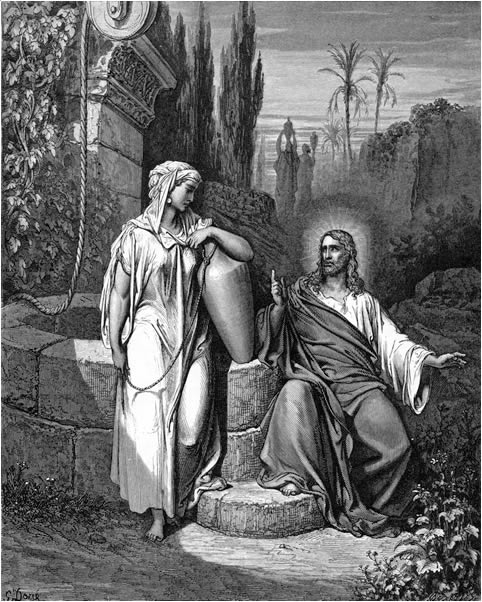
Four months between sowing and harvest was a common saying about the farmer's year. Jesus points at the fields in front of them, where Samaritans are walking out of Sychar toward Him, and calls the crop ripe. The reaper is already drawing his wages.
The record, by era
The Church Fathers5 voices
"Say ye not, that there are yet four months, and then cometh harvest?" He was aglow for the work, and was arranging to send forth laborers. You count four months to the harvest; I show you another harvest, white and ready. Behold, I say unto you, "Lift up your eyes, and see that the fields are already white for the harvest." Therefore He is going to send forth the reapers. "For in this is the saying true, that one reapeth, another soweth: that both he that soweth and he that reapeth may rejoice together. I have sent you to reap that on which ye have not labored: others have labored, and ye are entered into their labor." What then? He sent reapers; sent He not the sowers? Whither the reapers? Where others labored already. For where labor had already been bestowed, surely there had been sowing; and what had been sown had now become ripe, and required the sickle and the threshing. Whither, then, were the reapers to be sent? Where the prophets had already preached before; for they were the sowers. For had they not been the sowers, whence had this come to the woman, "I know that Messias will come"? That woman was now ripened fruit, and the harvest fields were white, and sought the sickle. "I sent you," then. Whither? "To reap what ye have not sown: others sowed, and ye are entered into their labors." Who labored? Abraham, Isaac, and Jacob. Read their labors; in all their labors there is a prophecy of Christ, and for that reason they were sowers. Moses, and all the other patriarchs, and all the prophets, how much they suffered in that cold season when they sowed! Therefore was the harvest now ready in Judea. Justly was the corn there said to be as it were ripe, when so many thousands of men brought the price of their goods, and, laying them at the apostles' feet, having eased their shoulders of this worldly baggage, began to follow the Lord Christ. […]
(tom. xv. in Joan. c. 39-49) How can we consistently give an allegorical meaning to the words, Lift up your eyes, &c. and only a literal one to the words, There are yet four months, and then cometh harvest? The same principle of interpretation surely must be applied to the latter, that is to the former. The four months represent the four elements, i. e. our natural life; the harvest, the end of the world, when all conflict shall have ceased, and truth shall prevail. The disciples then regard the truth as incomprehensible in our natural state, and look forward to the end of the world for attaining the knowledge of it. But this idea our Lord condemns: Say not ye, there are four months, and then cometh harvest? Behold, I say unto you, Lift up your eyes. In many places of Holy Scripture, we are commanded in the same way to raise the thoughts of our minds, which cling so obstinately to earth. A difficult task this for one who indulges his passions, and lives carnally. Such an one will not see if the fields be white to the harvest. For when are the fields white to the harvest? When the Word of God comes to light up and make fruitful the fields of Scripture. Indeed, all sensible things are as it were fields made white for the harvest, if only reason be at hand to interpret them. We lift up our eyes, and behold the whole universe overspread with the brightness of truth. And he that reapeth those harvests, has a double reward of his reaping; first, his wages; And he that reapeth receiveth wages; meaning his reward in the life to come; secondly, a certain good state of the understanding, which is the fruit of contemplation, And gathereth fruit unto life eternal. […]
A commentator
Cyril of AlexandriaCommentary on the Gospel of John, Book 2 · Written before 444.
proposed
Behold I say unto you, Lift up your eyes and look on the fields, for they are white already to harvest. That is, raising up the eye of your understanding a little from the affairs of the earth, consider ye the spiritual sowing, that it hath progressed already and whitened unto the floor, and at length calls for the reaper's sickle unto itself. But from the similarity to things in actual life, you will see what is meant. For you will conceive that the spiritual sowing and multitude of spiritual ears, are they who, tilled beforehand by the voice of the Prophets, are brought to the faith that should be shown through Christ. But it is white, as being already ripe and ready to the faith, and confirmed unto piety. But the sickle of the reaper is the glittering and most sharp word of the Apostle, cutting away the hearers from the worship according to the law, transferring them to the floor, that is, to the Church of God: there they bruised and pressed by good toils shall be set forth pure wheat worthy of the garner of Him Who gathereth it.
A commentator
Cyril of AlexandriaCommentary on the Gospel of John, Book 2 · Written before 444.
proposed
Say not YE, There are yet four months and the harvest cometh? He again taketh occasions of His Discourse from the time and event, and from the grosser things of sense He fashioneth His declaration of spiritual ideas. For it was yet winter at that time, and the tender sprouting and fresh stalk of the seed was scarce bristling forth from the soil: but after the expiration of four months, it was awaiting its fall into the hand of the reaper. Do not therefore YE men say (saith He) that there are yet four months, and the harvest cometh?
"Say ye not, that there are yet four months, and then cometh harvest? Behold, I say unto you, Lift up your eyes, and look upon the fields, for they are white already to harvest." Behold, He again by familiar words leadeth them up to the consideration of greater matters; for when He spoke of "meat," He signified nothing else than the salvation of the men who should come to Him; and again, the "field" and the "harvest" signify the very same thing, the multitude of souls prepared for the reception of the preaching; and the "eyes" of which He speaketh are those both of the mind and of the body; (for they now beheld the crowd of Samaritans advancing;) and the readiness of their will He calleth, "fields already white." For as the ears of corn, when they have become white, and are ready for reaping, so these, He saith, are prepared and fitted for salvation. And wherefore instead of calling them "fields" and "harvest," did He not plainly say, that "the men were coming to believe and were ready to receive the Word, having been instructed by the Prophets; and now bringing forth fruit"? What mean these figures used by Him? for this He doth not here only, but through all the Gospel; and the Prophets also employ the same method, saying many things in a metaphorical manner. What then may be the cause of this? for the grace of the Spirit did not ordain it to be so without a reason, but why and wherefore? On two accounts; one, that the discourse may be more vivid, and bring what is said more clearly before our eyes. For the mind when it has laid hold on a familiar image of the matters in hand, is more aroused, and beholding them as it were in a picture, is occupied by them to a greater degree. This is one reason; the other is, that the statement may be sweetened, and that the memory of what is said may be more lasting. […]
18 more voices on this verse
The Medieval Church5 voices
A commentator
Bernard of ClairvauxSermons on the Song of Songs, Sermon 78 · Written before 1153.
proposed
But hear her preparer himself, as it were pointing her out with his finger to the watchmen, but under another figure. "Lift up your eyes," he says, "and see the fields, that they are white already," that is, prepared, "for harvest" (Jn 4:35). From this …
Now ye are expecting a material harvest. But I say unto you, that a spiritual harvest is at hand: Lift up your eyes, and look on the fields; for they are white already to harvest. He alludes to the Samaritans who are approaching.
Then when he says, Do you not have a saying: There are still four months, and it will be harvest time? he makes use of a simile. Note that when Christ asked the Samaritan woman for a drink, "Give me a drink," he made use …
Here is touched upon the encouragement of the disciples to preach on account of the salvation of the Samaritans. And he encourages them to this both from consideration of their readiness to believe, and from consideration of the reward of preachers. He urges them to …
The Lord now begins to reveal more clearly to the disciples what He had previously said in a veiled manner. He says: "You say, that is, you think, that in four months the harvest will come, that is, the physical harvest; but I say to …
The Puritans and the Awakening3 voices
Say not ye, there are yet four months,.... Our Lord had been in Jerusalem and Judea, about eight months from the last passover, and there remained four more to the next passover: and then cometh harvest? barley harvest, which began at that time. Now as the passover was in the middle of the month Nisan, which was about the latter end of our March; reckoning four months back from thence shows, that it was about the latter end of our November, or beginning of December, that Christ was in Samaria, and at Jacob's well.
The fields are white already - As if he had said, The spiritual harvest is ripe already. The Samaritans, ripe for the Gospel, covered the ground round about them.
); so that it is computed that he staid in Judea about six months, to build upon the foundation John had laid there. We have no particular account of his sermons and miracles there, only in general,
quarantine:debris (2026-07-29) — leading-punctuation+unbalanced-parens
The Nineteenth Century10 voices
A commentator
Albert Barnes1798–1870
Notes, Explanatory and Practical, on the Old and New Testaments (1832-1869)
Say not ye - This seems to have been a proverb. Ye say - that is, men say. Four months and ... - The common time from sowing the seed to the harvest, in Judea, was about “four months.” The meaning of this passage may be thus expressed: “The husbandman, when he sows his seed, is compelled to wait a considerable period before it produces a crop. He is encouraged in sowing it; he expects fruit; his labor is lightened by that expectation; but it is not “immediate” - it is remote. But it is not so with my preaching.
A commentator
J.C. Ryle1816–1900
Expository Thoughts on the Gospels: John (lightly modernized text, Grace Gems edition) (1869)
We have, for one thing, in these verses, an instructive pattern of zeal for the good of others. We read, that our Lord Jesus Christ declares, "My food is to do the will of him who sent me, and to finish his work." To do good was not merely duty and pleasure to Him. He counted it as His food and drink. Job, one of the holiest Old Testament saints, could say, that he esteemed God's word "more than his necessary food." (Job 23:12.) The Great Head of the New Testament Church went even further.
MANY unbelieving Christians have a very large stock of reasons for not expecting to see many conversions. They suppose that any present manifestation of the Divine power in connection with the Truth of God is not to be expected. They read the history of past ages and they wonder, and sometimes, when their eyes are sufficiently clear, they look forward with some sort of hope to the repetition of these scenes in future years, that is to say, when they, themselves, are dead and buried, and a new age shall have come upon the world.
THE disciples had gone away into the city to buy meat and for this they cannot be censured. It was necessary that food should be provided and it naturally fell to their lot to perform that duty. Do not say that they were carnal or un-spiritual because of this, for the most spiritual people must eat to live. When they came back from making their purchases, they found their Master sitting by the well, as they had left Him.
A commentator
Jamieson, Fausset & Brown1802–1910
Commentary Critical and Explanatory on the Whole Bible (1871)
proposed
meantime--that is, while the woman was away. Master, eat--Fatigue and thirst we saw He felt; here is revealed another of our common infirmities to which the Lord was subject--hunger.
quarantine:debris (2026-07-29) — starts-lowercase
A commentator
Jamieson, Fausset & Brown1802–1910
Commentary Critical and Explanatory on the Whole Bible (1871)
proposed
yet four months, and then harvest--that is, "In current speech, ye say thus at this season; but lift up your eyes and look upon those fields in the light of another husbandry, for lo! in that sense, they are even now white to harvest, ready for the sickle." The simple beauty of this language is only surpassed by the glow of holy emotion in the Redeemer's own soul which it expresses.
quarantine:debris (2026-07-29) — starts-lowercase
A commentator
J.C. Ryle1816–1900
Expository Thoughts on the Gospels: John (lightly modernized text, Grace Gems edition) (1869)
proposed
We have, for one thing, in these verses, an instructive pattern of zeal for the good of others. We read, that our Lord Jesus Christ declares, "My food is to do the will of him who sent me, and to finish his work." To do good was not merely duty and pleasure to Him. He counted it as His food and drink. Job, one of the holiest Old Testament saints, could say, that he esteemed God's word "more than his necessary food." (Job 23:12.) The Great Head of the New Testament Church went even further. He could say the same of God's work. Do we do any work for God? Do we try, however feebly, to set forward His cause on earth—to check that which is evil, to promote that which is good? If we do, let us never be ashamed of doing it with all our heart, and soul, and mind, and strength. Whatever our hand finds to do for the souls of others, let us do it with our might. (Eccles. 9:10.) The world may mock and sneer, and call us enthusiasts. The world can admire zeal in any service but that of God, and can praise enthusiasm on any subject but that of religion. Let us work on unmoved. Whatever men may say and think, we are walking in the steps of our Lord Jesus Christ. Let us, beside this, take comfort in the thought that Jesus Christ never changes. He that sat by the well of Samaria, and found it "food and drink" to do good to an ignorant soul, is always in one mind. High in heaven at God's right hand, He still delights to save sinners, and still approves zeal and labor in the cause of God. The work of the missionary and the evangelist may be despised and ridiculed in many quarters. But while man is mocking, Christ is well pleased! Thanks be to God, Jesus is the, same yesterday, and today, and forever. We have, for another thing, in these verses, strong encouragement held out to those who labor to do good to souls.
MANY unbelieving Christians have a very large stock of reasons for not expecting to see many conversions. They suppose that any present manifestation of the Divine power in connection with the Truth of God is not to be expected. They read the history of past ages and they wonder, and sometimes, when their eyes are sufficiently clear, they look forward with some sort of hope to the repetition of these scenes in future years, that is to say, when they, themselves, are dead and buried, and a new age shall have come upon the world. But as to God working any wonders in the world now—as to the conversion of thousands now—they do not expect it. And if it were to happen they would be surprised, and beyond all measure astonished. They are forever dwelling in the past, or seeking to roost in the future—but as for now, now seeing God's arm made bare, now setting to work for the conversion of men, now expecting that God will win hearts unto Himself—they are not brought up to this mark yet. Their common reason for expecting nothing now is this—that there are yet four months, and then comes the harvest. They say, "This is not the time. We must have patience. We must wait. This is not the man. This is not the hour. This is not the place. We must wait till, under other circumstances, other men being given, we look for grander results. But we must not expect them now—there are yet four months, and then comes the harvest." You know that this is the general feeling at present in the Christian Church—not to expect any great things now, but to be waiting and watching for something or other which may one of these days, in the order of Providence, "turn up." Meanwhile, it is true that death does not cease to slay! Meanwhile, it is a fact that our cemeteries and graveyards are being crowded, and that multitudes are perishing for lack of knowledge.
THE disciples had gone away into the city to buy meat and for this they cannot be censured. It was necessary that food should be provided and it naturally fell to their lot to perform that duty. Do not say that they were carnal or un-spiritual because of this, for the most spiritual people must eat to live. When they came back from making their purchases, they found their Master sitting by the well, as they had left Him. They naturally expected that He would be as ready to partake of the provision as they were to offer it to Him, but He made no movement in that direction. His mind was evidently far away from the idea of food. He was absorbed in something else and, therefore, His disciples sought to call Him back to a sense of His need. I do not suppose that they had, themselves, eaten. It was hardly like them to do so while their Lord was not with them. They, therefore, wished to eat and they were all the more struck with the fact that He had no care for refreshment. Knowing how weary He had been when they left Him—so weary that He bade them go alone into the city—they were perplexed at His indifference to food and, perhaps, judged that He was over-fatigued and, therefore, they urged Him to eat. Importunately, one after another said, "Good Master, it is long since You have eaten; the way has been weary, the day is hot, You seem very faint. We pray You, eat a little that You may be revived. The woman to whom You spoke has gone. Your good work, for a while, is over, let us eat together." Again I confess that I do not agree with those who blame these disciples. If it is true that there is nothing very elevated in providing food, there is certainly nothing unworthy in the act. I admire their care for their Master. I praise them for so lovingly pressing upon Him the supply of His necessities.
There are yet four months, and then cometh harvest? - In Palestine, the harvest did not begin till after the passover, which was fixed on the 14th of the month Nisan, which answers to our March, and sometimes extends into April. The barley harvest was the first; after that the wheat; and both were finished by Pentecost. For, in the feast of Pentecost, the first fruits of all the harvest were carried to the temple, and waved before the Lord. See Lev 23:11. The four months, of which our Lord speaks here, must be computed, according to M. Toynard, from Shebat, which was the eleventh month of the sacred year, and which commenced that year on the 13th of January: from that, till the beginning of the wheat harvest, which began about a month after the passover, there were exactly four months. The passover was that year on the 15th of Nisan, or March 28; and Pentecost took place on the 17th of May. We may therefore suppose that it was about the 13th of January, or beginning of the month Shebat, that John the Baptist was cast into prison, and that Christ retired into Galilee. The fixing of this epoch is of considerable importance. See Calmet’s Com. on this place. The following method of dividing the seasons among the Jews is thus stated in Bava Metsia, fol. 106. “Half Tisri, all Marheshvan, and half Cisleu, is זרע zera. Seed-Time. Half Cisleu, whole Tebeth, and half Shebat, is חורף choreph, Winter. Half Shebat, whole Adar, and half Nisan, is קור kor, the Winter Solstice. Half Nisan, all Ijar, and half Sivan, is קציר katsir, Harvest. Half Sivan, all Tammuz, and half Ab, is קייץ kyits, Summer. Half Ab, all Elul, and half Tisri, is חום chum, the great Heat.” The Jews sowed wheat and spelt in Tisri and Marheshvan; and barley in Shebat and Adar. […]
The words behind it
28 Greek wordsEvery Greek word of this verse in the order it stands, with what it means and the door to its own study. The last column counts the times a word stands in the whole Bible: the rarer the word, the more the places it appears belong together.
| Greek | Sound | Meaning | Word study | In the Bible |
|---|---|---|---|---|
| οὐχ | ouch | Surely | G3756 → | 1664 times |
| ὑμεῖς | humeis | you yourselves | G4771 → | 2973 times |
| λέγετε | legete | say | G3004 → | 1325 times |
| ὅτι | hoti | that | G3754 → | 1292 times |
| ἔτι | eti | yet | G2089 → | 140 times |
| τετράμηνός | tetramenos | four months | G5072 → | |
| ἐστιν | estin | it is | G1510 → | 2333 times |
| καὶ | kai | and | G2532 → | 9120 times |
| ὁ | ho | the | G3588 → | 19766 times |
| θερισμὸς | therismos | harvest | G2326 → | |
| ἔρχεται; | erchetai | comes? | G2064 → | 628 times |
| ἰδοὺ | idou | Behold | G2400 → | 200 times |
| λέγω | lego | I say | G3004 → | 1325 times |
| ὑμῖν· | humin | to you; | G4771 → | 2973 times |
| ἐπάρατε | eparate | do lift up | G1869 → | 19 times |
| τοὺς | tous | the | G3588 → | 19766 times |
| ὀφθαλμοὺς | ophthalmous | eyes | G3788 → | 100 times |
| ὑμῶν | humon | of you | G4771 → | 2973 times |
| καὶ | kai | and | G2532 → | 9120 times |
| θεάσασθε | theasasthe | do see | G2300 → | 20 times |
| τὰς | tas | the | G3588 → | 19766 times |
| χώρας | choras | fields | G5561 → | 28 times |
| ὅτι | hoti | because | G3754 → | 1292 times |
| λευκαί | leukai | white | G3022 → | |
| εἰσιν | eisin | they are | G1510 → | 2333 times |
| πρὸς | pros | toward | G4314 → | 700 times |
| θερισμόν | therismon | harvest | G2326 → | |
| ἤδη. | ede | already! | G2235 → | 61 times |
οὐχSurely
ouchG3756 →1664 times
ὑμεῖςyou yourselves
humeisG4771 →2973 times
λέγετεsay
legeteG3004 →1325 times
ὅτιthat
hotiG3754 →1292 times
ἔτιyet
etiG2089 →140 times
τετράμηνόςfour months
tetramenosG5072 →
ἐστινit is
estinG1510 →2333 times
καὶand
kaiG2532 →9120 times
ὁthe
hoG3588 →19766 times
θερισμὸςharvest
therismosG2326 →
ἔρχεται;comes?
erchetaiG2064 →628 times
ἰδοὺBehold
idouG2400 →200 times
λέγωI say
legoG3004 →1325 times
ὑμῖν·to you;
huminG4771 →2973 times
ἐπάρατεdo lift up
eparateG1869 →19 times
τοὺςthe
tousG3588 →19766 times
ὀφθαλμοὺςeyes
ophthalmousG3788 →100 times
ὑμῶνof you
humonG4771 →2973 times
καὶand
kaiG2532 →9120 times
θεάσασθεdo see
theasastheG2300 →20 times
τὰςthe
tasG3588 →19766 times
χώραςfields
chorasG5561 →28 times
ὅτιbecause
hotiG3754 →1292 times
λευκαίwhite
leukaiG3022 →
εἰσινthey are
eisinG1510 →2333 times
πρὸςtoward
prosG4314 →700 times
θερισμόνharvest
therismonG2326 →
ἤδη.already!
edeG2235 →61 times
A shaded row is a word that stands 400 times or fewer in the Bible.
The walk
5 stopsEach card is a verse this one points to, and under it the verses that one points to in turn. Where several paths arrive at the same place, that place is listed first: the text keeps returning to it.
Through
John 4:30So they left the town and made their way toward Jesus.
it leads to
- Acts 10:33
So I sent for you immediately, and you were kind enough to come. Now then, we are all here in the presence of God to listen to everything the Lord has instructed you to…
- Acts 8:5–8
Philip went down to a city in Samaria and proclaimed the Christ to them.
- Matthew 20:16
So the last will be first, and the first will be last.”
- Luke 17:16–18
He fell facedown at Jesus’ feet in thanksgiving to Him—and he was a Samaritan.
- Romans 5:20
The law came in so that the trespass would increase; but where sin increased, grace increased all the more,
- Acts 10:33
Where this verse is studied
On this page
Studies16
About John
This page draws on 19 works. Open the list of works
This page draws on Adam Clarke, Commentary on the Bible; Albert Barnes, Notes, Explanatory and Practical, on the Old and New Testaments (1832-1869); Augustine of Hippo, Tractates on John 15; Bernard of Clairvaux, Sermons on the Song of Songs, Sermon 78; Bonaventure, Commentary on John, Chapter 4; Charles Spurgeon, The Metropolitan Tabernacle Pulpit, Sermon No. 706: “Fields White For Harvest” (lightly modernized text, CCEL edition); Charles Spurgeon, The Metropolitan Tabernacle Pulpit, Sermon No. 1901: “Mysterious Meat” (lightly modernized text, CCEL edition); Cyril of Alexandria, Commentary on the Gospel of John, Book 2; Irenaeus, Against Heresies Book IV, Chapter XXIII; J.C. Ryle, Expository Thoughts on the Gospels: John (lightly modernized text, Grace Gems edition); Jamieson, Fausset & Brown, Commentary Critical and Explanatory on the Whole Bible; John Chrysostom, Homily on the Gospel of John 34; John Gill, Exposition of the New Testament (1746-1748); John Wesley, Explanatory Notes upon the New Testament; Matthew Henry, Commentary on the Whole Bible; Origen of Alexandria, Catena Aurea by Aquinas; Theophylact of Ohrid, Catena Aurea by Aquinas; Theophylact of Ohrid, Commentary on John and Thomas Aquinas, Commentary on John.