
John 4:15
in John 4The woman said to Him, “Sir, give me this water so that I will not get thirsty and have to keep coming here to draw water.”
BSB
The same verse in ASV and KJV ▾
ASV
The woman saith unto him, Sir, give me this water, that I thirst not, neither come all the way hither to draw.
KJV
The woman saith unto him, Sir, give me this water, that I thirst not, neither come hither to draw.
⋯
This verse in John 4
Commentary
21 notes on this verseGive me this water, that I thirst not neither come hither to draw. Jesus saith unto her, Again does she both speak and imagine only ordinary things, and of the things that were said understands no whit; but she supposes that in being released from petty toils, will consist all the aim of our Saviour, and to thirsting no more does she bound the measure of the grace of God, not so much as in bare idea receiving things above the world.
This site's exposition
keep coming here to draw water
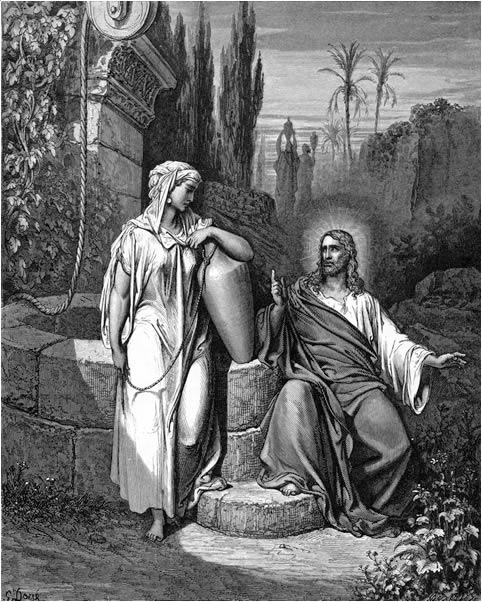
The woman asks for the water and names her reason, an end to the daily trip to the well. She still hears the offer as something to carry home in a jar. Jesus answers by turning to her own life.
The record, by era
The Church Fathers5 voices
What He was promising them was a certain feeding and abundant fullness of the Holy Spirit: but the woman did not yet understand; and not understanding, how did she answer? "The woman saith unto Him, Sir, give me this water, that I thirst not, neither come hither to draw." Want forced her to labor, and her weakness was pleading against the toil. Would that she heard the invitation, "Come unto me, all ye that labor and are heavy laden, and I will refresh you!" This is, in fact, what Jesus was saying to her, that she might no longer labor: but she did not yet understand.
(Tr. xv. c. 15-18) Or thus; The woman as yet understands Him of the flesh only. She is delighted to be relieved for ever from thirst, and takes this promise of our Lord's in a carnal sense. For God had once granted to His servant Elijah, that he should neither hunger nor thirst for forty days; and if He could grant this for forty days, why not for ever? Eager to possess such a gift, she asks Him for the living water; The woman saith unto Him, Sir, give me this water, that I thirst not, neither come hither to draw. Her poverty obliged her to labour more than her strength could well bear; would that she could hear, Come unto Me, all that labour and are heavy laden, and I will refresh you. (Mat. 11:28) Jesus had said this very thing, i. e. that she need not labour any longer; but she did not understand Him.
Still, however, the woman has her mind on the flesh: she is delighted with the thought of thirsting no more, and fancies that this was promised to her by the Lord after a carnal sense; which it will be indeed, but in the resurrection of the dead. She desired this now. God had indeed granted once to His servant Elias, that during forty days he neither hungered nor thirsted. Could not He give this always, seeing He had power to give it during forty days? She, however, sighed for it, desiring to have no want, no toil. To be always coming to that fountain, to be burdened with a weight with which to supply her want, and, when that which she had drawn is spent, to be obliged to return again: this was a daily toil to her; because that want of hers was to be relieved, not extinguished. Such a gift as Jesus promised delighted her; she asks Him to give her living water.
The woman straightway believed, showing herself much wiser than Nicodemus, and not only wiser, but more manly. For he when he heard ten thousand such things neither invited any others to this hearing, nor himself spake forth openly; but she exhibited the actions of an Apostle, preaching the Gospel to all, and calling them to Jesus, and drawing a whole city forth to Him. Nicodemus when he had heard said, "How can these things be?" And when Christ set before him a clear illustration, that of "the wind," he did not even so receive the Word. But the woman not so; at first she doubted, but afterwards receiving the Word not by any regular demonstration, but in the form of an assertion, she straightway hastened to embrace it. For when Christ said, "It shall be in him a well of water springing up into everlasting Life," immediately the woman saith, "Give me this water, that I thirst not, neither come hither to draw."
Seest thou how little by little she is led up to the highest doctrines? First she thought Him some Jew who was transgressing the Law; then when He had repelled that accusation, (for it was necessary that the person who was to teach her such things should not be suspected,) having heard of "living water," she supposed that this was spoken of material water; afterwards, having learnt that the words were spiritual, she believed that the water could remove the necessity caused by thirst, but knew not yet what this could be; she still doubted, deeming it indeed to be above material things, but not being exactly informed. But here having gained a clearer insight, but not yet fully perceiving the whole, (for she saith, "Give me this water, that I thirst not, neither come hither to draw,") she for the time preferreth Him to Jacob. "For" (saith she) "I need not this well if I receive from thee that water." Seest thou how she setteth Him before the Patriarch? This is the act of a fairly-judging soul. She had shown how great an opinion she had of Jacob, she saw One better than he, and was not held back by her prepossession. Thus this woman was neither of an easy temper, (she did not carelessly receive what was said, how can she have done so when she enquired with so great exactness?) nor yet disobedient, nor disputatious, and this she showed by her petition. Yet to the Jews once He said, "Whosoever shall eat of My flesh shall never hunger, and he that believeth on Me shall never thirst" (c. vi. 35); but they not only did not believe, but were offended at Him. The woman had no such feeling, she remains and petitions. To the Jews He said, "He that believeth on Me shall never thirst"; not so to the woman, but more grossly, "He that drinketh of this Water shall never thirst." For the promise referred to spiritual and unseen things. […]
14 more voices on this verse
The Medieval Church3 voices
The Lord stirred up the woman to consent; here now to the woman consenting and asking he sets forth the word of faith for believing. Because the woman, even though she had been stirred up, was nevertheless not yet illuminated, the Lord does not immediately …
Then when he says, The woman said, he states her request for the gift. First, her understanding of the gift is noted. Secondly, the woman is found guilty (v 17). As was said, the way to obtain this gift is by prayer and request. And …
What disposition does the woman show at this point? Although not yet a lofty one, for she thinks the discussion is about physical water, nevertheless she does reveal some forward progress. Before, she was perplexed and said, "Where do You have living water?" But now, …
The Puritans and the Awakening3 voices
The woman saith unto him, Sir,.... See Gill on Joh 4:11; give me this water, that I thirst not. The Syriac and Persic versions add, "again": neither come hither; the Ethiopic version adds here, "again"; to draw.
This woman's meeting with Christ at the well may remind us of the stories of Rebekah, Rachel, and Jethro's daughter, who all met with husbands, good husbands, no worse than Isaac, Jacob, and Moses, when they came to the wells for water. Thirdly, How the preventing grace of God sometimes brings people unexpectedly under the means of conversion and salvation.
Even those that are weak and ignorant may yet have some faint and fluctuating desires towards Christ and his gifts, and some good wishes of grace and glory. Carnal hearts, in their best wishes, look no higher than carnal ends. "Give it to me," saith she, "not that I may have everlasting life" (which Christ proposed), "but that I come not hither to draw. " 2.
The Nineteenth Century7 voices
A commentator
Jamieson, Fausset & Brown1802–1910
Commentary Critical and Explanatory on the Whole Bible (1871)
proposed
give me this water, &c.--This is not obtuseness--that is giving way--it expresses a wondering desire after she scarce knew what from this mysterious Stranger.
quarantine:debris (2026-07-29) — starts-lowercase
A commentator
J.C. Ryle1816–1900
Expository Thoughts on the Gospels: John (lightly modernized text, Grace Gems edition) (1869)
proposed
Conversation With a Samaritan Woman But he had to pass through Samaria. Now he came to a Samaritan town called Sychar, near the plot of land that Jacob had given to his son Joseph. Jacob’s well was there, so Jesus, since he was tired from the journey, sat right down beside the well. It was about noon. A Samaritan woman came to draw water. Jesus said to her, "Give me some water to drink." (For his disciples had gone off into the town to buy supplies.)
A commentator
J.C. Ryle1816–1900
Expository Thoughts on the Gospels: John (lightly modernized text, Grace Gems edition) (1869)
proposed
Conversation With a Samaritan Woman But he had to pass through Samaria. Now he came to a Samaritan town called Sychar, near the plot of land that Jacob had given to his son Joseph. Jacob’s well was there, so Jesus, since he was tired from the journey, sat right down beside the well. It was about noon. A Samaritan woman came to draw water. Jesus said to her, "Give me some water to drink." (For his disciples had gone off into the town to buy supplies.) So the Samaritan woman said to him, "How can you—a Jew—ask me, a Samaritan woman, for water to drink?" (For Jews use nothing in common with Samaritans.) Jesus answered her, "If you had known the gift of God and who it is who said to you, ‘Give me some water to drink,’ you would have asked him, and he would have given you living water." "Sir," the woman said to him, "you have no bucket and the well is deep; where then do you get this living water? Surely you’re not greater than our ancestor Jacob, are you? For he gave us this well and drank from it himself, along with his sons and his livestock." Jesus replied, "Everyone who drinks some of this water will be thirsty again. But whoever drinks some of the water that I will give him will never be thirsty again, but the water that I will give him will become in him a fountain of water springing up to eternal life." The woman said to him, "Sir, give me this water, so that I will not be thirsty or have to come here to draw water." He said to her, "Go call your husband and come back here." The woman replied, "I have no husband." Jesus said to her, "Right you are when you said, ‘I have no husband,’ for you have had five husbands and the man you are living with now is not your husband. This you said truthfully!" The woman said to him, "Sir, I see that you are a prophet.
You will remember that our Savior had been speaking to the woman of Samaria concerning living water. He had endeavored to catch her attention by using a metaphor to her work and her position. Water was uppermost in her thoughts and Jesus sanctified the element to His own gracious end. Sitting at the well's mouth, I think I can see His earnest face and note the woman's wondering eyes while He talked to her as she had never been spoken to before concerning water which caused a man never to thirst again.
You will remember that our Savior had been speaking to the woman of Samaria concerning living water. He had endeavored to catch her attention by using a metaphor to her work and her position. Water was uppermost in her thoughts and Jesus sanctified the element to His own gracious end. Sitting at the well's mouth, I think I can see His earnest face and note the woman's wondering eyes while He talked to her as she had never been spoken to before concerning water which caused a man never to thirst again. At first the woman raised questions: the skeptical part of her nature took its turn and quibbled, and carped, and argued. "Sir, You have nothing to draw with, and the well is deep," and so on. Do you not see all the elements of the infidel in her? But she is in good hands, and soon she has passed from the period of questioning into that of petitioning, and she cries this time, "Sir, give me this water." She was still, I am afraid, very ignorant. She did not even understand her own petition. That is clear from the words which follow the text, "That I thirst not, neither come here to draw." She was giving a material meaning to a spiritual utterance. She was thinking of the water that could moisten her lips, when Christ was speaking of that Living Water, His own Grace and love which touches the heart, and the heart only. Her eyes were dark but her face was turned the right way. And, best of all, Jesus was there, who can lead the blind in a way which they know not. It will be all well with her—you may leave her alone and think of yourselves. I hope I am now conversing with some here who have gotten clear of this woman's ignorance and have passed away also, as she did, from the period of questions. You know best who you are and where you are, but I hope you are desirous to partake of the Divine Grace which saves. You have got away from raising difficulties.
Give me this water - She did not as yet comprehend our Lord’s meaning; but her curiosity was much excited, and this was the design of our Lord, that he might have her mind properly prepared to receive the great truths which he was about to announce.
A commentator
Albert Barnes1798–1870
Notes, Explanatory and Practical, on the Old and New Testaments (1832-1869)
proposed
The woman said ... - It may seem strange that the woman did not yet understand him, but it shows how slow sinners are to understand the doctrines of religion.
Modern Voices1 voice
In John 4, Jesus' encounter with the Samaritan woman is itself a Purim-style reversal the rejected becomes chosen, the overlooked becomes entrusted, and the outsider becomes the first to hear a clear declaration of Messiah.
The words behind it
18 Greek wordsEvery Greek word of this verse in the order it stands, with what it means and the door to its own study. The last column counts the times a word stands in the whole Bible: the rarer the word, the more the places it appears belong together.
| Greek | Sound | Meaning | Word study | In the Bible |
|---|---|---|---|---|
| Λέγει | legei | Says | G3004 → | 1325 times |
| πρὸς | pros | to | G4314 → | 700 times |
| αὐτὸν | auton | Him | G846 → | 5565 times |
| ἡ | he | the | G3588 → | 19766 times |
| γυνή· | gune | woman; | G1135 → | 211 times |
| κύριε, | kurie | Sir, | G2962 → | 711 times |
| δός | dos | do give | G1325 → | 412 times |
| μοι | moi | me | G3165 → | 1936 times |
| τοῦτο | touto | this | G3778 → | 1381 times |
| τὸ | to | <the> | G3588 → | 19766 times |
| ὕδωρ | hudor | water | G5204 → | 76 times |
| ἵνα | ina | that | G2443 → | 668 times |
| μὴ | me | not | G3361 → | 1066 times |
| διψῶ | dipso | I may thirst | G1372 → | 16 times |
| μηδὲ | mede | nor | G3366 → | |
| διέρχωμαι | dierchomai | I may come | G1330 → | |
| ἐνθάδε | enthade | here | G1759 → | |
| ἀντλεῖν. | antlein | to draw. | G501 → | 4 times |
ΛέγειSays
legeiG3004 →1325 times
πρὸςto
prosG4314 →700 times
αὐτὸνHim
autonG846 →5565 times
ἡthe
heG3588 →19766 times
γυνή·woman;
guneG1135 →211 times
κύριε,Sir,
kurieG2962 →711 times
δόςdo give
dosG1325 →412 times
μοιme
moiG3165 →1936 times
τοῦτοthis
toutoG3778 →1381 times
τὸ<the>
toG3588 →19766 times
ὕδωρwater
hudorG5204 →76 times
ἵναthat
inaG2443 →668 times
μὴnot
meG3361 →1066 times
διψῶI may thirst
dipsoG1372 →16 times
μηδὲnor
medeG3366 →
διέρχωμαιI may come
dierchomaiG1330 →
ἐνθάδεhere
enthadeG1759 →
ἀντλεῖν.to draw.
antleinG501 →4 times
A shaded row is a word that stands 400 times or fewer in the Bible.
The walk
8 stopsEach card is a verse this one points to, and under it the verses that one points to in turn. Where several paths arrive at the same place, that place is listed first: the text keeps returning to it.
Through
Romans 6:23For the wages of sin is death, but the gift of God is eternal life in Christ Jesus our Lord.
it leads to
- John 3:36
Whoever believes in the Son has eternal life. Whoever rejects the Son will not see life. Instead, the wrath of God remains on him.”
- Romans 5:12
Therefore, just as sin entered the world through one man, and death through sin, so also death was passed on to all men, because all sinned.
- James 1:15
Then after desire has conceived, it gives birth to sin; and sin, when it is full-grown, gives birth to death.
- John 6:40
For it is My Father’s will that everyone who looks to the Son and believes in Him shall have eternal life, and I will raise him up at the last day.”
- Ezekiel 18:20
The soul who sins is the one who will die. A son will not bear the iniquity of his father, and a father will not bear the iniquity of his son. The righteousness of…
- John 3:36
Through
Romans 8:5Those who live according to the flesh set their minds on the things of the flesh; but those who live according to the Spirit set their minds on the things of the Spirit.
it leads to
- 1 Corinthians 2:14
The natural man does not accept the things that come from the Spirit of God. For they are foolishness to him, and he cannot understand them, because they are spiritually discerned.
- Galatians 5:19–25
The acts of the flesh are obvious: sexual immorality, impurity, and debauchery;
- John 3:6
Flesh is born of flesh, but spirit is born of the Spirit.
- 1 Corinthians 2:14
Where this verse is studied
About John
This page draws on 17 works. Open the list of works
This page draws on Adam Clarke, Commentary on the Bible; Albert Barnes, Notes, Explanatory and Practical, on the Gospels; Albert Barnes, Notes, Explanatory and Practical, on the Old and New Testaments (1832-1869); Augustine of Hippo, Tractates on John 15; Augustine of Hippo, Catena Aurea by Aquinas; Bonaventure, Commentary on John, Chapter 4; Charles Spurgeon, The Metropolitan Tabernacle Pulpit, Sermon No. 770: “The Water of Life” (lightly modernized text, CCEL edition); Cyril of Alexandria, Commentary on the Gospel of John, Book 2; J.C. Ryle, Expository Thoughts on the Gospels: John (lightly modernized text, Grace Gems edition); Jamieson, Fausset & Brown, Commentary Critical and Explanatory on the Whole Bible; Jane Hamon, PURIM – A TIME FOR REVERSALS!!; John Chrysostom, Homily on the Gospel of John 32; John Gill, Exposition of the New Testament; John Gill, Exposition of the New Testament (1746-1748); Matthew Henry, Commentary on the Whole Bible; Theophylact of Ohrid, Commentary on John and Thomas Aquinas, Commentary on John.