
John 4:42
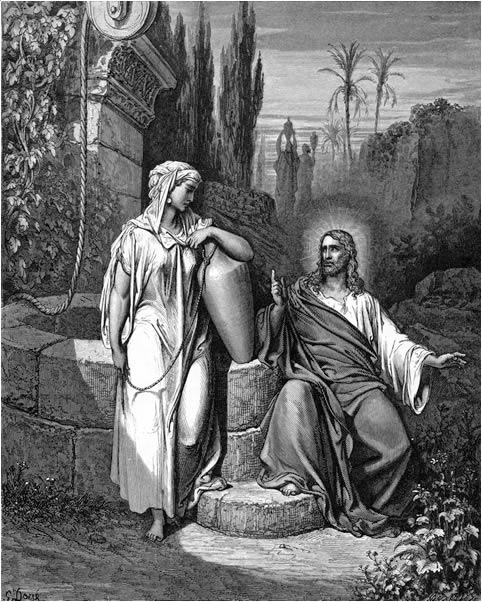
in John 4They said to the woman, “We now believe not only because of your words; we have heard for ourselves, and we know that this man truly is the Savior of the world.”
BSB
The same verse in ASV and KJV ▾
ASV
and they said to the woman, Now we believe, not because of thy speaking: for we have heard for ourselves, and know that this is indeed the Saviour of the world.
KJV
And said unto the woman, Now we believe, not because of thy saying: for we have heard him ourselves, and know that this is indeed the Christ, the Saviour of the world.
⋯
This verse in John 4
Commentary
17 notes on this verseA commentator
Origen of AlexandriaCOMMENTARY ON THE GOSPEL OF JOHN 13.353, 362-63 · Written before 253.
The Samaritans renounce their faith that was based on the speech of the woman when they discover that hearing the Savior himself is better than that faith, so that they, too, know "that this is truly the Savior of the world."
The record, by era
The Church Fathers4 voices
(Tr. xv. c. 33) So then they knew Christ first by report of another, afterwards by His own presence; which is still the case of those that are without the fold, and not yet Christians. Christ is announced to them by some charitable Christians, by the report of the woman, i. e. the Church; they come to Christ, they believe on Him, through the instrumentality of that woman; He stays withthem two days, i. e. gives them two precepts of charity. And thenceforth their belief is stronger. They believe that He is indeed the Saviour of the world.
"And many Samaritans of that city believed on Him, because of the saying of the woman, who testified, He told me all that ever I did. And when the Samaritans came to Him, they besought Him that He would tarry with them; and He tarried there two days. And many more believed because of His word; and said to the woman, Now we believe, not because of thy words; for we have heard Him ourselves, and we know that this is indeed the Saviour of the world." This also must be slightly noticed, for the lesson is come to an end. The woman first announced Him, and the Samaritans believed her testimony; and they besought Him to stay with them, and He stayed there two days, and many more believed. And when they had believed, they said to the woman, "Now we believe, not because of thy word; but we are come to know Him ourselves, and we know that this is indeed the Saviour of the world:" first by report, then by His presence. So it is to-day with them that are without, and are not yet Christians. Christ is made known to them by Christian friends; and just upon the report of that woman, that is, the Church, they come to Christ, they believe through this report. He stays with them two days, that is, gives them two precepts of charity; and many more believe, and more firmly believe, on Him, because He is in truth the Saviour of the world.
A commentator
Cyril of AlexandriaCommentary on the Gospel of John, Book 2 · Written before 444.
proposed
From the greater things does the faith of the Samaritans spring, and not any longer from what they learn from others, but from those whereof they are the wondering ear-witnesses. For they say that they know that He is indeed the Saviour of the world, making the confession of their hope in Him the pledge of their faith.
Yet there was no likelihood that these would have believed, since they had seen no sign, and had hostile feelings towards the Jews; but still, inasmuch as they gave in sincerity their judgment on His words, this stood not in their way, but they received a notion which surmounted their hindrances, and vied with each other to reverence Him the more. For, saith the Evangelist, "they said to the woman, Now we believe, not because of thy saying: for we have heard Him ourselves, and know that this is indeed the Christ, the Saviour of the world." The scholars overshot their instructress. With good reason might they condemn the Jews, both by their believing on, and their receiving Him. The Jews, for whose sake He had contrived the whole scheme, continually were for stoning Him, but these, when He was not even intending to come to them, drew Him to themselves. And they, even with signs, remain uncorrected; these, without signs, manifested great faith respecting Him, and glory in this very thing that they believe without them; while the others ceased not asking for signs and tempting Him. Such need is there everywhere of an honest soul; and if truth lay hold on such an one, she easily masters it; or if she masters it not, this is owing not to any weakness of truth, but to want of candor in the soul itself. Since the sun too, when he encounters clear eyes, easily enlightens them; if he enlightens them not, it is the fault of their infirmity, not of his weakness. Hear then what these say; "We know that this is of a truth the Christ, the Saviour of the world." Seest thou how they at once understood that He should draw the world to Him, that He came to order aright our common salvation, that He intended not to confine His care to the Jews, but to sow His Word everywhere? […]
The Medieval Church1 voice
"And they said to the woman: We now believe, not because of your speech," as though begging for a human reason: "for we ourselves have heard and know that this is truly the Savior of the world:" that is, by hearing we have come to …
11 more voices on this verse
The Medieval Church2 voices
Secondly, this fruit was increased because of the way in which they believed: for they say to the woman: Now we believe not just because of your story. Here we should note that three things are necessary for the perfection of faith; and they are …
Look, indeed, in a short time the people surpassed their teacher. For they call Him not a prophet, not the Savior of Israel, but the Savior of the world, and even with the article: He is that Savior, who properly and truly saved all. Many …
The Puritans and the Awakening1 voice
And said unto the woman,....
The Nineteenth Century8 voices
We have heard him ourselves - On seeing and hearing our Lord, the faith of those who had already believed on the woman’s testimony was abundantly confirmed; and, besides those, may others believed who had not heard the woman speak. This is indeed the Christ - The promised Messiah. The Savior of the world - Not of the Jews only, but of the Samaritans, and of the whole Gentile world.
A commentator
J.C. Ryle1816–1900
Expository Thoughts on the Gospels: John (lightly modernized text, Grace Gems edition) (1869)
We have, for one thing, in these verses, an instructive pattern of zeal for the good of others. We read, that our Lord Jesus Christ declares, "My food is to do the will of him who sent me, and to finish his work." To do good was not merely duty and pleasure to Him. He counted it as His food and drink. Job, one of the holiest Old Testament saints, could say, that he esteemed God's word "more than his necessary food." (Job 23:12.) The Great Head of the New Testament Church went even further.
A commentator
Jamieson, Fausset & Brown1802–1910
Commentary Critical and Explanatory on the Whole Bible (1871)
These Samaritans were the foundation of the Church afterwards built up there. No miracle appears to have been wrought there (but unparalleled supernatural knowledge displayed): "we have heard Him ourselves" (Joh 4:42) sufficed to raise their faith to a point never attained by the Jews, and hardly as yet by the disciples--that He was "the Saviour of the world" [ALFORD].
THE most important question concerning any man living is this—is he a saved soul or not? It is of comparatively little consequence whether he is rich or poor, educated or uneducated, compared with this—is he among the living before God—or is he dead in sins? Is he pardoned or unpardoned? Is he a child of God or an heir of wrath? Is he walking in the darkness or has he passed into light? Therefore of all the days of a man's history the most important is the day in which he is born-again.
A commentator
J.C. Ryle1816–1900
Expository Thoughts on the Gospels: John (lightly modernized text, Grace Gems edition) (1869)
proposed
We have, for one thing, in these verses, an instructive pattern of zeal for the good of others. We read, that our Lord Jesus Christ declares, "My food is to do the will of him who sent me, and to finish his work." To do good was not merely duty and pleasure to Him. He counted it as His food and drink. Job, one of the holiest Old Testament saints, could say, that he esteemed God's word "more than his necessary food." (Job 23:12.) The Great Head of the New Testament Church went even further. He could say the same of God's work. Do we do any work for God? Do we try, however feebly, to set forward His cause on earth—to check that which is evil, to promote that which is good? If we do, let us never be ashamed of doing it with all our heart, and soul, and mind, and strength. Whatever our hand finds to do for the souls of others, let us do it with our might. (Eccles. 9:10.) The world may mock and sneer, and call us enthusiasts. The world can admire zeal in any service but that of God, and can praise enthusiasm on any subject but that of religion. Let us work on unmoved. Whatever men may say and think, we are walking in the steps of our Lord Jesus Christ. Let us, beside this, take comfort in the thought that Jesus Christ never changes. He that sat by the well of Samaria, and found it "food and drink" to do good to an ignorant soul, is always in one mind. High in heaven at God's right hand, He still delights to save sinners, and still approves zeal and labor in the cause of God. The work of the missionary and the evangelist may be despised and ridiculed in many quarters. But while man is mocking, Christ is well pleased! Thanks be to God, Jesus is the, same yesterday, and today, and forever. We have, for another thing, in these verses, strong encouragement held out to those who labor to do good to souls.
THE most important question concerning any man living is this—is he a saved soul or not? It is of comparatively little consequence whether he is rich or poor, educated or uneducated, compared with this—is he among the living before God—or is he dead in sins? Is he pardoned or unpardoned? Is he a child of God or an heir of wrath? Is he walking in the darkness or has he passed into light? Therefore of all the days of a man's history the most important is the day in which he is born-again. If the man is, indeed, saved, and a new man in Christ Jesus, he will look back upon the day of his regeneration as his chief birthday. His new birth is second in order of time, but he will always put it first in importance. His birth gave him his being, but his new birth secured his well-being. Being born first we might have descended into Hell, but, being born a second time we are assured of Heaven! If we were to observe those days with the greatest festivity which deserved best to be commemorated, we should certainly make high days and holidays of the days in which we looked to Jesus, and "found in Him our star, our sun." For this reason the circumstances which surround our new birth are to us among the most deeply interesting incidents of our own or any other human history. The details may be very simple. They may not suffice to make a biography, but still, to us, they are most important. We delight to think of the place where Jesus met with us, the Providence which brought us to the spot where we first heard the words which convicted us of sin.
A commentator
Charles Spurgeon1834–1892
The Metropolitan Tabernacle Pulpit, Sermon No. 2623: “How Faith Comes” (lightly modernized text, CCEL edition) · Written before 1892.
proposed
WHEREVER faith exists, it is the gift of God. It is a plant that never sprang up spontaneously from the soil of corrupt human nature. Whether it is little faith or great faith, it is equally of Divine origin, and wherever it is found— whether in the child of pious parents who was brought up with the utmost care, or in one who has lived all the former part of his life in the vilest sin—it is equally and alike the fruit of the Spirit and the effect of God's Grace.
A commentator
Charles Spurgeon1834–1892
The Metropolitan Tabernacle Pulpit, Sermon No. 2623: “How Faith Comes” (lightly modernized text, CCEL edition) · Written before 1892.
proposed
WHEREVER faith exists, it is the gift of God. It is a plant that never sprang up spontaneously from the soil of corrupt human nature. Whether it is little faith or great faith, it is equally of Divine origin, and wherever it is found— whether in the child of pious parents who was brought up with the utmost care, or in one who has lived all the former part of his life in the vilest sin—it is equally and alike the fruit of the Spirit and the effect of God's Grace. From this fact I gather great encouragement because, if it needs Divine power to implant faith in the heart that looks more favorable, it needs no more to implant and preserve it in the soul that appears most unprepared to receive it. Casting our eyes over the whole map of Palestine, we might have said that Samaria was probably as unlikely a place as any in the entire country in which we might expect to find followers of the Lord Jesus, for, at the very threshold of Christ's announcing Himself, there would be found this prejudice, that the Samaritans would not believe in a Jew. They would not even listen to a Jew, for, while the Jews had no dealings with the Samaritans, the Samaritans reciprocated the feeling and had no dealings with the Jews. Yet it was among the Samaritans, the members of the mongrel faith into which Judaism had deteriorated, that Christ was to find a large number of His followers! My Brothers, you will be wise to go, first, to those places where there seems to be least likelihood of conversions. You will often find that God judges not as man judges—"Man looks on the outward appearance"—but God, who reads the hearts of men, can see a certain readiness where we reckon that there is the most unreadiness! The Lord knows that the soil where the Seed of the Kingdom is sown may be in the best condition for fruitfulness even when we fancy that it cannot possibly yield us any return for our labor.
The words behind it
24 Greek wordsEvery Greek word of this verse in the order it stands, with what it means and the door to its own study. The last column counts the times a word stands in the whole Bible: the rarer the word, the more the places it appears belong together.
| Greek | Sound | Meaning | Word study | In the Bible |
|---|---|---|---|---|
| τῇ | tea | <the> | G3588 → | 19766 times |
| τε | te | and | G5037 → | 213 times |
| γυναικὶ | gunaiki | to the woman | G1135 → | 211 times |
| ἔλεγον | elegon | they were saying | G3004 → | 1325 times |
| ὅτι | hoti | that | G3754 → | 1292 times |
| οὐκέτι | ouketi | no longer | G3756 →G2089 → | 140 times |
| διὰ | dia | because of | G1223 → | 664 times |
| τὴν | ten | <the> | G3588 → | 19766 times |
| σὴν | sen | your | G4771 → | 2973 times |
| λαλιὰν | lalian | speech | G2981 → | |
| πιστεύομεν· | pisteuomen | we believe; | G4100 → | 237 times |
| αὐτοὶ | autoi | we ourselves | G846 → | 5565 times |
| γὰρ | gar | for | G1063 → | 1039 times |
| ἀκηκόαμεν | akekoamen | have heard | G191 → | 425 times |
| καὶ | kai | and | G2532 → | 9120 times |
| οἴδαμεν | oidamen | we know | ||
| ὅτι | hoti | that | G3754 → | 1292 times |
| οὗτός | houtos | this | G3778 → | 1381 times |
| ἐστιν | estin | is | G1510 → | 2333 times |
| ἀληθῶς | alethos | truly | G230 → | 18 times |
| ὁ | ho | the | G3588 → | 19766 times |
| σωτὴρ | soter | Savior | G4990 → | |
| τοῦ | tou | of the | G3588 → | 19766 times |
| κόσμου | kosmou | world | G2889 → | 185 times |
τῇ<the>
teaG3588 →19766 times
τεand
teG5037 →213 times
γυναικὶto the woman
gunaikiG1135 →211 times
ἔλεγονthey were saying
elegonG3004 →1325 times
ὅτιthat
hotiG3754 →1292 times
οὐκέτιno longer
διὰbecause of
diaG1223 →664 times
τὴν<the>
tenG3588 →19766 times
σὴνyour
senG4771 →2973 times
λαλιὰνspeech
lalianG2981 →
πιστεύομεν·we believe;
pisteuomenG4100 →237 times
αὐτοὶwe ourselves
autoiG846 →5565 times
γὰρfor
garG1063 →1039 times
ἀκηκόαμενhave heard
akekoamenG191 →425 times
καὶand
kaiG2532 →9120 times
οἴδαμενwe know
oidamen
ὅτιthat
hotiG3754 →1292 times
οὗτόςthis
houtosG3778 →1381 times
ἐστινis
estinG1510 →2333 times
ἀληθῶςtruly
alethosG230 →18 times
ὁthe
hoG3588 →19766 times
σωτὴρSavior
soterG4990 →
τοῦof the
touG3588 →19766 times
κόσμουworld
kosmouG2889 →185 times
A shaded row is a word that stands 400 times or fewer in the Bible.
The walk
8 stopsEach card is a verse this one points to, and under it the verses that one points to in turn. Where several paths arrive at the same place, that place is listed first: the text keeps returning to it.
Through
John 1:29The next day John saw Jesus coming toward him and said, “Look, the Lamb of God, who takes away the sin of the world!
it leads to
- 1 John 2:2
He Himself is the atoning sacrifice for our sins, and not only for ours but also for the sins of the whole world.
Reached by 2 separate paths from here.
- Isaiah 53:7
He was oppressed and afflicted, yet He did not open His mouth. He was led like a lamb to the slaughter, and as a sheep before her shearers is silent, so He did not…
- 1 Peter 1:19
but with the precious blood of Christ, a lamb without blemish or spot.
- 1 John 3:5
But you know that Christ appeared to take away sins, and in Him there is no sin.
- 2 Corinthians 5:21
God made Him who knew no sin to be sin on our behalf, so that in Him we might become the righteousness of God.
- 1 John 2:2
Through
1 John 5:20And we know that the Son of God has come and has given us understanding, so that we may know Him who is true; and we are in Him who is true—in His Son…
it leads to
- 1 Timothy 3:16
By common confession, the mystery of godliness is great: He appeared in the flesh, was vindicated by the Spirit, was seen by angels, was proclaimed among the nations, was believed in throughout the world,…
Reached by 2 separate paths from here.
- John 17:3
Now this is eternal life, that they may know You, the only true God, and Jesus Christ, whom You have sent.
- 1 Timothy 3:16
Through
1 John 4:14And we have seen and testify that the Father has sent His Son to be the Savior of the world.
it leads to
- 1 John 4:10
And love consists in this: not that we loved God, but that He loved us and sent His Son as the atoning sacrifice for our sins.
Reached by 2 separate paths from here.
- 1 John 4:10
Where this verse is studied
About John
This page draws on 14 works. Open the list of works
This page draws on Adam Clarke, Commentary on the Bible; Augustine of Hippo, Catena Aurea by Aquinas; Augustine of Hippo, Tractates on John 15; Bonaventure, Commentary on John, Chapter 4; Charles Spurgeon, The Metropolitan Tabernacle Pulpit, Sermon No. 1053: “Testimony And Experience” (lightly modernized text, CCEL edition); Charles Spurgeon, The Metropolitan Tabernacle Pulpit, Sermon No. 2623: “How Faith Comes” (lightly modernized text, CCEL edition); Cyril of Alexandria, Commentary on the Gospel of John, Book 2; J.C. Ryle, Expository Thoughts on the Gospels: John (lightly modernized text, Grace Gems edition); Jamieson, Fausset & Brown, Commentary Critical and Explanatory on the Whole Bible; John Chrysostom, Homily on the Gospel of John 35; John Gill, Exposition of the New Testament (1746-1748); Origen of Alexandria, COMMENTARY ON THE GOSPEL OF JOHN 13.353, 362-63; Theophylact of Ohrid, Commentary on John and Thomas Aquinas, Commentary on John.