
John 4:12
in John 4Are You greater than our father Jacob, who gave us this well and drank from it himself, as did his sons and his livestock?”
BSB
The same verse in ASV and KJV ▾
ASV
Art thou greater than our father Jacob, who gave us the well, and drank thereof himself, and his sons, and his cattle?
KJV
Art thou greater than our father Jacob, which gave us the well, and drank thereof himself, and his children, and his cattle?
⋯
This verse in John 4
Commentary
24 notes on this verseThe Samaritans then were aliens (for they were colonists of the Babylonians), but they call Jacob their father for two reasons. For as inhabiting a country bordering on, and the neighbour of the Jews' land, they were taking a little impression themselves of their worship, and were accustomed to boast of the Jews' ancestors. Besides, it was really true that the greater number of the inhabitants of Samaria were sprung from the root of Jacob.
This site's exposition
You have nothing to draw with
on John 4:11-12
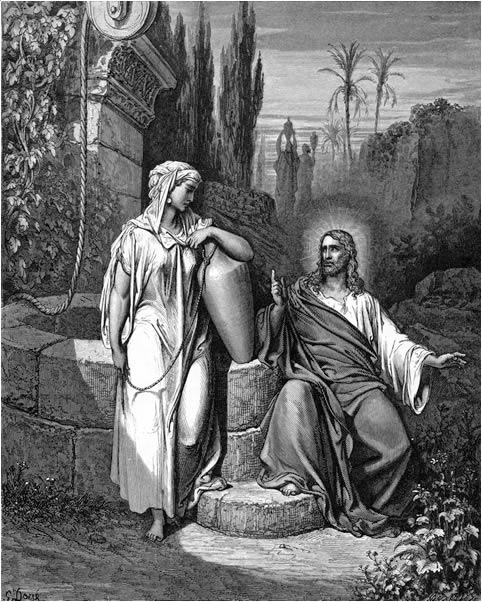
The woman hears the offer at its surface and asks how He will reach water in a deep well. Her question about Jacob names the patriarch both Samaritans and Jews claimed as father, whose well stood as his gift. She measures Jesus against the largest gift she knows.
This site's exposition
greater than our father Jacob
Cyril of Alexandria says the Samaritans, as neighbors of the Jews, took up their worship and ancestors, and most in Samaria did spring from Jacob. Adam Clarke counts them a mixed race from the nations the Assyrian king settled there, as 2 Kings 17:24 records.
The record, by era
The Church Fathers5 voices
(Tr. xv. c. 13.) She understands the living water to be the water in the well; and therefore says, Thou wishest to give me living water; but Thou hast nothing to draw with as I have: Thou canst not then give me this living water; Art Thou greater than our father Jacob, who gave us the well, and drank thereof himself, and his children, and his cattle?
Besides, the Samaritans were always pleased with the mountains and the wells of their ancestors. Thus, in the Gospel of John, the woman of Samaria, when conversing with the Lord at the well, says, "No doubt Thou art greater," etc.; and again, "Our fathers worshipped in this mountain; but ye say, that in Jerusalem is the place where men ought to worship." Accordingly, He who said, "Woe unto them that trust in the mountain of Samaria," vouchsafing now to restore that very region, purposely requests the men "to go and show themselves to the priests," because these were to be found only there where the temple was; submitting the Samaritan to the Jew, inasmuch as "salvation was of the Jews," whether to the Israelite or the Samaritan.
"And we have seen His glory, the glory as of the only begotten of the Father; " that is, of course, (the glory) of the Son, even Him who was visible, and was glorified by the invisible Father.
"Art thou greater than our father Jacob, which gave us the well, and drank thereof himself, and his children, and his cattle?" Observe how she thrusts herself into the noble stock of the Jews. For what she saith is somewhat of this kind: "Jacob used this water, and had nothing better to give us." And this she said showing that from the first answer (of Christ) she had conceived a great and sublime thought; for by the words, "he drank thereof himself, and his children, and his cattle," she implies nothing else, than that she had a notion of a better Water, but that she never found it, nor clearly knew it. More clearly to explain what she means to say, the sense of her words is this: "Thou canst not assert that Jacob gave us this well, and used another himself; for he and his children drank of this one, which they would not have done if they had had another and a better. Now of the water of this well it is not in thy power to give me, and thou canst not have another and a better, unless thou dost confess that thou art greater than Jacob. Whence then hast thou that water which thou promisest that thou wilt give us?"
The Jews did not converse with Him thus mildly, and yet He spake to them on the same subject, making mention of the like water, but they profited nothing; and when He made mention of Abraham, they even attempted to stone Him. Not so does this woman approach Him; but with much gentleness, in the midst of the heat, at noon, she with much patience saith and hears all, and does not so much as think of what the Jews most probably would have asserted, that "This fellow is mad, and beside himself: he hath tied me to this fount and well, giving me nothing, but using big words"; no, she endures and perseveres until she has found what she seeks.
16 more voices on this verse
The Church Fathers1 voice
If now a woman of Samaria is so earnest to learn something profitable, if she abides by Christ though not as yet knowing Him, what pardon shall we obtain, who both knowing Him, and being not by a well, nor in a desert place, nor at noon-day, nor beneath the scorching sunbeams, but at morning-tide, and beneath a roof like this, enjoying shade and comfort, yet cannot endure to hear anything that is said, but are wearied by it. Not such was that woman; so occupied was she by Jesus' words, that she even called others to hear them. The Jews, on the contrary, not only did not call, but even hindered and impeded those who desired to come to Him, saying, "See, have any of the rulers believed on him? but this people, which knoweth not the Law, are cursed." Let us then imitate this woman of Samaria; let us commune with Christ. For even now He standeth in the midst of us, speaking to us by the Prophets and Disciples; let us hear and obey.
The Medieval Church5 voices
"Are you greater than our father Jacob?" Similar below in the eighth chapter: "Are you greater than our father Abraham?" "Who gave us the well:" therefore he gave it, because he found it. Concerning this well, Genesis 29: "Jacob set out and came to the …
The second point is given at, Are you greater than our father Jacob, who gave us this well? As if to say: Have you better water to give us than Jacob? She calls Jacob her father not because the Samaritans were descendants of the Jews, …
Or she calls Jacob their father, because she lived under the Mosaic law, and possessed the farm which Jacob gave to his son Joseph.
The addition, and his cattle, shows the abundance of the water; as if she said, Not only is the water sweet, so that Jacob and his sons drank of it, but so abundant, that it satisfied the vast multitude of the Patriarchs' cattle.
He considers Jacob his father and counts himself among the Jewish nobility. Look, if you will, at the woman's intelligence, how quickly she concludes from the difference of the waters about the difference of the givers. "If," she says, "You give such water, then without …
The Puritans and the Awakening3 voices
This woman's meeting with Christ at the well may remind us of the stories of Rebekah, Rachel, and Jethro's daughter, who all met with husbands, good husbands, no worse than Isaac, Jacob, and Moses, when they came to the wells for water. Thirdly, How the preventing grace of God sometimes brings people unexpectedly under the means of conversion and salvation.
I see not whence thou canst have it." Note, The springs of that living water which Christ has for those that come to him are secret and undiscovered. The fountain of life is hid with Christ. Christ has enough for us, though we see not whence he has it.
quarantine:debris (2026-07-29) — odd-straight-quotes
Art thou greater than our father Jacob,....
The Nineteenth Century6 voices
Our father Jacob - The ancient Samaritans were undoubtedly the descendants of Jacob; for they were the ten tribes that revolted in the reign of Rehoboam: but those in our Lord’s time were not genuine Israelites, but a corrupted race, sprung from a mixture of different nations, sent thither by Salmanezer, king of the Assyrians. See 2Ki 17:24.
A commentator
Jamieson, Fausset & Brown1802–1910
Commentary Critical and Explanatory on the Whole Bible (1871)
How is it that thou--not altogether refusing, yet wondering at so unusual a request from a Jew, as His dress and dialect would at once discover Him to be, to a Samaritan. for, &c.--It is this national antipathy that gives point to the parable of the good Samaritan (Lu 10:30-37), and the thankfulness of the Samaritan leper (Lu 17:16, 18).
A commentator
Jamieson, Fausset & Brown1802–1910
Commentary Critical and Explanatory on the Whole Bible (1871)
proposed
The indwelling of the Holy Ghost as the Spirit of Christ is the secret of this life with all its enduring energies and satisfactions, as is expressly said (Joh 7:37-39).
A commentator
J.C. Ryle1816–1900
Expository Thoughts on the Gospels: John (lightly modernized text, Grace Gems edition) (1869)
proposed
Conversation With a Samaritan Woman But he had to pass through Samaria. Now he came to a Samaritan town called Sychar, near the plot of land that Jacob had given to his son Joseph. Jacob’s well was there, so Jesus, since he was tired from the journey, sat right down beside the well. It was about noon. A Samaritan woman came to draw water. Jesus said to her, "Give me some water to drink." (For his disciples had gone off into the town to buy supplies.)
A commentator
J.C. Ryle1816–1900
Expository Thoughts on the Gospels: John (lightly modernized text, Grace Gems edition) (1869)
proposed
Conversation With a Samaritan Woman But he had to pass through Samaria. Now he came to a Samaritan town called Sychar, near the plot of land that Jacob had given to his son Joseph. Jacob’s well was there, so Jesus, since he was tired from the journey, sat right down beside the well. It was about noon. A Samaritan woman came to draw water. Jesus said to her, "Give me some water to drink." (For his disciples had gone off into the town to buy supplies.) So the Samaritan woman said to him, "How can you—a Jew—ask me, a Samaritan woman, for water to drink?" (For Jews use nothing in common with Samaritans.) Jesus answered her, "If you had known the gift of God and who it is who said to you, ‘Give me some water to drink,’ you would have asked him, and he would have given you living water." "Sir," the woman said to him, "you have no bucket and the well is deep; where then do you get this living water? Surely you’re not greater than our ancestor Jacob, are you? For he gave us this well and drank from it himself, along with his sons and his livestock." Jesus replied, "Everyone who drinks some of this water will be thirsty again. But whoever drinks some of the water that I will give him will never be thirsty again, but the water that I will give him will become in him a fountain of water springing up to eternal life." The woman said to him, "Sir, give me this water, so that I will not be thirsty or have to come here to draw water." He said to her, "Go call your husband and come back here." The woman replied, "I have no husband." Jesus said to her, "Right you are when you said, ‘I have no husband,’ for you have had five husbands and the man you are living with now is not your husband. This you said truthfully!" The woman said to him, "Sir, I see that you are a prophet.
A commentator
Albert Barnes1798–1870
Notes, Explanatory and Practical, on the Old and New Testaments (1832-1869)
proposed
Art thou greater? - Art thou wiser, or better able to find water, than Jacob was? It seems that she supposed that he meant that he could direct her to some living spring, or to some better well in that region, and that this implied more knowledge or skill than Jacob had. To find water and to furnish a good well was doubtless considered a matter of signal skill and success. It was a subject of great importance in that region. This shows how ready sinners are to misunderstand the words of Christ, and to pervert the doctrines of religion. If she had had any proper anxiety about her soul, she would at least have “suspected” that he meant to direct her thoughts to spiritual objects. Our father Jacob - The Samaritans were composed partly of the remnant of the ten tribes, and partly of people sent from Chaldea; still, they considered themselves descendants of Jacob. Which gave us - This was doubtless the tradition, though there is no evidence that it was true. And drank thereof ... - This was added in commendation of the water of the well. A well from which Jacob, and his sons, and cattle had drank must be pure, and wholesome, and honored, and quite as valuable as any that Jesus could furnish. People like to commend that which their ancestors used as superior to anything else. The world over, people love to speak of that which their ancestors have done, and boast of titles and honors that have been handed down from them, even if it is nothing better than existed here - because Jacob’s cattle had drunk of the water.
Modern Voices1 voice
In John 4, Jesus' encounter with the Samaritan woman is itself a Purim-style reversal the rejected becomes chosen, the overlooked becomes entrusted, and the outsider becomes the first to hear a clear declaration of Messiah.
The words behind it
26 Greek wordsEvery Greek word of this verse in the order it stands, with what it means and the door to its own study. The last column counts the times a word stands in the whole Bible: the rarer the word, the more the places it appears belong together.
| Greek | Sound | Meaning | Word study | In the Bible |
|---|---|---|---|---|
| μὴ | me | Not | G3361 → | 1066 times |
| σὺ | su | You yourself | G4771 → | 2973 times |
| μείζων | meizon | greater | G3173 → | 243 times |
| εἶ | ei | are | G1510 → | 2333 times |
| τοῦ | tou | [than] the | G3588 → | 19766 times |
| πατρὸς | patros | father | G3962 → | 410 times |
| ἡμῶν | hemon | of us | G3165 → | 1936 times |
| Ἰακώβ, | iakob | Jacob, | G2384 → | 27 times |
| ὃς | hos | who | G3739 → | 1405 times |
| ἔδωκεν | edoken | gave | G1325 → | 412 times |
| ἡμῖν | hemin | us | G3165 → | 1936 times |
| τὸ | to | the | G3588 → | 19766 times |
| φρέαρ, | phrear | well, | G5421 → | |
| καὶ | kai | and | G2532 → | 9120 times |
| αὐτὸς | autos | himself | G846 → | 5565 times |
| ἐξ | ex | of | G1537 → | 911 times |
| αὐτοῦ | autou | it | G846 → | 5565 times |
| ἔπιεν | epien | drank | G4095 → | 72 times |
| καὶ | kai | and | G2532 → | 9120 times |
| οἱ | hoi | the | G3588 → | 19766 times |
| υἱοὶ | huioi | sons | G5207 → | 377 times |
| αὐτοῦ | autou | of him | G846 → | 5565 times |
| καὶ | kai | and | G2532 → | 9120 times |
| τὰ | ta | the | G3588 → | 19766 times |
| θρέμματα | thremmata | livestock | G2353 → | |
| αὐτοῦ;¶ | autou | of him? | G846 → | 5565 times |
μὴNot
meG3361 →1066 times
σὺYou yourself
suG4771 →2973 times
μείζωνgreater
meizonG3173 →243 times
εἶare
eiG1510 →2333 times
τοῦ[than] the
touG3588 →19766 times
πατρὸςfather
patrosG3962 →410 times
ἡμῶνof us
hemonG3165 →1936 times
Ἰακώβ,Jacob,
iakobG2384 →27 times
ὃςwho
hosG3739 →1405 times
ἔδωκενgave
edokenG1325 →412 times
ἡμῖνus
heminG3165 →1936 times
τὸthe
toG3588 →19766 times
φρέαρ,well,
phrearG5421 →
καὶand
kaiG2532 →9120 times
αὐτὸςhimself
autosG846 →5565 times
ἐξof
exG1537 →911 times
αὐτοῦit
autouG846 →5565 times
ἔπιενdrank
epienG4095 →72 times
καὶand
kaiG2532 →9120 times
οἱthe
hoiG3588 →19766 times
υἱοὶsons
huioiG5207 →377 times
αὐτοῦof him
autouG846 →5565 times
καὶand
kaiG2532 →9120 times
τὰthe
taG3588 →19766 times
θρέμματαlivestock
thremmataG2353 →
αὐτοῦ;¶of him?
autouG846 →5565 times
A shaded row is a word that stands 400 times or fewer in the Bible.
The walk
8 stopsEach card is a verse this one points to, and under it the verses that one points to in turn. Where several paths arrive at the same place, that place is listed first: the text keeps returning to it.
Through
Matthew 12:42The Queen of the South will rise at the judgment with this generation and condemn it; for she came from the ends of the earth to hear the wisdom of Solomon, and now One…
it leads to
- Hebrews 1:2–4
But in these last days He has spoken to us by His Son, whom He appointed heir of all things, and through whom He made the universe.
Reached by 2 separate paths from here.
- 1 Kings 10:1–13
Now when the queen of Sheba heard about the fame of Solomon concerning the name of the LORD, she came to test him with difficult questions.
- 2 Chronicles 9:1–12
Now when the queen of Sheba heard about the fame of Solomon, she came to test him with difficult questions. She arrived in Jerusalem with a very large caravan—with camels bearing spices, gold in…
- Luke 11:31–32
The Queen of the South will rise at the judgment with the men of this generation and condemn them; for she came from the ends of the earth to hear the wisdom of Solomon,…
- Hebrews 1:2–4
Through
Hebrews 3:3For Jesus has been counted worthy of greater glory than Moses, just as the builder of a house has greater honor than the house itself.
it leads to
- 1 Corinthians 3:9
For we are God’s fellow workers; you are God’s field, God’s building.
- 1 Peter 2:5–7
you also, like living stones, are being built into a spiritual house to be a holy priesthood, offering spiritual sacrifices acceptable to God through Jesus Christ.
- Zechariah 6:12–13
And you are to tell him that this is what the LORD of Hosts says: ‘Here is a man whose name is the Branch, and He will branch out from His place and build…
- 1 Corinthians 3:9
Through
John 4:6Since Jacob’s well was there, Jesus, weary from His journey, sat down by the well. It was about the sixth hour.
it leads to
- Hebrews 4:15
For we do not have a high priest who is unable to sympathize with our weaknesses, but we have one who was tempted in every way that we are, yet was without sin.
- Hebrews 4:15
Where this verse is studied
On this page
Studies9
About John
Who and where
1 name in this verse with a page on the site.
This page draws on 18 works. Open the list of works
This page draws on Adam Clarke, Commentary on the Bible; Albert Barnes, Notes, Explanatory and Practical, on the Old and New Testaments (1832-1869); Augustine of Hippo, Catena Aurea by Aquinas; Bede, Catena Aurea by Aquinas; Bonaventure, Commentary on John, Chapter 4; Cyril of Alexandria, Commentary on the Gospel of John, Book 2; J.C. Ryle, Expository Thoughts on the Gospels: John (lightly modernized text, Grace Gems edition); Jamieson, Fausset & Brown, Commentary Critical and Explanatory on the Whole Bible; Jane Hamon, PURIM – A TIME FOR REVERSALS!!; John Chrysostom, Homily on the Gospel of John 31; John Gill, Exposition of the New Testament; John Gill, Exposition of the New Testament (1746-1748); Matthew Henry, Commentary on the Whole Bible; Tertullian, Against Marcion Book IV; Tertullian, Against Praxeas; Theophylact of Ohrid, Catena Aurea by Aquinas; Theophylact of Ohrid, Commentary on John and Thomas Aquinas, Commentary on John.