
John 4:10
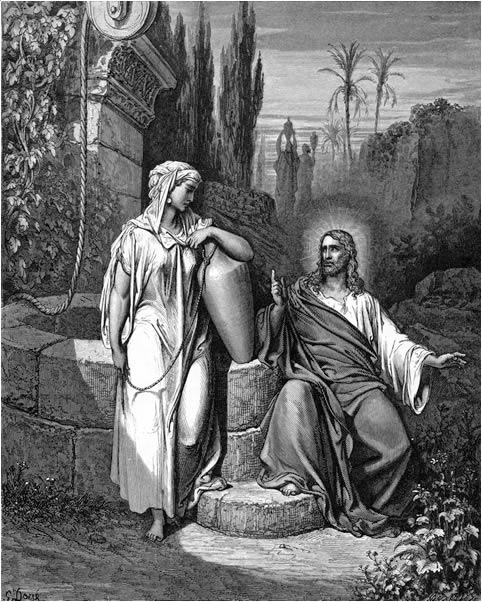
in John 4Jesus answered, “If you knew the gift of God and who is asking you for a drink, you would have asked Him, and He would have given you living water.”
BSB
The same verse in ASV and KJV ▾
ASV
Jesus answered and said unto her, If thou knewest the gift of God, and who it is that saith to thee, Give me to drink; thou wouldest have asked of him, and he would have given thee living water.
KJV
Jesus answered and said unto her, If thou knewest the gift of God, and who it is that saith to thee, Give me to drink; thou wouldest have asked of him, and he would have given thee living water.
⋯
This verse in John 4
Commentary
33 notes on this verseJesus calls the quickening gift of the Spirit "living water" because mere human nature is parched to its very roots, now rendered dry and barren of all virtue by the crimes of the devil. But now human nature runs back to its pristine beauty, and drinking in that which is life-giving, it is made beautiful with a variety of good things and, budding into a virtuous life, it sends out healthy shoots of love toward God.
This site's exposition
the gift of God
Living water named water flowing from a spring. Jesus turns the request around and offers her the gift of God, which He alone gives. Jeremiah 2:13 calls the LORD the fountain of living waters His people abandoned.
The record, by era
The Church Fathers5 voices
Is this too to be proved, that the Holy Spirit is called in the sacred books the gift of God? If people look for this too, we have in the Gospel according to John the words of our Lord Jesus Christ, who says, "If any one thirst, let him come to me and drink: he that believeth on me, as the Scripture saith, out of his belly shall flow rivers of living water." And the evangelist has gone on further to add, "And this He spake of the Spirit, which they should receive who believe in Him." And hence Paul the apostle also says, "And we have all been made to drink into one Spirit." The question then is, whether that water is called the gift of God which is the Holy Spirit. But as we find here that this water is the Holy Spirit, so we find elsewhere in the Gospel itself that this water is called the gift of God. For when the same Lord was talking with the woman of Samaria at the well, to whom He had said, "Give me to drink," and she had answered that the Jews "have no dealings" with the Samaritans, Jesus answered and said unto her, "If thou hadst known the gift of God, and who it is that says to thee, Give me to drink, thou wouldest have asked of Him, and He would have given thee living water. The woman saith unto Him, Sir, thou hast nothing to draw with, and the well is deep: whence then hast thou this living water, etc.? […]
At length, hear who it is that asketh drink: "Jesus answered and said unto her, If thou knewest the gift of God, and who it is that saith to thee, Give me to drink, thou wouldest, it may be, have asked of Him, and He would have given thee living water." He asks to drink, and promises to give drink. He longs as one about to receive; He abounds as one about to satisfy. "If thou knewest," saith He, "the gift of God." The gift of God is the Holy Spirit. But as yet He speaks to the woman guardedly, and enters into her heart by degrees. It may be He is now teaching her. For what can be sweeter and kinder than that exhortation? "If thou knewest the gift of God," etc.: thus far He keeps her in suspense. That is commonly called living water which issues from a spring: that which is collected from rain in pools and cisterns is not called living water. And it may have flowed from a spring; yet if it should stand collected in some place, not admitting to it that from which it flowed, but, with the course interrupted, separated, as it were, from the channel of the fountain, it is not called "living water:" but that is called living water which is taken as it flows. Such water there was in that fountain. Why, then, did He promise to give that which He was asking?
The woman, however, being in suspense, saith to Him, "Lord, thou hast nothing to draw with, and the well is deep." See how she understood the living water, simply the water which was in that fountain. "Thou wouldst give me living water, and I carry that with which to draw, and thou dost not. The living water is here; how art thou to give it me?" Understanding another thing, and taking it carnally, she does in a manner knock, that the Master may open up that which is closed. She was knocking in ignorance, not with earnest purpose; she is still an object of pity, not yet of instruction.
(Tract. xv) He who asked to drink, however, out of the woman's vessel, thirsted for the woman's faith: Jesus answered and said unto her, If thou knewest the gift of God, or Who it is that saith to thee, Give Me to drink, thou wouldest have asked of Him, and He would have given thee living water. (1. lxxxiii. Quaest. qu. 64) He lets her know that it was not the water, which she meant, that Ho asked for; but that knowing her faith, He wished to satisfy her thirst, by giving her the Holy Spirit. For so must we interpret the living water, which is the gift of God; as He saith, If thou knewest the gift of God. (Tr. xv) Living water is that which comes out of a spring, in distinction to what is collected in ponds and cisterns from the rain. If spring water too becomes stagnant, i. e. collects into some spot, where it is quite separated from its fountain head, it ceases to be living water.
A commentator
Hippolytus of RomeThe Refutation of All Heresies - Book 5 · Written before 235.
proposed
They assert, however, that Edem is the brain, as it were, bound and tightly fastened in encircling robes, as if (in) heaven. But they suppose that man, as far as the head only, is Paradise, therefore that "this river, which proceeds out of Edem," that is, from the brain, "is divided into four heads, and that the name of the first river is called Phison; this is that which encompasseth all the land of Havilath: there is gold, and the gold of that land is excellent, and there is bdellium and the onyx stone." This, he says, is the eye, which, by its honour (among the rest of the bodily organs), and its colours, furnishes testimony to what is spoken. "But the name of the second river is Gihon: this is that which compasseth the land of Ethiopia." This, he says, is hearing, since Gihon is (a tortuous stream), resembling a sort of labyrinth. "And the name of the third is Tigris. This is that which floweth over against (the country of) the Assyrians." This, he says, is smelling, employing the exceedingly rapid current of the stream (as an analogy of this sense). But it flows over against (the country of) the Assyrians, because in every act of respiration following upon expiration, the breath drawn in from the external atmosphere enters with swifter motion and greater force. For this, he says, is the nature of respiration. "But the fourth river is Euphrates." This, they assert, is the mouth, through which are the passage outwards of prayer, and the passage inwards of nourishment. (The mouth) makes glad, and nurtures and fashions the Spiritual Perfect Man. […]
26 more voices on this verse
The Church Fathers8 voices
And in that day it says, "Living water shall come forth out of Jerusalem." This is that spiritual, sweet, life-giving and saving drink of the teaching of Christ. He speaks of it in the Gospel according to John, when instructing the Samaritan woman.… What was this drink, then, that came forth from Jerusalem? For it was there that its gospel went forth and its heralds filled the world. This is what is meant by the words "The living water shall go forth to the first sea and the last sea," by which is meant the bounds of the whole world. That which is toward the eastern ocean is called "the first sea," that toward the west is meant by "the last sea," which, indeed, the living water of the saving gospel teaching has filled. He also taught about this when he said, "Whosoever shall drink of the water, which I shall give him, shall never thirst."
And in them too the rest of the prophecy was fulfilled, when on the day of our Savior's coming living water came forth from Jerusalem. The fruitful living word of Jerusalem, yes, from Jerusalem itself, and was spread over all the earth, even to the utmost bounds of the world. The Lord and Savior himself speaks of this water to the Samaritan woman.… And he goes on to teach what advantage would accrue to everyone who tastes of the living spiritual spring. Those that drink of it, denying the many evil demons who ruled them of old, will confess their one Lord and King, and that the Lord, who once was known only to the Hebrews, will become King of all nations that believe in him from all the earth, and that his name will be one, encircling all the earth and the wilderness. And who is not struck at seeing this fulfilled? For the Christian name, derived from the name of Christ (and Christ was indeed the Lord) has encircled every place and city and land and the very nations that dwell in the wilderness and at the ends of the earth, as the prophecy foretold.
Not everyone knows the gift of God, because not all desire the living water, for if they did desire it they would never postpone the sacrament of baptism.… Do not delay the remedies of your salvation because you do not know when your soul may …
A commentator
Cyril of AlexandriaCommentary on the Gospel of John, Book 2 · Written before 444.
proposed
If thou knewest the gift of God, and Who It is That saith to thee, Give Me to drink; thou wouldest have asked of Him, and He would have given thee living water. The woman saith unto Him, Not knowing the Essence of the Only Begotten, surpassing earth and heaven, yea rather being wholly ignorant of the Incarnate Word, the woman was calling Him a Jew. And profitably is He silent to this, that the foundation of His discourse with her may be kept. Yet does He uplift her to a higher conception of Himself, saying that she knows not Who It is Who asked drink, or how great grace Divine gifts have, insomuch that if she had had knowledge of it, she would not have endured to be behindhand, for she would have prevented the Lord in asking. He rouses her then by these things to a very earnest wish to learn. Observe how now too fashioning His discourse skillfully and free from boast, He says that He is God, even though the woman be slow to understand. For inducing her to marvel at the gift of God, He introduces Himself as the Giver of it. For if (says He,) thou knewest the gift of God and Who It is That saith to thee, thou wouldest have asked of Him. But whom would it befit to give the things of God? would it not Him Who is by Nature God? But He calls the quickening gift of the Spirit living water, whereby alone human nature, albeit well nigh parched to its very roots, rendered now dry and barren of all virtue by the villainies of the devil, runneth back to its pristine beauty of nature, and drinking in the life-giving grace, is adorned with varied forms of good things, and shooting forth into a virtuous habit puts forth most thriving shoots of love towards God. […]
And therefore He answered the woman, and said, "If thou knewest the gift of God and who it is that saith to thee, Give Me to drink, thou wouldest have asked of Him, and He would have given thee living water." First, He showeth that she is worthy to hear and not to be overlooked, and then He revealeth Himself. For she, as soon as she had learnt who He was, would straightway hearken and attend to Him; which none can say of the Jews, for they, when they had learned, asked nothing of Him, nor did they desire to be informed on any profitable matter, but insulted and drove Him away. But when the woman had heard these words, observe how gently she answers: "Sir, thou hast nothing to draw with, and the well is deep; from whence then hast thou that living water?" Already He hath raised her from her low opinion of Him, and from deeming that He is a common man. For not without a reason doth she here call Him, "Lord"; but assigning to Him high honor. That she spake these words to honor Him, is plain from what is said afterwards, since she did not laugh nor mock, but doubted for a while.
And wonder not if she did not at once perceive all, for neither did Nicodemus. What saith he? "How can these things be?" and again, "How can a man be born when he is old?" and again, "Can he enter the second time into his mother's womb, and be born?" But this woman more reverently: "Sir, thou hast nothing to draw with, and the well is deep; from whence then hast thou that living water?" Christ said one thing, and she imagined another, hearing nothing beyond the words, and as yet unable to form any lofty thought. Yet, had she spoken hastily, she might have said, "If thou hadst had that living water, thou wouldest not have asked of me, but wouldest rather have provided for thyself. Thou art but a boaster." But she said nothing like this; she answers with much gentleness, both at first and afterwards.
For at first she saith, "How is it that thou, being a Jew, askest drink of me?" she saith not, as though speaking to an alien and an enemy, "Far be it from me to give to thee, who art a foe and a stranger to our nation." And afterwards again, when she heard Him utter great words, a thing at which enemies are most annoyed, she did not mock nor deride; but what saith she? "Art thou greater than our father Jacob, which gave us the well, and drank thereof himself, and his children, and his cattle?"
A commentator
Cyril of AlexandriaCommentary on the Gospel of John, Book 2 · Written before 444.
proposed
Enquiry is the beginning of learning, and to those who are ignorant upon any subject, doubt concerning it is the root of understanding. This commencement the discourse aims at: wherefore the Saviour wisely hints, that He accounts of no value the customs of the Jews.
The Medieval Church4 voices
Christ does not reveal Himself until the woman's virtue has been made manifest. But when the woman's virtue was revealed — her perceptiveness and exactness — then He begins to converse with her about higher matters. "If you," He says, "knew the gift of God," …
"Jesus answered and said to her: If you knew the gift of God." The gift of God is the Holy Spirit, concerning which Acts 2: "Repent, and let each one of you be baptized, and you shall receive the gift of the Holy Spirit." The …
Now (v 10), the Evangelist gives us Christ's spiritual teaching. First, he gives the teaching itself. Secondly, the effect it had (v 27). As to the first, he does two things. First, a summary of the entire instruction is given. Secondly, he unfolds it part …
The grace of the Holy Spirit then He calls living water; i. e. lifegiving, refreshing, stirring. For the grace of the Holy Spirit is ever stirring him who does good works, directing the risings of his heart.
The Puritans and the Awakening3 voices
This woman's meeting with Christ at the well may remind us of the stories of Rebekah, Rachel, and Jethro's daughter, who all met with husbands, good husbands, no worse than Isaac, Jacob, and Moses, when they came to the wells for water. Thirdly, How the preventing grace of God sometimes brings people unexpectedly under the means of conversion and salvation.
Jesus answered and said unto her,....
Note, ( a. ) Those that would have any benefit by Christ must ask for it, must be earnest in prayer to God for it. ( b. ) Those that have a right knowledge of Christ will seek to him, and if we do not seek unto him it is a sign that we do not know him, Ps. ix. 10 . ( c. ) Christ knows what they that want the means of knowledge would have done if they had had them, Matt. xi.
The Nineteenth Century10 voices
If thou knewest the gift of God - Δωρεαν signifies a free gift. A gift is any thing that is given, for which no equivalent has been or is to be returned: a free gift is that which has been given without asking or entreaty. Such a gift of kindness was Jesus Christ to the world, Joh 3:16; and through him comes the gift of the Spirit, which those who believe on his name were to receive.
THE matter will turn, this morning, upon those few words, "If you knew the gift of God." The woman of Samaria, who was met by our Lord at the well, was an object of electing love but she was not yet regenerated. One difficulty alone lay in the way—she was willing to receive the Truth of God, perfectly willing to be obedient to it—but ignorance lay like a stone before the door of her sepulcher. "If you knew the gift of God," says Christ, "then you would have asked, and I would have given." There was the one barrier!
A commentator
Jamieson, Fausset & Brown1802–1910
Commentary Critical and Explanatory on the Whole Bible (1871)
If thou knewest, &c.--that is, "In Me thou seest only a petitioner to thee; but if thou knewest who that Petitioner is, and the Gift that God is giving to men, thou wouldst have changed places with Him, gladly suing of Him living water--nor shouldst thou have sued in vain" (gently reflecting on her for not immediately meeting His request).
A commentator
Jamieson, Fausset & Brown1802–1910
Commentary Critical and Explanatory on the Whole Bible (1871)
How is it that thou--not altogether refusing, yet wondering at so unusual a request from a Jew, as His dress and dialect would at once discover Him to be, to a Samaritan. for, &c.--It is this national antipathy that gives point to the parable of the good Samaritan (Lu 10:30-37), and the thankfulness of the Samaritan leper (Lu 17:16, 18).
A commentator
J.C. Ryle1816–1900
Expository Thoughts on the Gospels: John (lightly modernized text, Grace Gems edition) (1869)
proposed
Conversation With a Samaritan Woman But he had to pass through Samaria. Now he came to a Samaritan town called Sychar, near the plot of land that Jacob had given to his son Joseph. Jacob’s well was there, so Jesus, since he was tired from the journey, sat right down beside the well. It was about noon. A Samaritan woman came to draw water. Jesus said to her, "Give me some water to drink." (For his disciples had gone off into the town to buy supplies.)
A commentator
J.C. Ryle1816–1900
Expository Thoughts on the Gospels: John (lightly modernized text, Grace Gems edition) (1869)
proposed
Conversation With a Samaritan Woman But he had to pass through Samaria. Now he came to a Samaritan town called Sychar, near the plot of land that Jacob had given to his son Joseph. Jacob’s well was there, so Jesus, since he was tired from the journey, sat right down beside the well. It was about noon. A Samaritan woman came to draw water. Jesus said to her, "Give me some water to drink." (For his disciples had gone off into the town to buy supplies.) So the Samaritan woman said to him, "How can you—a Jew—ask me, a Samaritan woman, for water to drink?" (For Jews use nothing in common with Samaritans.) Jesus answered her, "If you had known the gift of God and who it is who said to you, ‘Give me some water to drink,’ you would have asked him, and he would have given you living water." "Sir," the woman said to him, "you have no bucket and the well is deep; where then do you get this living water? Surely you’re not greater than our ancestor Jacob, are you? For he gave us this well and drank from it himself, along with his sons and his livestock." Jesus replied, "Everyone who drinks some of this water will be thirsty again. But whoever drinks some of the water that I will give him will never be thirsty again, but the water that I will give him will become in him a fountain of water springing up to eternal life." The woman said to him, "Sir, give me this water, so that I will not be thirsty or have to come here to draw water." He said to her, "Go call your husband and come back here." The woman replied, "I have no husband." Jesus said to her, "Right you are when you said, ‘I have no husband,’ for you have had five husbands and the man you are living with now is not your husband. This you said truthfully!" The woman said to him, "Sir, I see that you are a prophet.
THE matter will turn, this morning, upon those few words, "If you knew the gift of God." The woman of Samaria, who was met by our Lord at the well, was an object of electing love but she was not yet regenerated. One difficulty alone lay in the way—she was willing to receive the Truth of God, perfectly willing to be obedient to it—but ignorance lay like a stone before the door of her sepulcher. "If you knew the gift of God," says Christ, "then you would have asked, and I would have given." There was the one barrier! If that could be removed she would be a saved soul. The impediment which lay so much in her way was ignorance concerning the Lord Jesus Himself. She was not an un-instructed woman. She was evidently acquainted, at least, with portions of Biblical history. she could speak of "Father Jacob, which gave us the well, and drank there himself, and his children, and his cattle." She was versed certainly in the peculiarities of her sect—"How is it that You, being a Jew, ask drink of me, which am a woman of Samaria? For the Jews have no dealings with the Samaritans." She was equally well acquainted with the hopes, which were common to her people and to the Jewish nation—"I know that Messiah comes, which is called Christ. When He is come, He will tell us all things." She was not, therefore, kept out of the kingdom on account of ignorance.
A commentator
Charles Spurgeon1834–1892
The Metropolitan Tabernacle Pulpit, Sermon No. 2277: “Sychar's Sinner Saved” (lightly modernized text, CCEL edition) · Written before 1892.
proposed
I COULD not help saying, in the reading, that the woman's answer to our Lord was, at least, somewhat abrupt, if not really rude, but, with great meekness, Jesus took no notice of it so as to blame her for her tone, or for her unkind manner. He was too intent upon saving her soul to care about a little rudeness on her part. Learn a lesson from your Lord's conduct! When you are dealing with souls, do not always expect them to yield to you at once. Do not expect them, even, to receive your expostulations with thankfulness.
A commentator
Charles Spurgeon1834–1892
The Metropolitan Tabernacle Pulpit, Sermon No. 2277: “Sychar's Sinner Saved” (lightly modernized text, CCEL edition) · Written before 1892.
proposed
I COULD not help saying, in the reading, that the woman's answer to our Lord was, at least, somewhat abrupt, if not really rude, but, with great meekness, Jesus took no notice of it so as to blame her for her tone, or for her unkind manner. He was too intent upon saving her soul to care about a little rudeness on her part. Learn a lesson from your Lord's conduct! When you are dealing with souls, do not always expect them to yield to you at once. Do not expect them, even, to receive your expostulations with thankfulness. Be prepared to be repelled and even to be ridiculed. And when it so happens, do not be put out of temper, or out of heart, but go straight on with your work whichever way they may go. Our Savior, instead of being vexed at the rudeness of the woman, said to her, "If you knew." "Ah, poor Soul, you do not know to whom you are speaking thus rudely!" "If you knew the gift of God, and who it is that says to you, Give Me to drink; you would have asked of Him, and He would have given you living water." Oh, that we might have a passion for the souls of men! May we be vehement in our desire, with a love that burns like coals of juniper! May we not be put off by any discouragements, but let us resolve that before we have done with any poor sinner, we will do all in our power to bring him to Christ, so that, if men are lost, it shall not be our fault—and if they are saved, we will, at least, have this part in it—that we have set Christ plainly before them as their soul's only hope! Now, our Savior, having thus set us an example of great meekness, went on to read this woman's heart in a amazing manner and, reading her heart, He foretold what her action would be when her ignorance was removed. It is a difficult thing to tell what people will do under such and such circumstances, for men and women are very unaccountable creatures.
A commentator
Albert Barnes1798–1870
Notes, Explanatory and Practical, on the Old and New Testaments (1832-1869)
proposed
The gift of God - The word “gift,” here denotes “favor.” It may refer to Jesus Himself, as the gift of God to the world, given to save men from death Joh 3:16; 2Co 9:15, or it may refer to the opportunity then afforded her of seeking salvation. If thou knewest how favorable an opportunity God now gives thee to gain a knowledge of himself, etc. And who it is ... - If thou knewest that the Messiah was speaking. Living water - The Jews used the expression “living water” to denote springs, fountains, or running streams, in opposition to dead and stagnant water. Jesus here means to denote by it his doctrine, or his grace and religion, in opposition to the impure and dead notions of the Jews and the Samaritans. See Joh 4:14. This was one of the many instances in which he took occasion from common topics of conversation to introduce religious discourse. None ever did it so happily as he did, but, by studying his example and manner, we may learn also to do it. One way to acquire the art is to have the mind full of the subject; to make religion our first and main thing; to carry it with us into all employments and into all society; to look upon everything in a religious light, and out of the abundance of the heart the mouth will speak, Mat 12:34.
Modern Voices1 voice
In John 4, Jesus' encounter with the Samaritan woman is itself a Purim-style reversal the rejected becomes chosen, the overlooked becomes entrusted, and the outsider becomes the first to hear a clear declaration of Messiah.
The words behind it
30 Greek wordsEvery Greek word of this verse in the order it stands, with what it means and the door to its own study. The last column counts the times a word stands in the whole Bible: the rarer the word, the more the places it appears belong together.
| Greek | Sound | Meaning | Word study | In the Bible |
|---|---|---|---|---|
| Ἀπεκρίθη | apekrithe | Answered | G611 → | 231 times |
| Ἰησοῦς | iesous | Jesus | G2424 → | 908 times |
| καὶ | kai | and | G2532 → | 9120 times |
| εἶπεν | eipen | said | G2036 → | 925 times |
| αὐτῇ· | autea | to her; | G846 → | 5565 times |
| εἰ | ei | If | G1487 → | 508 times |
| ᾔδεις | edeis | you had known | G1492 → | 374 times |
| τὴν | ten | the | G3588 → | 19766 times |
| δωρεὰν | dorean | gift | G1431 → | |
| τοῦ | tou | <the> | G3588 → | 19766 times |
| θεοῦ | theou | of God | G2316 → | 1312 times |
| καὶ | kai | and | G2532 → | 9120 times |
| τίς | tis | who | G5101 → | 563 times |
| ἐστιν | estin | it is | G1510 → | 2333 times |
| ὁ | ho | who | G3588 → | 19766 times |
| λέγων | legon | is saying | G3004 → | 1325 times |
| σοι· | soi | to you; | G4771 → | 2973 times |
| δός | dos | do give | G1325 → | 412 times |
| μοι | moi | Me | G3165 → | 1936 times |
| πεῖν, | pein | to drink, | G4095 → | 72 times |
| σὺ | su | you yourself | G4771 → | 2973 times |
| ἂν | an | then would | G302 → | 165 times |
| ᾔτησας | etesas | you have asked | G154 → | 70 times |
| αὐτὸν | auton | Him | G846 → | 5565 times |
| καὶ | kai | and | G2532 → | 9120 times |
| ἔδωκεν | edoken | He gave | G1325 → | 412 times |
| ἄν | an | maybe | G302 → | 165 times |
| σοι | soi | to you | G4771 → | 2973 times |
| ὕδωρ | hudor | water | G5204 → | 76 times |
| ζῶν. | zon | living. | G2198 → | 139 times |
ἈπεκρίθηAnswered
apekritheG611 →231 times
ἸησοῦςJesus
iesousG2424 →908 times
καὶand
kaiG2532 →9120 times
εἶπενsaid
eipenG2036 →925 times
αὐτῇ·to her;
auteaG846 →5565 times
εἰIf
eiG1487 →508 times
ᾔδειςyou had known
edeisG1492 →374 times
τὴνthe
tenG3588 →19766 times
δωρεὰνgift
doreanG1431 →
τοῦ<the>
touG3588 →19766 times
θεοῦof God
theouG2316 →1312 times
καὶand
kaiG2532 →9120 times
τίςwho
tisG5101 →563 times
ἐστινit is
estinG1510 →2333 times
ὁwho
hoG3588 →19766 times
λέγωνis saying
legonG3004 →1325 times
σοι·to you;
soiG4771 →2973 times
δόςdo give
dosG1325 →412 times
μοιMe
moiG3165 →1936 times
πεῖν,to drink,
peinG4095 →72 times
σὺyou yourself
suG4771 →2973 times
ἂνthen would
anG302 →165 times
ᾔτησαςyou have asked
etesasG154 →70 times
αὐτὸνHim
autonG846 →5565 times
καὶand
kaiG2532 →9120 times
ἔδωκενHe gave
edokenG1325 →412 times
ἄνmaybe
anG302 →165 times
σοιto you
soiG4771 →2973 times
ὕδωρwater
hudorG5204 →76 times
ζῶν.living.
zonG2198 →139 times
A shaded row is a word that stands 400 times or fewer in the Bible.
The walk
8 stopsEach card is a verse this one points to, and under it the verses that one points to in turn. Where several paths arrive at the same place, that place is listed first: the text keeps returning to it.
Through
Isaiah 44:3For I will pour water on the thirsty land, and currents on the dry ground. I will pour out My Spirit on your descendants, and My blessing on your offspring.
it leads to
- Joel 2:28
And afterward, I will pour out My Spirit on all people. Your sons and daughters will prophesy, your old men will dream dreams, your young men will see visions.
- Acts 2:17
‘In the last days, God says, I will pour out My Spirit on all people. Your sons and daughters will prophesy, your young men will see visions, your old men will dream dreams.
- Isaiah 59:21
“As for Me, this is My covenant with them,” says the LORD. “My Spirit will not depart from you, and My words that I have put in your mouth will not depart from your…
- John 7:37–39
On the last and greatest day of the feast, Jesus stood up and called out in a loud voice, “If anyone is thirsty, let him come to Me and drink.
- Proverbs 1:23
If you had repented at my rebuke, then surely I would have poured out my spirit on you; I would have made my words known to you.
- Joel 2:28
Through
Revelation 7:17For the Lamb in the center of the throne will be their shepherd. ‘He will lead them to springs of living water,’ and ‘God will wipe away every tear from their eyes.’”
it leads to
- John 7:37–38
On the last and greatest day of the feast, Jesus stood up and called out in a loud voice, “If anyone is thirsty, let him come to Me and drink.
Reached by 2 separate paths from here.
- John 4:14
But whoever drinks the water I give him will never thirst. Indeed, the water I give him will become in him a fount of water springing up to eternal life.”
Reached by 2 separate paths from here.
- John 7:37–38
Through
John 4:14But whoever drinks the water I give him will never thirst. Indeed, the water I give him will become in him a fount of water springing up to eternal life.”
it leads to
- John 7:38–39
Whoever believes in Me, as the Scripture has said: ‘Streams of living water will flow from within him.’”
- John 7:38–39
Where this verse is studied
About John
This page draws on 23 works. Open the list of works
This page draws on Adam Clarke, Commentary on the Bible; Albert Barnes, Notes, Explanatory and Practical, on the Old and New Testaments (1832-1869); Augustine of Hippo, ON THE TRINITY 15.19.33; Augustine of Hippo, Tractates on John 15; Augustine of Hippo, Catena Aurea by Aquinas; Bonaventure, Commentary on John, Chapter 4; Brooke Foss Westcott, The Gospel according to St. John; Caesarius of Arles, SERMON 170.4; Charles Spurgeon, The Metropolitan Tabernacle Pulpit, Sermon No. 782: “Saving Knowledge” (lightly modernized text, CCEL edition); Charles Spurgeon, The Metropolitan Tabernacle Pulpit, Sermon No. 2277: “Sychar's Sinner Saved” (lightly modernized text, CCEL edition); Cyril of Alexandria, Commentary on the Gospel of John, Book 2; Eusebius of Caesarea, PROOF OF THE GOSPEL 6.18.48-49; Eusebius of Caesarea, PROOF OF THE GOSPEL 10.7.7-8; Hippolytus of Rome, The Refutation of All Heresies - Book 5; J.C. Ryle, Expository Thoughts on the Gospels: John (lightly modernized text, Grace Gems edition); Jamieson, Fausset & Brown, Commentary Critical and Explanatory on the Whole Bible; Jane Hamon, PURIM – A TIME FOR REVERSALS!!; John Chrysostom, Homily on the Gospel of John 31; John Gill, Exposition of the New Testament (1746-1748); Matthew Henry, Commentary on the Whole Bible; Theophylact of Ohrid, Commentary on John; Theophylact of Ohrid, Catena Aurea by Aquinas and Thomas Aquinas, Commentary on John.