
John 4:29
in John 4“Come, see a man who told me everything I ever did. Could this be the Christ?”
BSB
The same verse in ASV and KJV ▾
ASV
Come, see a man, who told me all things that ever I did: can this be the Christ?
KJV
Come, see a man, which told me all things that ever I did: is not this the Christ?
⋯
This verse in John 4
Commentary
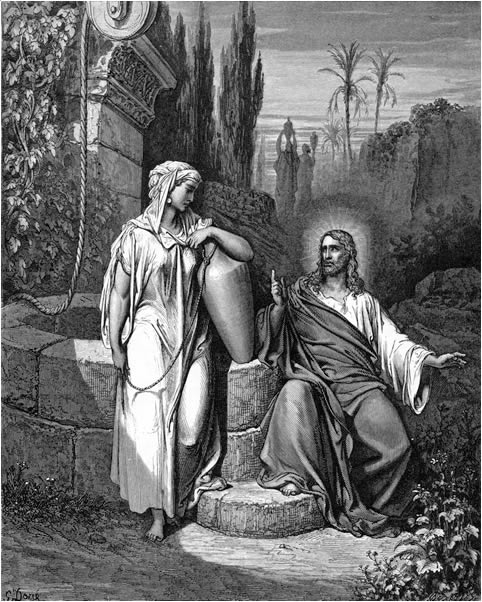
22 notes on this verseCome, see a man,.... An uncommon, an extraordinary man, a prophet, and, who himself says, he is the Messiah, who is now at Jacob's well; come, go along with me, and see him and converse with him, and judge for yourselves, who, and what he is: she does not say, "go and see"; for she proposed to go along with them herself, that she might have more conversation with him, and knowledge of him, and grace from him: so such that have tasted that the Lord is gracious, desire more grace from him, and communion with him.
This site's exposition
left her water jar
on John 4:28-30
She leaves the jar she came for and walks back into the town with her report. Her testimony is one fact about her own life and a question she puts to the town, whether this man is the Christ. The town goes out to see.
This site's exposition
Come, see a man
John Wesley notes that Jesus had told her only a few things, and her own conscience supplied the rest. Albert Barnes hears modesty in her question, since she likely believed and still left the town to judge the evidence. Gill notes the word come: she was going back too.
The record, by era
The Church Fathers5 voices
"The woman then left her water-pot." Having heard, "I that speak with thee am He," and having received Christ the Lord into her heart, what could she do but now leave her water-pot, and run to preach the gospel? She cast out lust, and hastened to proclaim the truth. Let them who would preach the gospel learn; let them throw away their water-pot at the well. You remember what I said before of the water-pot: it was a vessel with which the water was drawn, called hydria, from its Greek name, because water is hydor in Greek; just as if it were called aquarium, from the Latin. She threw away her water-pot then, which was no longer of use, but a burden to her, such was her avidity to be satisfied with that water. Throwing her burden away, to make known Christ, "she ran to the city, and says to those men. Come, and see a man that told me all things that ever I did." Step by step, lest those men should get angry and indignant, and should persecute her. "Is this Christ? Then they went out of the city, and came to Him."
So kindled was she by His words, that she left her water pot and the purpose for which she came, ran into the city, and drew all the people to Jesus. "Come," she saith, "see a Man which told me all things that ever I did."
Observe too how prudently she speaks; she said not, "Come and see the Christ," but with the same condescension by which Christ had netted her she draws the men to Him; "Come," she saith, "see a Man who told me all that ever I did." She was not ashamed to say that He "told me all that ever I did." Yet she might have spoken otherwise, "Come, see one that prophesieth"; but when the soul is inflamed with holy fire, it looks then to nothing earthly, neither to glory nor to shame, but belongs to one thing alone, the flame which occupieth it.
"Is not this the Christ?" Observe again here the great wisdom of the woman; she neither declared the fact plainly, nor was she silent, for she desired not to bring them in by her own assertion, but to make them to share in this opinion by hearing Him; which rendered her words more readily acceptable to them. Yet He had not told all her life to her, only from what had been said she was persuaded as to the rest. Nor did she say, "Come, believe," but, "Come, see"; a gentler expression than the other, and one which more attracted them. Seest thou the wisdom of the woman? She knew, she knew certainly that having but tasted that Well, they would be affected in the same manner as herself. Yet any one of the grosser sort would have concealed the reproof which Jesus had given; but she parades her own life, and brings it forward before all men, so as to attract and capture all.
A commentator
Cyril of AlexandriaCommentary on the Gospel of John, Book 2 · Written before 444.
proposed
O wondrous change! O truly great and God-befitting Might, translucent with unspeakable marvel! Skilful workwoman unto doctrine, and initiater is she, who understood none of the things that were said at first, and therefore rightly heard, Go, call thy husband and come hither. For see how skilfully she conversed with the Samaritans. She does not say at once that she has found the Christ, nor does she introduce Jesus at first into her account. For rightly would she have been rejected, as far surpassing the measure of words befitting her, finding her hearers not ignorant of her habits.
14 more voices on this verse
The Medieval Church4 voices
"Come and see the man who told me all things that I have done." She was drawing them by this, that he had revealed her secrets: she did not say: Come and see a prophet: but she divulges her own life, so that she might …
It is only by degrees, however, that she comes to the preaching of Christ. First she calls Him a man, not Christ; for fear those who heard her might be angry, and refuse to come.
Truly, a soul inflamed by divine fire looks upon nothing earthly, neither upon shame nor upon dishonor. And so she is not ashamed to reveal her deeds, but says: "Who told me everything that I have done." She could have said otherwise: "Come, see a …
Next we see her manner of preaching (v 29). She first invites them to see Christ, saying, Come and see the man. Although she had heard Christ say that he was the Christ, she did not at once tell the people that they should come …
The Puritans and the Awakening2 voices
A man who told me all things that ever I did - Our Lord had told her but a few things. But his words awakened her conscience, which soon told her all the rest. Is not this the Christ? - She does not doubt of it herself, but incites them to make the inquiry.
Doubtless, it was not her affliction (the burying of so many husbands), but her sin, that Christ intended to upbraid her with; either she had eloped (as the law speaks), had run away from her husbands, and married others, or by her undutiful, unclean, disloyal conduct, had provoked them to divorce her, or by indirect means had, contrary to law, divorced them.
The Nineteenth Century8 voices
A commentator
Albert Barnes1798–1870
Notes, Explanatory and Practical, on the Old and New Testaments (1832-1869)
Is not this the Christ? - Though she probably believed it, yet she proposed it modestly, lest she should appear to dictate in a case which was so important, and which demanded so much attention. The evidence on which she was satisfied that he was the Messiah was that he had told her all things that she had done - perhaps much more than is here recorded. The question which she submitted to them was whether this was not satisfactory proof that he was the Messiah.
Behold our Lord and Master with divinely skillful art seeking after a single soul! We must have large Congregations or we are disinclined for soul-winning. The habit of the age is to do nothing but what is ostentatious—every work must be with beat of drum or sound of tambourine! I pray that the Lord may work in us the steadfast desire to do good on the quiet, by stealth, when no one looks on, when not a single disciple is near.
A commentator
Jamieson, Fausset & Brown1802–1910
Commentary Critical and Explanatory on the Whole Bible (1871)
proposed
left her water-pot--How exquisitely natural! The presence of strangers made her feel that it was time for her to withdraw, and He who knew what was in her heart, and what she was going to the city to do, let her go without exchanging a word with her in the hearing of others.
quarantine:debris (2026-07-29) — starts-lowercase
A commentator
Jamieson, Fausset & Brown1802–1910
Commentary Critical and Explanatory on the Whole Bible (1871)
proposed
is not this the Christ--The form of the question (in the Greek) is a distant, modest way of only half insinuating what it seemed hardly fitting for her to affirm; nor does she refer to what He said of Himself, but solely to His disclosure to her of the particulars of her own life.
quarantine:debris (2026-07-29) — starts-lowercase
A commentator
J.C. Ryle1816–1900
Expository Thoughts on the Gospels: John (lightly modernized text, Grace Gems edition) (1869)
proposed
These verses continue the well-known story of the Samaritan woman's conversion. Short as the passage may appear, it contains points of deep interest and importance. The mere worldling, who cares, nothing about experimental religion, may see nothing particular in these verses. To all who desire to know something of the experience of a converted person, they will be found full of food for thought. We see, firstly, in this passage, how marvelous in the eyes of man are Christ's dealings with souls. We are told that the disciples "marveled that he talked with the woman."
A commentator
J.C. Ryle1816–1900
Expository Thoughts on the Gospels: John (lightly modernized text, Grace Gems edition) (1869)
proposed
These verses continue the well-known story of the Samaritan woman's conversion. Short as the passage may appear, it contains points of deep interest and importance. The mere worldling, who cares, nothing about experimental religion, may see nothing particular in these verses. To all who desire to know something of the experience of a converted person, they will be found full of food for thought. We see, firstly, in this passage, how marvelous in the eyes of man are Christ's dealings with souls. We are told that the disciples "marveled that he talked with the woman." That their Master should take the trouble to talk to a woman at all, and to a Samaritan woman, and to an adulterous woman at a well, when He was wearied with His journey—all this was amazing to the eleven disciples. It was a sort of thing which they did not expect. It was contrary to their idea of what a religious teacher should do. It startled them and filled them with surprise. The feeling displayed by the disciples on this occasion, does not stand alone in the Bible. When our Lord allowed publicans and sinners to draw near to Him and be in His company, the Pharisees marveled. They exclaimed, "This man receives sinners and eats with them." (Luke 15:2.). When Saul came back from Damascus, a converted man and a new creature, the Christians at Jerusalem were astonished. "They did not believe that he was a disciple." (Acts 9:26.). When Peter was delivered from Herod's prison by an angel, and brought to the door of the house where disciples were praying for his deliverance, they were so taken by surprise that they could not believe it was Peter. "When they saw him they were astonished." (Acts 12:16.) But why should we stop short in Bible instances? The true Christian has only to look around him in this world in order to see abundant illustrations of the truth before us.
Behold our Lord and Master with divinely skillful art seeking after a single soul! We must have large Congregations or we are disinclined for soul-winning. The habit of the age is to do nothing but what is ostentatious—every work must be with beat of drum or sound of tambourine! I pray that the Lord may work in us the steadfast desire to do good on the quiet, by stealth, when no one looks on, when not a single disciple is near. Oh that we may have such an estimate of the value of a single soul that we count whole days well spent to bring one fallen woman or one drunk to the Savior's feet! Blessed is he who works on though he is never heard of and looks for his reward from his Master. In the heat of the day the Lord Jesus found rest and refreshment in speaking to one whom many would scarcely look upon except with eyes of scorn. Blessed Savior, we do not marvel, as the disciples did, that You did speak with the woman, but we do wonder with a higher kind of astonishment that You ever did speak to the likes of us who have so sadly fallen, done You dishonor and grieved Your heart! We are amazed that He who is the Glory of Heaven, "Light of light, very God of very God," should shroud Himself in the likeness of sinful flesh and, being found in fashion as a Man, should seek after us unworthy ones. Oh, the compassion of the Redeemer's heart! Read this chapter through carefully and see the skill which that compassion taught Him. How sweetly ready He was to converse with her and take up her questions. Never imagine that the 30 years of retirement at Nazareth were wasted. I would gladly go, if I were young, for 30 years to learn how to talk as He did, if His own Spirit would teach me the lesson. He was a perfect Teacher because as Man, He had lent a willing ear to the heavenly instruction of the Holy Spirit and, therefore, grew in knowledge and fitness for His work.
All things that ever I did - The Jews believed that one essential characteristic of the Messiah would be, that he should be able to tell the secrets of all hearts. This they believed was predicted, Isa 11:2, Isa 11:3. When the famous impostor Barchochab, who rose up under the empire of Adrian, about a hundred years after the incarnation, professed himself to be the Messiah, after having been deceived by him for two years, they at last thought of putting his divinity to proof on this ground: they brought before him persons whom he did not know, some of whom were very vicious, and others of a different character; they desired him to point out who were the righteous, and who were the wicked; which when he could not do, they rose up and put him to death. La Bible de Martin.
The words behind it
14 Greek wordsEvery Greek word of this verse in the order it stands, with what it means and the door to its own study. The last column counts the times a word stands in the whole Bible: the rarer the word, the more the places it appears belong together.
| Greek | Sound | Meaning | Word study | In the Bible |
|---|---|---|---|---|
| δεῦτε, | deute | Come, | G1205 → | |
| ἴδετε | idete | do see | G1492 → | 374 times |
| ἄνθρωπον | anthropon | a man | G444 → | 549 times |
| ὃς | hos | who | G3739 → | 1405 times |
| εἶπέν | eipen | told | G2036 → | 925 times |
| μοι | moi | me | G3165 → | 1936 times |
| πάντα | panta | all things | G3956 → | 1235 times |
| ὅσα | hosa | as much as | G3745 → | 110 times |
| ἐποίησα· | epoiesa | I did; | G4160 → | 569 times |
| μήτι | meti | surely not ever | G3385 → | 18 times |
| οὗτός | houtos | this | G3778 → | 1381 times |
| ἐστιν | estin | is | G1510 → | 2333 times |
| ὁ | ho | the | G3588 → | 19766 times |
| χριστός; | christos | Christ? | G5547 → | 523 times |
δεῦτε,Come,
deuteG1205 →
ἴδετεdo see
ideteG1492 →374 times
ἄνθρωπονa man
anthroponG444 →549 times
ὃςwho
hosG3739 →1405 times
εἶπένtold
eipenG2036 →925 times
μοιme
moiG3165 →1936 times
πάνταall things
pantaG3956 →1235 times
ὅσαas much as
hosaG3745 →110 times
ἐποίησα·I did;
epoiesaG4160 →569 times
μήτιsurely not ever
metiG3385 →18 times
οὗτόςthis
houtosG3778 →1381 times
ἐστινis
estinG1510 →2333 times
ὁthe
hoG3588 →19766 times
χριστός;Christ?
christosG5547 →523 times
A shaded row is a word that stands 400 times or fewer in the Bible.
The walk
8 stopsEach card is a verse this one points to, and under it the verses that one points to in turn. Where several paths arrive at the same place, that place is listed first: the text keeps returning to it.
Through
Revelation 22:17The Spirit and the bride say, “Come!” Let the one who hears say, “Come!” And let the one who is thirsty come, and the one who desires the water of life drink freely.
it leads to
- John 4:14
But whoever drinks the water I give him will never thirst. Indeed, the water I give him will become in him a fount of water springing up to eternal life.”
- Revelation 21:6
And He told me, “It is done! I am the Alpha and the Omega, the Beginning and the End. To the thirsty I will give freely from the spring of the water of life.
- Isaiah 55:1–3
“Come, all you who are thirsty, come to the waters; and you without money, come, buy, and eat! Come, buy wine and milk without money and without cost!
- John 7:37
On the last and greatest day of the feast, Jesus stood up and called out in a loud voice, “If anyone is thirsty, let him come to Me and drink.
- Isaiah 12:3
With joy you will draw water from the springs of salvation,
- John 4:14
Through
John 4:25The woman said, “I know that Messiah” (called Christ) “is coming. When He comes, He will explain everything to us.”
it leads to
- John 1:49
“Rabbi,” Nathanael answered, “You are the Son of God! You are the King of Israel!”
- Daniel 9:24–26
Seventy weeks are decreed for your people and your holy city to stop their transgression, to put an end to sin, to make atonement for iniquity, to bring in everlasting righteousness, to seal up…
- Matthew 1:16
and Jacob the father of Joseph, the husband of Mary, of whom was born Jesus, who is called Christ.
- John 1:49
Where this verse is studied
On this page
Studies16
On this verse
On this chapter
About John
This page draws on 16 works. Open the list of works
This page draws on Adam Clarke, Commentary on the Bible; Albert Barnes, Notes, Explanatory and Practical, on the Old and New Testaments (1832-1869); Alcuin of York, Catena Aurea by Aquinas; Augustine of Hippo, Tractates on John 15; Bonaventure, Commentary on John, Chapter 4; Charles Spurgeon, The Metropolitan Tabernacle Pulpit, Sermon No. 1678: “The Samaritan Woman and Her Mission” (lightly modernized text, CCEL edition); Cyril of Alexandria, Commentary on the Gospel of John, Book 2; J. C. Ryle, Expository Thoughts on the Gospels, John; J.C. Ryle, Expository Thoughts on the Gospels: John (lightly modernized text, Grace Gems edition); Jamieson, Fausset & Brown, Commentary Critical and Explanatory on the Whole Bible; John Chrysostom, Homily on the Gospel of John 34; John Gill, Exposition of the New Testament (1746-1748); John Wesley, Explanatory Notes upon the New Testament; Matthew Henry, Commentary on the Whole Bible; Theophylact of Ohrid, Commentary on John and Thomas Aquinas, Commentary on John.