
John 4:20
in John 4Our fathers worshiped on this mountain, but you Jews say that the place where one must worship is in Jerusalem.”
BSB
The same verse in ASV and KJV ▾
ASV
Our fathers worshipped in this mountain; and ye say, that in Jerusalem is the place where men ought to worship.
KJV
Our fathers worshipped in this mountain; and ye say, that in Jerusalem is the place where men ought to worship.
⋯
This verse in John 4
Commentary
20 notes on this verseConceiving that the Lord is in truth a Prophet and a Jew, she boasts exceedingly of the customs of her country, and asserts that the Samaritans are far superior in wisdom to the Jews. For the Jews admitting too gross notions of the Divine and Incorporeal Nature, contended that in Jerusalem alone, or its neighbour Sion, ought the God over all to be worshipped, as though the whole Ineffable and Incomprehensible Nature had once for all there taken abode, and was enclosed in temples made with hands.
This site's exposition
You are a prophet
on John 4:19-20
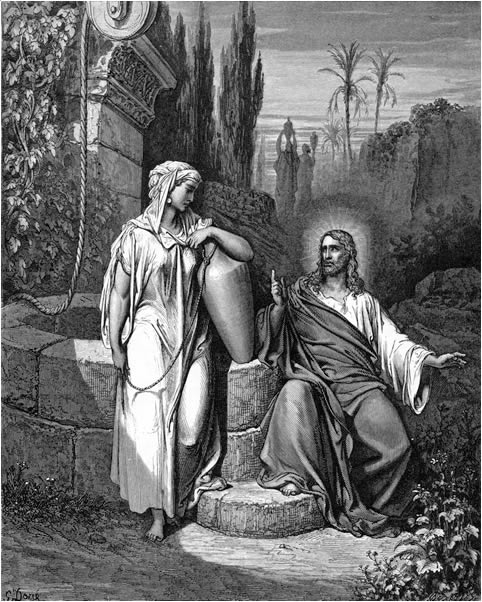
A stranger who knows her history is a prophet in her eyes, and she puts the old dispute to Him. This mountain is Gerizim, where the Samaritans held Moses had appointed the altar, against Jerusalem, where the temple stood. She asks a prophet to settle it.
This site's exposition
worshiped on this mountain
Adam Clarke ties the claim to Jacob's altar at Genesis 33:20 and to the temple Sanballat built on the mountain about 332 years before Christ. Gerizim stood close enough to point at, says John Gill.
The record, by era
The Church Fathers5 voices
(Tr. xv. c. 23) And she begins enquiries on a subject that perplexed her; Our fathers worshipped in this mountain; and ye say that in Jerusalem is the place where men ought to worship. This was a great dispute between the Samaritans and the Jews. The Jews worshipped in the temple built by Solomon, and made this a ground of boasting over the Samaritans. The Samaritans replied, Why boast ye, because ye have a temple which we have not? Did our fathers, who pleased God, worship in that temple? Is it not better to pray to God in this mountain, where our fathers worshipped?
She begins to ask about a matter that is wont to disquiet her. For there was a contention between the Samaritans and the Jews, because the Jews worshipped God in the temple built by Solomon; but the Samaritans, being situated at a distance from it, did not worship there. For this reason the Jews, because they worshipped God in the temple, boasted themselves to be better than the Samaritans. "For the Jews have no dealings with the Samaritans:" because the latter said to them, How is it you boast and account yourselves to be better than we, just because you have a temple which we have not? Did our fathers, who were pleasing to God, worship in that temple? Was it not in this mountain where we are they worshipped? We then do better, say they, who pray to God in this mountain, where our fathers prayed. Both peoples contended in ignorance, because they had not the husband: they were inflated against each other, on the one side in behalf of the temple, on the other in behalf of the mountain.
A commentator
Origen of AlexandriaCOMMENTARY ON THE GOSPEL OF JOHN 13.77-79 · Written before 253.
proposed
On the statement "our fathers" and what follows one must understand the disagreement between the Samaritans and the Jews over the place they considered holy. For the Samaritans worship God on the mountain called Gerizim, because they consider it to be holy. Moses refers to this mountain in Deuteronomy when he says, "And Moses commanded the people in that day saying, 'These shall stand on Mount Gerizim to bless the people, when you have crossed the Jordan.' " … The Jews, on the other hand, because they think Zion is divine and God's dwelling place, think it has been chosen by the Father of all. For this reason they say Solomon built the temple on Zion, and all the levitical and priestly service is performed there. As a consequence of these assumptions, each nation has considered its fathers to have worshiped God, but one on this mountain and one on the other.
Then when she suspected this, she asks Him nothing concerning this life, not concerning bodily health, or possessions, or wealth, but at once concerning doctrines. For what saith she? "Our fathers worshiped in this mountain," (meaning Abraham and his family, for thither they say that he led up his son,) "and how say ye that in Jerusalem is the place where men ought to worship?" Seest thou how much more elevated in mind she has become? She who was anxious that she might not be troubled for thirst, now questions concerning doctrines. What then doth Christ? He doth not resolve the question, (for to answer simply to men's words was not His care, for it was needless,) but leads the woman on to the greater height, and doth not converse with her on these matters, until she has confessed that He was a Prophet, so that afterwards she might hear His Word with abundant belief; for having been persuaded of this, she could no longer doubt concerning what should be said to her.
"Our fathers worshiped in this mountain," (meaning Abraham and his family, for thither they say that he led up his son,) "and how say ye that in Jerusalem is the place where men ought to worship?" Seest thou how much more elevated in mind she has become? She who was anxious that she might not be troubled for thirst, now questions concerning doctrines. What then doth Christ? He doth not resolve the question, (for to answer simply to men's words was not His care, for it was needless,) but leads the woman on to the greater height, and doth not converse with her on these matters, until she has confessed that He was a Prophet, so that afterwards she might hear His Word with abundant belief; for having been persuaded of this, she could no longer doubt concerning what should be said to her.
12 more voices on this verse
The Church Fathers2 voices
Let us now after this be ashamed, and blush. A woman who had had five husbands, and who was of Samaria, was so eager concerning doctrines, that neither the time of day, nor her having come for another purpose, nor anything else, led her away from enquiring on such matters; but we not only do not enquire concerning doctrines, but towards them all our dispositions are careless and indifferent.
(tom. xiii. c. 13) Or thus; The Samaritans regarded Mount Gerizim, near which Jacob dwelt, as sacred, and worshipped upon it; while the sacred place of the Jews was Mount Sion, God's own choice. The Jews being the people from whom salvation came, are the type of true believers; the Samaritans of heretics. Gerizim, which signifies division, becomes the Samaritans; Sion, which signifies watch-tower, becomes the Jews.
The Medieval Church3 voices
Then she asks her question about prayer, saying: Our ancestors worshiped on this mountain, but you people claim that Jerusalem is the place where men must worship God. Here we should admire the woman's diligence and attention: for women are considered curious and unproductive, and …
She says this about Abraham and his successors. "For here," they say, "Isaac was offered by him as a sacrifice." "How is it then," she says, "that you say one must worship in Jerusalem?" Do you see how she rose higher? Shortly before this she …
"Our fathers worshipped on this mountain," namely Abraham and Jacob — "and you say that Jerusalem is the place where one ought to worship." If, therefore, the fathers are to be imitated, how then do you say this, as though despising the custom of the …
The Puritans and the Awakening2 voices
Our fathers worshipped in this mountain,.... Mount Gerizim, which was just by, and within sight; so that the woman could point to it; it was so near to Shechem, or Sychar, that Jotham's voice was heard from the top of it thither, Jdg 9:
It was agreed between the Jews and the Samaritans that God is to be worshipped (even those who were such fools as to worship false gods were not such brutes as to worship none), and that religious worship is an affair of great importance: men would not contend about it if they were not concerned about it.
The Nineteenth Century4 voices
Worshipped in this mountain - Probably pointing to Mount Gerizim, at the foot of which Sychar was situated. The patriarchs had worshipped here-Jacob builded an altar on this mountain, and worshiped the true God: see Gen 22:2; Gen 33:20. Thus she could say, Our fathers worshipped in this mountain. On this mountain Sanballat had built them a temple, about 332 years before our Lord’s incarnation. See Joseph. Antiq. xi. c. viii. s. 4, and 2 Maccabees 6:2. Many heathens considered particular places as having a peculiar sanctity or fitness, for the worship of their deities, beyond others.
A commentator
J.C. Ryle1816–1900
Expository Thoughts on the Gospels: John (lightly modernized text, Grace Gems edition) (1869)
proposed
Conversation With a Samaritan Woman But he had to pass through Samaria. Now he came to a Samaritan town called Sychar, near the plot of land that Jacob had given to his son Joseph. Jacob’s well was there, so Jesus, since he was tired from the journey, sat right down beside the well. It was about noon. A Samaritan woman came to draw water. Jesus said to her, "Give me some water to drink." (For his disciples had gone off into the town to buy supplies.)
A commentator
J.C. Ryle1816–1900
Expository Thoughts on the Gospels: John (lightly modernized text, Grace Gems edition) (1869)
proposed
Conversation With a Samaritan Woman But he had to pass through Samaria. Now he came to a Samaritan town called Sychar, near the plot of land that Jacob had given to his son Joseph. Jacob’s well was there, so Jesus, since he was tired from the journey, sat right down beside the well. It was about noon. A Samaritan woman came to draw water. Jesus said to her, "Give me some water to drink." (For his disciples had gone off into the town to buy supplies.) So the Samaritan woman said to him, "How can you—a Jew—ask me, a Samaritan woman, for water to drink?" (For Jews use nothing in common with Samaritans.) Jesus answered her, "If you had known the gift of God and who it is who said to you, ‘Give me some water to drink,’ you would have asked him, and he would have given you living water." "Sir," the woman said to him, "you have no bucket and the well is deep; where then do you get this living water? Surely you’re not greater than our ancestor Jacob, are you? For he gave us this well and drank from it himself, along with his sons and his livestock." Jesus replied, "Everyone who drinks some of this water will be thirsty again. But whoever drinks some of the water that I will give him will never be thirsty again, but the water that I will give him will become in him a fountain of water springing up to eternal life." The woman said to him, "Sir, give me this water, so that I will not be thirsty or have to come here to draw water." He said to her, "Go call your husband and come back here." The woman replied, "I have no husband." Jesus said to her, "Right you are when you said, ‘I have no husband,’ for you have had five husbands and the man you are living with now is not your husband. This you said truthfully!" The woman said to him, "Sir, I see that you are a prophet.
A commentator
Albert Barnes1798–1870
Notes, Explanatory and Practical, on the Old and New Testaments (1832-1869)
proposed
Our fathers - The Samaritans; perhaps also meaning to intimate that the patriarchs had done it also. See Gen 12:6; Gen 33:20. Worshipped - Had a place of worship. In this mountain - Mount Gerizim, only a little way from Sychar. On this mountain they had built a temple somewhat similar to the one in Jerusalem. This was one of the main subjects of controversy between them and the Jews. The old Samaritan Pentateuch, or five books of Moses, has the word “Gerizim” instead of “Ebal” in Deu 27:4. On this account, as well as because the patriarchs are mentioned as having worshipped in Shechem, they supposed that that was the proper place on which to erect the temple. Ye say - Ye Jews. In Jerusalem - The place where the temple was built. This was built in accordance with the promise and command of God, Deu 12:5, Deu 12:11. In building this, David and Solomon were under the divine direction, 2Sa 7:2-3, 2Sa 7:13; 1Ki 5:5, 1Ki 5:12; 1Ki 8:15-22. As it was contemplated in the law of Moses that there should be but one place to offer sacrifice and to hold the great feasts, so it followed that the Samaritans were in error in supposing that their temple was the place. Accordingly, our Saviour decided in favor of the Jews, yet in such a manner as to show the woman that the question was of much less consequence than they supposed it to be.
Modern Voices1 voice
In John 4, Jesus' encounter with the Samaritan woman is itself a Purim-style reversal the rejected becomes chosen, the overlooked becomes entrusted, and the outsider becomes the first to hear a clear declaration of Messiah.
The words behind it
20 Greek wordsEvery Greek word of this verse in the order it stands, with what it means and the door to its own study. The last column counts the times a word stands in the whole Bible: the rarer the word, the more the places it appears belong together.
| Greek | Sound | Meaning | Word study | In the Bible |
|---|---|---|---|---|
| οἱ | hoi | The | G3588 → | 19766 times |
| πατέρες | pateres | fathers | G3962 → | 410 times |
| ἡμῶν | hemon | of us | G3165 → | 1936 times |
| ἐν | en | on | G1722 → | 2738 times |
| τῷ | to | <the> | G3588 → | 19766 times |
| ὄρει | orei | mountain | G3735 → | 62 times |
| τούτῳ | touto | this | G3778 → | 1381 times |
| προσεκύνησαν, | prosekunesan | worshiped, | G4352 → | 60 times |
| καὶ | kai | and | G2532 → | 9120 times |
| ὑμεῖς | humeis | you yourselves | G4771 → | 2973 times |
| λέγετε | legete | say | G3004 → | 1325 times |
| ὅτι | hoti | that | G3754 → | 1292 times |
| ἐν | en | in | G1722 → | 2738 times |
| Ἱεροσολύμοις | hi'erosolumois | Jerusalem | G2414 → | 62 times |
| ἐστὶν | estin | is | G1510 → | 2333 times |
| ὁ | ho | the | G3588 → | 19766 times |
| τόπος | topos | place | G5117 → | 94 times |
| ὅπου | hopou | where | G3699 → | 82 times |
| προσκυνεῖν | proskunein | to worship | G4352 → | 60 times |
| δεῖ.¶ | dei | it is necessary. | G1163 → | 101 times |
οἱThe
hoiG3588 →19766 times
πατέρεςfathers
pateresG3962 →410 times
ἡμῶνof us
hemonG3165 →1936 times
ἐνon
enG1722 →2738 times
τῷ<the>
toG3588 →19766 times
ὄρειmountain
oreiG3735 →62 times
τούτῳthis
toutoG3778 →1381 times
προσεκύνησαν,worshiped,
prosekunesanG4352 →60 times
καὶand
kaiG2532 →9120 times
ὑμεῖςyou yourselves
humeisG4771 →2973 times
λέγετεsay
legeteG3004 →1325 times
ὅτιthat
hotiG3754 →1292 times
ἐνin
enG1722 →2738 times
ἹεροσολύμοιςJerusalem
hi'erosolumoisG2414 →62 times
ἐστὶνis
estinG1510 →2333 times
ὁthe
hoG3588 →19766 times
τόποςplace
toposG5117 →94 times
ὅπουwhere
hopouG3699 →82 times
προσκυνεῖνto worship
proskuneinG4352 →60 times
δεῖ.¶it is necessary.
deiG1163 →101 times
A shaded row is a word that stands 400 times or fewer in the Bible.
The walk
7 stopsEach card is a verse this one points to, and under it the verses that one points to in turn. Where several paths arrive at the same place, that place is listed first: the text keeps returning to it.
Through
Deuteronomy 11:29When the LORD your God brings you into the land you are entering to possess, you are to proclaim the blessing on Mount Gerizim and the curse on Mount Ebal.
it leads to
- Joshua 8:30–35
At that time Joshua built an altar on Mount Ebal to the LORD, the God of Israel,
- Deuteronomy 27:12–26
“When you have crossed the Jordan, these tribes shall stand on Mount Gerizim to bless the people: Simeon, Levi, Judah, Issachar, Joseph, and Benjamin.
- Joshua 8:30–35
Through
Deuteronomy 27:12“When you have crossed the Jordan, these tribes shall stand on Mount Gerizim to bless the people: Simeon, Levi, Judah, Issachar, Joseph, and Benjamin.
it leads to
- Judges 9:7
When this was reported to Jotham, he climbed to the top of Mount Gerizim, raised his voice, and cried out: “Listen to me, O leaders of Shechem, and may God listen to you.
- Joshua 8:33–35
All Israel, foreigners and citizens alike, with their elders, officers, and judges, stood on both sides of the ark of the covenant of the LORD facing the Levitical priests who carried it. Half of…
- Genesis 30:24
She named him Joseph, and said, “May the LORD add to me another son.”
- Genesis 35:18
And with her last breath—for she was dying—she named him Ben-oni. But his father called him Benjamin.
- Genesis 30:18
Then Leah said, “God has rewarded me for giving my maidservant to my husband.” So she named him Issachar.
- Judges 9:7
Where this verse is studied
On this page
Studies16
On this verse
About John
Who and where
1 name in this verse with a page on the site.
This page draws on 17 works. Open the list of works
This page draws on Adam Clarke, Commentary on the Bible; Albert Barnes, Notes, Explanatory and Practical, on the Old and New Testaments (1832-1869); Augustine of Hippo, Catena Aurea by Aquinas; Augustine of Hippo, Tractates on John 15; Bonaventure, Commentary on John, Chapter 4; Cyril of Alexandria, Commentary on the Gospel of John, Book 2; J.C. Ryle, Expository Thoughts on the Gospels: John (lightly modernized text, Grace Gems edition); Jamieson, Fausset & Brown, Commentary Critical and Explanatory on the Whole Bible; Jane Hamon, PURIM – A TIME FOR REVERSALS!!; John Chrysostom, Homily on the Gospel of John 32; John Gill, Exposition of the New Testament (1746-1748); John Lightfoot, Horae Hebraicae et Talmudicae on John; Matthew Henry, Commentary on the Whole Bible; Origen of Alexandria, COMMENTARY ON THE GOSPEL OF JOHN 13.77-79; Origen of Alexandria, Catena Aurea by Aquinas; Theophylact of Ohrid, Commentary on John and Thomas Aquinas, Commentary on John.