
John 4:30
in John 4So they left the town and made their way toward Jesus.
BSB
The same verse in ASV and KJV ▾
ASV
They went out of the city, and were coming to him.
KJV
Then they went out of the city, and came unto him.
⋯
This verse in John 4
Commentary
13 notes on this verseThey went out of the city - Such effect had the simple testimony of the woman on their minds. And came unto him - Or, Were coming to him; for they did not reach him immediately; all that discourse between him and his disciples, mentioned Joh 4:31-39, inclusive, having taken place before the people of Sychar got to the well. See Joh 4:40.
This site's exposition
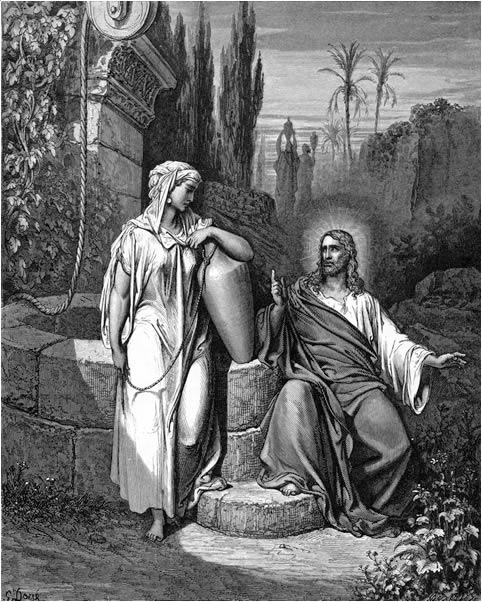
left her water jar
on John 4:28-30
She leaves the jar she came for and walks back into the town with her report. Her testimony is one fact about her own life and a question she puts to the town, whether this man is the Christ. The town goes out to see.
The record, by era
The Church Fathers2 voices
"The woman then left her water-pot." Having heard, "I that speak with thee am He," and having received Christ the Lord into her heart, what could she do but now leave her water-pot, and run to preach the gospel? She cast out lust, and hastened to proclaim the truth. Let them who would preach the gospel learn; let them throw away their water-pot at the well. You remember what I said before of the water-pot: it was a vessel with which the water was drawn, called hydria, from its Greek name, because water is hydor in Greek; just as if it were called aquarium, from the Latin. She threw away her water-pot then, which was no longer of use, but a burden to her, such was her avidity to be satisfied with that water. Throwing her burden away, to make known Christ, "she ran to the city, and says to those men. Come, and see a man that told me all things that ever I did." Step by step, lest those men should get angry and indignant, and should persecute her. "Is this Christ? Then they went out of the city, and came to Him."
A commentator
Cyril of AlexandriaCommentary on the Gospel of John, Book 2 · Written before 444.
proposed
They went out of the city, and came unto Him. The obedience of the Samaritans is a conviction of the hardness of heart of the Jews, and their inhumanity is clearly shown in the gentleness of these. And let the seeker of learning see again the difference of habit in both, that he may justly wonder at Jesus, departing from the Synagogue of the Jews, and giving Himself rather to the aliens.
The Medieval Church2 voices
"They went out of the city and were coming to him." Rightly they went out, because Christ was before the gate as one unknown, and suffered outside the gate: whence in the last chapter of Hebrews: "Christ suffered outside the gate: let us therefore go …
The fruit of her preaching is given when he says, At that they set out from the town, to where she had returned, to meet him, Christ. We see by this that if we desire to come to Christ, we must set out from the …
The Puritans and the Awakening1 voice
Then they went out of the city,....
6 more voices on this verse
The Nineteenth Century6 voices
Behold our Lord and Master with divinely skillful art seeking after a single soul! We must have large Congregations or we are disinclined for soul-winning. The habit of the age is to do nothing but what is ostentatious—every work must be with beat of drum or sound of tambourine! I pray that the Lord may work in us the steadfast desire to do good on the quiet, by stealth, when no one looks on, when not a single disciple is near.
A commentator
Jamieson, Fausset & Brown1802–1910
Commentary Critical and Explanatory on the Whole Bible (1871)
proposed
left her water-pot--How exquisitely natural! The presence of strangers made her feel that it was time for her to withdraw, and He who knew what was in her heart, and what she was going to the city to do, let her go without exchanging a word with her in the hearing of others.
quarantine:debris (2026-07-29) — starts-lowercase
A commentator
J.C. Ryle1816–1900
Expository Thoughts on the Gospels: John (lightly modernized text, Grace Gems edition) (1869)
proposed
These verses continue the well-known story of the Samaritan woman's conversion. Short as the passage may appear, it contains points of deep interest and importance. The mere worldling, who cares, nothing about experimental religion, may see nothing particular in these verses. To all who desire to know something of the experience of a converted person, they will be found full of food for thought. We see, firstly, in this passage, how marvelous in the eyes of man are Christ's dealings with souls. We are told that the disciples "marveled that he talked with the woman."
A commentator
J.C. Ryle1816–1900
Expository Thoughts on the Gospels: John (lightly modernized text, Grace Gems edition) (1869)
proposed
These verses continue the well-known story of the Samaritan woman's conversion. Short as the passage may appear, it contains points of deep interest and importance. The mere worldling, who cares, nothing about experimental religion, may see nothing particular in these verses. To all who desire to know something of the experience of a converted person, they will be found full of food for thought. We see, firstly, in this passage, how marvelous in the eyes of man are Christ's dealings with souls. We are told that the disciples "marveled that he talked with the woman." That their Master should take the trouble to talk to a woman at all, and to a Samaritan woman, and to an adulterous woman at a well, when He was wearied with His journey—all this was amazing to the eleven disciples. It was a sort of thing which they did not expect. It was contrary to their idea of what a religious teacher should do. It startled them and filled them with surprise. The feeling displayed by the disciples on this occasion, does not stand alone in the Bible. When our Lord allowed publicans and sinners to draw near to Him and be in His company, the Pharisees marveled. They exclaimed, "This man receives sinners and eats with them." (Luke 15:2.). When Saul came back from Damascus, a converted man and a new creature, the Christians at Jerusalem were astonished. "They did not believe that he was a disciple." (Acts 9:26.). When Peter was delivered from Herod's prison by an angel, and brought to the door of the house where disciples were praying for his deliverance, they were so taken by surprise that they could not believe it was Peter. "When they saw him they were astonished." (Acts 12:16.) But why should we stop short in Bible instances? The true Christian has only to look around him in this world in order to see abundant illustrations of the truth before us.
Behold our Lord and Master with divinely skillful art seeking after a single soul! We must have large Congregations or we are disinclined for soul-winning. The habit of the age is to do nothing but what is ostentatious—every work must be with beat of drum or sound of tambourine! I pray that the Lord may work in us the steadfast desire to do good on the quiet, by stealth, when no one looks on, when not a single disciple is near. Oh that we may have such an estimate of the value of a single soul that we count whole days well spent to bring one fallen woman or one drunk to the Savior's feet! Blessed is he who works on though he is never heard of and looks for his reward from his Master. In the heat of the day the Lord Jesus found rest and refreshment in speaking to one whom many would scarcely look upon except with eyes of scorn. Blessed Savior, we do not marvel, as the disciples did, that You did speak with the woman, but we do wonder with a higher kind of astonishment that You ever did speak to the likes of us who have so sadly fallen, done You dishonor and grieved Your heart! We are amazed that He who is the Glory of Heaven, "Light of light, very God of very God," should shroud Himself in the likeness of sinful flesh and, being found in fashion as a Man, should seek after us unworthy ones. Oh, the compassion of the Redeemer's heart! Read this chapter through carefully and see the skill which that compassion taught Him. How sweetly ready He was to converse with her and take up her questions. Never imagine that the 30 years of retirement at Nazareth were wasted. I would gladly go, if I were young, for 30 years to learn how to talk as He did, if His own Spirit would teach me the lesson. He was a perfect Teacher because as Man, He had lent a willing ear to the heavenly instruction of the Holy Spirit and, therefore, grew in knowledge and fitness for His work.
A commentator
Albert Barnes1798–1870
Notes, Explanatory and Practical, on the Old and New Testaments (1832-1869)
proposed
They went out of the city - The men of the city left it and went to Jesus, to hear and examine for themselves.
The words behind it
8 Greek wordsEvery Greek word of this verse in the order it stands, with what it means and the door to its own study. The last column counts the times a word stands in the whole Bible: the rarer the word, the more the places it appears belong together.
| Greek | Sound | Meaning | Word study | In the Bible |
|---|---|---|---|---|
| ἐξῆλθον | exelthon | They went forth | G1831 → | 216 times |
| ἐκ | ek | out of | G1537 → | 911 times |
| τῆς | tes | the | G3588 → | 19766 times |
| πόλεως | poleos | city | G4172 → | 163 times |
| καὶ | kai | and | G2532 → | 9120 times |
| ἤρχοντο | erchonto | were coming | G2064 → | 628 times |
| πρὸς | pros | unto | G4314 → | 700 times |
| αὐτόν.¶ | auton | Him. | G846 → | 5565 times |
ἐξῆλθονThey went forth
exelthonG1831 →216 times
ἐκout of
ekG1537 →911 times
τῆςthe
tesG3588 →19766 times
πόλεωςcity
poleosG4172 →163 times
καὶand
kaiG2532 →9120 times
ἤρχοντοwere coming
erchontoG2064 →628 times
πρὸςunto
prosG4314 →700 times
αὐτόν.¶Him.
autonG846 →5565 times
A shaded row is a word that stands 400 times or fewer in the Bible.
The walk
8 stopsEach card is a verse this one points to, and under it the verses that one points to in turn. Where several paths arrive at the same place, that place is listed first: the text keeps returning to it.
Through
Matthew 20:16So the last will be first, and the first will be last.”
it leads to
- Matthew 19:30
But many who are first will be last, and the last will be first.
- Mark 10:31
But many who are first will be last, and the last will be first.”
- Matthew 22:14
For many are called, but few are chosen.”
- Luke 13:28–30
There will be weeping and gnashing of teeth when you see Abraham, Isaac, Jacob, and all the prophets in the kingdom of God, but you yourselves are thrown out.
- Matthew 19:30
Through
Romans 5:20The law came in so that the trespass would increase; but where sin increased, grace increased all the more,
it leads to
- Romans 6:1
What then shall we say? Shall we continue in sin so that grace may increase?
- Titus 3:3–7
For at one time we too were foolish, disobedient, misled, and enslaved to all sorts of desires and pleasures—living in malice and envy, being hated and hating one another.
- Romans 6:14
For sin shall not be your master, because you are not under law, but under grace.
- Psalms 25:11
For the sake of Your name, O LORD, forgive my iniquity, for it is great.
- Romans 6:1
Where this verse is studied
About John
This page draws on 12 works. Open the list of works
This page draws on Adam Clarke, Commentary on the Bible; Albert Barnes, Notes, Explanatory and Practical, on the Old and New Testaments (1832-1869); Augustine of Hippo, Tractates on John 15; Bonaventure, Commentary on John, Chapter 4; Charles Spurgeon, The Metropolitan Tabernacle Pulpit, Sermon No. 1678: “The Samaritan Woman and Her Mission” (lightly modernized text, CCEL edition); Cyril of Alexandria, Commentary on the Gospel of John, Book 2; J. C. Ryle, Expository Thoughts on the Gospels, John; J.C. Ryle, Expository Thoughts on the Gospels: John (lightly modernized text, Grace Gems edition); Jamieson, Fausset & Brown, Commentary Critical and Explanatory on the Whole Bible; John Gill, Exposition of the New Testament (1746-1748); Matthew Henry, Commentary on the Whole Bible and Thomas Aquinas, Commentary on John.