
John 4:13
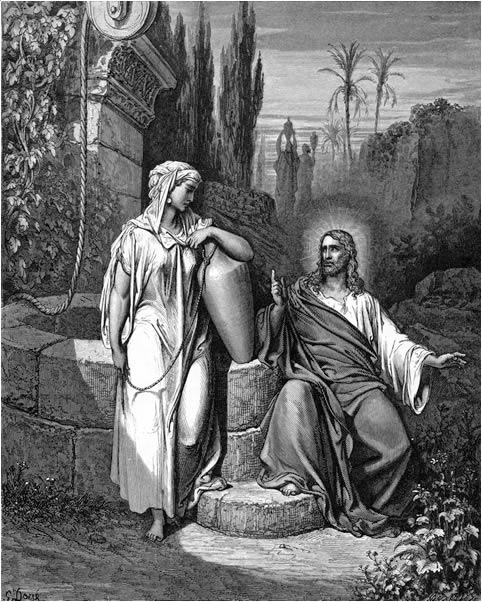
in John 4Jesus said to her, “Everyone who drinks this water will be thirsty again.
BSB
The same verse in ASV and KJV ▾
ASV
Jesus answered and said unto her, Every one that drinketh of this water shall thirst again:
KJV
Jesus answered and said unto her, Whosoever drinketh of this water shall thirst again:
⋯
This verse in John 4
Commentary
20 notes on this verseJesus answered and said unto her,.... In a mild and gentle manner, patiently bearing all her scoffs and flouts, and continuing to instruct and inform her, concerning this living water, showing the preferableness of it to all others: whosoever drinketh of this water; meaning in that well called Jacob's well, or any other common water: shall thirst again; as this woman had often done, and would again, as she herself knew, Joh 4:15, and as Jesus did, who very likely afterwards drank of it, Joh 19:
This site's exposition
Everyone who drinks this water
on John 4:13-14
Water from this well answers thirst for a day, and the walk back begins again. Jesus promises water that ends thirst for good, becoming a fount in the one who drinks and springing up to eternal life. The supply sits inside the believer.
The record, by era
The Church Fathers5 voices
(Tr. xv. c. 16) Which is true indeed both of material water, and of that of which it is the type. For the water in the well is the pleasure of the world, that abode of darkness. Men draw it with the waterpot of their lusts; pleasure is not relished, except it be preceded by lust. And when a man has enjoyed this pleasure, i. e. drunk of the water, he thirsts again; but if he have received water from Me, he shall never thirst. For how shall they thirst, who are drunken with the abundance of the house of God? (Ps. 36:8.) But He promised this fulness of the Holy Spirit.
The Lord speaks somewhat more clearly of that living water. Now the woman had said, "Art thou greater than our father Jacob, who gave us the well, and drank of it himself, his children, and his cattle?" Thou canst not give me of the living water of this well, because thou hast nothing to draw with: perhaps thou promisest another fountain? Canst thou be better than our father, who dug this well, and used it himself, and his? Let the Lord, then, declare what He called living water. "Jesus answered and said unto her, Every one that drinketh of this water shall thirst again: but he that drinketh of the water that I shall give him, shall not thirst forever; but the water which I shall give him will become in him a fountain of water, springing up into everlasting life." The Lord has spoken more openly: "It shall become in him a fountain of water, springing up into everlasting life. He that drinketh of this water shall not thirst forever." What more evident than that it was not visible, but invisible water, that He was promising? What more evident than that He was speaking, not in a carnal, but in a spiritual sense?
Nevertheless, let us not overlook the fact that it is something spiritual that the Lord was promising. What means, "Whoso shall drink of this water shall thirst again?" It is true as to this water; it is true as to what the water signified. Since the water in the well is the pleasure of the world in its dark depth: from this men draw it with the vessel of lusts. Stooping forward, they let down the lust to reach the pleasure fetched from the depth of the well, and enjoy the pleasure and the preceding lust let down to fetch it. For he who has not despatched his lust in advance cannot get to the pleasure. Consider lust, then, as the vessel; and pleasure as the water from the depth of the well: when one has got at the pleasure of this world, it is meat to him, it is drink, it is a bath, a show, an amour; can it be that he will not thirst again? Therefore, "Whoso shall drink of this water," saith He, "will thirst again;" but if he shall receive water of me, "he shall never thirst." "We shall be satisfied," it saith, "with the good things of Thy house." Of what water, then, is He to give, but of that of which it is said, "With Thee is the fountain of life"? For how shall they thirst, who "shall be drunk with the fatness of Thy house"?
There is a great difference, he says, between that water [in the well] and the water I promise to give. That [water], after they have drunk it, extinguishes their thirst for a short time. But then, when it has been consumed according to its nature, …
A commentator
Origen of AlexandriaCOMMENTARY ON THE GOSPEL OFJOHN 13.13, 15-16 · Written before 253.
proposed
One must investigate what is meant by "will thirst" in the statement "Everyone who drinks of this water will thirst again." … What is meant in the first place would be something like this: he who partakes of supposedly profound thoughts, even if he is satisfied for a little while and accepts the ideas that are drawn out and that he thinks he has discovered to be most profound, will, however, when he has reconsidered them, raise new questions.… But [the Word] says, I have the teaching that becomes a fountain of living water in the one who has received what I have declared. And he who has received of my water will receive so great a benefit that a fountain capable of discovering everything that is investigated will gush forth within him. The waters will leap upward. His understanding also will spring up and fly as swiftly as possible in accordance with this briskly flowing water, the springing and leaping itself carrying him to that higher life that is eternal.
13 more voices on this verse
The Church Fathers4 voices
But, my opponents ask, if Christ came as the Saviour of men, as you say, why does He not, with uniform benevolence, free all without exception? I reply, does not He free all alike who invites all alike? or does He thrust back or repel …
Scripture calls the grace of the Spirit sometimes "Fire," sometimes "Water," showing that these names are not descriptive of its essence, but of its operation; for the Spirit, being Invisible and Simple, cannot be made up of different substances. Now the one John declares, speaking thus, "He shall baptize you with the Holy Ghost, and with Fire" (Matt. iii. 11): the other, Christ, "Out of his belly shall flow rivers of living water." (John vii. 38.) "But this," saith John, "spake He of the Spirit, which they should receive." So also conversing with the woman, He calleth the Spirit water; for, "Whosoever shall drink of the water which I shall give him, shall never thirst." So also He calleth the Spirit by the name of "fire," alluding to the rousing and warming property of grace, and its power of destroying transgressions; but by that of "water," to declare the cleansing wrought by it, and the great refreshment which it affordeth to those minds which receive it. And with good reason; for it makes the willing soul like some garden thick with all manner of trees fruitful and ever-flourishing, allowing it neither to feel despondency nor the plots of Satan, and quenches all the fiery darts of the wicked one.
Wherefore also He, having heard, "Art thou greater than our father Jacob," leaveth Jacob, and speaketh concerning the water, saying, "Whosoever shall drink of this water, shall thirst again"; and He maketh His comparison, not by depreciating one, but by showing the excellence of the other; for He saith not, that "this water is naught," nor "that it is inferior and contemptible," but what even nature testifies that He saith: "Whosoever shall drink of this water shall thirst again; but whosoever shall drink of the Water which I shall give him, shall never thirst." The woman before this had heard of "living Water" (v. 10), but had not known its meaning. Since because that water is called "living" which is perennial and bubbles up unceasingly from uninterrupted springs, she thought that this was the water meant. Wherefore He points out this more clearly by speaking thus, and establishing by a comparison the superiority (of the water which He would give). What then saith He? "Whosoever shall drink of the Water that I shall give him, shall never thirst." This and what was said next especially showed the superiority, for material water possesses none of these qualities. And what is it that follows? "It shall be in him a well of water springing up into everlasting life." For as one that hath a well within him could never be seized by thirst, so neither can he that hath this Water.
But as often as water is named alone in the Holy Scriptures, baptism is referred to, as we see intimated in Isaiah: "Remember not," says he, "the former things, and consider not the things of old. Behold, I will do a new thing, which shall now spring forth; and ye shall know it. I will even make a way in the wilderness, and rivers in the dry place, to give drink to my elected people, my people whom I have purchased, that they might show forth my praise."
The Medieval Church3 voices
"Jesus answered and said to her: Everyone who drinks of this water," namely visible and material, "shall thirst again:" and therefore it is no great thing to give this, nor do I promise this. "But whoever drinks of the water that I shall give him …
Then when he says, Jesus replied and said, he sets down the Lord's response, in which he explains the power of his doctrine. First, with respect to the fact that he had called it water. Secondly, with respect to the fact that he called it …
A commentator
BonaventureCollations on the Hexaemeron, Collation 17 · Written in the 13th century.
proposed
Scripture enlightens from nearby by means of the gifts of graces which supplement what is lacking in human activity. For many scientists came as guests: they came to our house and to our activity. But in these matters, activity must reach a limit. Wherefore Scripture …
The Puritans and the Awakening2 voices
This woman's meeting with Christ at the well may remind us of the stories of Rebekah, Rachel, and Jethro's daughter, who all met with husbands, good husbands, no worse than Isaac, Jacob, and Moses, when they came to the wells for water. Thirdly, How the preventing grace of God sometimes brings people unexpectedly under the means of conversion and salvation.
It is no better than other water; it will quench the present thirst, but the thirst will return, and in a few hours a man will have as much need, and as much desire, of water as ever he had." This intimates, 1. The infirmities of our bodies in this present state; they are still necessitous, and ever craving.
quarantine:debris (2026-07-29) — odd-straight-quotes
The Nineteenth Century3 voices
A commentator
Albert Barnes1798–1870
Notes, Explanatory and Practical, on the Old and New Testaments (1832-1869)
Shall thirst again - Jesus did not directly answer her question, or say that he was greater than Jacob, but he gave her an answer by which she might infer that he was. He did not despise or undervalue Jacob or his gifts; but, however great might be the value of that well, the water could not altogether remove thirst.
A commentator
J.C. Ryle1816–1900
Expository Thoughts on the Gospels: John (lightly modernized text, Grace Gems edition) (1869)
proposed
Conversation With a Samaritan Woman But he had to pass through Samaria. Now he came to a Samaritan town called Sychar, near the plot of land that Jacob had given to his son Joseph. Jacob’s well was there, so Jesus, since he was tired from the journey, sat right down beside the well. It was about noon. A Samaritan woman came to draw water. Jesus said to her, "Give me some water to drink." (For his disciples had gone off into the town to buy supplies.)
A commentator
J.C. Ryle1816–1900
Expository Thoughts on the Gospels: John (lightly modernized text, Grace Gems edition) (1869)
proposed
Conversation With a Samaritan Woman But he had to pass through Samaria. Now he came to a Samaritan town called Sychar, near the plot of land that Jacob had given to his son Joseph. Jacob’s well was there, so Jesus, since he was tired from the journey, sat right down beside the well. It was about noon. A Samaritan woman came to draw water. Jesus said to her, "Give me some water to drink." (For his disciples had gone off into the town to buy supplies.) So the Samaritan woman said to him, "How can you—a Jew—ask me, a Samaritan woman, for water to drink?" (For Jews use nothing in common with Samaritans.) Jesus answered her, "If you had known the gift of God and who it is who said to you, ‘Give me some water to drink,’ you would have asked him, and he would have given you living water." "Sir," the woman said to him, "you have no bucket and the well is deep; where then do you get this living water? Surely you’re not greater than our ancestor Jacob, are you? For he gave us this well and drank from it himself, along with his sons and his livestock." Jesus replied, "Everyone who drinks some of this water will be thirsty again. But whoever drinks some of the water that I will give him will never be thirsty again, but the water that I will give him will become in him a fountain of water springing up to eternal life." The woman said to him, "Sir, give me this water, so that I will not be thirsty or have to come here to draw water." He said to her, "Go call your husband and come back here." The woman replied, "I have no husband." Jesus said to her, "Right you are when you said, ‘I have no husband,’ for you have had five husbands and the man you are living with now is not your husband. This you said truthfully!" The woman said to him, "Sir, I see that you are a prophet.
Modern Voices1 voice
In John 4, Jesus' encounter with the Samaritan woman is itself a Purim-style reversal the rejected becomes chosen, the overlooked becomes entrusted, and the outsider becomes the first to hear a clear declaration of Messiah.
The words behind it
14 Greek wordsEvery Greek word of this verse in the order it stands, with what it means and the door to its own study. The last column counts the times a word stands in the whole Bible: the rarer the word, the more the places it appears belong together.
| Greek | Sound | Meaning | Word study | In the Bible |
|---|---|---|---|---|
| Ἀπεκρίθη | apekrithe | Answered | G611 → | 231 times |
| Ἰησοῦς | iesous | Jesus | G2424 → | 908 times |
| καὶ | kai | and | G2532 → | 9120 times |
| εἶπεν | eipen | said | G2036 → | 925 times |
| αὐτῇ· | autea | to her; | G846 → | 5565 times |
| πᾶς | pas | Everyone | G3956 → | 1235 times |
| ὁ | ho | who | G3588 → | 19766 times |
| πίνων | pinon | is drinking | G4095 → | 72 times |
| ἐκ | ek | of | G1537 → | 911 times |
| τοῦ | tou | <the> | G3588 → | 19766 times |
| ὕδατος | hudatos | water | G5204 → | 76 times |
| τούτου | toutou | this | G3778 → | 1381 times |
| διψήσει | dipsesei | will thirst | G1372 → | 16 times |
| πάλιν. | palin | again. | G3825 → | 139 times |
ἈπεκρίθηAnswered
apekritheG611 →231 times
ἸησοῦςJesus
iesousG2424 →908 times
καὶand
kaiG2532 →9120 times
εἶπενsaid
eipenG2036 →925 times
αὐτῇ·to her;
auteaG846 →5565 times
πᾶςEveryone
pasG3956 →1235 times
ὁwho
hoG3588 →19766 times
πίνωνis drinking
pinonG4095 →72 times
ἐκof
ekG1537 →911 times
τοῦ<the>
touG3588 →19766 times
ὕδατοςwater
hudatosG5204 →76 times
τούτουthis
toutouG3778 →1381 times
διψήσειwill thirst
dipseseiG1372 →16 times
πάλιν.again.
palinG3825 →139 times
A shaded row is a word that stands 400 times or fewer in the Bible.
The walk
8 stopsEach card is a verse this one points to, and under it the verses that one points to in turn. Where several paths arrive at the same place, that place is listed first: the text keeps returning to it.
Through
John 6:27Do not work for food that perishes, but for food that endures to eternal life, which the Son of Man will give you. For on Him God the Father has placed His seal of…
it leads to
- Colossians 3:2
Set your minds on things above, not on earthly things.
- Isaiah 55:2
Why spend money on that which is not bread, and your labor on that which does not satisfy? Listen carefully to Me, and eat what is good, and your soul will delight in the…
- John 6:54
Whoever eats My flesh and drinks My blood has eternal life, and I will raise him up at the last day.
- 2 Timothy 2:19
Nevertheless, God’s firm foundation stands, bearing this seal: “The Lord knows those who are His,” and, “Everyone who calls on the name of the Lord must turn away from iniquity.”
- Matthew 6:19
Do not store up for yourselves treasures on earth, where moth and rust destroy, and where thieves break in and steal.
- Colossians 3:2
Through
Luke 16:24So he cried out, ‘Father Abraham, have mercy on me and send Lazarus to dip the tip of his finger in water and cool my tongue. For I am in agony in this fire.’
it leads to
- Revelation 22:1
Then the angel showed me a river of the water of life, as clear as crystal, flowing from the throne of God and of the Lamb
- John 4:10
Jesus answered, “If you knew the gift of God and who is asking you for a drink, you would have asked Him, and He would have given you living water.”
- John 4:14
But whoever drinks the water I give him will never thirst. Indeed, the water I give him will become in him a fount of water springing up to eternal life.”
- Revelation 22:1
Where this verse is studied
On this page
Studies8
About John
This page draws on 16 works. Open the list of works
This page draws on Albert Barnes, Notes, Explanatory and Practical, on the Old and New Testaments (1832-1869); Arnobius of Sicca, Against the Heathen Book 2; Augustine of Hippo, Catena Aurea by Aquinas; Augustine of Hippo, Tractates on John 15; Bonaventure, Commentary on John, Chapter 4; Bonaventure, Collations on the Hexaemeron, Collation 17; Cyprian, Epistle LXII; J. C. Ryle, Expository Thoughts on the Gospels, John; J.C. Ryle, Expository Thoughts on the Gospels: John (lightly modernized text, Grace Gems edition); Jane Hamon, PURIM – A TIME FOR REVERSALS!!; John Chrysostom, Homily on the Gospel of John 32; John Gill, Exposition of the New Testament (1746-1748); Matthew Henry, Commentary on the Whole Bible; Origen of Alexandria, COMMENTARY ON THE GOSPEL OFJOHN 13.13, 15-16; Theodore of Mopsuestia, COMMENTARY ON JOHN 24 and Thomas Aquinas, Commentary on John.