
John 4:23
in John 4But a time is coming and has now come when the true worshipers will worship the Father in spirit and in truth, for the Father is seeking such as these to worship Him.
BSB
The same verse in ASV and KJV ▾
ASV
But the hour cometh, and now is, when the true worshippers shall worship the Father in spirit and truth: for such doth the Father seek to be his worshippers.
KJV
But the hour cometh, and now is, when the true worshippers shall worship the Father in spirit and in truth: for the Father seeketh such to worship him.
⋯
This verse in John 4
Commentary
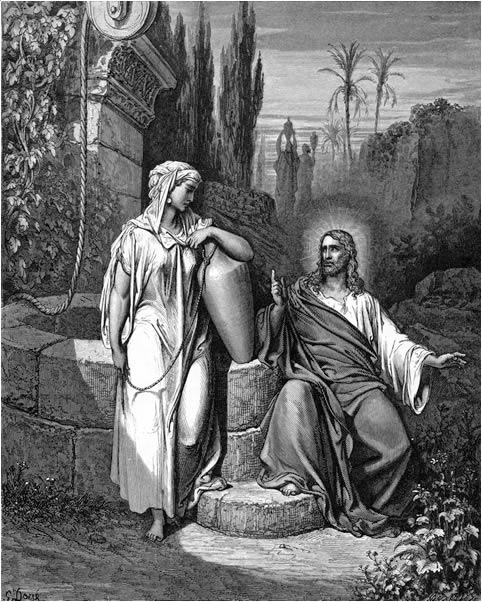
33 notes on this verseIn the mystical doctrine, we understand that this well is also referred to there, because there the Samaritan woman, that is, the guardian (the guardian, however, of heavenly precepts), drew divine mysteries from that well, knowing that God is spirit, and is not worshipped in a place but in spirit; and because he is the Messiah, Christ. And therefore, he who is still expected by the Jews has already come. Having heard these things, that woman who appears to be of the Church, recognized the sacraments of the law, and believed.
This site's exposition
the true worshipers will worship the Father
on John 4:23-24
The hour is coming and has now come, so the shift has already begun. Worship in spirit and in truth rises from the person himself and answers to what God has shown, at any place on earth. God is Spirit, and He seeks worshipers like these.
The record, by era
The Church Fathers5 voices
What does it mean, then, that the Father is worshiped in Christ, except that the Father is in Christ and the Father speaks in Christ and abides in Christ? He does not abide, indeed, as a body in a body, for God is not a body.… So not an engrafting of a body is meant, but unity of power. Therefore, by unity of power, Christ is jointly worshiped in the Father when God the Father is worshiped in Christ. In the same way then, by unity of the same power the Spirit is jointly worshiped in God when God is worshiped in the Spirit.… When God is said to be worshiped in truth (by the proper meaning of the word itself often expressed after the same manner), it ought to be understood that the Son too is worshiped. So, in the same way, the Spirit is also worshiped because God is worshiped in Spirit. Therefore the Father is worshiped both with the Son and with the Spirit, because the Trinity is worshiped.
Or go to the bee, and learn how laborious she is; for she, feeding on the whole meadow, produces one honey-comb. And if "thou prayest in the closet," as the Lord taught, "to worship in spirit," thy management will no longer be solely occupied about the house, but also about the soul, what must be bestowed on it, and how, and how much; and what must be laid aside and treasured up in it; and when it ought to be produced, and to whom.
What, however, does the Lord teach the woman now, as one whose husband has begun to be present? "The woman saith unto Him, Sir, I perceive that thou art a prophet. Our fathers worshipped in this mountain; and ye say that in Jerusalem is the place where men ought to worship. Jesus saith unto her, Woman, believe me." For the Church will come, as it is said in the Song of Songs, "will come, and will pass over from the beginning of faith." She will come in order to pass through; and pass through she cannot, except from the beginning of faith. Rightly she now hears, the husband being present: "Woman, believe me." For there is that in thee now which can believe, since thy husband is present. Thou hast begun to be present with the understanding when thou calledst me a prophet. Woman, believe me; for if ye believe not, ye will not understand. Therefore, "Woman, believe me, for the hour will come when ye shall neither in this mountain nor in Jerusalem worship the Father. Ye worship ye know not what: we worship what we know; for salvation is of the Jews. But the hour will come." When? "And now is." Well, what hour? "When the true worshippers shall worship the Father in spirit and in truth," not in this mountain, not in the temple, but in spirit and in truth. "For the Father seeketh such to worship Him." Why does the Father seek such to worship Him, not on a mountain, not in the temple, but in spirit and in truth? "God is Spirit." If God were body, it were right that He should be worshipped on a mountain, for a mountain is corporeal; it were right He should be worshipped in the temple, for a temple is corporeal. "God is Spirit; and they that worship Him, must worship in spirit and in truth."
(Tr. xv. c. 25) O for a mountain to pray on, thou criest, high and inaccessible, that I may be nearer to God, and God may hear me better, for He dwelleth on high. Yes, God dwelleth on high, but He hath respect unto the humble. Wherefore descend that thou mayest ascend. "Ways on high are in their heart," (Ps. 74:7.) it is said, "passing in the valley of tears," and in "tears" is humility. Wouldest thou pray in the temple? pray in thyself; but first do thou become the temple of God.
We have heard, and it is manifest; we had gone out of doors, and we are sent inward. Would I could find, thou didst say, some high and lonely mountain! For I think that, because God is on high, He hears me the rather from a high place. Because thou art on a mountain, dost thou imagine thyself near to God. and that He will quickly hear thee, as if calling to Him from the nearest place? He dwells on high, but regards the lowly. "The Lord is near." To whom? To the high, perhaps? "To them who are contrite of heart." 'Tis a wonderful thing: He dwelleth on high, and yet is near to the lowly; "He hath regard to lowly things, but lofty things He knoweth from afar;" He seeth the proud afar off, and He is the less near to them the higher they appear to themselves to be. Didst thou seek a mountain, then? Come down, that thou mayest come near Him. But wouldest thou ascend? Ascend, but do not seek a mountain. "The ascents," it saith, "are in his heart, in the valley of weeping." The valley is humility. Therefore do all within. Even if perhaps thou seekest some lofty place, some holy place, make thyself a temple for God within time. "For the temple of God is holy, which temple are ye." Wouldest thou pray in a temple? Pray in thyself. But be thou first a temple of God, for He in His temple heareth him that prays.
26 more voices on this verse
The Church Fathers9 voices
A commentator
Hippolytus of RomeThe Refutation of All Heresies - Book 5 · Written before 235.
proposed
The Phrygians, however, further assert that the father of the universe is "Amygdalus," not a tree, he says, but that he is "Amygdalus" who previously existed; and he having in himself the perfect fruit, as it were, throbbing and moving in the depth, rent his breasts, and produced his now invisible, and nameless, and ineffable child. respecting whom we shall speak. For the word "Amyxai" signifies, as it were, to burst and sever through, as he says (happens) in the case of inflamed bodies, and which have in themselves any tumour; and when doctors have cut this, they call it "Amychai." In this way, he says, the Phrygians call him "Amygdalus," from which proceeded and was born the Invisible (One), "by whom all things were made, and nothing was made without Him." And the Phrygians say that what has been thence produced is "Syrictas" (piper), because the Spirit that is born is harmonious. "For God," he says, "is Spirit; wherefore," he affirms, "neither in this mountain do the true worshippers worship, nor in Jerusalem, but in spirit. For the adoration of the perfect ones," he says, "is spiritual, not carnal." The Spirit, however, he says, is there where likewise the Father is named, and the Son is there born from this Father. This, he says, is the many-named, thousand-eyed Incomprehensible One, of whom every nature-each, however, differently-is desirous. This, he says, is the word of God, which, he says, is a word of revelation of the Great Power. Wherefore it will be sealed, and hid, and concealed, lying in the habitation where lies the basis of the root of the universe, viz. Aeons, Powers, Intelligences, Gods, Angels, delegated Spirits, Entities, Nonentities, Generables, Ingenerables, Incomprehensibles, Comprehensibles, Years, Months, Days, Hours, (and) Invisible Point from which what is least begins to increase gradually. […]
A commentator
Origen of AlexandriaCOMMENTARY ON THE GOSPEL OF JOHN 13.86-88, 99-100, 112 · Written before 253.
proposed
Twice it is written, "The hour is coming." The first time it is written without the addition of "and now is." I think the first alludes to that purely spiritual worship that will begin at the time of perfection. The second, however, means, I think, the worship of those being perfected in this life so far as it is possible for human nature to progress. It is possible, therefore, to worship the Father in spirit and in truth not only when "the hour comes" but also when it "now is." … For just as the angels do not worship the Father in Jerusalem because they worship the Father in a better way than those in Jerusalem, so those who can already be like the angels in their attitude will not worship the Father in Jerusalem but in a better way than those in Jerusalem.…When, however, someone worships neither on this mountain nor in Jerusalem, once the hour has come he worships the Father boldly because he has become a son. Therefore it is not said, "worship God" but "worship the Father." … True worshipers worship the Father in spirit and truth not only in the coming hour but also in the present. But those who worship in spirit, since they worship as they have received, worship at present in the pledge of the Spirit. But when they shall receive the Spirit in his fullness, they will worship the Father in spirit.
A commentator
Origen of AlexandriaCOMMENTARY ON THE GOSPEL OF JOHN 13.119, 140 · Written before 253.
proposed
If the Father seeks true worshipers, he seeks them through the Son, "who came to seek and to save that which was lost," purifying and educating those whom he equips to be true worshipers through the Word and sound doctrine.…God is a Spirit.… God, who brings us into the true life, is called Spirit, and in the Scriptures, the Spirit is said to make us alive. It is clear from this that "making alive" refers not only to ordinary life but to what is more divine.
(tom. xiii. c. 14) Twice it is said, The hour cometh, and the first time without the addition, and now is. The first seems to allude to that purely spiritual worship which is suited only to a state of perfection; the second to earthly worship, perfected as far as is consistent with human nature. When that hour cometh, which our Lord speaks of, the mountain of the Samaritans must be avoided, and God must be worshipped in Sion, where is Jerusalem, which is called by Christ the city of the Great King. And this is the Church, where sacred oblations and spiritual victims are offered up by those who understand the spiritual law. So that when the fulness of time shall have come, the true worship, we must suppose, will no longer be attached to Jerusalem, i. e. to the present Church: for the Angels do not worship the Father at Jerusalem: and thus those who have obtained the likeness of the Jews, worship the Father better than they who are at Jerusalem. And when this hour is come, we shall be accounted by the Father as sons. Wherefore it is not said, Worship God, but, Worship the Father. But for the present the true worshippers worship the Father in spirit and in truth.
"An hour will come," saith He, "when the true adorers shall adore the Father in spirit and truth. For God is a Spirit, and accordingly requires His adorers to be such." We are the true adorers and the true priests, who, praying in spirit, sacrifice, in spirit, prayer,-a victim proper and acceptable to God, which assuredly He has required, which He has looked forward to for Himself! This victim, devoted from the whole heart, fed on faith, tended by truth, entire in innocence, pure in chastity, garlanded with love, we ought to escort with the pomp of good works, amid psalms and hymns, unto God's altar, to obtain for us all things from God.
A commentator
Cyril of AlexandriaCommentary on the Gospel of John, Book 2 · Written before 444.
proposed
He is intimating the time now present of His Own Presence and says that the type shall be transferred to truth and the shadow of the Law to spiritual worship: He tells that through the Gospel teaching the true worshipper, that is, the spiritual man, shall be conducted to a polity well-pleasing unto the Father, hasting unto ownness with God. For God is conceived of as a Spirit, in reference to the embodied nature. Rightly therefore does He accept the spiritual worshipper, who does not in form and type carry in Jewish wise the form of godliness, but in Gospel manner resplendent in the achievements of virtue and in rightness of the Divine doctrines fulfilleth the really true worship.
He, among the rest of His salutary admonitions and divine precepts wherewith He counsels His people for their salvation, Himself also gave a form of praying-Himself advised and instructed us what we should pray for. He who made us to live, taught us also to pray, with that same benignity, to wit, wherewith He has condescended to give and confer all things else; in order that while we speak to the Father in that prayer and supplication which the Son has taught us, we may be the more easily heard. Already He had foretold that the hour was coming "when the true worshippers should worship the Father in spirit and in truth; " and He thus fulfilled what He before promised, so that we who by His sanctification have received the Spirit and truth, may also by His teaching worship truly and spiritually. For what can be a more spiritual prayer than that which was given to us by Christ, by whom also the Holy Spirit was given to us? What praying to the Father can be more truthful than that which was delivered to us by the Son who is the Truth, out of His own mouth? So that to pray otherwise than He taught is not ignorance alone, but also sin; since He Himself has established, and said, "Ye reject the commandments of God, that ye may keep your own traditions."
"We, O woman," He saith, "excel you in the manner of our worship, but even this shall henceforth have an end. Not the places only, but even the manner of serving God shall be changed. And this change is at your very doors. 'For the hour cometh, and now is.'" For since what the Prophets said they said long before the event, to show that here it is not so, He saith, "And now is." Think not, He saith, that this is a prophecy of such a kind as shall be accomplished after a long time, the fulfillment is already at hand and at your very doors, "when the true worshipers shall worship the Father in spirit and in truth." In saying "true," He excludeth Jews as well as Samaritans; for although the Jews be better than the Samaritans, yet are they far inferior to those that shall come, as inferior as is the type to the reality. But He speaketh of the Church, that she is the "true" worship, and such as is meet for God.
"For the Father seeketh such to worship Him." If then He in times past sought such as these, He allowed to those others their way of worship, not willingly, but from condescension, and for this reason, that He might bring them in also. Who then are "the true worshipers"? Those who confine not their service by place, and who serve God in spirit; as Paul saith, "Whom I serve in my spirit in the Gospel of His Son": and again, "I beseech you that ye present your bodies a living sacrifice, acceptable unto God, your reasonable service." (Rom. i. 9 and xii. 1.)
The Medieval Church5 voices
Or, because many think that they worship God in the spirit, i. e. with the mind, who yet held heretical doctrines concerning Him, for this reason He adds, and in truth. May not the words too refer to the two kinds of philosophy among us, i. e. active and contemplative; the spirit standing for action, according to the Apostle, As many as are led by the Spirit of God; (Rom. 8:14) truth, on the other hand, for contemplation. Or, (to take another view,) as the Samaritans thought that God was confined to a certain place, and ought to be worshipped in that place; in opposition to this notion, our Lord may mean to teach them here, that the true worshippers worship not locally, but spiritually. Or again, all being a type and shadow in the Jewish system, the meaning may be that the true worshippers will worship not in type, but in truth. God being a Spirit, seeketh for spiritual worshippers; being the truth, for true ones.
Although we Jews surpass you Samaritans in the form of worship, the form of Jewish worship will also eventually come to an end. And the change will occur not only in the place, but also in the manner of worship, and this change is very …
"But the hour is coming." I said that you do not worship perfectly, because you believe God to be local: nor do the Jews perfectly, because under figures. "But the hour is coming," namely of grace, "and now is," because Christ had already come: "when …
In saying, the hour cometh, He refers to the Gospel dispensation, which was now approaching; under which the shadows of types were to withdraw, and the pure light of truth was to enlighten the minds of believers.
Now (v 23), he compares the third kind of worship to the first two. First, he mentions its superiority to the others. Secondly, how appropriate this kind of worship is (v 23b). As to the first point, we should note, as Origen says, that when …
The Puritans and the Awakening3 voices
The true worshippers shall worship the Father - Not here or there only, but at all times and in all places.
But the hour cometh, and now is, when the true worshippers,....
The worshippers were generally carnal, and strangers to the inward part of divine worship. Note, It is possible that we may be better than our neighbours, and yet not so good as we should be. It concerns us to be right, not only in the object of our worship, but in the manner of it; and it is this which Christ here instructs us in.
The Nineteenth Century8 voices
A commentator
Albert Barnes1798–1870
Notes, Explanatory and Practical, on the Old and New Testaments (1832-1869)
But the hour cometh, and now is - The old dispensation is about to pass away, and the new one to commence. “Already” there is so much light that God may be worshipped acceptably in any place. The true worshippers - All who truly and sincerely worship God. They who do it with the heart, and not merely in form.
THE WOMAN’S CONSCIENCE had been aroused by Christ’s declaration of her sin. He was touching upon matters of the most vital importance, and her depraved heart naturally shrunk from the lancet, From the truth which was becoming inconveniently personal she flew to that natural resort of the carnal mind, namely, to religions discourse upon points of outward observance. Instead of confessing her sin, and asking how it may be forgiven, she must needs say, “Our fathers worshipped in this mountain; and ye say, that in Jerusalem is the place where men ought to worship.”
A commentator
Jamieson, Fausset & Brown1802–1910
Commentary Critical and Explanatory on the Whole Bible (1871)
proposed
hour cometh, and now is--evidently meaning her to understand that this new economy was in some sense being set up while He was talking to her, a sense which would in a few minutes so far appear, when He told her plainly He was the Christ.
quarantine:debris (2026-07-29) — starts-lowercase
A commentator
Jamieson, Fausset & Brown1802–1910
Commentary Critical and Explanatory on the Whole Bible (1871)
proposed
1Ti 2:8). worship the Father--She had talked simply of "worship"; our Lord brings up before her the great OBJECT of all acceptable worship--"THE FATHER."
quarantine:debris (2026-07-29) — unbalanced-parens
A commentator
J.C. Ryle1816–1900
Expository Thoughts on the Gospels: John (lightly modernized text, Grace Gems edition) (1869)
proposed
Conversation With a Samaritan Woman But he had to pass through Samaria. Now he came to a Samaritan town called Sychar, near the plot of land that Jacob had given to his son Joseph. Jacob’s well was there, so Jesus, since he was tired from the journey, sat right down beside the well. It was about noon. A Samaritan woman came to draw water. Jesus said to her, "Give me some water to drink." (For his disciples had gone off into the town to buy supplies.)
A commentator
J.C. Ryle1816–1900
Expository Thoughts on the Gospels: John (lightly modernized text, Grace Gems edition) (1869)
proposed
Conversation With a Samaritan Woman But he had to pass through Samaria. Now he came to a Samaritan town called Sychar, near the plot of land that Jacob had given to his son Joseph. Jacob’s well was there, so Jesus, since he was tired from the journey, sat right down beside the well. It was about noon. A Samaritan woman came to draw water. Jesus said to her, "Give me some water to drink." (For his disciples had gone off into the town to buy supplies.) So the Samaritan woman said to him, "How can you—a Jew—ask me, a Samaritan woman, for water to drink?" (For Jews use nothing in common with Samaritans.) Jesus answered her, "If you had known the gift of God and who it is who said to you, ‘Give me some water to drink,’ you would have asked him, and he would have given you living water." "Sir," the woman said to him, "you have no bucket and the well is deep; where then do you get this living water? Surely you’re not greater than our ancestor Jacob, are you? For he gave us this well and drank from it himself, along with his sons and his livestock." Jesus replied, "Everyone who drinks some of this water will be thirsty again. But whoever drinks some of the water that I will give him will never be thirsty again, but the water that I will give him will become in him a fountain of water springing up to eternal life." The woman said to him, "Sir, give me this water, so that I will not be thirsty or have to come here to draw water." He said to her, "Go call your husband and come back here." The woman replied, "I have no husband." Jesus said to her, "Right you are when you said, ‘I have no husband,’ for you have had five husbands and the man you are living with now is not your husband. This you said truthfully!" The woman said to him, "Sir, I see that you are a prophet.
THE WOMAN’S CONSCIENCE had been aroused by Christ’s declaration of her sin. He was touching upon matters of the most vital importance, and her depraved heart naturally shrunk from the lancet, From the truth which was becoming inconveniently personal she flew to that natural resort of the carnal mind, namely, to religions discourse upon points of outward observance. Instead of confessing her sin, and asking how it may be forgiven, she must needs say, “Our fathers worshipped in this mountain; and ye say, that in Jerusalem is the place where men ought to worship.” The carnal heart dreads the contact of spiritual truth, and finds a most convenient way of avoiding it by running to questions of holy places, holy times, and holy customs. Jesus, to her astonishment, informs her that the question which she had asked was of only temporary importance. There had been a time when it was well to know that salvation was of the Jews, and that the rival temple of the Samaritans was an imposture; but he says in effect to her, “Woman, believe me that question is of no importance now, for the hour cometh, yea and now is, when the external is to be abolished and the ritualistic is to be put away, and a purer, simpler, and more spiritual worship, is to take its place.” The worship which our Lord Jesus Christ established involved a change. That is implied in the expressions here used. He announced to her that the hour was just then come when all questions about this or that place must cease, and be superseded by spiritual worship. Our Lord gave a very brief, but I think a very instructive description of what this worship was to be. If you observe carefully the words, you will see that it was a distinguishing kind of worship, for he mentions true worshippers.
The true worshippers shall worship - in spirit - The worship of the Samaritans was a defective worship - they did not receive the prophetical writings: that of the Jews was a carnal worship, dealing only in the letter, and referring to the spirit and design, which were at a distance, by types and ceremonies. The Gospel of Christ showed the meaning of all these carnal ordinances, and the legal sacrifices, which had all their consummation in his offering of himself: thus a spiritual dispensation took the place of the carnal one which prefigured it. The preaching of the Gospel discovered the true nature of God, of salvation, of the human soul, of earthly and of heavenly things; and, because of this, it is put in opposition to the defective Samaritan worship.
Modern Voices1 voice
In John 4, Jesus' encounter with the Samaritan woman is itself a Purim-style reversal the rejected becomes chosen, the overlooked becomes entrusted, and the outsider becomes the first to hear a clear declaration of Messiah.
The words behind it
26 Greek wordsEvery Greek word of this verse in the order it stands, with what it means and the door to its own study. The last column counts the times a word stands in the whole Bible: the rarer the word, the more the places it appears belong together.
| Greek | Sound | Meaning | Word study | In the Bible |
|---|---|---|---|---|
| ἀλλ᾽ | all᾽ | But | G235 → | 635 times |
| ἔρχεται | erchetai | is coming | G2064 → | 628 times |
| ὥρα | hora | an hour | G5610 → | 106 times |
| καὶ | kai | and | G2532 → | 9120 times |
| νῦν | nun | now | G3568 → | 145 times |
| ἐστιν, | estin | is, | G1510 → | 2333 times |
| ὅτε | hote | when | G3753 → | 103 times |
| οἱ | hoi | the | G3588 → | 19766 times |
| ἀληθινοὶ | alethinoi | true | G228 → | 28 times |
| προσκυνηταὶ | proskunetai | worshipers | G4353 → | |
| προσκυνήσουσιν | proskunesousin | will worship | G4352 → | 60 times |
| τῷ | to | the | G3588 → | 19766 times |
| πατρὶ | patri | Father | G3962 → | 410 times |
| ἐν | en | in | G1722 → | 2738 times |
| πνεύματι | pneumati | spirit | G4151 → | 378 times |
| καὶ | kai | and | G2532 → | 9120 times |
| ἀληθείᾳ· | aletheia | truth; | G225 → | 109 times |
| καὶ | kai | also | G2532 → | 9120 times |
| γὰρ | gar | for | G1063 → | 1039 times |
| ὁ | ho | the | G3588 → | 19766 times |
| πατὴρ | pater | Father | G3962 → | 410 times |
| τοιούτους | toioutous | such | G5108 → | |
| ζητεῖ | zetei | seeks | G2212 → | 117 times |
| τοὺς | tous | who | G3588 → | 19766 times |
| προσκυνοῦντας | proskunountas | worship | G4352 → | 60 times |
| αὐτόν. | auton | Him. | G846 → | 5565 times |
ἀλλ᾽But
all᾽G235 →635 times
ἔρχεταιis coming
erchetaiG2064 →628 times
ὥραan hour
horaG5610 →106 times
καὶand
kaiG2532 →9120 times
νῦνnow
nunG3568 →145 times
ἐστιν,is,
estinG1510 →2333 times
ὅτεwhen
hoteG3753 →103 times
οἱthe
hoiG3588 →19766 times
ἀληθινοὶtrue
alethinoiG228 →28 times
προσκυνηταὶworshipers
proskunetaiG4353 →
προσκυνήσουσινwill worship
proskunesousinG4352 →60 times
τῷthe
toG3588 →19766 times
πατρὶFather
patriG3962 →410 times
ἐνin
enG1722 →2738 times
πνεύματιspirit
pneumatiG4151 →378 times
καὶand
kaiG2532 →9120 times
ἀληθείᾳ·truth;
aletheiaG225 →109 times
καὶalso
kaiG2532 →9120 times
γὰρfor
garG1063 →1039 times
ὁthe
hoG3588 →19766 times
πατὴρFather
paterG3962 →410 times
τοιούτουςsuch
toioutousG5108 →
ζητεῖseeks
zeteiG2212 →117 times
τοὺςwho
tousG3588 →19766 times
προσκυνοῦνταςworship
proskunountasG4352 →60 times
αὐτόν.Him.
autonG846 →5565 times
A shaded row is a word that stands 400 times or fewer in the Bible.
The walk
8 stopsEach card is a verse this one points to, and under it the verses that one points to in turn. Where several paths arrive at the same place, that place is listed first: the text keeps returning to it.
Through
Romans 8:26In the same way, the Spirit helps us in our weakness. For we do not know how we ought to pray, but the Spirit Himself intercedes for us with groans too deep for words.
it leads to
- Matthew 10:20
For it will not be you speaking, but the Spirit of your Father speaking through you.
- Ephesians 6:18
Pray in the Spirit at all times, with every kind of prayer and petition. To this end, stay alert with all perseverance in your prayers for all the saints.
- Galatians 4:6
And because you are sons, God sent the Spirit of His Son into our hearts, crying out, “Abba, Father!”
- John 14:16
And I will ask the Father, and He will give you another Advocate to be with you forever—
- Jude 1:20–21
But you, beloved, by building yourselves up in your most holy faith and praying in the Holy Spirit,
- Matthew 10:20
Through
Galatians 4:6And because you are sons, God sent the Spirit of His Son into our hearts, crying out, “Abba, Father!”
it leads to
- Romans 8:15–17
For you did not receive a spirit of slavery that returns you to fear, but you received the Spirit of sonship, by whom we cry, “Abba! Father!”
- Romans 5:5
And hope does not disappoint us, because God has poured out His love into our hearts through the Holy Spirit, whom He has given us.
- Romans 8:15–17
Through
Philippians 3:3For it is we who are the circumcision, we who worship by the Spirit of God, who glory in Christ Jesus, and who put no confidence in the flesh—
it leads to
- Colossians 2:11
In Him you were also circumcised, in the putting off of your sinful nature, with the circumcision performed by Christ and not by human hands.
- Colossians 2:11
Where this verse is studied
On this page
Studies8
About John
This page draws on 28 works. Open the list of works
This page draws on Adam Clarke, Commentary on the Bible; Albert Barnes, Notes, Explanatory and Practical, on the Old and New Testaments (1832-1869); Alcuin of York, Catena Aurea by Aquinas; Ambrose of Milan, On Isaac and the Soul 4.26; Ambrose of Milan, On the Holy Spirit 3.11.82, 85; Augustine of Hippo, Tractates on John 15; Augustine of Hippo, Catena Aurea by Aquinas; Bonaventure, Commentary on John, Chapter 4; Charles Spurgeon, The Metropolitan Tabernacle Pulpit, Sermon No. 695: “The Axe at the Root—A Testimony Against Puseyite Idolatry” (lightly modernized text, CCEL edition); Clement of Alexandria, The Stromata Book 1; Cyprian, Treatise IV On the Lord's Prayer; Cyril of Alexandria, Commentary on the Gospel of John, Book 2; Hippolytus of Rome, The Refutation of All Heresies - Book 5; J.C. Ryle, Expository Thoughts on the Gospels: John (lightly modernized text, Grace Gems edition); Jamieson, Fausset & Brown, Commentary Critical and Explanatory on the Whole Bible; Jane Hamon, PURIM – A TIME FOR REVERSALS!!; John Calvin, Commentary on the Gospel according to John; John Chrysostom, Homily on the Gospel of John 33; John Gill, Exposition of the New Testament (1746-1748); John Wesley, Explanatory Notes upon the New Testament; Matthew Henry, Commentary on the Whole Bible; Origen of Alexandria, COMMENTARY ON THE GOSPEL OF JOHN 13.86-88, 99-100, 112; Origen of Alexandria, COMMENTARY ON THE GOSPEL OF JOHN 13.119, 140; Origen of Alexandria, Catena Aurea by Aquinas; Tertullian, On Prayer; Theophylact of Ohrid, Catena Aurea by Aquinas; Theophylact of Ohrid, Commentary on John and Thomas Aquinas, Commentary on John.