
John 4:21
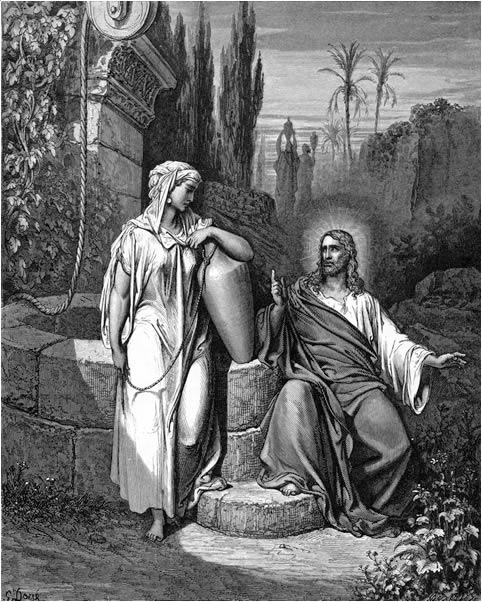
in John 4“Believe Me, woman,” Jesus replied, “a time is coming when you will worship the Father neither on this mountain nor in Jerusalem.
BSB
The same verse in ASV and KJV ▾
ASV
Jesus saith unto her, Woman, believe me, the hour cometh, when neither in this mountain, nor in Jerusalem, shall ye worship the Father.
KJV
Jesus saith unto her, Woman, believe me, the hour cometh, when ye shall neither in this mountain, nor yet at Jerusalem, worship the Father.
⋯
This verse in John 4
Commentary
21 notes on this verseA commentator
Origen of AlexandriaCOMMENTARY ON THE GOSPEL OF JOHN 13.81, 83, 85 · Written before 253.
The Jews stand for those who think intelligently and salvation is from them. The Samaritans represent the heterodox. So they deify Gerizim, which means "separation" or "division." The Jews, on the other hand, revere Zion, which signifies "watchtower." … Inasmuch, then, as the hour mentioned by the Lord has not yet come when they worship the Father neither on this mountain nor in Jerusalem, one must flee the mountain of the Samaritans and worship God on Zion, where Jerusalem lies. Christ calls this Jerusalem the city of the great king.
This site's exposition
you will worship the Father
on John 4:21-22
Jesus tells her the hour comes when worship is bound to no mountain at all. Before He sets the quarrel aside He settles it, naming the Samaritans as worshiping what they do not know and the Jews as worshiping what they know. Salvation is from the Jews.
The record, by era
The Church Fathers5 voices
(Tr. xv. c. 24) Believe Me, our Lord says with fitness, as the husband is now present. For now there is one in thee that believes, thou hast begun to be present in the understanding; but if ye will not believe, surely ye shall not be established. (Isa. 7:9)
What, however, does the Lord teach the woman now, as one whose husband has begun to be present? "The woman saith unto Him, Sir, I perceive that thou art a prophet. Our fathers worshipped in this mountain; and ye say that in Jerusalem is the place where men ought to worship. Jesus saith unto her, Woman, believe me." For the Church will come, as it is said in the Song of Songs, "will come, and will pass over from the beginning of faith." She will come in order to pass through; and pass through she cannot, except from the beginning of faith. Rightly she now hears, the husband being present: "Woman, believe me." For there is that in thee now which can believe, since thy husband is present. Thou hast begun to be present with the understanding when thou calledst me a prophet. Woman, believe me; for if ye believe not, ye will not understand. Therefore, "Woman, believe me, for the hour will come when ye shall neither in this mountain nor in Jerusalem worship the Father. Ye worship ye know not what: we worship what we know; for salvation is of the Jews. But the hour will come." When? "And now is." Well, what hour? "When the true worshippers shall worship the Father in spirit and in truth," not in this mountain, not in the temple, but in spirit and in truth. "For the Father seeketh such to worship Him." Why does the Father seek such to worship Him, not on a mountain, not in the temple, but in spirit and in truth? "God is Spirit." If God were body, it were right that He should be worshipped on a mountain, for a mountain is corporeal; it were right He should be worshipped in the temple, for a temple is corporeal. "God is Spirit; and they that worship Him, must worship in spirit and in truth."
A commentator
Cyril of AlexandriaCommentary on the Gospel of John, Book 2 · Written before 444.
proposed
He condemns alike the folly of all, saying that the mode of worship of both shall be transformed to the more truthful. For no longer (saith He) shall a place be sought, wherein they shall deem that God properly dwells, but as filling and able to contain all things, shall they worship the Lord every one from his place, as one of the holy Prophets says. He says that His own sojourn in the world with a Body is the time and season for a change of such customs. Observe how with most gentle leading of discourse, does He guide the mind of the woman to right conceptions respecting the Son, by calling God the Father. For how shall the Father at all be conceived of, if the Son be not?
Everywhere, beloved, we have need of faith, faith the mother of blessings, the medicine of salvation; and without this it is impossible to possess any one of the great doctrines. Without this, men are like to those who attempt to cross the open sea without a ship, who for a little way hold out by swimming, using both hands and feet, but when they have advanced farther, are quickly swamped by the waves: in like manner they who use their own reasonings, before they have learnt anything, suffer shipwreck; as also Paul saith, "Who concerning faith have made shipwreck." (1 Tim. i. 19.) That this be not our case, let us hold fast the sacred anchor by which Christ bringeth over the Samaritan woman now.
An exceedingly great doctrine He revealed to her, and one which He did not mention either to Nicodemus or Nathanael. She was eager to prove her own privileges more honorable than those of the Jews; and this she subtly argued from the Fathers, but Christ met not this question. For it was for the time distracting to speak on the matter, and to show why the Fathers worshiped in the mountain, and why the Jews at Jerusalem. Wherefore on this point He was silent, and having taken away from both places priority in dignity, rouses her soul by showing that neither Jews nor Samaritans possessed anything great in comparison with that which was to be given; and then He introduceth the difference. Yet even thus He declared that the Jews were more honorable, not preferring place to place, but giving them the precedence because of their intention. As though He had said, "About the 'place' of worship ye have no need henceforth to dispute, but in the 'manner' the Jews have an advantage over you Samaritans, for 'ye,' He saith, 'worship ye know not what; we know what we worship.'"
14 more voices on this verse
The Church Fathers2 voices
How then did the Samaritans "know not" what they worshiped? Because they thought that God was local and partial; so at least they served Him, and so they sent to the Persians, and reported that "the God of this place is wroth with us" (2 Kings xxvi.), in this respect forming no higher opinion of Him than of their idols. Wherefore they continued to serve both Him and devils, joining things which ought not to be joined. The Jews, on the contrary, were free from this supposition, at least the greater part of them, and knew that He was God of the world. Therefore He saith, "Ye worship ye know not what; we know what we worship." Do not wonder that He numbereth Himself among Jews, for He speaketh to the woman's opinion of Him as though He were a Jewish Prophet, and therefore He putteth, "we worship." For that He is of the objects of worship is clear to every one, because to worship belongs to the creature, but to be worshiped to the Lord of the creature. But for a time He speaketh as a Jew; and the expression "we" in this place meaneth "we Jews." Having then exalted what was Jewish, He next maketh Himself credible, and persuadeth the woman to give the greater heed to His words, by rendering His discourse above suspicion, and showing that He doth not exalt what belongs to them by reason of relationship to those of His own tribe. For it is clear, that one who had made these declarations concerning the place on which the Jews most prided themselves, and thought that they were superior to all, and who had taken away their high claims, would not after this speak to get favor of any, but with truth and prophetic power. When therefore He had for a while removed her from such reasonings, saying, "Woman, believe Me," and what follows, then He addeth...
"For salvation is of the Jews." What He saith is of this kind: neither, that blessings to the world came from them, (for to know God and condemn idols had its beginning, from them, and with you the very act of worship, although ye do it not rightly, yet received its origin from them,) or else, He speaketh of His own Coming. Or rather, one would not be wrong in calling both these things "salvation" which He said was "of the Jews"; which Paul implied when he said, "Of whom is Christ according to the flesh, who is God over all." (Rom. ix. 5.) Seest thou how He commendeth the old Covenant, and showeth that it is the root of blessings, and that He is throughout not opposed to the Law, since He maketh the groundwork of all good things to come from the Jews?
The Medieval Church3 voices
"Jesus says to her: Woman, believe me, the hour is coming when you will worship the Father neither on this mountain nor in Jerusalem." This hour is the time of grace, in which the error of the gentiles and the shadow of the legal commandments …
Therefore Christ too, seeing her understanding, although He does not resolve this perplexity of hers (for it was not of particular importance), reveals another, more important truth, which He had not revealed either to Nicodemus or to Nathanael. "The time is coming," He says, "when …
Christ's answer is now set down (v 21). First he distinguishes three types of prayer. Secondly, he compares them to each other (v 22). As to the first, he first of all gains the woman's attention, to indicate that he was about to say something …
The Puritans and the Awakening3 voices
Note, The worship of God is not now, under the gospel, appropriated to any place, as it was under the law, but it is God's will that men pray every where. Our reason teaches us to consult decency and convenience in the places of our worship: but our religion gives no preference to one place above another, in respect to holiness and acceptableness to God.
Those that apply themselves to Christ for instruction shall find him meek, to teach the meek his way. Now here, [1.] He puts a slight upon the question, as she had proposed it, concerning the place of worship (
quarantine:debris (2026-07-29) — unbalanced-parens
Jesus saith unto her, woman, believe me,....
The Nineteenth Century5 voices
A commentator
Albert Barnes1798–1870
Notes, Explanatory and Practical, on the Old and New Testaments (1832-1869)
Believe me - As she had professed to believe that he was a prophet, it was right to require her to put faith in what he was about to utter. It also shows the importance of what he was about to say. The hour cometh - The time is coming, or is near. When neither in this mountain ... - Hitherto the public solemn worship of God has been confined to one place. It has been a matter of dispute whether that place should be Jerusalem or Mount Gerizim.
A commentator
Jamieson, Fausset & Brown1802–1910
Commentary Critical and Explanatory on the Whole Bible (1871)
proposed
1Ti 2:8). worship the Father--She had talked simply of "worship"; our Lord brings up before her the great OBJECT of all acceptable worship--"THE FATHER."
quarantine:debris (2026-07-29) — unbalanced-parens
A commentator
J.C. Ryle1816–1900
Expository Thoughts on the Gospels: John (lightly modernized text, Grace Gems edition) (1869)
proposed
Conversation With a Samaritan Woman But he had to pass through Samaria. Now he came to a Samaritan town called Sychar, near the plot of land that Jacob had given to his son Joseph. Jacob’s well was there, so Jesus, since he was tired from the journey, sat right down beside the well. It was about noon. A Samaritan woman came to draw water. Jesus said to her, "Give me some water to drink." (For his disciples had gone off into the town to buy supplies.)
A commentator
J.C. Ryle1816–1900
Expository Thoughts on the Gospels: John (lightly modernized text, Grace Gems edition) (1869)
proposed
Conversation With a Samaritan Woman But he had to pass through Samaria. Now he came to a Samaritan town called Sychar, near the plot of land that Jacob had given to his son Joseph. Jacob’s well was there, so Jesus, since he was tired from the journey, sat right down beside the well. It was about noon. A Samaritan woman came to draw water. Jesus said to her, "Give me some water to drink." (For his disciples had gone off into the town to buy supplies.) So the Samaritan woman said to him, "How can you—a Jew—ask me, a Samaritan woman, for water to drink?" (For Jews use nothing in common with Samaritans.) Jesus answered her, "If you had known the gift of God and who it is who said to you, ‘Give me some water to drink,’ you would have asked him, and he would have given you living water." "Sir," the woman said to him, "you have no bucket and the well is deep; where then do you get this living water? Surely you’re not greater than our ancestor Jacob, are you? For he gave us this well and drank from it himself, along with his sons and his livestock." Jesus replied, "Everyone who drinks some of this water will be thirsty again. But whoever drinks some of the water that I will give him will never be thirsty again, but the water that I will give him will become in him a fountain of water springing up to eternal life." The woman said to him, "Sir, give me this water, so that I will not be thirsty or have to come here to draw water." He said to her, "Go call your husband and come back here." The woman replied, "I have no husband." Jesus said to her, "Right you are when you said, ‘I have no husband,’ for you have had five husbands and the man you are living with now is not your husband. This you said truthfully!" The woman said to him, "Sir, I see that you are a prophet.
The hour cometh, etc. - The time was now at hand in which the spiritual worship of God was about to be established in the earth, and all the Jewish rites and ceremonies entirely abolished. Worship the Father - This epithet shows the mild, benignant, and tender nature of the Gospel dispensation. Men are called to worship their heavenly Father, and to consider themselves as his children. In reference to this, our Lord’s prayer begins, Our Father, who art in heaven, etc. See Joh 4:23.
Modern Voices1 voice
In John 4, Jesus' encounter with the Samaritan woman is itself a Purim-style reversal the rejected becomes chosen, the overlooked becomes entrusted, and the outsider becomes the first to hear a clear declaration of Messiah.
The words behind it
22 Greek wordsEvery Greek word of this verse in the order it stands, with what it means and the door to its own study. The last column counts the times a word stands in the whole Bible: the rarer the word, the more the places it appears belong together.
| Greek | Sound | Meaning | Word study | In the Bible |
|---|---|---|---|---|
| Λέγει | legei | Says | G3004 → | 1325 times |
| αὐτῇ | autea | to her | G846 → | 5565 times |
| ὁ | ho | <the> | G3588 → | 19766 times |
| Ἰησοῦς· | iesous | Jesus; | G2424 → | 908 times |
| πίστευέ | pisteue | do believe | G4100 → | 237 times |
| μοι, | moi | Me, | G3165 → | 1936 times |
| γύναι, | gunai | woman, | G1135 → | 211 times |
| ὅτι | hoti | that | G3754 → | 1292 times |
| ἔρχεται | erchetai | is coming | G2064 → | 628 times |
| ὥρα | hora | an hour | G5610 → | 106 times |
| ὅτε | hote | when | G3753 → | 103 times |
| οὔτε | oute | neither [you will worship] | G3777 → | 87 times |
| ἐν | en | on | G1722 → | 2738 times |
| τῷ | to | <the> | G3588 → | 19766 times |
| ὄρει | orei | mountain | G3735 → | 62 times |
| τούτῳ | touto | this | G3778 → | 1381 times |
| οὔτε | oute | nor | G3777 → | 87 times |
| ἐν | en | in | G1722 → | 2738 times |
| Ἱεροσολύμοις | hi'erosolumois | Jerusalem | G2414 → | 62 times |
| προσκυνήσετε | proskunesete | will you worship | G4352 → | 60 times |
| τῷ | to | the | G3588 → | 19766 times |
| πατρί. | patri | Father. | G3962 → | 410 times |
ΛέγειSays
legeiG3004 →1325 times
αὐτῇto her
auteaG846 →5565 times
ὁ<the>
hoG3588 →19766 times
Ἰησοῦς·Jesus;
iesousG2424 →908 times
πίστευέdo believe
pisteueG4100 →237 times
μοι,Me,
moiG3165 →1936 times
γύναι,woman,
gunaiG1135 →211 times
ὅτιthat
hotiG3754 →1292 times
ἔρχεταιis coming
erchetaiG2064 →628 times
ὥραan hour
horaG5610 →106 times
ὅτεwhen
hoteG3753 →103 times
οὔτεneither [you will worship]
outeG3777 →87 times
ἐνon
enG1722 →2738 times
τῷ<the>
toG3588 →19766 times
ὄρειmountain
oreiG3735 →62 times
τούτῳthis
toutoG3778 →1381 times
οὔτεnor
outeG3777 →87 times
ἐνin
enG1722 →2738 times
ἹεροσολύμοιςJerusalem
hi'erosolumoisG2414 →62 times
προσκυνήσετεwill you worship
proskuneseteG4352 →60 times
τῷthe
toG3588 →19766 times
πατρί.Father.
patriG3962 →410 times
A shaded row is a word that stands 400 times or fewer in the Bible.
The walk
8 stopsEach card is a verse this one points to, and under it the verses that one points to in turn. Where several paths arrive at the same place, that place is listed first: the text keeps returning to it.
Through
Matthew 18:20For where two or three gather together in My name, there am I with them.”
it leads to
- 1 Corinthians 5:4
When you are assembled in the name of our Lord Jesus and I am with you in spirit, along with the power of the Lord Jesus,
- Revelation 21:3
And I heard a loud voice from the throne saying: “Behold, the dwelling place of God is with man, and He will dwell with them. They will be His people, and God Himself will…
- Matthew 28:20
and teaching them to obey all that I have commanded you. And surely I am with you always, even to the end of the age.”
- Zechariah 2:5
For I will be a wall of fire around it, declares the LORD, and I will be the glory within it.’”
- John 20:26
Eight days later, His disciples were once again inside with the doors locked, and Thomas was with them. Jesus came and stood among them and said, “Peace be with you.”
- 1 Corinthians 5:4
Through
John 4:23But a time is coming and has now come when the true worshipers will worship the Father in spirit and in truth, for the Father is seeking such as these to worship Him.
it leads to
- Philippians 3:3
For it is we who are the circumcision, we who worship by the Spirit of God, who glory in Christ Jesus, and who put no confidence in the flesh—
- Matthew 15:7–9
You hypocrites! Isaiah prophesied correctly about you:
- John 5:25
Truly, truly, I tell you, the hour is coming and has now come when the dead will hear the voice of the Son of God, and those who hear will live.
- Philippians 3:3
Where this verse is studied
On this page
Studies8
About John
Who and where
1 name in this verse with a page on the site.
This page draws on 16 works. Open the list of works
This page draws on Adam Clarke, Commentary on the Bible; Albert Barnes, Notes, Explanatory and Practical, on the Old and New Testaments (1832-1869); Augustine of Hippo, Catena Aurea by Aquinas; Augustine of Hippo, Tractates on John 15; Bonaventure, Commentary on John, Chapter 4; Brooke Foss Westcott, The Gospel according to St. John; Cyril of Alexandria, Commentary on the Gospel of John, Book 2; J.C. Ryle, Expository Thoughts on the Gospels: John (lightly modernized text, Grace Gems edition); Jamieson, Fausset & Brown, Commentary Critical and Explanatory on the Whole Bible; Jane Hamon, PURIM – A TIME FOR REVERSALS!!; John Chrysostom, Homily on the Gospel of John 33; John Gill, Exposition of the New Testament (1746-1748); Matthew Henry, Commentary on the Whole Bible; Origen of Alexandria, COMMENTARY ON THE GOSPEL OF JOHN 13.81, 83, 85; Theophylact of Ohrid, Commentary on John and Thomas Aquinas, Commentary on John.