
John 4:7
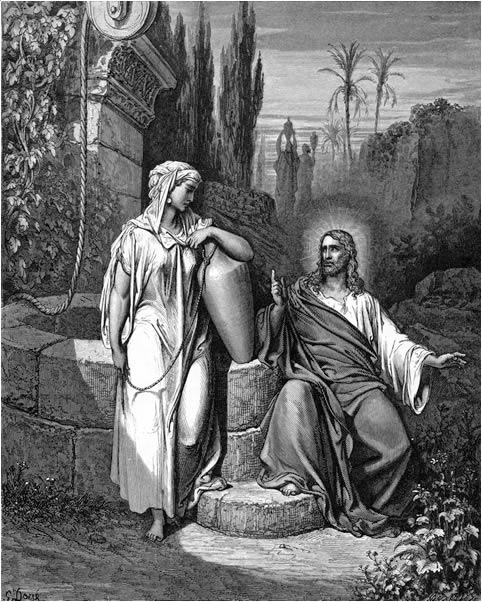
in John 4When a Samaritan woman came to draw water, Jesus said to her, “Give Me a drink.”
BSB
The same verse in ASV and KJV ▾
ASV
There cometh a woman of Samaria to draw water: Jesus saith unto her, Give me to drink.
KJV
There cometh a woman of Samaria to draw water: Jesus saith unto her, Give me to drink.
⋯
This verse in John 4
Commentary
27 notes on this verseThe Saviour was not ignorant of the woman's coming. For right well did He know being Very God, that she would forthwith be there to draw the cold stream from the fountain. But when she was now come, He began to get His prey within the toils, and straightway holding forth the word of teaching, made His discourse from what was before Him. The Law appointed for the Jews that they must not be defiled in any way, and therefore ordered them to withdraw from every unclean thing, and not to mix themselves up with strangers, or uncircumcised.
This site's exposition
Give Me a drink
on John 4:7-9
Women drew water in the cool of the morning and the evening, and this one comes alone at noon. Jesus asks her for a drink, crossing the line a Jewish man kept from a Samaritan and from a woman alone. Jews and Samaritans kept apart.
The record, by era
The Church Fathers5 voices
"And there came a woman." Figure of the Church not yet justified, but now about to be justified: for this is the subject of the discourse. She comes ignorant, she finds Him, and there is a dealing with her. Let us see what, and wherefore. "There cometh a woman of Samaria to draw water." The Samaritans did not belong to the nation of the Jews: they were foreigners, though they inhabited neighboring lands. It would take a long time to relate the origin of the Samaritans; that we may not be detained by long discourse of this, and leave necessary matters unsaid, suffice to say, then, that we regard the Samaritans as aliens. And, lest you should think that I have said this with more boldness than truth, hear the Lord Jesus Himself, what He said of that Samaritan, one of the ten lepers whom He had cleansed, who alone returned to give thanks: "Were there not ten cleansed? And where are the nine? There was not another to give glory to God, save this stranger." It is pertinent to the image of the reality, that this woman, who bore the type of the Church, comes of strangers: for the Church was to come of the Gentiles, an alien from the race of the Jews. In that woman, then, let us hear ourselves, and in her acknowledge ourselves, and in her give thanks to God for ourselves. For she was the figure, not the reality; for she both first showed forth the figure and became the reality. For she believed on Him who, of her, set the figure before us. "She cometh, then, to draw water." Had simply come to draw water, as people are wont to do, be they men or women.
(Tract. xv. c. 10) The woman here is the type of the Church, not yet justified, but just about to be. And it is a part of the resemblance, that she comes from a foreign people. The Samaritans were foreigners, though they were neighbours; and in like manner the Church was to come from the Gentiles, and to be alien from the Jewish race. (1. lxxxiii. Quaest. qu. 64) Jesus also thirsted after that woman's faith? He thirsteth for their faith, for whom He shed His blood.
"Jesus saith unto her, Give me to drink. For His disciples were gone away into the city to buy meat. Then saith the Samaritan woman unto Him, How is it that thou, being a Jew, askest drink of me, who am a Samaritan woman? For the Jews have no dealings with the Samaritans." You see that they were aliens: indeed, the Jews would not use their vessels. And as the woman brought with her a vessel with which to draw the water, it made her wonder that a Jew sought drink of her,-a thing which the Jews were not accustomed to do. But He who was asking drink was thirsting for the faith of the woman itself.
A commentator
Hippolytus of RomeThe Refutation of All Heresies - Book 5 · Written before 235.
proposed
First, then, from the wind-that is, from the serpent-has resulted the originating principle of generation in the manner declared, all things having simultaneously received the principle of generation. After, then, the light and the spirit had been received, he says, into the polluted and baneful (and) disordered womb, the serpent-the wind of the darkness, the first-begotten of the waters-enters within and produces man, and the impure womb neither loves nor recognises any other form. The perfect Word of supernal light being therefore assimilated (in form) to the beast, (that is,) the serpent, entered into the defiled womb, having deceived (the womb) through the similitude of the beast itself, in order that (the Word) may loose the chains that encircle the perfect mind which has been begotten amidst impurity of womb by the primal offspring of water, (namely,) serpent, wind, (and) beast. This, he says, is the form of the servant, and this the necessity of the Word of God coming down into the womb of a virgin. But he says it is not sufficient that the Perfect Man, the Word, has entered into the womb of a virgin, and loosed the pangs which were in that darkness. Nay, more than this was requisite; for after his entrance into the foul mysteries of the womb, he was washed, and drank of the cup of life-giving bubbling water. And it was altogether needful that he should drink who was about to strip off the servile form, and assume celestial raiment.
The Savior asks for water from the woman, then, and feigns thirst so that he might give eternal grace to the thirsty. For the source was not able to be thirsty, nor was he in whom there is living water able to draw water full …
20 more voices on this verse
The Church Fathers4 voices
"There cometh a woman of Samaria to draw water." Observe how he declareth that the woman came forth for another purpose, in every way silencing the shameless gainsaying of the Jews, that none might say that He acted in opposition to His own command, bidding His disciples not to enter into any city of the Samaritans, yet conversing with Samaritans. And therefore the Evangelist has put, "For His disciples were gone away into the city to buy meat." Bringing in many reasons for His conversation with her.
And in this place it is not His laboriousness alone that is shown, but also His freedom from pride; not merely by His being tired, nor by His sitting by the way-side, but by His having been left alone, and His disciples having been separated from Him. And yet it was in His power, if He had willed it, either not to have sent them all away, or when they departed to have had other ministers. But He would not; for so He accustomed His disciples to tread all pride beneath their feet.
Seest thou that His sitting was because of weariness? because of the heat? because of his waiting for His disciples? He knew, indeed, what should take place among the Samaritans, but it was not for this that He came principally; yet, though He came not for this, it behooved not to reject the woman who came to Him, when she manifested such a desire to learn. The Jews, when He was even coming to them, drove Him away; they of the Gentiles, when He was proceeding in another direction, drew Him to them. They envied, these believed on Him. They were angry with, these revered and worshiped Him. What then? Was He to overlook the salvation of so many, to send away such noble zeal? This would have been unworthy of His lovingkindness. Therefore He ordered all the matter in hand with the Wisdom which became Him. He sat resting His body and cooling It by the fountain; for it was the very middle of the day, as the Evangelist has declared, when he says, "It was about the sixth hour."
"Jesus therefore, being wearied with His journey, sat thus by the well; and it was about the sixth hour. There cometh a woman of Samaria to draw water. Jesus saith unto her, Give Me to drink. For His disciples were gone away into the city to buy meat." Hence we learn His activity in journeying, His carelessness about food, and how He treated it as a matter of minor importance. And so the disciples were taught to use the like disposition themselves; for they took with them no provisions for the road. And this another Evangelist declares, saying, that when He spake to them concerning "the leaven of the Pharisees," they thought that it was because they carried no bread; and when he introduces them plucking the ears of corn, and eating, and when he saith that Jesus came to the fig-tree by reason of hunger, it is for nothing else but only to instruct us by all these to despise the belly, and not to deem that its service is anxiously to be attended to.
The Medieval Church6 voices
The argument with the woman arises naturally from the occasion: Jesus saith unto her, Give me to drink. As man, the labour and heat He had undergone had made Him thirsty.
And furthermore, lest anyone accuse the Lord of the fact that, having commanded His disciples not to go on the path to the Gentiles, He Himself comes to the Samaritans, for this reason he says that His sitting in this place was due to weariness, …
Having determined the opportunity for preaching, here is determined the manifestation made through preaching. And because this manifestation was first made particularly, and secondly commonly: therefore first it treats of the preaching made to the woman; secondly, of the preaching made to the Samaritans, at …
A commentator
BonaventureDisputed Questions on Evangelical Perfection, Question 2 · Written in the 13th century.
proposed
Likewise, John 4: Give me to drink: Augustine in the original, Homily 15 on John: "In everything that Christ did as man, He was providing an example for those who would believe in Him"; and afterwards: "He asks to drink and promises to give drink, …
A commentator
BonaventureDisputed Questions on Evangelical Perfection, Question 2 · Written in the 13th century.
proposed
Likewise, Jerome to Rusticus: "What is lowlier than the Samaritan woman? Yet she not only believes in the Messiah, whom she recognizes at the well, but also, while the Apostles were buying food, she refreshes the hungry one and sustains the weary one": therefore it …
Next, we have a preliminary remark concerning the one who listens to Christ. First, we are introduced to the person who is taught. Secondly, we are given her preparation for his teaching. The teaching is given to a Samaritan woman; so he says, a Samaritan …
The Puritans and the Awakening2 voices
This woman's meeting with Christ at the well may remind us of the stories of Rebekah, Rachel, and Jethro's daughter, who all met with husbands, good husbands, no worse than Isaac, Jacob, and Moses, when they came to the wells for water. Thirdly, How the preventing grace of God sometimes brings people unexpectedly under the means of conversion and salvation.
There cometh a woman of Samaria,....
The Nineteenth Century7 voices
A commentator
Albert Barnes1798–1870
Notes, Explanatory and Practical, on the Old and New Testaments (1832-1869)
Of Samaria - Not of the “city” of Samaria, for this was at a distance of 8 miles, but a woman who was a Samaritan, and doubtless from the city of Sychar. Give me to drink - This was in the heat of the day, and when Jesus was weary with his journey.
A commentator
Jamieson, Fausset & Brown1802–1910
Commentary Critical and Explanatory on the Whole Bible (1871)
But with all that is human, how much also of the divine have we here, both blended in one glorious manifestation of the majesty, grace, pity, patience with which "the Lord" imparts light and life to this unlikeliest of strangers, standing midway between Jews and heathens. the sixth hour--noonday, reckoning from six A.M.
A commentator
J.C. Ryle1816–1900
Expository Thoughts on the Gospels: John (lightly modernized text, Grace Gems edition) (1869)
proposed
Conversation With a Samaritan Woman But he had to pass through Samaria. Now he came to a Samaritan town called Sychar, near the plot of land that Jacob had given to his son Joseph. Jacob’s well was there, so Jesus, since he was tired from the journey, sat right down beside the well. It was about noon. A Samaritan woman came to draw water. Jesus said to her, "Give me some water to drink." (For his disciples had gone off into the town to buy supplies.)
A commentator
J.C. Ryle1816–1900
Expository Thoughts on the Gospels: John (lightly modernized text, Grace Gems edition) (1869)
proposed
Conversation With a Samaritan Woman But he had to pass through Samaria. Now he came to a Samaritan town called Sychar, near the plot of land that Jacob had given to his son Joseph. Jacob’s well was there, so Jesus, since he was tired from the journey, sat right down beside the well. It was about noon. A Samaritan woman came to draw water. Jesus said to her, "Give me some water to drink." (For his disciples had gone off into the town to buy supplies.) So the Samaritan woman said to him, "How can you—a Jew—ask me, a Samaritan woman, for water to drink?" (For Jews use nothing in common with Samaritans.) Jesus answered her, "If you had known the gift of God and who it is who said to you, ‘Give me some water to drink,’ you would have asked him, and he would have given you living water." "Sir," the woman said to him, "you have no bucket and the well is deep; where then do you get this living water? Surely you’re not greater than our ancestor Jacob, are you? For he gave us this well and drank from it himself, along with his sons and his livestock." Jesus replied, "Everyone who drinks some of this water will be thirsty again. But whoever drinks some of the water that I will give him will never be thirsty again, but the water that I will give him will become in him a fountain of water springing up to eternal life." The woman said to him, "Sir, give me this water, so that I will not be thirsty or have to come here to draw water." He said to her, "Go call your husband and come back here." The woman replied, "I have no husband." Jesus said to her, "Right you are when you said, ‘I have no husband,’ for you have had five husbands and the man you are living with now is not your husband. This you said truthfully!" The woman said to him, "Sir, I see that you are a prophet.
A commentator
Charles Spurgeon1834–1892
The Metropolitan Tabernacle Pulpit, Sermon No. 2423: “The Model Soul-winner” (lightly modernized text, CCEL edition) · Written before 1892.
proposed
THIS was the beginning of that interesting conversation which not only blessed this woman, but has been a means of Grace to many others ever since, for this chapter and the previous one must be looked upon as among the most soul-winning parts of God's Word. I suppose that every portion of Scripture has had its use in the experience of men and women, but these two chapters have very, very largely been blessed in the commencement of the Divine Life.
A commentator
Charles Spurgeon1834–1892
The Metropolitan Tabernacle Pulpit, Sermon No. 2423: “The Model Soul-winner” (lightly modernized text, CCEL edition) · Written before 1892.
proposed
THIS was the beginning of that interesting conversation which not only blessed this woman, but has been a means of Grace to many others ever since, for this chapter and the previous one must be looked upon as among the most soul-winning parts of God's Word. I suppose that every portion of Scripture has had its use in the experience of men and women, but these two chapters have very, very largely been blessed in the commencement of the Divine Life. Many have been led through the door of regeneration and the gateway of faith by the Truth of God so plainly taught in them. I shall not delay you with any preface, but shall take you at once to the subject mentioned in our text. I. You have before you, here, first, THE MODEL SOUL-WINNER. Jesus said to the woman of Samaria, "Give Me a drink." I speak to many here who are wise to win souls. I hope that I also address many more who, although they have not yet learned this wisdom, are anxious, if possible, to be used of God to bless their fellow creatures. Here, then, is a perfect model for you—study it and copy it. First, observe that our Savior, as the model Soul-Winner, was not reserved and distant. "Jesus therefore, being wearied with His journey, sat thus on the well." If He had not been wonderfully anxious to win a soul, He would have kept Himself to Himself—and if this woman had spoken to Him, He would have answered her shortly and have let her see that He did not desire any conversation with her. There is a way of being civil, but, at the same time, of repressing anything like familiarity. There are some persons who have great gifts of freezing—they can freeze you, almost, with a look! You never dare to speak to them, again.
There cometh a woman of Samaria to draw water - That this was the employment of the females, we see in different parts of the Sacred Writings. See Gen 24:11, etc.; Exo 2:16, and the note at the end of that chapter. The Jews say that those who wished to get wives went to the wells where young women were accustomed to come and draw water; and it is supposed that women of ill fame frequented such places also. See several proofs in Schoettgen.
Modern Voices1 voice
In John 4, Jesus' encounter with the Samaritan woman is itself a Purim-style reversal the rejected becomes chosen, the overlooked becomes entrusted, and the outsider becomes the first to hear a clear declaration of Messiah.
The words behind it
14 Greek wordsEvery Greek word of this verse in the order it stands, with what it means and the door to its own study. The last column counts the times a word stands in the whole Bible: the rarer the word, the more the places it appears belong together.
| Greek | Sound | Meaning | Word study | In the Bible |
|---|---|---|---|---|
| Ἔρχεται | erchetai | Comes | G2064 → | 628 times |
| γυνὴ | gune | a woman | G1135 → | 211 times |
| ἐκ | ek | out of | G1537 → | 911 times |
| τῆς | tes | <the> | G3588 → | 19766 times |
| Σαμαρείας | samareias | Samaria | G4540 → | 11 times |
| ἀντλῆσαι | antlesai | to draw | G501 → | 4 times |
| ὕδωρ. | hudor | water. | G5204 → | 76 times |
| λέγει | legei | Says | G3004 → | 1325 times |
| αὐτῇ | autea | to her | G846 → | 5565 times |
| ὁ | ho | <the> | G3588 → | 19766 times |
| Ἰησοῦς· | iesous | Jesus; | G2424 → | 908 times |
| δός | dos | do give | G1325 → | 412 times |
| μοι | moi | Me | G3165 → | 1936 times |
| πεῖν. | pein | to drink. | G4095 → | 72 times |
ἜρχεταιComes
erchetaiG2064 →628 times
γυνὴa woman
guneG1135 →211 times
ἐκout of
ekG1537 →911 times
τῆς<the>
tesG3588 →19766 times
ΣαμαρείαςSamaria
samareiasG4540 →11 times
ἀντλῆσαιto draw
antlesaiG501 →4 times
ὕδωρ.water.
hudorG5204 →76 times
λέγειSays
legeiG3004 →1325 times
αὐτῇto her
auteaG846 →5565 times
ὁ<the>
hoG3588 →19766 times
Ἰησοῦς·Jesus;
iesousG2424 →908 times
δόςdo give
dosG1325 →412 times
μοιMe
moiG3165 →1936 times
πεῖν.to drink.
peinG4095 →72 times
A shaded row is a word that stands 400 times or fewer in the Bible.
The walk
8 stopsEach card is a verse this one points to, and under it the verses that one points to in turn. Where several paths arrive at the same place, that place is listed first: the text keeps returning to it.
Through
John 19:28After this, knowing that everything had now been accomplished, and to fulfill the Scripture, Jesus said, “I am thirsty.”
it leads to
- Psalms 69:21
They poisoned my food with gall and gave me vinegar to quench my thirst.
- Psalms 22:15
My strength is dried up like a potsherd, and my tongue sticks to the roof of my mouth. You lay me in the dust of death.
- John 19:30
When Jesus had received the sour wine, He said, “It is finished.” And bowing His head, He yielded up His spirit.
- Luke 22:37
For I tell you that this Scripture must be fulfilled in Me: ‘And He was numbered with the transgressors.’ For what is written about Me is reaching its fulfillment.”
- Luke 18:31
Then Jesus took the Twelve aside and said to them, “Look, we are going up to Jerusalem, and everything the prophets have written about the Son of Man will be fulfilled.
- Psalms 69:21
Through
Matthew 10:42And if anyone gives even a cup of cold water to one of these little ones because he is My disciple, truly I tell you, he will never lose his reward.”
it leads to
- Hebrews 6:10
For God is not unjust. He will not forget your work and the love you have shown for His name as you have ministered to the saints and continue to do so.
- Matthew 25:40
And the King will reply, ‘Truly I tell you, whatever you did for one of the least of these brothers of Mine, you did for Me.’
- Mark 9:41–42
Indeed, if anyone gives you even a cup of water because you bear the name of Christ, truly I tell you, he will never lose his reward.
- Hebrews 6:10
Where this verse is studied
About John
This page draws on 21 works. Open the list of works
This page draws on Adam Clarke, Commentary on the Bible; Albert Barnes, Notes, Explanatory and Practical, on the Gospels; Albert Barnes, Notes, Explanatory and Practical, on the Old and New Testaments (1832-1869); Augustine of Hippo, Tractates on John 15; Augustine of Hippo, Catena Aurea by Aquinas; Bonaventure, Commentary on John, Chapter 4; Bonaventure, Disputed Questions on Evangelical Perfection, Question 2; Charles Spurgeon, The Metropolitan Tabernacle Pulpit, Sermon No. 2423: “The Model Soul-winner” (lightly modernized text, CCEL edition); Cyril of Alexandria, Commentary on the Gospel of John, Book 2; Hippolytus of Rome, The Refutation of All Heresies - Book 5; J.C. Ryle, Expository Thoughts on the Gospels: John (lightly modernized text, Grace Gems edition); Jamieson, Fausset & Brown, Commentary Critical and Explanatory on the Whole Bible; Jane Hamon, PURIM – A TIME FOR REVERSALS!!; John Chrysostom, Homily on the Gospel of John 31; John Gill, Exposition of the New Testament (1746-1748); John Lightfoot, Horae Hebraicae et Talmudicae on John; Matthew Henry, Commentary on the Whole Bible; Maximus of Turin, SERMON 22.2; Theophylact of Ohrid, Catena Aurea by Aquinas; Theophylact of Ohrid, Commentary on John and Thomas Aquinas, Commentary on John.