
John 4:9
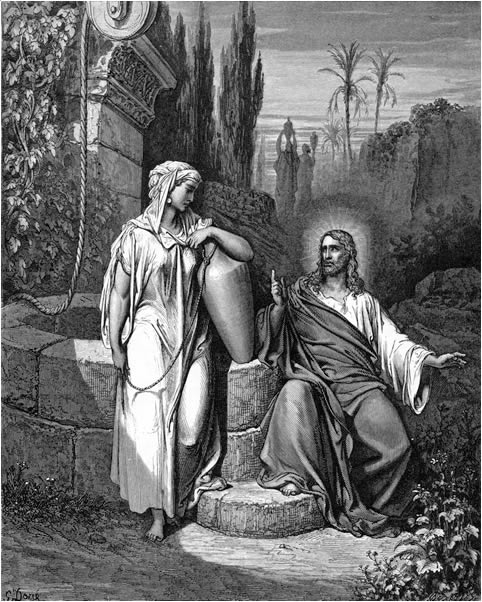
in John 4“You are a Jew,” said the woman. “How can You ask for a drink from me, a Samaritan woman?” (For Jews do not associate with Samaritans.)
BSB
The same verse in ASV and KJV ▾
ASV
The Samaritan woman therefore saith unto him, How is it that thou, being a Jew, askest drink of me, who am a Samaritan woman? (For Jews have no dealings with Samaritans.)
KJV
Then saith the woman of Samaria unto him, How is it that thou, being a Jew, askest drink of me, which am a woman of Samaria? for the Jews have no dealings with the Samaritans.
⋯
This verse in John 4
Commentary
19 notes on this verseA commentator
Albert Barnes1798–1870
Notes, Explanatory and Practical, on the Old and New Testaments (1832-1869)
No dealings with the Samaritans - For an account of the Samaritans, and of the differences between them and the Jews, see the notes at Mat 10:5.
This site's exposition
Give Me a drink
on John 4:7-9
Women drew water in the cool of the morning and the evening, and this one comes alone at noon. Jesus asks her for a drink, crossing the line a Jewish man kept from a Samaritan and from a woman alone. Jews and Samaritans kept apart.
This site's exposition
a Samaritan woman
Matthew Henry notes that a Jew would bear any hardship before he would owe a Samaritan a kindness. So a Jew asking a Samaritan woman for a drink startled her. His dress and speech told her He was a Jew.
The record, by era
The Church Fathers5 voices
(Tract. xiii) The Jews would not even use their vessels. So it would astonish the woman to hear a Jew ask to drink out of her vessel; a thing so contrary to Jewish rule.
It is evident that the blessed John wanted to reveal the virtue of the woman through this story. This request for water was not to be taken lightly. She instead first brings up the rules of the law. With great honesty she did not tolerate …
What doth the woman? When she heard, "Give Me to drink," she very wisely makes the speech of Christ an occasion for a question, and saith, "How is it that thou, being a Jew, askest drink of me, which am a Samaritan? For the Jews have no dealings with the Samaritans." And whence did she suppose Him to be a Jew? From His dress, perhaps, and from His dialect. Observe, I pray you, how considerate the woman was. If there was need of caution, Jesus needed it, not she. For she doth not say, "The Samaritans have no dealings with the Jews," but, "The Jews do not admit the Samaritans." Yet still, although free herself from blame, when she supposed that another was falling into it she would not even so hold her peace, but corrected, as she thought, what was done unlawfully.
A commentator
Methodius of OlympusOration Concerning Simeon and Anna, Section VIII · Written before 311.
proposed
And all this was, not of works of righteousness which we have done, nor because we loved Thee,-for our first earthly forefather, who was honourably entertained, in the delightful abode of Paradise, despised Thy divine and saving commandment, and was judged unworthy of that life-giving place, and mingling his seed with the bastard off-shoots of sin, he rendered it very weak;-but Thou, O Lord, of Thine own self, and of Thine ineffable love toward the creature of Thine hands, hast confirmed Thy mercy toward us, and, pitying our estrangement from Thee, hast moved Thyself at the sight of our degradation to take us into compassion.
Perhaps some one may ask how it was that Jesus asked drink of her, when the law did not permit it. If it be answered that it was because He knew beforehand that she would not give it, then for this very reason He ought not to have asked. What then can we say? That the rejecting such observances as these was now a matter of indifference to Him; for He who induced others to do them away, would much more Himself pass them by. "Not that which goeth in," saith He, "defileth a man, but that which goeth out." And this conversation with the woman would be no slight charge against the Jews. For often did He draw them to Himself, both by words and deeds, but they would not attend; while observe how she is detained by a simple request. For He did not as yet enter on the prosecution of this business, nor the way of salvation, yet if any came to Him He did not prevent them. And to the disciples also He said thus, "Into any city of the Samaritans enter ye not." He did not say, "And when they come to you, reject them"; that would have been very unworthy of His lovingkindness.
11 more voices on this verse
The Medieval Church3 voices
By appearance and, perhaps, by clothing, and by other bodily bearing, and by the conversation itself, the Samaritan woman took the Lord for a Jew, which is why she says to Him: "How is it that you, being a Jew," and so on. See how …
"The woman therefore says to Him." Here secondly He arouses her by promising or offering a benefit: because the woman, considering Him to be a Jew, did not wish to render service, but rather raises a question. Therefore he says: "That Samaritan woman therefore says …
Our Lord prepared the woman to receive his spiritual teaching by giving her an occasion to question him. First, her question is given. Secondly, her reason for asking it (v 9). Here we should point out that our Lord, when asking the woman for a …
The Puritans and the Awakening3 voices
This woman's meeting with Christ at the well may remind us of the stories of Rebekah, Rachel, and Jethro's daughter, who all met with husbands, good husbands, no worse than Isaac, Jacob, and Moses, when they came to the wells for water. Thirdly, How the preventing grace of God sometimes brings people unexpectedly under the means of conversion and salvation.
Two things this woman wonders at, 1. That he should ask this kindness; for it was the pride of the Jews that they would endure any hardship rather than be beholden to a Samaritan. It was part of Christ's humiliation that he was born of the Jewish nation, which was now not only in an ill state, subject to the Romans, but in an ill name among the nations.
Then saith the woman of Samaria unto him,....
The Nineteenth Century4 voices
A commentator
Jamieson, Fausset & Brown1802–1910
Commentary Critical and Explanatory on the Whole Bible (1871)
How is it that thou--not altogether refusing, yet wondering at so unusual a request from a Jew, as His dress and dialect would at once discover Him to be, to a Samaritan. for, &c.--It is this national antipathy that gives point to the parable of the good Samaritan (Lu 10:30-37), and the thankfulness of the Samaritan leper (Lu 17:16, 18).
A commentator
J.C. Ryle1816–1900
Expository Thoughts on the Gospels: John (lightly modernized text, Grace Gems edition) (1869)
proposed
Conversation With a Samaritan Woman But he had to pass through Samaria. Now he came to a Samaritan town called Sychar, near the plot of land that Jacob had given to his son Joseph. Jacob’s well was there, so Jesus, since he was tired from the journey, sat right down beside the well. It was about noon. A Samaritan woman came to draw water. Jesus said to her, "Give me some water to drink." (For his disciples had gone off into the town to buy supplies.)
A commentator
J.C. Ryle1816–1900
Expository Thoughts on the Gospels: John (lightly modernized text, Grace Gems edition) (1869)
proposed
Conversation With a Samaritan Woman But he had to pass through Samaria. Now he came to a Samaritan town called Sychar, near the plot of land that Jacob had given to his son Joseph. Jacob’s well was there, so Jesus, since he was tired from the journey, sat right down beside the well. It was about noon. A Samaritan woman came to draw water. Jesus said to her, "Give me some water to drink." (For his disciples had gone off into the town to buy supplies.) So the Samaritan woman said to him, "How can you—a Jew—ask me, a Samaritan woman, for water to drink?" (For Jews use nothing in common with Samaritans.) Jesus answered her, "If you had known the gift of God and who it is who said to you, ‘Give me some water to drink,’ you would have asked him, and he would have given you living water." "Sir," the woman said to him, "you have no bucket and the well is deep; where then do you get this living water? Surely you’re not greater than our ancestor Jacob, are you? For he gave us this well and drank from it himself, along with his sons and his livestock." Jesus replied, "Everyone who drinks some of this water will be thirsty again. But whoever drinks some of the water that I will give him will never be thirsty again, but the water that I will give him will become in him a fountain of water springing up to eternal life." The woman said to him, "Sir, give me this water, so that I will not be thirsty or have to come here to draw water." He said to her, "Go call your husband and come back here." The woman replied, "I have no husband." Jesus said to her, "Right you are when you said, ‘I have no husband,’ for you have had five husbands and the man you are living with now is not your husband. This you said truthfully!" The woman said to him, "Sir, I see that you are a prophet.
That thou, being a Jew - Probably the inhabitants of Judea distinguished themselves from those of Samaria by some peculiar mode of dress; and by this the Samaritan woman might have known Christ: but it is likely that our Lord spoke the Galilean dialect, by which we find, from Mar 14:70, a Jew of that district might easily be known. The Jews have no dealings with the Samaritans - Perhaps better, Jews have no communion with Samaritans. These words appear to be added by the evangelist himself, in explanation of the woman’s question. The original word, συγχρωνται, has been variously translated and understood. It comes from συν, together, and χραομαι, I use, or borrow: hence it has been understood to mean, the Jews will be under no kind of obligation to the Samaritans - will borrow nothing from them - will not drink out of the same cup or well with them - will not sit down to meals with them, nor eat out of the same vessel - will have no religious connection, no commercial dealings with them. The word communion, I think, fully expresses the sense of the original; and, being as extensive in its meaning as our word dealings, is capable of as general an interpretation. The deadly hatred that subsisted between these two nations is known to all. The Jews cursed them, and believed them to be accursed. Their most merciful wish to the Samaritans was, that they might have no part in the resurrection; or, in other words, that they might be annihilated.
Modern Voices1 voice
In John 4, Jesus' encounter with the Samaritan woman is itself a Purim-style reversal the rejected becomes chosen, the overlooked becomes entrusted, and the outsider becomes the first to hear a clear declaration of Messiah.
The words behind it
23 Greek wordsEvery Greek word of this verse in the order it stands, with what it means and the door to its own study. The last column counts the times a word stands in the whole Bible: the rarer the word, the more the places it appears belong together.
| Greek | Sound | Meaning | Word study | In the Bible |
|---|---|---|---|---|
| λέγει | legei | Says | G3004 → | 1325 times |
| οὖν | oun | therefore | G3767 → | 497 times |
| αὐτῷ | auto | to Him | G846 → | 5565 times |
| ἡ | he | the | G3588 → | 19766 times |
| γυνὴ | gune | woman | G1135 → | 211 times |
| ἡ | he | <the> | G3588 → | 19766 times |
| Σαμαρῖτις· | samaritis | Samaritan; | G4542 → | |
| πῶς | pos | How | G4459 → | 103 times |
| σὺ | su | You yourself | G4771 → | 2973 times |
| Ἰουδαῖος | ioudaios | a Jew | G2453 → | 192 times |
| ὢν | on | being | G1510 → | 2333 times |
| παρ᾽ | par᾽ | from | G3844 → | 192 times |
| ἐμοῦ | emou | me | G1473 → | 839 times |
| πεῖν | pein | to drink | G4095 → | 72 times |
| αἰτεῖς | aiteis | you do ask | G154 → | 70 times |
| γυναικὸς | gunaikos | a woman | G1135 → | 211 times |
| Σαμαρίτιδος | samaritidos | Samaritan | G4542 → | |
| οὔσης; | ouses | being? | G1510 → | 2333 times |
| οὐ | ou | Not | G3756 → | 1664 times |
| γὰρ | gar | for | G1063 → | 1039 times |
| συγχρῶνται | sugchrontai | have association | G4798 → | |
| Ἰουδαῖοι | ioudaioi | Jews | G2453 → | 192 times |
| Σαμαρίταις.¶ | samaritais | with Samaritans. | G4541 → | 9 times |
λέγειSays
legeiG3004 →1325 times
οὖνtherefore
ounG3767 →497 times
αὐτῷto Him
autoG846 →5565 times
ἡthe
heG3588 →19766 times
γυνὴwoman
guneG1135 →211 times
ἡ<the>
heG3588 →19766 times
Σαμαρῖτις·Samaritan;
samaritisG4542 →
πῶςHow
posG4459 →103 times
σὺYou yourself
suG4771 →2973 times
Ἰουδαῖοςa Jew
ioudaiosG2453 →192 times
ὢνbeing
onG1510 →2333 times
παρ᾽from
par᾽G3844 →192 times
ἐμοῦme
emouG1473 →839 times
πεῖνto drink
peinG4095 →72 times
αἰτεῖςyou do ask
aiteisG154 →70 times
γυναικὸςa woman
gunaikosG1135 →211 times
ΣαμαρίτιδοςSamaritan
samaritidosG4542 →
οὔσης;being?
ousesG1510 →2333 times
οὐNot
ouG3756 →1664 times
γὰρfor
garG1063 →1039 times
συγχρῶνταιhave association
sugchrontaiG4798 →
ἸουδαῖοιJews
ioudaioiG2453 →192 times
Σαμαρίταις.¶with Samaritans.
samaritaisG4541 →9 times
A shaded row is a word that stands 400 times or fewer in the Bible.
The walk
8 stopsEach card is a verse this one points to, and under it the verses that one points to in turn. Where several paths arrive at the same place, that place is listed first: the text keeps returning to it.
Through
Matthew 10:5These twelve Jesus sent out with the following instructions: “Do not go onto the road of the Gentiles or enter any town of the Samaritans.
it leads to
- Acts 22:21–23
Then He said to me, ‘Go! I will send you far away to the Gentiles.’”
- 2 Kings 17:24–41
Then the king of Assyria brought people from Babylon, Cuthah, Avva, Hamath, and Sepharvaim and settled them in the towns of Samaria to replace the Israelites. They took possession of Samaria and lived in…
- 1 Thessalonians 2:16
hindering us from telling the Gentiles how they may be saved. As a result, they continue to heap up their sins to full capacity; the utmost wrath has come upon them.
- Romans 15:8–9
For I tell you that Christ has become a servant of the circumcised on behalf of God’s truth, to confirm the promises made to the patriarchs,
- John 4:22–24
You worship what you do not know; we worship what we do know, for salvation is from the Jews.
- Acts 22:21–23
Through
John 8:48The Jews answered Him, “Are we not right to say that You are a Samaritan and You have a demon?”
it leads to
- John 7:20
“You have a demon,” the crowd replied. “Who is trying to kill You?”
- John 7:20
Through
Acts 10:28He said to them, “You know how unlawful it is for a Jew to associate with a foreigner or visit him. But God has shown me that I should not call any man impure…
it leads to
- Ephesians 3:6–7
This mystery is that through the gospel the Gentiles are fellow heirs, fellow members of the body, and fellow partakers of the promise in Christ Jesus.
- Galatians 2:12–14
For before certain men came from James, he used to eat with the Gentiles. But when they arrived, he began to draw back and separate himself, for fear of those in the circumcision group.
- Ephesians 3:6–7
Where this verse is studied
On this page
Studies16
On this verse
About John
This page draws on 16 works. Open the list of works
This page draws on Adam Clarke, Commentary on the Bible; Albert Barnes, Notes, Explanatory and Practical, on the Old and New Testaments (1832-1869); Albert Barnes, Notes, Explanatory and Practical, on the Gospels; Augustine of Hippo, Catena Aurea by Aquinas; Bonaventure, Commentary on John, Chapter 4; J.C. Ryle, Expository Thoughts on the Gospels: John (lightly modernized text, Grace Gems edition); Jamieson, Fausset & Brown, Commentary Critical and Explanatory on the Whole Bible; Jane Hamon, PURIM – A TIME FOR REVERSALS!!; John Chrysostom, Homily on the Gospel of John 31; John Gill, Exposition of the New Testament (1746-1748); John Lightfoot, Horae Hebraicae et Talmudicae on John; Matthew Henry, Commentary on the Whole Bible; Methodius of Olympus, Oration Concerning Simeon and Anna, Section VIII; Theodore of Mopsuestia, COMMENTARY ON JOHN 2.4.9; Theophylact of Ohrid, Commentary on John and Thomas Aquinas, Commentary on John.