
Bozrah
Summary
Fortified Edomite city named in the judgment oracles (Isa 34:6; 63:1; Jer 49:13; Amos 1:12).
- Bozrah was one of Edom's chief fortified cities, named as early as Genesis as the home city of one of Edom's earliest kings.
- Every prophetic mention of Bozrah announces judgment on Edom, except one, where a triumphant figure returns FROM Bozrah rather than falling under judgment there.
- Isaiah 63:1-6 pictures that figure, robed and stained from treading judgment alone, and asked plainly who He is.
- The site's own curated commentary pool holds no reading of this figure as anyone but the LORD or Christ.
- The historical church has long connected Isaiah's bloodstained warrior to Revelation's rider whose robe is dipped in blood.
On this page
In Scripture
- Verses
- 8
- Books
- 5
Near Bozrah
- Sela48 km · 30 mi S
- Gomorrah49 km · 30 mi N
- Mount Hor50 km · 31 mi S
- Sodom55 km · 34 mi N
- En-gedi83 km · 52 mi N
- Beersheba92 km · 57 mi NW
Straight-line distances, computed from the gazetteer coordinates.
Where it is
the country around it
- Coordinates
- 30.7347° N, 35.6063° Efind it on the Atlas →
- Region
- Edom
- Kind of place
- City
- Located: the gazetteer fixes one site
Not located: Teman, Edom. The gazetteer records no location for them, so they are not marked.
Why Bozrah matters
Who is this who comes from Bozrah?
Isaiah 63:1-6, in the order it happens
Read Isaiah 63:1-6, in the order it happens
- Who is this coming from Bozrah?Isaiah 63:1Who is this coming from Edom, from Bozrah with crimson-stained garments? Who is this robed in splendor, marching in the greatness of His strength? “It is I, proclaiming vindication, mighty to save.”
- Why are Your garments red?Isaiah 63:2Why are Your clothes red, and Your garments like one who treads the winepress?
- I have trodden the winepress aloneIsaiah 63:3“I have trodden the winepress alone, and no one from the nations was with Me. I trampled them in My anger and trod them down in My fury; their blood spattered My garments, and all My clothes were stained.
- The day of vengeance, the year of redemptionIsaiah 63:4For the day of vengeance was in My heart, and the year of My redemption had come.
- No one to help; His own arm saved HimIsaiah 63:5I looked, but there was no one to help; I was appalled that no one assisted. So My arm brought Me salvation, and My own wrath upheld Me.
- He trampled the nations in His angerIsaiah 63:6I trampled the nations in My anger; in My wrath I made them drunk and poured out their blood on the ground.”
Isaiah gives no name for the questioner or the answering figure. The reading history behind this page's where_it_points section names Him as Christ.
What happened here, in order
in the order the canon tells it
- Jobab of Bozrah reigns in EdomGenesis 36:33When Bela died, Jobab son of Zerah from Bozrah reigned in his place.
- Fire sent on the citadels of BozrahAmos 1:12So I will send fire upon Teman to consume the citadels of Bozrah.
- A sacrifice in BozrahIsaiah 34:6The sword of the LORD is bathed in blood. It drips with fat—with the blood of lambs and goats, with the fat of the kidneys of rams. For the LORD has a sacrifice in Bozrah, a great slaughter in the land of Edom.
- A figure returns from Bozrah, robed and stainedIsaiah 63:1Who is this coming from Edom, from Bozrah with crimson-stained garments? Who is this robed in splendor, marching in the greatness of His strength? “It is I, proclaiming vindication, mighty to save.”
- Bozrah sworn to become a desolationJeremiah 49:13For by Myself I have sworn, declares the LORD, that Bozrah will become a desolation, a disgrace, a ruin, and a curse, and all her cities will be in ruins forever.
- An eagle spreads its wings over BozrahJeremiah 49:22Look! An eagle will soar and swoop down, spreading its wings over Bozrah. In that day the hearts of Edom’s mighty men will be like the heart of a woman in labor.
Where it points
The voices
each quoted from the work named
THIS, of course, refers to our blessed Lord Jesus Christ, who is described as “coming from Edom with dyed garments from Bozrah,” and who, when it is questioned who he is, replies, “I that speak in righteousness, mighty to save.” It will be well, then, at the commencement of our discourse to make one or two remarks concerning the mysteriously complex person of the man and God whom we call our Redeemer, Jesus Christ our Saviour. It is one of the mysteries of the Christian religion, that we are taught to believe that Christ is God, and yet a man.
Here is also an allusion to the garments of this conqueror, Edom signifying red, and Bozrah a vintage. Glorious - Such as generals march before their armies in. Righteousness - Here Christ gives an answer, wherein he both asserts his fidelity, that he will faithfully perform what he hath promised, and that he will truly execute justice.
Bozrah in Scripture
8 verses name it, in 5 books
Open a book to read its mentions here. Text: Berean Standard Bible.
Old TestamentNew Testamentsegment width = share of mentions
Old Testament5 books · 8 mentions
Genesis1 mention
1 Chronicles1 mention
Isaiah2 mentions
- Isaiah 34:6The sword of the LORD is bathed in blood. It drips with fat—with the blood of lambs and goats, with the fat of the kidneys of rams. For the LORD has a sacrifice in Bozrah, a great slaughter in the land of Edom.
- Isaiah 63:1Who is this coming from Edom, from Bozrah with crimson-stained garments? Who is this robed in splendor, marching in the greatness of His strength? “It is I, proclaiming vindication, mighty to save.”
Jeremiah3 mentions
- Jeremiah 48:24upon Kerioth, Bozrah, and all the towns of Moab, those far and near.
- Jeremiah 49:13For by Myself I have sworn, declares the LORD, that Bozrah will become a desolation, a disgrace, a ruin, and a curse, and all her cities will be in ruins forever.”
- Jeremiah 49:22Look! An eagle will soar and swoop down, spreading its wings over Bozrah. In that day the hearts of Edom’s mighty men will be like the heart of a woman in labor.
Common questions
Where was Bozrah, and whose capital was it?
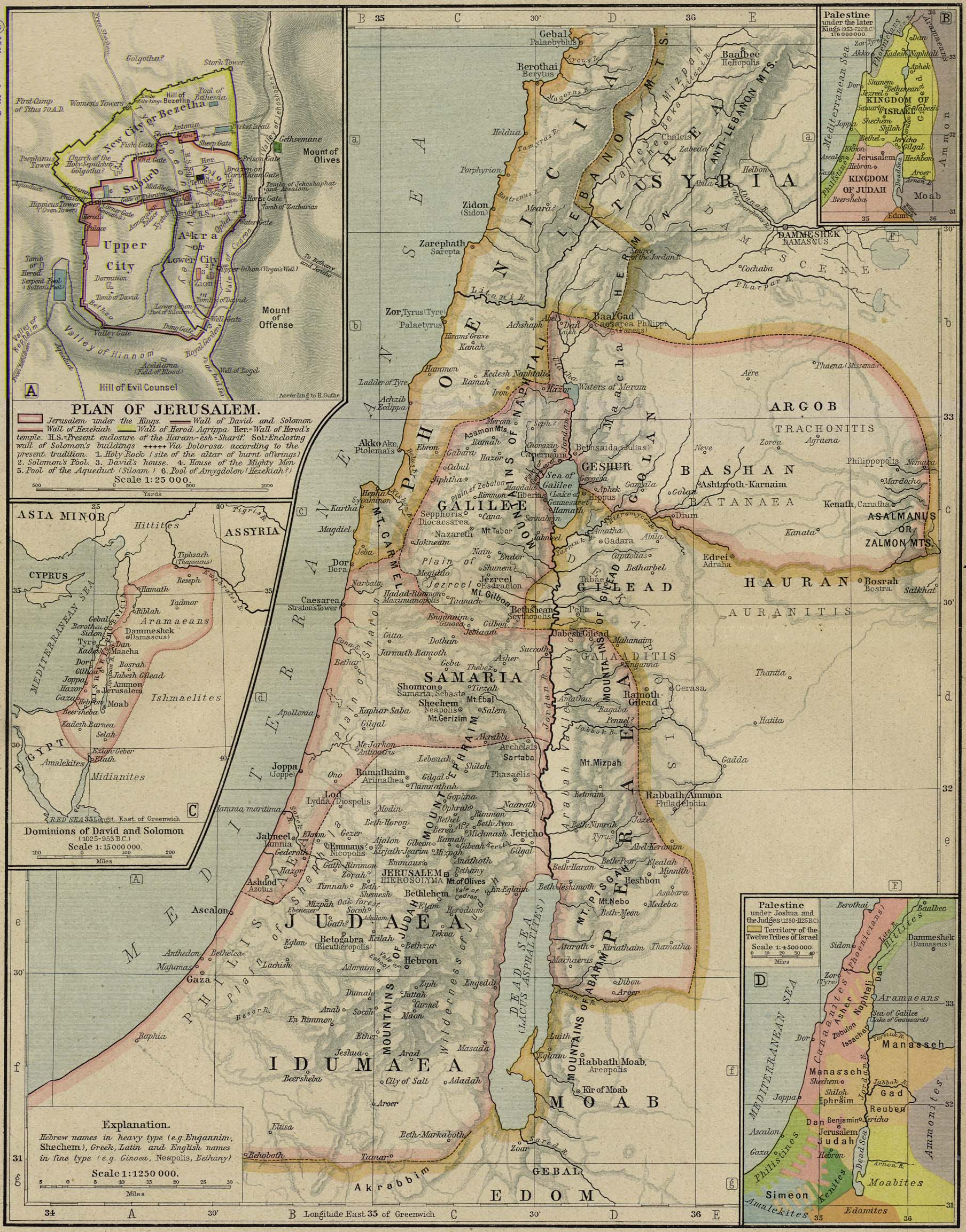
Bozrah was one of the chief fortified cities of Edom, generally identified with modern Buseirah. Genesis names it as the home city of Jobab, one of Edom's earliest kings, well before Israel had a king of its own.
Who is the figure "coming from Edom, from Bozrah" in Isaiah 63:1?
The historical commentary tradition, from the early church through Wesley and Spurgeon, reads Him as Christ. No voice in the site's own curated quote pool reads Him as anyone else, so this page states that reading plainly rather than presenting a live scholarly dispute where the tradition holds none.
Why does Isaiah 63 picture the LORD as a bloodied warrior returning from judgment?
The text answers its own question: the day of vengeance was in His heart, and the year of His redemption had come. He trod the winepress of judgment alone, with no one from the nations to help Him, and His own arm brought Him the victory.
Why does Scripture pronounce judgment on Bozrah specifically, rather than another Edomite city?
Bozrah was one of Edom's chief strongholds, so the prophets use it as a byword for Edom's strength and pride. Amos, Isaiah and Jeremiah all name it directly in their oracles against Edom as a whole.
Is the Bozrah of Isaiah 63 the same city as the Bozrah mentioned in Jeremiah 48:24?
Readers differ; the positions are named
No. Jeremiah 48:24 names a town in Moab that shares the same common Hebrew word, which simply means a fortified place. This page's Bozrah is the Edomite city named in Genesis, Amos, Isaiah and Jeremiah's oracle against Edom in chapter 49.
Sources cited
- OpenBible.info Bible Geocoding: Bozrah 1read 2026-08-20The coordinates on this page. Used under CC-BY with attribution to OpenBible.info.
- Charles Spurgeon, The New Park Street Pulpit, Sermon No. 111 (1857)Public domain, CCEL edition. Curated pool row id b993045c-2a0e-43f9-aa20-1ee6b53cf2eb.
- John Wesley, Explanatory Notes upon the Old TestamentPublic domain, CCEL edition. Curated pool row id 2542d83b-2c17-47c1-b43f-d64f836d7a9c.
- Piotr Bienkowski (ed.), Busayra: Excavations by Crystal-M. Bennett, 1971-1980 (British Academy Monographs in Archaeology 13, 2002)Confirms the general identification of Busayra (Buseirah), the site excavated by Crystal Bennett, with biblical Bozrah, the Edomite fortress city.
Keep studying
On this page
Books that name it5
Doorway2
Keep this page