
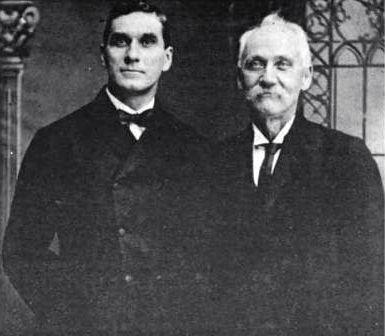
John G. Lake and Thomas Hezmalhalch, about 1908. Public domain.
1904 to 1925 · The churches · Featured Study
The Apostolic Faith Mission
A Pentecostal church of South Africa grew from the work of three American missionaries who arrived in 1908.
A sick man in Johannesburg went to “Pastors Tome and Lake, of the A F Mission,” and they prayed for him, as he later told the scholar Bengt Sundkler.
And they were all filled with the Holy Spirit and began to speak in other tongues as the Spirit enabled them.
- Began
- 1908, the year three Apostolic Faith missionaries reached Johannesburg
- Bodies
- The Apostolic Faith Mission of South Africa, The Zion Apostolic Church, The Zion Christian Church
Summary
The Apostolic Faith Mission began in Johannesburg. Its first members came from a Zion church that baptized and taught divine healing.
- Zion preachers baptized Africans in Johannesburg from 1904.
- John G. Lake set out for Africa with his wife and seven children.
- P. L. le Roux of Zion received his Pentecost.
- Elias Letwaba led the work among Africans after he met Lake.
- The Zion churches went on beside the Mission.
The Texts of Pentecost and of Healing
The Mission preached the Spirit's baptism, and the Zion church beside it prayed for the sick.
The American missionaries carried the name Apostolic Faith from the Pentecostal revival in America. Their Zion hosts already practised baptism by immersion and divine healing.
Is any one of you sick? He should call the elders of the church to pray over him and anoint him with oil in the name of the Lord.Sundkler counts divine healing among the marks of the Zion church Le Roux served before 1908.
The Branch in South Africa
The tree runs from the Zion baptisms in Johannesburg to the Zion Christian Church.
The Apostolic Faith Mission and the Zionist churches grew from one root in Johannesburg.
1904 to 1906
- Azusa Street, the Apostolic Faith in Los Angeles
- The Zion baptisms in Johannesburg
1908 to 1913
- The Apostolic Faith missionaries
- John G. Lake in South Africa
1913 to 1925
- The Apostolic Faith Mission
- The Zion Apostolic Church
- The Zion Christian Church
Each date is read from Sundkler (1961) or Lindsay (1972).
The site's tradition is Wesleyan-Pentecostal, the line that runs through Azusa Street to the missionaries who sailed for Johannesburg.
How the Mission Began: Zion in 1904 and the Missionaries of 1908
Sundkler's study and Lake's own account tell the start.
Bengt Sundkler studied these churches in Bantu Prophets in South Africa, whose second edition came out in 1961. He records that one overseer, Daniel Bryant, baptized the first group of twenty-seven Africans in Johannesburg on 8 May 1904, by triune immersion.
A white minister, P. L. le Roux, also joined that Zion church, by Sundkler's account.
Sundkler writes that three Pentecostal or Apostolic Faith missionaries arrived in Johannesburg from the United States. Lake's own account, printed by Gordon Lindsay in 1972, says his party left Indianapolis on 1 April 1908: his wife, seven children and four others.
Le Roux received his Pentecost, the baptism in the Holy Spirit, that same year. Lindsay says the meetings at Doornfontein grew until the little hall there became too small.
The Truth They Pressed: The Spirit's Baptism and Prayer for the Sick
The Mission joined the Pentecostal baptism to the Zion prayer for healing.
Sundkler read the Zionist practices as variations on a theme first sounded in Dowie's Zion on Lake Michigan, carried to the rivers of Zululand.
And these signs will accompany those who believe: In My name they will drive out demons; they will speak in new tongues; they will pick up snakes with their hands, and if they drink any deadly poison, it will not harm them; they will lay their hands on the sick, and they will be made well.”The sick man who went to Tome and Lake asked for the prayer these verses join to the gift of tongues.
Their Own Rule of Life
Sundkler recorded two marks of the Zion rule, one of baptism and one of daily life.
The Zion churches kept a strict rule that the Mission's missionaries met in Johannesburg.
| The rule | Its source |
|---|---|
| Baptism by triune immersion, three times under the water | Sundkler, on the baptisms of 1904 |
| No beer, no medicine, no tobacco and no pork | A Zionist leader, in an interview Sundkler printed |
The Churches and Their Counts
Sundkler counted the people of one Zionist church for 1925.
The Zion Christian Church gathered 926 people at its Zion City by 1925.
| Body | The count | Who counted, and for when |
|---|---|---|
| The Zion Christian Church | 515 men and 411 women | Sundkler, for 1925, at Lekganyane's Zion City |
Where the Work Went
Each place stands with the year its record gives.
The work moved from Johannesburg to the north of the Transvaal in twenty years.
| Year | Place | What happened there |
|---|---|---|
| 1904 | Johannesburg | Zion's first African converts went down into the water. |
| 1908 | Doornfontein, Johannesburg | Lake's meetings outgrew their hall. |
| About 1915 | The Transvaal | Le Roux turned to the Pentecostal work, and the Zion Apostolic Church went on. |
| 1925 | Near Pietersburg | Engenas Lekganyane's Zion Christian Church gathered at its Zion City. |
Elias Letwaba met Lake in these years, and Lindsay tells how the work among Africans passed to him.
In Their Own Words
Three of the American missionaries wrote home in 1908, and two Pentecostal papers printed their letters and a report.
John G. Lake (1870 to 1935)
letter to J. Roswell Flower, Doornfontein, Johannesburg, 30 May 1908, The Pentecost, volume 1, number 1 (Indianapolis, August 1908), page 7
The native tabernacle
“As the service proceeded the spirit of God fell upon the house in prayer. The natives recognized it just as quickly as we did, and without suggestion fell on their knees to pray as all natives here do, being exceedingly devout. They didn't wait for one another to pray. Out of the five hundred present two hundred and fifty broke out in prayer aloud at one time.”
Pentecostal
About this saying1 paragraph
Lake wrote to J. Roswell Flower from Doornfontein, Johannesburg, on 30 May 1908, of a service in a tabernacle of the Congregational American Mission. The Pentecost printed the letter in its first number, in August 1908.
J. O. Lehman
letter to the saints in Indianapolis, Fordsburg, Johannesburg, 8 June 1908, The Pentecost, volume 1, number 1 (Indianapolis, August 1908), page 7
The Zion Tabernacle
“We began our first continued meetings in the colored church, and notwithstanding the prejudice that exists with the white people against the natives, when God began to work the white people came in such crowds that the natives became timid and were crowded out. Since then we are offered the large Zion Tabernacle which seats several hundred in which to hold our meetings.”
American Pentecostal missionary to South Africa
About this saying1 paragraph
J. O. Lehman wrote to the saints at Indianapolis from Fordsburg, Johannesburg, on 8 June 1908, and the same number of The Pentecost printed his letter after Lake's.
Thomas Hezmalhalch
One Day with God in South Africa, a report dated Vryheid, Natal, 26 August 1908, The Latter Rain Evangel (Chicago, November 1908), the fifteenth page of the archive's scan of the issue
A report from Vryheid
“I have just left the Native Hospital after having prayed with twenty-one patients. I wish you could have seen how the Lord healed them. Glory to His name!”
American Pentecostal missionary to South Africa
About this saying1 paragraph
Thomas Hezmalhalch sent a report from Vryheid in Natal dated 26 August 1908. The Latter Rain Evangel of Chicago printed it in November 1908 as One Day with God in South Africa.
The Charges Against Lake and the Parting of the Churches
Lake left in 1913, and the African Zionists went their own way.
Lindsay records that Lake returned to America in 1913, after the death of his wife. The historian Barry Morton calls Lake a fraud, and the site's story of his years there sets out that charge with the answers to it.
About 1915 Le Roux gave himself to the Pentecostal work, and the African church he had served went on as the Zion Apostolic Church. Sundkler's edition lists many such churches, from the Zion Apostolic Church to the Zion Christian Church.
Books to Read Next
Bantu Prophets in South Africa
Bengt Sundkler · 1961
He traces the Zionist churches from the Zion baptisms in Johannesburg through the American missionaries.
In print: find it wherever books are sold.
John G. Lake, Apostle to Africa
Gordon Lindsay · 1972
It tells of the work at Doornfontein in Lake's own words.
In print: find it wherever books are sold.
What the Mission Handed On
The Mission handed on two streams from one Johannesburg root: a Pentecostal church that kept the Apostolic Faith name, and African Zionist churches that kept its prayer for the sick in their own hands.
Sources
Scripture is the Berean Standard Bible.
- The Holy Bible, Berean Standard Bible (read 2026)
- Bengt Sundkler, Bantu Prophets in South Africa, second edition (London: Oxford University Press for the International African Institute, 1961)
- Gordon Lindsay, John G. Lake, Apostle to Africa (Dallas: Christ for the Nations, 1972)
- The Pentecost, volume 1, number 1 (Indianapolis: Flower Publishing Co., August 1908), pages 6 and 7, the letters of John G. Lake (Doornfontein, 30 May 1908) and J. O. Lehman (Fordsburg, 8 June 1908)
- Thomas Hezmalhalch, One Day with God in South Africa, a report dated Vryheid, Natal, 26 August 1908, The Latter Rain Evangel (Chicago, November 1908), the fifteenth page of the archive's scan.