
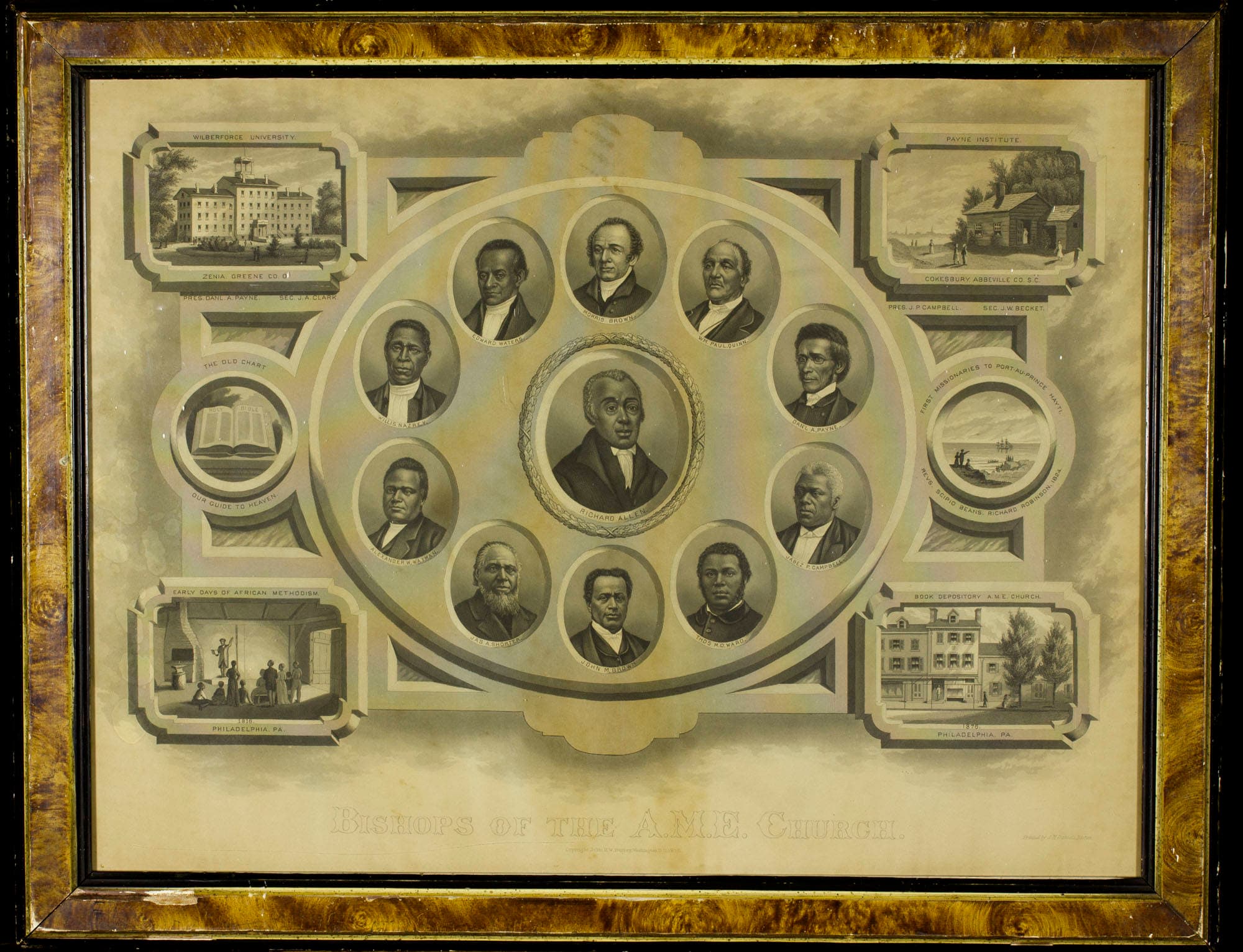
Bishops of the A.M.E. Church (c. 1876), Library Company of Philadelphia, no known restrictions
1786 to today · The churches · Featured Study
The African Methodist Episcopal Church
Formed in April 1816 by the Black Methodist congregations of Philadelphia, Baltimore and other places, with Richard Allen at their head.
There is neither Jew nor Greek, slave nor free, male nor female, for you are all one in Christ Jesus.
- Began
- April 1816, by a general meeting of Philadelphia and Baltimore, as Allen tells it
- Bodies
- Bethel, Philadelphia, Episcopal Districts in the United States, Episcopal Districts in Africa, Episcopal Districts in the Caribbean
Richard Allen made his first church in Philadelphia from the frame of an old blacksmith shop, hauled to Sixth Street.
Summary
Richard Allen, born a slave in 1760, led Black Methodists in Philadelphia out of St. George's church, and they opened a house of worship of their own. In 1816 their congregations became one church.
- The year the Black members left St. George's is disputed.
- Allen named his church Bethel, from Genesis 28.
- The congregation won its property back in the courts.
- Payne, the church's later historian, gives the days of April 1816 from memory gathered about 1850.
The Texts of a Church Refused at the Rail
The texts come from Galatians 3, Acts 10, John 4 and Genesis 28.
MannaFest reads this church's conviction from Galatians 3:28 and Acts 10:34 to 35, though Allen's book does not cite either. Allen records his people's answer to an elder who threatened to disown them: “We believe heaven is free for all who worship in spirit and truth.”
Then Peter began to speak: “I now truly understand that God does not show favoritism, but welcomes those from every nation who fear Him and do what is right.Peter says that God shows no favoritism, which MannaFest reads as the claim of the walkout from St. George's.
But a time is coming and has now come when the true worshipers will worship the Father in spirit and in truth, for the Father is seeking such as these to worship Him.Allen's answer to the elder echoes this verse, though he does not cite it.
And he was afraid and said, “How awesome is this place! This is none other than the house of God; this is the gate of heaven!”Jacob calls the place the house of God, which is what the name means.
and he called that place Bethel, though previously the city had been named Luz.Allen's footnote to the name of his church points to this chapter.
Genesis 28:17, Genesis 28:19
The African Methodist Branch of the Family of Churches
Seven names in four dated generations, each name with its own year.
The church grew out of the Methodist Episcopal Church through a society and a house of its own.
1784 to 1786
- The Methodist Episcopal Church, 1784
- Allen's society at St. George's, 1786
1787 to 1794
- The Free African Society, 1787
- Bethel, 1794
1816
- The African Methodist Episcopal Church, 1816
1891 to 1896
- Liberia and Sierra Leone, 1891
- South Africa, 1896
Dates from Allen (1833) and the church's own history page, for the society of 1787 and the missions.
The families from the Council of Ephesus to the Pentecostals stand together, each with its date.
How the Church Began: Allen's Account and Its Witnesses
Allen's book of 1833, the church's own history page and the congregation the men left.
Allen's book, “written by himself,” is his own account of the church's birth, and it was printed in 1833. His preface, on page 3, warns that “A great part of this work having been written many years after events actually took place,” some events stand “without day or date.”
He opens on page 5, “I was born in the year of our Lord 1760, on February 14th, a slave to Benjamin Chew, of Philadelphia.”
He bought his freedom later, and the printed year of the purchase is left blank as “17--.”
In February 1786 he came to Philadelphia and preached at St. George's at five in the morning. He writes on page 12, “I raised a society in 1786 of forty-two members.”
The sexton sent the Black members to the gallery. At prayer, he writes on page 13, he saw a trustee “pulling him up off of his knees,” meaning Absalom Jones.
Jones answered, “wait until prayer is over, and I will get up and trouble you no more.”
Then “we all went out of the church in a body.”
Allen gives no year for the walkout. The church's own history page places it after the Free African Society of 1787, and Historic St. George's, the congregation the men left, prints “In 1794 (date disputed).”
In 1793 a committee asked Allen to be their minister.
In July 1794 Asbury preached at the opening, and on page 18 Allen writes, “The house was called bethel agreeable to the prayer that was made.”
The Truth They Kept: A House Free for All Who Worship
The courts that upheld their house.
Allen's people stayed Methodists and won the right to their building. Bethel had been incorporated under the Methodist Conference with the members' consent: “Being ignorant of incorporations we cheerfully agreed thereto.”
About ten years later a Supplement took the house back under the Conference. The elder Robert Birch “applied to the Supreme Court for a writ of Mandamus,” and Allen writes that the suit “ended in our favor.”
Allen gives no year for the suit. The church's own history page says the congregation “successfully sued in the Pennsylvania courts in 1807 and 1815.”
Their Own Statement: The Resolution of April 1816
Allen's account of the general meeting, and Payne's days.
Allen writes that others “were in a situation nearly like those of Philadelphia and Baltimore,” which induced them “in April 1816 to call a general meeting, by way of Conference.”
On page 21 he gives its resolution, “That the people of Philadelphia, Baltimore, &c. &c., should become one body, under the name of the African Methodist Episcopal Church.”
Allen gives its reason as freedom “from that spiritual despotism which we have so recently experienced.”
The days of April 1816, as Payne gives them3 paragraphs
Bishop Daniel A. Payne, the church's historian and so an interested witness, gives the days in his History of 1891, page 14. Daniel Coker was “declared the Bishop-elect on the 9th of April, 1816,” declined the next day, and Allen was “consecrated the Bishop of the A. M. E. Church on the 11th of April, 1816.”
Payne also states the limit of his record, since there were no “printed minutes.”
He drew his list of members from men who had been present and from the fathers of the church living in 1850.
The Church Today
Districts on five continents, and a count of 1880.
The church's own history page, which carries no date, describes “membership in twenty Episcopal Districts in thirty-nine countries on five continents” and prints no present total.
For the past it says that “in 1880 AME membership reached 400,000,” giving no method of counting, and it ties that growth to the church's spread south of the Mason-Dixon line.
Allen's own footnote, written for his book, says of Bethel, “This church will at present accommodate between 3 and 4000 persons,” the pastor's estimate of his house.
Where the Church Went
It began in Philadelphia and Baltimore in 1816 and reached West Africa in 1891 and South Africa in 1896.
In eighty years the church reached from Philadelphia and Baltimore to West Africa and South Africa.
| Place | Date | What happened | The record |
|---|---|---|---|
| Philadelphia, Pennsylvania | July 1794 | Bethel opened | Allen (1833) |
| Philadelphia and Baltimore | April 1816 | The general meeting forms one church | Allen (1833) |
| Liberia and Sierra Leone | 1891 | The church spreads there | The church's history page |
| South Africa | 1896 | The church spreads there | The church's history page |
A Testimony of 1794: The Yellow Fever
Absalom Jones and Richard Allen answer their critics.
A narrative that Absalom Jones and Richard Allen dated January 1794, reprinted in Allen's book, answers the “censures thrown upon them” in the yellow fever of 1793.
They cite the bill of mortality: “In 1792 there were 67 of our colour buried, and in 1793, it amounted to 305.”
St. George's: The Failure, and How It Is Told Now
The Methodist Episcopal Church's failure, told by the people it pushed out.
The failure here is the Methodist Episcopal Church's, and Allen's account of it is the injured party's.
His people had “subscribed largely towards finishing St. George's Church, in building the gallery and laying new floors.”
The church the men left now tells the walkout on an undated page of its own site, read in October 2026, under the title The Great Walk Out.
Books to Read Next
The Life, Experience, and Gospel Labours of the Rt. Rev. Richard Allen
Richard Allen · 1833
Allen tells his own life, the walkout and the meeting of 1816.
Read it free at Documenting the American SouthHistory of the African Methodist Episcopal Church
Daniel A. Payne, edited by C. S. Smith · 1891
It is the church's own history, written by its bishop, and it prints Allen's narrative again.
Free at the Internet ArchiveWhat the Church Handed On
Pulled from their knees in a Methodist church they had helped to build, Allen's people answered by building a Methodist church of their own.
Sources
Scripture is the Berean Standard Bible.
- The Holy Bible, Berean Standard Bible (read 2026)
- Richard Allen, The Life, Experience, and Gospel Labours of the Rt. Rev. Richard Allen, written by himself (Philadelphia: Martin and Boden, 1833), pages 3 to 21, with the narrative of Absalom Jones and Richard Allen dated January 1794.
- Daniel A. Payne, History of the African Methodist Episcopal Church, edited by C. S. Smith (Nashville: Publishing House of the A. M. E. Sunday-School Union, 1891), pages 7 to 8 and 14.
- African Methodist Episcopal Church, Our History (undated; read 2026)
- Historic St. George's United Methodist Church, The Great Walk Out (undated; read 2026)
- World Council of Churches, African Methodist Episcopal Church (undated; read 2026)
Keep Studying
Values1
People and groups1
Subjects1
Doctrines1
Church history1