
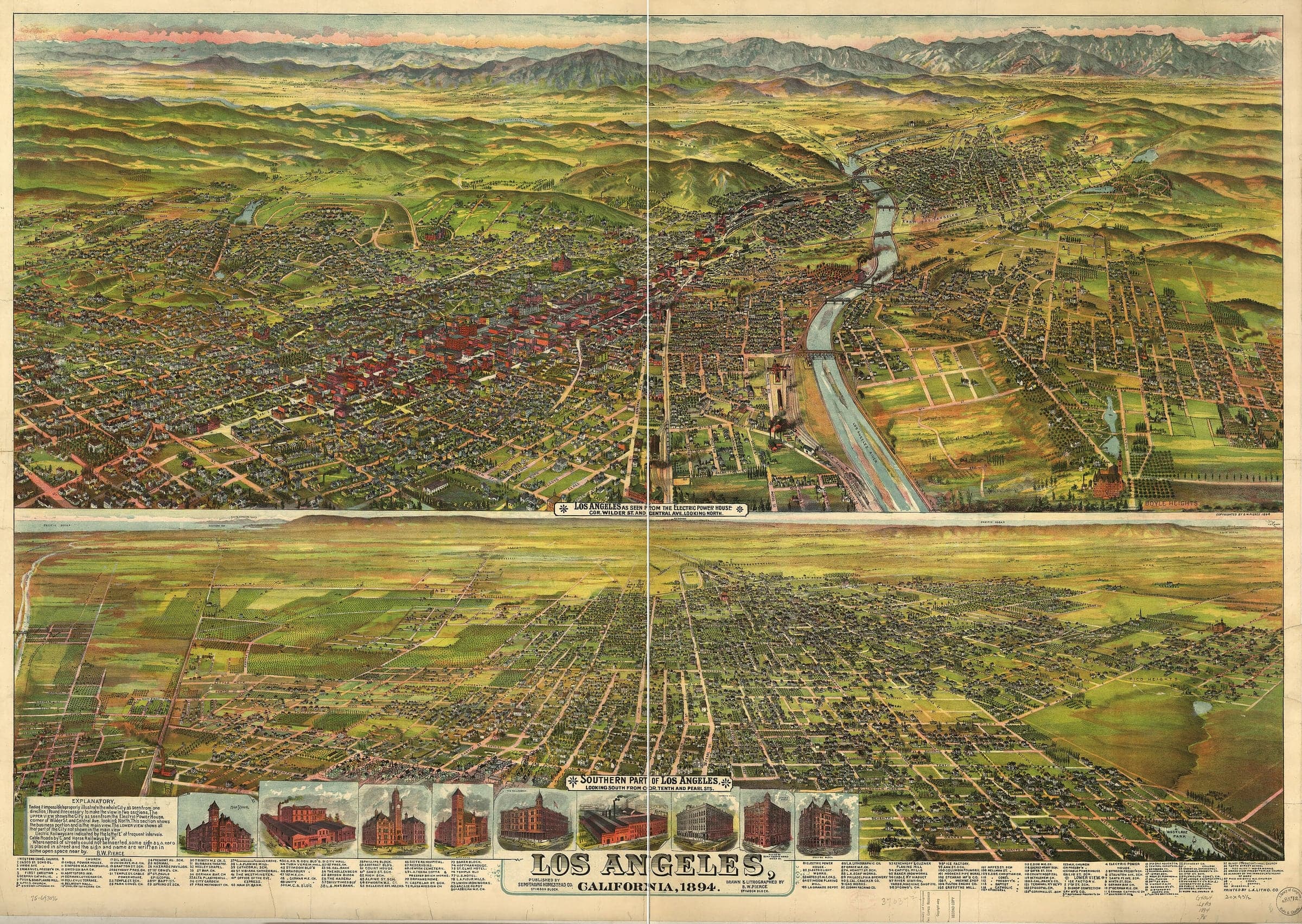
B. W. Pierce, Los Angeles, California, 1894. Public domain.
1895 to today · The churches · Featured Study
The Church of the Nazarene
A Holiness church whose own Manual of 1908 is the record of its founding and its faith.
Now may the God of peace Himself sanctify you completely, and may your entire spirit, soul, and body be kept blameless at the coming of our Lord Jesus Christ. The One who calls you is faithful, and He will do it.
- Began
- 30 October 1895 at Los Angeles, as the Manual of 1908 gives it
- Bodies
- The Church of the Nazarene, The Association of Pentecostal Churches of America, The Holiness Church of Christ
On 30 October 1895 a company in Los Angeles “formally constituted the Church, which by agreement was designated as The Church of the Nazarene.”
Summary
The Church of the Nazarene began in 1895 as one church in California and took in two other Holiness bodies by 1908. It teaches that God makes believers holy in a work after conversion.
- Phineas Bresee led its first meetings, in a hall.
- The Manual of 1908 calls that work entire sanctification.
- It holds that the work frees believers from inbred sin.
- It leaves its members free on the theories of the Second Coming.
- Its own count for 2025 is in the millions.
The Texts of the Manual
The Manual sets its teaching on Paul's prayer and on the call to repent.
The Manual's Agreed Statement of Belief holds that believers are to be “sanctified wholly,” in the King James wording of Paul's prayer in 1 Thessalonians 5:23. Under Repentance the Manual quotes Acts 17:30 in the King James words.
The call the Manual quotes
Although God overlooked the ignorance of earlier times, He now commands all people everywhere to repent.
The Manual takes from it that God calls every person to repent.
Acts 17:30BSB
The Nazarene Branch of the Family of Churches
The branch runs from the camp meetings to the church's count of 2025.
The church's line runs from the camp meetings through two unions to today.
1867
1895
- The Church of the Nazarene at Los Angeles
1907
- The Association of Pentecostal Churches of America
- The Pentecostal Church of the Nazarene
1908
- The Holiness Church of Christ
- The union at Pilot Point
2025
- The church of 2025
Penuel dates the camp meetings, the Manual dates 1895 to 1908, and the church's release of 2026 dates the last node.
How the Church Began in a Los Angeles Hall
The founders' own convictions shaped the church from its first month.
The Manual of 1908, published by authority of the General Assembly at Pilot Point, tells the founding in its historical statement. Under Rev. P. F. Bresee a company in Los Angeles “met together for public worship in a hall in that city for the first time on the first Sabbath of October, 1895.”
By the church's own count, eighty-five joined on the third Sabbath, and the number soon “increased to about one hundred.”
They were “convinced, both by the teachings of the Holy Scriptures and by their own experience, that entire sanctification necessarily implies a second work of Divine grace.”
They resolved to “follow Christ's example of preaching the Gospel to the poor.”
The Truth It Holds: Entire Sanctification
The Manual sets the work after justification.
The Manual's Doctrinal Statement calls entire sanctification “that act of God, subsequent to justification, by which regenerate believers are made free from inbred sin.”
By it they are “brought into the state of entire devotement to God, and the holy obedience of love made perfect.”
On original sin it says that sin “continues to exist with the new life of the regenerate until eradicated and destroyed by the baptism with the Holy Spirit.”
The Manual says the experience “is also known by various terms”: Christian Perfection, Perfect Love, Heart Purity, The Baptism with the Holy Spirit, The fulness of the blessing and Christian Holiness.
In 1908 the name Pentecostal and the phrase “The Baptism with the Holy Spirit” both referred to this experience of entire sanctification.
On the Second Coming the Doctrinal Statement leaves room. It says, “We do not, however, regard the numerous theories that gather around this Bible Doctrine as essential to salvation,” and grants “full liberty of belief.”
The Agreed Statement of Belief
Eight short articles stand as the belief the church asks of its members.
The Agreed Statement opens with the words “We, therefore, deem belief in the following brief statements sufficient.” Two of its eight articles concern sanctification.
Articles 6 and 7 set sanctification after justification and name the Spirit as its witness.
| Article | Its words |
|---|---|
| 6 | “That believers are to be sanctified wholly, subsequent to justification, through faith in the Lord Jesus Christ.” |
| 7 | “The Holy Spirit bears witness to justification by faith, and also to the further work of the entire sanctification of believers.” |
The Church Today
The General Secretary's release of January 2026 gives the count for 2025.
The General Secretary's release of 16 January 2026 says, “Global reports show total current membership for the Church of the Nazarene at 2,764,205.” The same release reports a net decrease of 0.62 percent from 2024.
From Los Angeles to Chicago and Pilot Point
One body joined the church at Chicago in 1907, and another at Pilot Point, Texas, in 1908.
The Association of Pentecostal Churches of America joined the church at Chicago, where the United General Assembly completed the union and “so declared by formal action, October 16, 1907.”
The Holiness Church of Christ came in at a General Assembly “called to meet at Pilot Point, Texas, October 8, 1908.”
There, the Manual says, “the union was completed by the unanimous action of all parties with great rejoicings.”
The Case Against Eradication
Wesley, Simpson and the Westminster divines each hold against the claim that inbred sin is destroyed.
The strongest case against the Manual's word “eradicated” comes from its own tradition. Wesley held that perfect love still leaves faults that need forgiveness.
In the Plain Account (1777) he wrote that “sin, improperly so called, (that is, an involuntary transgression of a divine law, known or unknown,) needs the atoning blood.”
A. B. Simpson of the Alliance taught a crisis of sanctification. Yet he wrote in The Four-Fold Gospel (1890), chapter 2, “We shall never become so inherently good that there will be no possibility or temptation to sin.”
The Westminster Confession of 1646 holds that sanctification is “imperfect in this life, there abiding still some remnants of corruption in every part.”
If we say we have no sin, we deceive ourselves, and the truth is not in us.The Reformed side sets this verse against eradication.
Books to Read Next
Manual of the Pentecostal Church of the Nazarene
The General Assembly at Pilot Point · 1908
It holds the church's historical statement, its Agreed Statement and its Doctrinal Statement.
Free at the Wesleyan Holiness Digital LibraryA Plain Account of Christian Perfection
John Wesley · 1777
Wesley sets out the perfection the Manual names as one of its terms.
Free at the Christian Classics Ethereal LibraryWhat the Church Handed On
The church handed on a Manual that set entire sanctification at the centre of its belief, and a union of three Holiness bodies. Wesley's own cautions question the Manual's word for the cure of sin.
Sources
Scripture is the Berean Standard Bible.
- The Holy Bible, Berean Standard Bible (read 2026)
- Manual of the Pentecostal Church of the Nazarene (Nazarene Publishing Company, 1908), the historical statement, pages 11 to 12, 19 and 21; the Agreed Statement of Belief, pages 23 to 24; the Doctrinal Statement, pages 26 to 29.
- Nazarene News Staff, General Secretary releases 2025 statistics (16 January 2026)
- John Wesley, A Plain Account of Christian Perfection, revised to 1777, in The Works of John Wesley, edited by Thomas Jackson (1872), volume 11, the 1759 Conference section.
- A. B. Simpson, The Four-Fold Gospel, third edition, revised (New York: Christian Alliance Publishing Co., copyright 1890), chapter 2.
- The Confession of Faith of the Assembly of Divines at Westminster (1646), chapter XIII.2, S. W. Carruthers's transcription of the manuscript (1946)
- Alexander McLean and Joel W. Eaton, editors, Penuel; or, Face to Face with God (New York: W. C. Palmer, Jr., 1869), pages 15 to 16.