
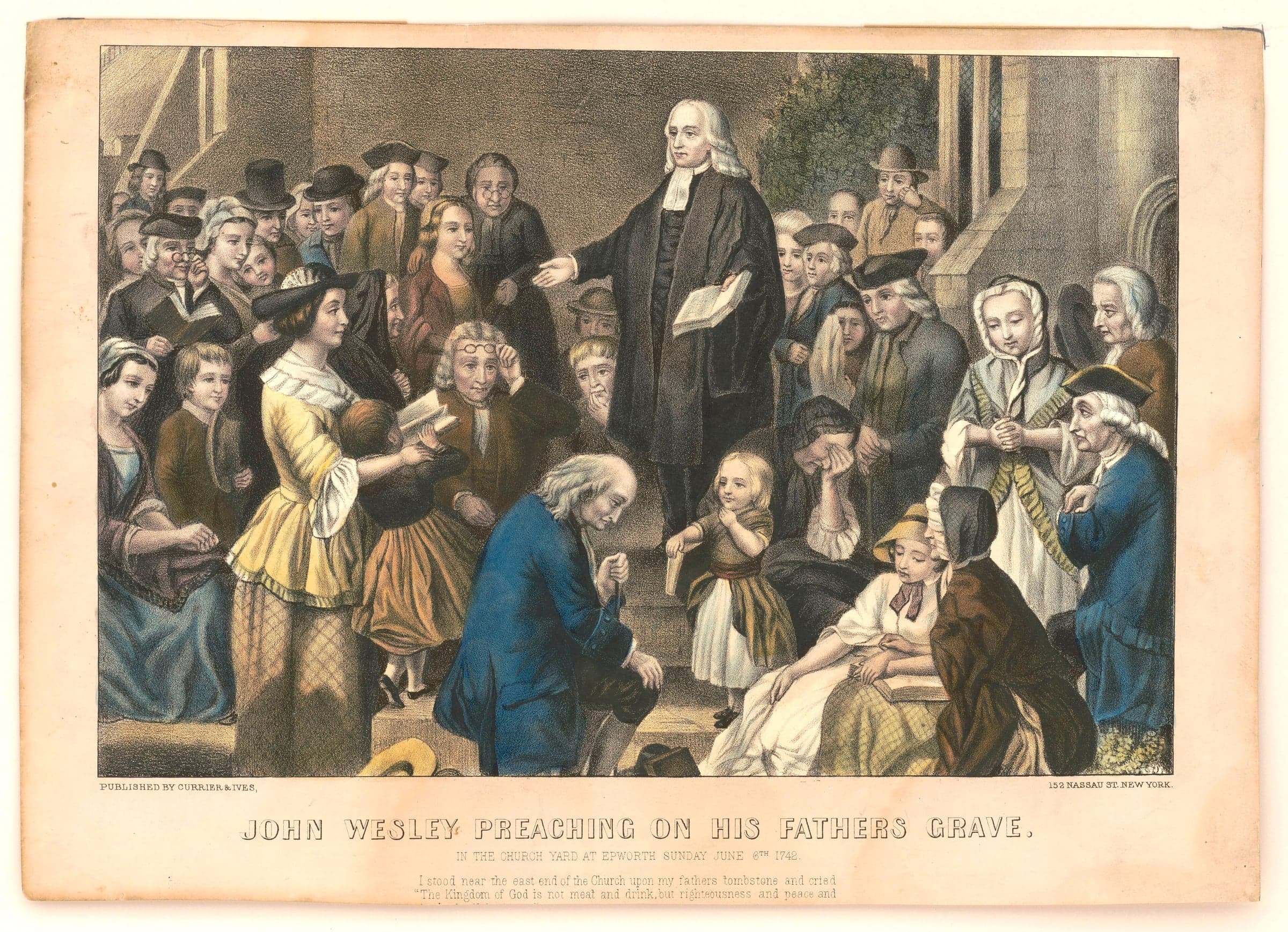
Currier and Ives, Wesley preaching on his father's grave, 1856 to 1907. Public domain.
1738 to 1771 · Story · Featured Study
Wesley and the Methodist Revival
How the Methodist revival began in London and Bristol, told from its leader's own Journal and a critic's book.
- Where
- Aldersgate Street, Bristol, Wednesbury
- Who
- John Wesley, George Whitefield
- When
- 24 May 1738 to 13 June 1771
Within a year of an evening in Aldersgate Street, John Wesley was preaching to crowds in the open air.
Summary
John Wesley's assurance of May 1738 was followed by his first sermon outdoors in April 1739. Crowds came to hear, and in 1743 a crowd tried to kill the preacher.
- Wesley took up preaching outdoors only after George Whitefield showed him the way at Bristol.
- Wesley and Whitefield quarrelled in 1741 over Wesley's sermon Free Grace.
- Later Wesley wrote that a woman with an extraordinary call might preach.
The Days and the Verses That Marked Them
The texts come from 2 Peter 1, Mark 12, Luke 4, James 5 and Hebrews 13.
Wesley's Journal ties the turns of the revival to verses of Scripture. His first sermon in the open air was on Luke 4:18.
Through these He has given us His precious and magnificent promises, so that through them you may become partakers of the divine nature, now that you have escaped the corruption in the world caused by evil desires.Wesley opened his Testament at this verse on the morning of his assurance.
When Jesus saw that the man had answered wisely, He said, “You are not far from the kingdom of God.” And no one dared to question Him any further.He opened it again at these words of Jesus as he went out.
Therefore confess your sins to each other and pray for each other so that you may be healed. The prayer of a righteous man has great power to prevail.Wesley gives the rule of the bands of 1739 in the words of this verse.
Jesus Christ is the same yesterday and today and forever.Wesley preached on this verse at noon on the day the mob took him.
James 5:16, Hebrews 13:8
The Revival Told Plainly, 1738 to 1771
It moves from an evening in London to a field at Bristol, a quarrel, a mob and a letter.
Wesley's Journal, his own record as the movement's leader, says that on the evening of 24 May he went “very unwillingly” to a society in Aldersgate Street. Someone there was reading Luther's preface to Romans.
“About a quarter before nine,” he wrote, “while he was describing the change which God works in the heart through faith in Christ, I felt my heart strangely warmed.”
The next spring, on Saturday 31 March, he met George Whitefield at Bristol. Whitefield was to set him an example of preaching in the fields on the Sunday.
Wesley wrote that he “could scarce reconcile my-self at first to this strange way of preaching in the fields.” He had been all his life “so tenacious of every point relating to decency and order.”
On 2 April he preached from “a little eminence in a ground adjoining to the city, to about three thousand people,” a number that is his own estimate.
Two days later three women agreed to meet together weekly, and four young men did the same.
By 1741 Whitefield had printed an answer to Wesley's sermon Free Grace. On 4 April Wesley objected to him “That it was quite imprudent to publish it at all.”
On 20 October 1743 a mob took Wesley at Wednesbury and carried him “through the main street, from one end of the town to the other.”
“Many cried out, ‘No, no! knock his brains out; down with him; kill him at once.’”
He came back to Wednesbury a little before ten, “having lost only one flap of my waistcoat, and a little skin from one of my hands.”
In 1771 Mary Bosanquet was preaching, and on 13 June Wesley wrote to her from Londonderry. “I think the strength of the cause rests there,” he wrote, “on your having an extraordinary call.”
He went on, “It is plain to me that the whole work of God termed Methodism is an extraordinary dispensation of His providence.”
Who Tells the Story: the Leader and His Critic
Wesley's Journal and a hostile book, each named for what it is.
Almost every scene of these years comes from Wesley's Journal, which he published himself and which the New York edition of his Works carried in 1831. It is the movement's own record, written by its leader, and it reports his estimates of his crowds as his.
The hostile press is the second witness. The Enthusiasm of Methodists and Papists Compar'd was printed in London in 1749 without its author's name.
The Internet Archive catalogues it under George Lavington, and it speaks of “that Enthusiastic and Fanatical Spirit now working in a set of pretended Reformers among us.”
What the Record Leaves Unsaid
One witness for Aldersgate, and Wesley's own account of Wednesbury.
None of the others in the room left an account that has been found, so Wesley is the one witness to his own evening.
For the night at Wednesbury the account is Wesley's own, and the crowd's cries are the words he remembered.
Books to Read Next
The Works of the Reverend John Wesley, volume III, his Journal
John Wesley · 1831
It holds Aldersgate, Bristol and Wednesbury in Wesley's own words.
Free at the Internet ArchiveThe Enthusiasm of Methodists and Papists Compar'd
Catalogued under George Lavington · 1749
It is the movement's critic, writing in the revival's first decade.
Free at the Internet ArchiveWhat the Revival Left
Through every one of these scenes Wesley kept dating his days and naming the text he preached. The man who had thought saving souls outside a church almost a sin became the preacher of the open field.
Sources
Scripture is the Berean Standard Bible.
- The Holy Bible, Berean Standard Bible (read 2026)
- John Wesley, Journal, 1738 to 1743, in The Works of the Reverend John Wesley, A.M. (New York: J. Emory and B. Waugh, 1831), volume III, pages 74, 126 to 127, 207 and 296 to 297.
- The Enthusiasm of Methodists and Papists Compar'd (London: J. and P. Knapton, 1749), the preface, catalogued under George Lavington.
- John Wesley to Mary Bosanquet, Londonderry, 13 June 1771, in Wesley's Letters: 1771 (Wesley Center Online, Northwest Nazarene University; the print edition is not named on the Wesley Center page)
Keep Studying
People and groups5
Doctrines1
Trials of life1
Subjects1
Church history2