
1675 to 1738 · Subject · Featured Study
The Pietists
Spener's proposals of 1675, Francke's orphan house at Halle, and the line from them to Herrnhut and John Wesley.
Philipp Jakob Spener was asked for a preface to a new edition of Arndt's sermons, and the preface he wrote became the book Pia Desideria.
- Books
- Colossians, 1 Peter, John, 1 John
- Hold in memory
- Colossians 3:16, 1 Peter 2:9
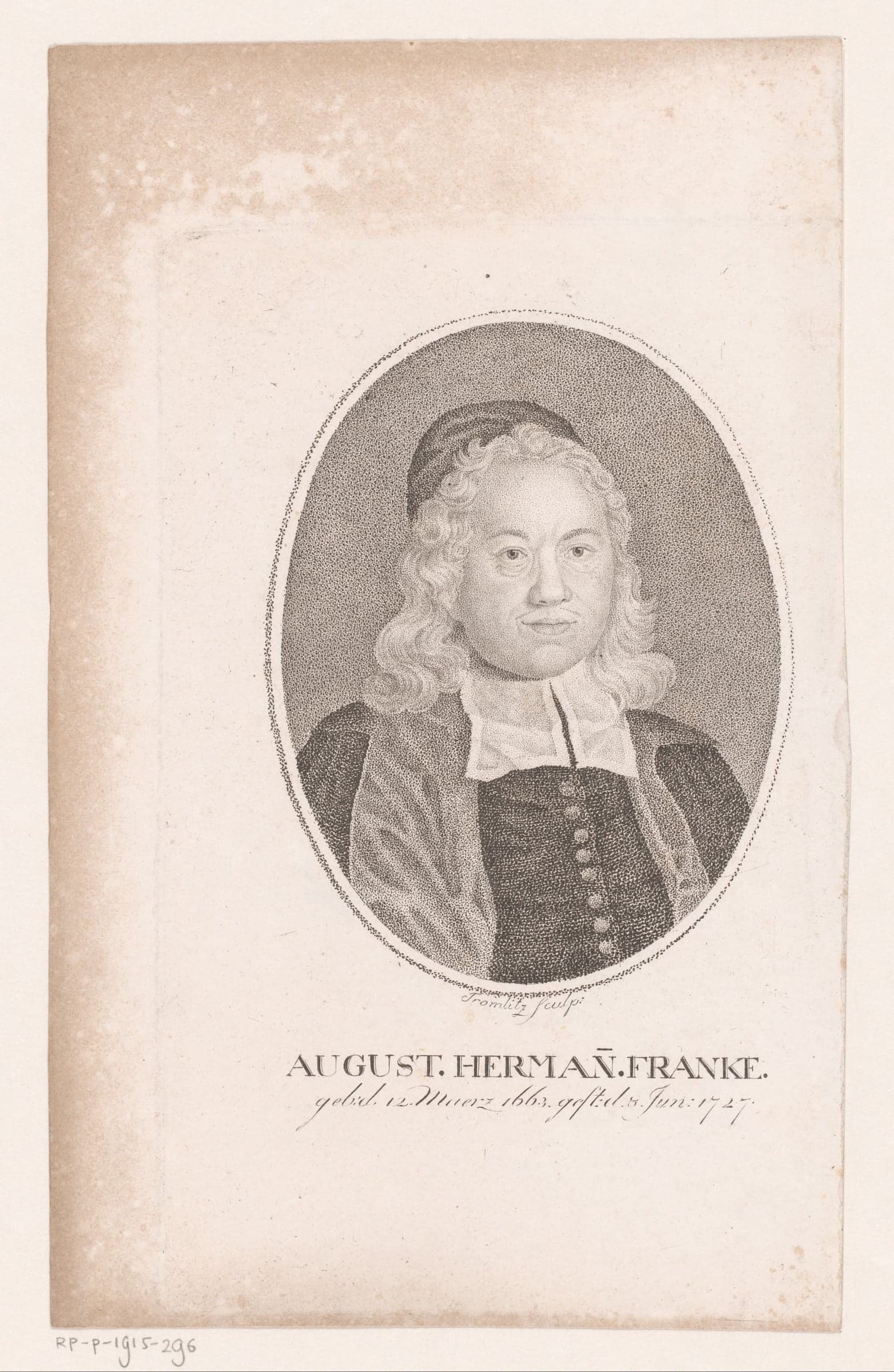
Unknown printmaker, Portrait of August Hermann Francke, 1777. Public domain.
Let the word of Christ richly dwell within you as you teach and admonish one another with all wisdom, and as you sing psalms, hymns, and spiritual songs with gratitude in your hearts to God.
Summary
The Pietists were Lutherans who worked to renew their own church. They asked for more of the Bible among the people and a faith lived out in love.
- Spener's Pia Desideria came out in 1675, as the 1911 Britannica dates it.
- Francke built a school and an orphan house at Halle from the gifts in one alms box.
- Count Zinzendorf of Herrnhut went to school at Halle.
- Wesley called at Halle twice in the summer of 1738.
The Verses Spener and Francke Set Before the Church
Spener grounded his proposals in Colossians 3, 1 Corinthians 14, 1 Peter 2 and John 13, and Francke his alms box in 1 John 3.
Spener's book, in its Frankfurt printing of 1706, rests each of its first proposals on Scripture. Francke wrote two verses on the alms box that began his work at Halle, and a third met him the day before.
Spener's proposals, 1675
Let the word of Christ richly dwell within you as you teach and admonish one another with all wisdom, and as you sing psalms, hymns, and spiritual songs with gratitude in your hearts to God.
Spener quotes it as the warrant for reading the whole Bible among the people and for meetings to study it.
What then shall we say, brothers? When you come together, everyone has a psalm or a teaching, a revelation, a tongue, or an interpretation. All of these must be done to build up the church.
Spener asks for meetings in the apostolic manner Paul sets out in 1 Corinthians 14, where more than one believer speaks.
But you are a chosen people, a royal priesthood, a holy nation, a people for God’s own possession, to proclaim the virtues of Him who called you out of darkness into His marvelous light.
Spener proves the priesthood of every believer from these words, as Luther had.
1 Peter 2:9BSB
A new commandment I give you: Love one another. As I have loved you, so you also must love one another. By this everyone will know that you are My disciples, if you love one another.”
Spener cites it for love as the mark of Christ's disciples, though his printer set the reference as John 14.
Francke's alms box, 1695
If anyone with earthly possessions sees his brother in need, but withholds his compassion from him, how can the love of God abide in him?
Francke wrote this verse over the alms box he fixed in his parlour.
1 John 3:17BSB
Each one should give what he has decided in his heart to give, not out of regret or compulsion. For God loves a cheerful giver.
Francke wrote this verse under the same box.
And God is able to make all grace abound to you, so that in all things, at all times, having all that you need, you will abound in every good work.
Francke writes that this verse met him, as if by accident, the day before he set up the box.
1 John 3:17, 2 Corinthians 9:7, 2 Corinthians 9:8
From Arndt to Wesley
The dated steps run from Arndt's book to Wesley's visits to Halle.
The current ran from Arndt's book of 1606 to Wesley's visits to Halle in 1738, a span of about 130 years.
- Arndt writes True Christianity1606 to 1609The 1911 Britannica, Arndt, Johann
- Spener publishes Pia Desideria1675The 1911 Britannica, Pietism, the one source for the year
- Francke's charity school opens at HalleEaster 1695Francke's own account, English of 1705
- The Danish mission reaches TranquebarJune 1706The Halle mission's report printed in London in 1716
- Zinzendorf at school at HalleAugust 1710 to April 1716Spangenberg, Life of Zinzendorf, English of 1838, pages 6 to 10
- Wesley at HalleJuly and August 1738Wesley, Journal, edition of 1831, volume III, pages 81 and 106 to 107
A timeline of dated steps, each row naming the record that fixes its date.
The era of the Puritans and the Pietists holds the wider story of these years in England, New England and Germany.
What the Record Says Beside the Era Page
MannaFest's era page on the Puritans and Pietists tells Halle's mission and money more strongly than the sources do.
Francke's own account and the report of 1716 claim less than the era page.
| The era page says | What the record says |
|---|---|
| The Halle men were the first Protestant missionaries most historians count | The report of 1716 gives the arrival at Tranquebar and claims no first. Hutton names Ziegenbalg among the Danish state's missionaries. |
| Francke refused to solicit funds and kept a ledger of answered prayers | Francke writes that he kept the box from the rich, fearing they would not part with their money, and names no ledger. |
Spener's Six Proposals and Francke's Halle
Spener's book and meetings began the movement, and Francke built on them at Halle.
Johann Arndt, who lived from 1555 to 1621, wrote True Christianity between 1606 and 1609 on the union of the believer with Christ. The 1911 Britannica says the German Pietists held him “in very high repute.”
Spener held meetings at his house in Frankfurt, the collegia pietatis, where he repeated his sermons and opened passages of the New Testament for those present. The Britannica says these meetings “gave rise to the name ‘Pietists.’”
A Lutheran superintendent, whose opinion was printed with the book and who is an interested witness for that reason, says that at first he heard ill reports of the meetings. Then he learned they were held “nur bloß zu Göttlicher ehr / und geistlichem wachsthum,” in MannaFest's English only for God's honour and for spiritual growth.
The six proposals, as the printing of 1706 gives them1 table, 2 paragraphs
The six proposals in MannaFest's English, from Spener's German in the Frankfurt printing of 1706.
| Proposal | What Spener asks | Its ground |
|---|---|---|
| 1 | More of the Word of God among the people, the books of the Bible read in order, and meetings where gifted believers speak | Colossians 3:16 and 1 Corinthians 14 |
| 2 | The setting up and diligent exercise of the spiritual priesthood | Luther, and 1 Peter 2:9 |
| 3 | A Christianity that stands in practice more than in knowledge | John 13:34 to 35 and the letters of John |
| 4 | Love toward the erring, so they see that all is done from love for them | Spener's own counsel |
| 5 | Fit ministers trained in the schools and the universities | Spener's own counsel |
| 6 | Preaching aimed at the inner man, so that faith and its fruits grow in the hearers | Spener's own counsel |
Spener's German for the second proposal reads “die auffrichtung und fleissige übung des Geistlichen Priesterthums.”
For the third, he writes that Christianity must “in der praxi bestehe,” stand in practice.
August Hermann Francke told the beginning of Halle himself in Pietas Hallensis, printed in English in 1705 for readers who might give. Early in 1695 he fixed an alms box in his parlour, with a verse over it and another under it as a silent call to all who came in.
About a quarter of a year later one gift came to a sum the English translator gives as eighteen shillings and sixpence. Francke took it as the foundation of a charity school, which began about Easter 1695.
In 1696, a week before Whitsuntide, Francke began to lodge orphans in a house. He records that in 1698, “on the 13th of July, the Foundation for an Hospital was laid in the Name of God.”
Where the Current Ran: Tranquebar, Herrnhut and Wesley
Danish missionaries reached India, Halle schooled Zinzendorf, and Wesley came to see it in 1738.
Part III of Francke's account, printed in English in 1716, says two young candidates of divinity, Bartholomew Ziegenbalg and Henry Plutscho, were sent by the King of Denmark. It says they reached Tranquebar the next June, in 1706, and that Ziegenbalg could preach in the Malabar tongue within eight months.
Spangenberg, Zinzendorf's colleague and an interested witness, writes that Spener was a sponsor at the baptism of Zinzendorf, born at Dresden on 26 May 1700. The 1911 Britannica calls Zinzendorf Spener's godson, and nothing shows it had a source apart from Spangenberg.
Spangenberg reports the Count saying that his institutions in Upper Lusatia began from Spener's idea of little churches inside the great church.
On his way to Herrnhut in July 1738, John Wesley came to Halle and sent a note to Professor Francke, “the son of that August Herman Francke whose name is indeed as precious ointment.”
At the Orphan House Wesley was told that six hundred and fifty children were wholly maintained there, a figure he gives as what “we were informed.”
He thought about three thousand more were taught.
On 19 August, on the road home from Herrnhut, Wesley called on Professor Francke and on Professor Knappe at Halle.
Where the Pietists Were Opposed
Wittenberg charged Spener with errors, and Halle bred the first resistance to Zinzendorf.
The 1911 Britannica, the one source for the number, reports that in 1695 the theological faculty of Wittenberg formally laid 264 errors to Spener's charge.
The same work names Loescher, superintendent at Dresden, among the leaders of the reaction against the Pietists at the start of the eighteenth century.
Spangenberg adds that the opposition Zinzendorf met for the rest of his life began at Halle, in the Pietist school that formed him.
Spener had rested his proposals on Luther, on 1 Peter 2:9 and on the love texts of John.
Books to Read Next
Pia Desideria
Philipp Jakob Spener · 1675
It is the founding text in German, with two opinions printed after it.
Free scan of the 1706 printingPietas Hallensis
August Hermann Francke · 1705
Francke tells the beginning of his work in his own words, for readers who might give.
Free scan of the 1705 EnglishThe Life of Nicholas Lewis Count Zinzendorf
August Gottlieb Spangenberg, translated by Samuel Jackson · 1838
Spangenberg tells Zinzendorf's baptism and his years at Halle.
Free at the Internet ArchiveThe Works of the Reverend John Wesley, volume III, his Journal
John Wesley · 1831
Wesley records his two calls at Halle in the summer of 1738.
Free scan of volume IIIWhat the Pietists Handed On
Spener and Francke left a book of proposals and a school that began with one gift in a box. Within a lifetime their work reached Tranquebar, Herrnhut and Wesley's journal.
Sources
Scripture is the Berean Standard Bible.
- The Holy Bible, Berean Standard Bible (read 2026)
- Philipp Jakob Spener, Pia Desideria (1675), Frankfurt printing of 1706 with two appended opinions, the proposals on pages 101 to 126 and the superintendent's opinion on page 274.
- Encyclopaedia Britannica, eleventh edition (1911), volume 21, Pietism.
- Encyclopaedia Britannica, eleventh edition (1911), volume 25, Spener, Philipp Jakob.
- Encyclopaedia Britannica, eleventh edition (1911), volume 2, Arndt, Johann.
- August Hermann Francke, Pietas Hallensis (London: J. Downing, 1705), sections IV to VIII and XXVIII, page 29.
- August Hermann Francke, Pietas Hallensis, Part III (London, 1716), Of the Mission to the East Indies.
- August Gottlieb Spangenberg, The Life of Nicholas Lewis Count Zinzendorf, translated by Samuel Jackson (London, 1838), chapter I and pages 6 to 10 and 41.
- John Wesley, Journal, July and August 1738, in The Works of the Reverend John Wesley (New York: J. Emory and B. Waugh, 1831), volume III, pages 81 and 106 to 107.
- J. E. Hutton, A History of the Moravian Church, second edition (1909), Book Two, chapter VI.
Keep Studying
People and groups6
Doctrines1
Values2
Subjects1