
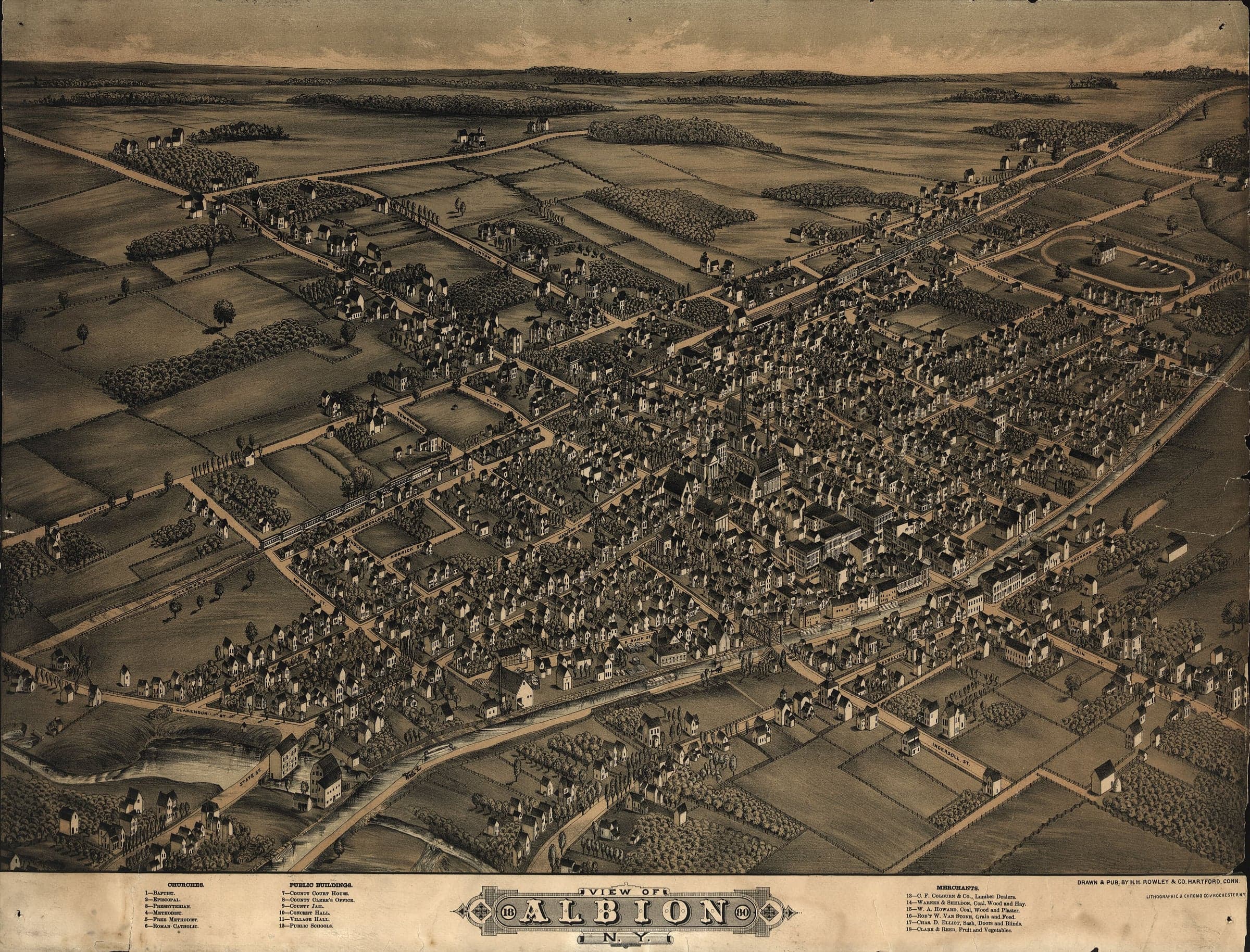
H. H. Rowley and Co., View of Albion, N.Y., 1880. Public domain.
1858 to 1891 · The churches · Featured Study
The Free Methodist Church
A Methodist church formed in 1860 that required every seat in its churches to be free and taught entire sanctification.
There is neither Jew nor Greek, slave nor free, male nor female, for you are all one in Christ Jesus.
- Began
- 23 August 1860 at Pekin, New York (Roberts names Pekin; the Cyclopaedia of Methodism gives the day)
- Bodies
- The Free Methodist Church
Roberts recorded that on 1 December 1858 “one hundred and ninety five leading men, from forty-seven circuits and stations,” met at Albion, New York, to protest the expulsion of two preachers.
Summary
The Free Methodist Church began in 1860 in New York and Illinois. B. T. Roberts was its first leader.
- A small church in Illinois took the name first.
- It taught that God makes a believer holy in an instant.
- It grew each time it was counted.
- Roberts wrote in 1891 that women should be ordained.
The Texts Behind the Church's Calling
Roberts used the King James words of Luke 4:18 and set Paul's words on oneness in Christ over his book on women.
Roberts's phrase “preach the Gospel to the poor” follows the King James wording of Jesus' words at Nazareth. Ordaining Women (1891) carries Galatians 3:28 on its title page.
Good news to the poor
“The Spirit of the Lord is on Me, because He has anointed Me to preach good news to the poor. He has sent Me to proclaim liberty to the captives and recovery of sight to the blind, to release the oppressed, to proclaim the year of the Lord’s favor.”
Jesus reads these words of Isaiah at Nazareth, and their King James form gave Roberts his words for the church's work.
The Free Methodist Branch of the Family of Churches
The branch runs from the Methodist Episcopal Church to the ten conferences of 1876.
The church came out of the Methodist Episcopal Church through conventions in 1858 and 1860.
1784 to 1858
- The Methodist Episcopal Church
- The convention at Albion
1860
- The society at St. Charles
- The convention at Pekin
1876
- Ten annual conferences
Wesley's letter of 1784 dates the first node, and Roberts and the Cyclopaedia of Methodism date the rest.
The Holiness churches grew up beside the Free Methodists from the camp meeting at Vineland in 1867.
The Christian Traditions sets this church among the other families, from Ephesus in 431 to the Pentecostals in 1906.
How the Church Began: the Expulsions and the Appeal
Isaac M. Chesbrough of Pekin proposed the convention at Albion.
Roberts's Why Another Sect (1879) reprints the article on the church from the Cyclopaedia of Methodism, whose author he names as Bishop Simpson. It is the parent church's account, and Roberts answers it chapter by chapter in the same volume.
The Cyclopaedia dates the church from a convention of 23 August 1860. It says the convention was “composed of ministers and laymen, who had been members of the Methodist Episcopal Church, but became dissatisfied with the workings of its government.”
It says the founders were “known as ‘Nazarites’” and that “In 1858, two of the leaders were expelled from the Conference.”
The General Conference at Buffalo in 1860, it says, “declined to entertain the appeal.”
The convention at Albion called the expulsion of Roberts and McCreery “an act of wicked persecution.”
The Truth It Kept: Free Seats, the Poor and Women
Roberts claimed a mission to the poor and an equal place for women.
In the preface to Why Another Sect Roberts wrote that the church requires “that all the seats be free.”
He added, “It has a mission from God to hold up the New Testament standard of religion; and to preach the Gospel to the poor.”
Why Another Sect also sets out the church's stand against slavery and against secret societies.
In Ordaining Women (1891) Roberts argued “That in Christ Jesus all peculiar privileges based on nationality, or condition, or sex are abolished.”
He went on, “In the Gospel one nation has the same rights and privileges as another, the bond the same as the free, the female the same as the male.”
Wesley had allowed women to preach by an extraordinary call. He wrote to Mary Bosanquet in 1771 that “St. Paul's ordinary rule was, ‘I permit not a woman to speak in the congregation.’ Yet in extraordinary cases he made a few exceptions.”
The Article on Entire Sanctification
The convention of 1860 wrote the second work of grace into its articles.
The Cyclopaedia printed the church's article, and Roberts reprinted it whole: “Entire sanctification takes place subsequently to justification, and is the work of God, wrought instantaneously upon the consecrated, believing soul. After a soul is cleansed from all sin, it is then fully prepared to grow in grace.”
The article sets growth after the moment of cleansing, as Wesley did in A Plain Account of Christian Perfection (1777): “there is a gradual work, both before and after that moment.”
The Church in Its Own Counts
Membership grew more than fourfold in sixteen years.
Roberts printed the church's own counts in his appendix of 1879, with no method of counting: 2,498 members in 1862, 4,889 in 1866, 6,556 in 1870, 7,466 in 1874 and 10,682 in 1878.
At its founding, the Cyclopaedia says, the church “accepted the doctrines of Methodism, as contained in the Articles of Religion.”
Where the Church Began
It began in New York and in Illinois and stayed in the North.
A society in Illinois took the name four months before the Discipline was adopted in New York.
| Date | Place | What happened there |
|---|---|---|
| 27 April 1860 | St. Charles, Illinois | A society of 112 members, by Roberts's count, took the name. |
| August 1860 | Pekin, New York | A convention adopted the Discipline and elected Roberts General Superintendent. |
At St. Charles the society “organized themselves into an independent church, with the name of Free Methodist.” By the Cyclopaedia's account the church remained “confined almost exclusively to the Northern states.”
The Charge of Fanaticism
The parent church charged the new church's early leaders with wild fanaticism.
The Cyclopaedia says, “In its early history, some of its leaders encouraged a spirit of wild fanaticism, claiming the power of healing by the laying on of hands.”
Roberts answered that the article held “some fifteen statements or re-statements, which are utterly untrue” (page 17). He printed the reply of the preachers charged with forming a Nazarite association: “This charge we declare to be as groundless as the other. We have never encouraged excesses.”
The parent church is the hostile witness here and Roberts the interested one.
Books to Read Next
Why Another Sect
B. T. Roberts · 1879
It is the founders' own case for their church, written twenty years on.
Free at the Internet ArchiveOrdaining Women
B. T. Roberts · 1891
Roberts argues from Scripture that women may be ordained.
Free at the Internet ArchiveWhat the Church Handed On
The church handed on free seats for the poor, an instant work of holiness and an early case for ordaining women. It kept the Methodist Articles of Religion while it left the Methodist Episcopal Church.
Sources
Scripture is the Berean Standard Bible.
- The Holy Bible, Berean Standard Bible (read 2026)
- B. T. Roberts, Why Another Sect (Rochester: The Earnest Christian Publishing House, 1879), the preface, pages 17, 19 to 21, 25 (the Cyclopaedia of Methodism reprinted), 191 to 192, the chapter on St. Charles, and the appendix, pages 330 to 331.
- B. T. Roberts, Ordaining Women (Rochester: Earnest Christian Publishing House, 1891), title page and page 58.
- John Wesley, letter to Mary Bosanquet, Londonderry, 13 June 1771 (the print edition behind the online text is not named on its page)
- John Wesley, A Plain Account of Christian Perfection, revised to 1777, in The Works of John Wesley, edited by Thomas Jackson (1872), volume 11.
Keep Studying
Studies1
People and groups5