
Skip to content
mannafest.faith
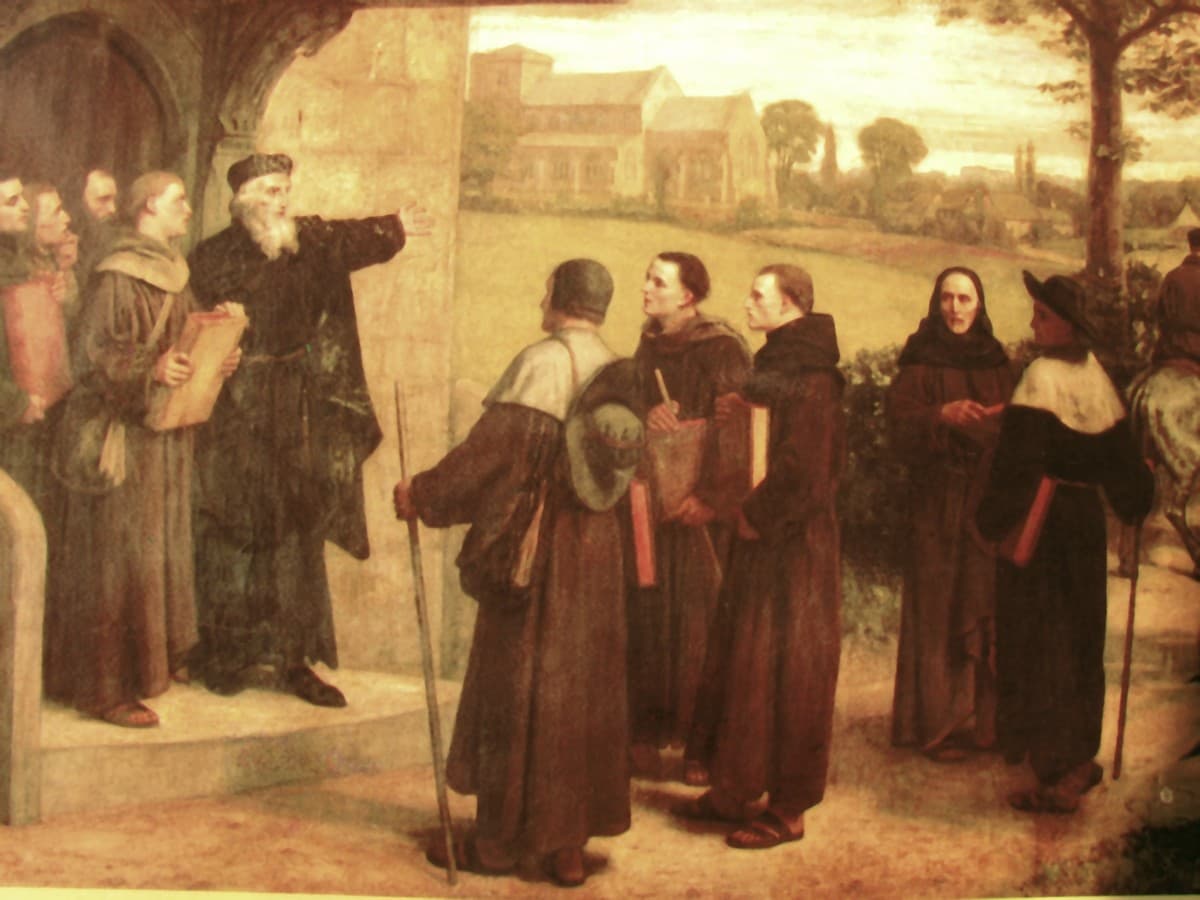
Wycliffe Giving 'The Poor Priests' His Translation

Wycliffe Giving 'The Poor Priests' His Translation, W. F. Yeames, public domain

The Great Cloud of Witnesses, era 4 of 10 · Church history · Featured Study

The Long Middle

Nine hundred years, and the usual summary is "the dark ages." It is not that simple. The institution grew corrupt in places, and at the same time monks copied Scripture by hand, missionaries walked into pagan Europe, and God kept a lamp burning.

Span
AD 600–1500
Boundary
The span closes at 1500 because the Reformation opens in the next generation.

For nine hundred years the faith in Europe was kept by monks and taught in new schools.

Summary

In 1054 east and west broke apart. They have not come back.

  • Benedict wrote his Rule about AD 530. It set the shape of monk life for a thousand years.
  • The split of 1054 had been coming for centuries.
  • Anselm wrote about 1078. Thomas Aquinas began his Summa in 1265.
  • The first crusade was called in 1095. The fourth sacked Christian Constantinople in 1204.
  • Wycliffe died in 1384 and Hus was burned in 1415.

The era's own voice

Why he wrote it: Anselm wrote the Proslogion in the monastery at Bec as a meditation, looking for a single argument for God that would need no other, and he addresses it to God rather than to an opponent. The famous sentence about believing in order to understand is a description of what he is doing in the book.

What else says so: Eadmer, his companion and secretary, describes the writing of it in the Life of Anselm, finished about 1114, and the monk Gaunilo's reply and Anselm's answer to it were copied with the book from the start.

“I do not seek to understand that I may believe, but I believe in order to understand. For this also I believe: that unless I believed, I should not understand.”

Anselm of Canterbury (c. 1033–1109) · Proslogion, chapter 1 (c. 1078); Sidney Norton Deane translation, 1903

The turning points

The era hangs on these moments, each with a document a reader can open.

  1. 731Bede finishes his history of the English churchIt is the best written source for how a whole people was converted, by a monk who names his informants and says where he is unsure.Bede, Ecclesiastical History of the English People, 731
  2. 1054East and West break apartThe act that day formalised a separation already a century old, and it has never healed.The mutual excommunications of 1054, recorded by Humbert of Silva Candida and in the Greek accounts of Cerularius
  3. 1274Thomas Aquinas dies with the Summa unfinishedIt is the high point of the medieval attempt to set out the whole faith in order, and it is still the framework Catholic theology argues inside.Thomas Aquinas, Summa Theologiae, 1265 to 1274
  4. 1382The Bible in English, and the LollardsThe first complete English Bible, made by hand, and the reason its makers were hunted tells you what the century thought a Bible in the people's language would do.The Wycliffe Bible, 1382 to 1395
  5. c. 1455Gutenberg prints a BibleEverything the next century did depended on it: a book could now be copied faster than it could be suppressed.The Gutenberg Bible, Mainz, about 1455

The 5 turning points of The Long Middle, AD 600–1500, in order, each with the document that records it and why it earned its place.

The story

A farmer in 1100 heard the Bible only as it was read aloud in Latin, a language he did not speak, and learned the story from carvings, windows and plays performed outside the church door. He would have thought owning a book was something kings did.

People call these centuries "the dark ages," and the label does more harm than good. Yes, the lights of the old Roman world went out, learning shrank, and much of the church's leadership grew rich, political, and cruel. But a lamp kept burning the whole way through. If you own a Bible today, someone in this era copied it by hand so that you could.

The Light shines in the darkness, and the darkness has not overcome it.
John 1:5BSB

"The light shineth in the darkness; and the darkness apprehended it not." This is the whole era in one sentence, the lamp was never put out, however dark the room got.

When the empire collapsed, monasteries became lifeboats. Under Benedict's Rule, work and prayer, in balance, communities took in travelers, farmed, taught children, and above all copied books. A single Bible took one man the better part of a year and the skins of a small herd of animals. In the cold scriptorium at Jarrow, Bede wrote the history that still tells us what happened; he died in 735 dictating John's Gospel into English, and finished the last sentence before he stopped.

The gospel went north with men who had every reason to stay home. Patrick had been kidnapped from Britain at sixteen and sold as a slave in Ireland; when he escaped, he went back, voluntarily, to the people who had taken him. From Ireland Columba sailed to Iona in 563, and from Iona Aidan came down to Lindisfarne in 635, walking rather than riding so he could talk to whoever he met on the road.

Your word is a lamp to my feet and a light to my path.
Psalm 119:105BSB

The verse the copyists lived by. Monks spent years of their lives hand-copying Scripture, and the Waldensians memorized it because owning a page could cost them everything.

Then England repaid the favor. In the 720s an English monk named Boniface walked into the German forests and cut down an oak sacred to Thor at Geismar while the crowd waited for the god to strike him dead. Nothing happened. The early account says he built a chapel out of the wood. He kept at it for thirty more years and was killed in Frisia in 754; the monastery at Fulda still displays a book, slashed through, said to be the one he lifted against the swords.

On Christmas Day in the year 800 a pope crowned Charlemagne emperor, and Europe got a Christian empire. That brought real good, schools, scholars, a clean new handwriting (our lowercase letters come from it), and manuscripts copied by the thousand. It also brought a terrible confusion. Charlemagne's wars in Saxony forced baptism at the point of a sword, and one campaign in 782 is reported to have ended in the execution of thousands of prisoners. A faith that spreads by conquest has already lost something it cannot get back by winning.

The grass withers and the flowers fall, but the word of our God stands forever.”
Isaiah 40:8BSB

Rome fell, empires rose and split, popes fought kings, and the Word of God outlasted all of it, which is exactly what this verse promised.

The other instinct was healthier. In 863 two brothers from Thessalonica, Cyril and Methodius, went to the Slavic peoples and did something obvious that almost nobody was doing: they built an alphabet so those people could read Scripture in their own language. Churchmen objected that only Hebrew, Greek, and Latin were fit for holy things. The brothers appealed to Rome and, in 868, won. Everything Wycliffe and Tyndale would later be hunted for was already settled, once, in their favor.

In 1054 the church tore in half, East and West, and it is worth telling honestly because there is no cartoon villain in it. Greeks and Latins had drifted apart for centuries: different languages, different worship, a clause about the Holy Spirit that the West added to the Nicene Creed without a council, and Rome's growing claim to authority over all bishops. On July 16 papal legates left a decree of excommunication on the altar of Hagia Sophia; the patriarch excommunicated them in return. Crusader armies sacking Constantinople in 1204 made the wound permanent. Both sides had arguments; both sides had pride. The mutual condemnations were finally lifted in 1965, and the churches are still apart.

You are the light of the world. A city on a hill cannot be hidden.
Matthew 5:14BSB

What sent Patrick back to the people who had enslaved him, Columba to Iona, and Boniface into the German forests: light is for putting where the dark is.

Where did the medieval church go wrong? Name it plainly. Church offices were bought and sold. Popes commanded armies, and from 1309 the papacy sat in Avignon under French influence; from 1378 to 1417 rival popes each claimed the chair, and for a stretch there were three. Indulgences began as a way of easing the church's penances and drifted, over generations, into something that looked to ordinary people like buying forgiveness. And the Bible stayed in Latin. Books were chained in churches because they were worth more than a house, but in England the Constitutions of Oxford in 1408 went further and made it illegal to translate Scripture into English, or to own a translation, without a bishop's permission. When you have to get a license to read God's Word, something has gone badly wrong.

And yet faith burned on, often in the same building. Anselm was thinking his way to the heart of the cross while kings tried to bully him. Bernard of Clairvaux wrote about loving God for God's own sake. In 1209 a rich young man in Assisi took Jesus' words about leaving everything at face value, and Francis and his friars went out on foot to people the parish system had quit reaching. Later came the quiet writers, Julian of Norwich in her cell, Thomas à Kempis in his, whose books ordinary Protestants still read for their own souls.

The era's writings, 1 to 3 of 9: each with its date and one line on what it holds.

WritingDateWhat it holds
Bede, Ecclesiastical History of the English People731The first real history of Christianity in England, written by a monk who names his sources, and the book that gave the world the habit of dating years from the birth of Christ.
Anselm, Cur Deus Homo ("Why God Became Man")c. 1098A patient argument for why our rescue required God Himself to become a man and die, still one of the clearest books ever written on the cross.
Bernard of Clairvaux, On Loving Godc. 1128A monk who advised popes writes about loving God for God's own sake; the warm devotional stream of the Middle Ages runs through this little book.

The clearest protest came from the edges. Around 1173 Peter Waldo, a merchant of Lyons, gave his money away, paid to have the Gospels translated into everyday speech, and preached. Condemned within a decade, the Waldensians were driven into the Alpine valleys and hunted there for three hundred years. They kept the Scriptures alive by memorizing them, because a copy in the house was evidence. They were still there when the Reformation arrived, and they joined it.

Two men are called morning stars. At Oxford, John Wycliffe argued that Scripture stands above the church's custom and that a plowman had a right to read it; the English Bible his circle produced was copied by hand and carried around the country by preachers called Lollards, at the cost of prison and, after 1401, the stake. Wycliffe died in his bed in 1384. Forty-four years later his bones were dug up, burned, and thrown in a river, a small revenge that changed nothing. His writings had already reached Prague.

The era's writings, 4 to 6 of 9: each with its date and one line on what it holds.

WritingDateWhat it holds
The Waldensian Scripturesfrom c. 1175Gospels and other portions put into the common speech of southern France and the Alps, an underground Bible movement three centuries before printing made it safe.
Thomas Aquinas, Summa Theologiae1265–1274A monumental attempt to set out the whole of Christian teaching in order; brilliant and hugely influential, and later contested by the Reformers, who judged that its method leaned too heavily on Aristotle and on church tradition alongside Scripture.
The Wycliffe Bible1382–1395The first complete Bible in English, made from the Latin by Wycliffe's circle and copied by hand, around 250 manuscripts survive, which tells you how badly people wanted it.

There Jan Hus preached the same things in Czech and drew a nation. Summoned to the Council of Constance in 1415 with the emperor's written promise of safe conduct, he was tried and burned on July 6. His name means "goose" in his own language, and the tradition is that he said they might cook this goose, but a swan would come whom they could not silence. Whether or not he said it, his people kept the memory; the Bohemian Brethren organized in 1457, and their descendants become the Moravians who set the next great missionary era on fire.

The last piece was a machine. Around 1455 Gutenberg printed a Bible in Mainz, and within one lifetime the presses had produced more books than all the copyists of the previous thousand years. The hunger was already there, vernacular devotion, plays in the town square, roughly eighteen printed German Bibles before Luther ever wrote a word. Put a press beside that hunger and 1517 becomes not a miracle out of nowhere but a fire that finally found air. Nine hundred years, and God never left Himself without a witness.

The era's writings, 7 to 9 of 9: each with its date and one line on what it holds.

WritingDateWhat it holds
Julian of Norwich, Revelations of Divine Lovec. 1395The earliest surviving book written in English by a woman: a series of visions of Christ's suffering and God's kindness, written by an anchoress who lived in a cell attached to a church.
Thomas à Kempis, The Imitation of Christc. 1418–1427Short, plain chapters on following Jesus in ordinary life; after the Bible it became the most widely read Christian book in the world, and Protestants have loved it as much as anyone.
Everyman and the mystery plays15th centuryBible stories and the summons of death acted out in town squares in the local language, for people who could not read Latin, this was how Scripture came through the door.

Isaiah 40:8, Matthew 5:14

Why these years

The span closes at 1500 because the Reformation opens in the next generation. It opens about AD 600 for the reasons given on the era before it. Both dates are conveniences. The name is worse than the dates. Renaissance writers coined middle ages for the gap between their own time and the classical one, and it flattens nine centuries into one word.

What did not change

The monastery did not change. For a thousand years the same daily round of psalms, work and reading held the learning of the West together, and the manuscripts we read the fathers from were copied inside it.

The hard part

The crusades killed Jews in the Rhineland before they ever reached the east. The fourth sacked Christian Constantinople in 1204. They left a memory in the Muslim world that has not faded. The inquisitions that grew out of the thirteenth century handed the condemned to secular authorities for burning. The church of this era did these things through its own institutions and with its own arguments, and no account of the period that leaves them out is honest.

The other half of the record is a fact and not an excuse. The same institutions kept literacy alive, fed the poor at scale, ended slavery in most of western Europe by the eleventh century, and built the universities. Both halves are the same church.

Two errors keep being repeated about this period and both are false. Educated people in the middle ages did not think the earth was flat. The sphere is standard in Bede, in Sacrobosco's textbook of about 1230, and in Dante. The dark ages is a label applied from outside. Petrarch used it first, in the fourteenth century, for how the period looked to men who preferred the classical one.

What this page leaves out

This page follows the West. It leaves out Byzantium after 1054, the eastern churches under Islamic rule, the Crusades except where they bear on the split, and the scholastic argument in any detail.

What it handed the church

Your Bible reached you through this era. Every ancient text we have was carried across the collapse of the Roman world on the patience of men copying by hand in cold rooms.

The instinct to put Scripture into a person's own language was born here and never died. Cyril and Methodius built an alphabet for it, the Waldensians risked their lives for it, and Wycliffe's circle finished the first English Bible 130 years before Tyndale.

Missionary courage got its template here: Patrick going back to the people who enslaved him, Boniface walking unarmed into the German forests, Aidan traveling on foot so he could talk to whoever he met.

The era is also a standing warning. When Scripture is locked away from ordinary believers and the church's offices are for sale, corruption follows as surely as night, and no amount of institutional grandeur substitutes for an open Bible.

The protests raised by the Waldensians, Wycliffe, and Hus set the exact agenda of 1517: Scripture's authority, the gospel in the common tongue, and the difference between God's forgiveness and a receipt for it.

East and West have been divided since 1054, and both traditions kept confessing the same Nicene faith through it. That should send a Christian to prayer rather than to scorekeeping.

The dated line14 dated moments of the era in order, the turning points included

Every dated moment of The Long Middle in order, 14 in all, the turning points included.

YearMomentWhat happened
5th–6th c.The Celtic thread beginsPatrick, kidnapped from Britain as a teenager and sold into Irish slavery, goes back to his captors' island as a missionary, traditionally dated to about 432, though his own Confession tells the story without giving a single year. In 563 Columba sails from Ireland to the island of Iona and plants the monastery that will send preachers into Scotland and northern England for centuries.
590–604Gregory the Great, and a mission to EnglandA Roman monk becomes bishop of Rome during plague and famine, feeds the city, writes a handbook on pastoral care that shapes clergy for a thousand years, and in 597 sends Augustine of Canterbury with about forty monks to the Anglo-Saxons. Within a century England is sending missionaries of its own.
c. 723Boniface fells the oak at GeismarAn English monk walks into the German forests and cuts down an oak sacred to Thor, telling the crowd it is only a tree. The early account says he built a chapel from its timber. He was killed in Frisia in 754, and the Fulda monastery still shows a book said to be the one he raised against the swords.
731Bede finishes his history of the English churchAt the monastery of Jarrow in Northumbria, a monk who almost never left home writes the Ecclesiastical History of the English People, careful, sourced, and the reason we know this century at all. He is dictating a translation of John's Gospel into English when he dies in 735.
800Charlemagne crowned in RomeOn Christmas Day, Pope Leo III crowns the Frankish king emperor. It brings schools, a reform of handwriting, and copied manuscripts on a scale Europe had not seen since Rome fell, and it also welds church to sword in a way the next seven centuries never fully undo.
863Cyril and Methodius go to the SlavsTwo brothers from Thessalonica invent an alphabet so Slavic peoples can read Scripture and worship in their own speech. They are opposed by churchmen who insist only Hebrew, Greek, and Latin are holy tongues; in 868 the pope backs the brothers. Everything Wycliffe and Tyndale later fight for is already in this decision.
1054East and West break apartOn July 16, papal legates lay a decree of excommunication on the altar of Hagia Sophia in Constantinople; the patriarch, Michael Cerularius, excommunicates them back. It formalized a split that had been widening for centuries over language, the filioque clause added to the Nicene Creed in the West, and how far Rome's authority reached.
1093Anselm becomes Archbishop of CanterburyA reluctant monk-scholar takes the post and keeps thinking. His Cur Deus Homo (c. 1098) works out why the God-man had to die, a book Protestants and Catholics alike still read on the atonement. He is exiled twice for refusing to let a king run the church.
c. 1173Peter Waldo gives it all awayA wealthy merchant of Lyons hears the gospel read, sells what he has, hires translators to put the Gospels into everyday speech, and starts preaching. Condemned in 1184, his followers scatter into the Alpine valleys and keep the Scriptures alive there, often memorized, because owning a copy could cost a life.
1209Francis of Assisi and the friarsA rich young man from Assisi takes Jesus' words to the twelve literally, gives up everything, and goes preaching in a patched robe. Innocent III approves his little band around 1209–1210. Whatever came of the order later, its first fire was real: the gospel carried on foot to people the parish system had stopped reaching.
1274Thomas Aquinas dies with his great work unfinishedThe most influential theologian of the medieval West dies on March 7 at about forty-nine. The traditional account says that months earlier, after an experience during Mass, he stopped writing and said that all he had written seemed like straw. His Summa Theologiae ends mid-argument.
1382–1395The Bible in English, and the LollardsJohn Wycliffe (d. 1384) argued that Scripture, not church custom, is the final authority, and that a plowman had a right to read it. The English Bible that carries his name came out of his circle, translated from the Latin, hand-copied, and carried around by poor preachers called Lollards. Scholars still debate how much Wycliffe translated himself.
1415Jan Hus burned at ConstanceThe Bohemian preacher came to the council under the emperor's written safe conduct, was tried anyway, and was burned on July 6. The same council condemned Wycliffe; in 1428 his bones were dug up, burned, and thrown into the River Swift.
c. 1455Gutenberg prints a BibleIn Mainz, Johannes Gutenberg produces a Latin Bible with movable metal type. Within fifty years presses across Europe have turned out millions of books, and by the time Luther writes, roughly eighteen German editions of the Bible have already been printed. The stage is set.

1054, 1093, c. 1173, 1209, 1274, 1382–1395, 1415, c. 1455

Books to Read Next

The Confession of St. Patrick
Patrick

Short enough to read in one sitting, and it is Patrick in his own voice, a man who calls himself unlearned explaining why he went back to Ireland. Free, public domain.

Ecclesiastical History of the English People
Bede · 731

The best window into the early medieval church there is, written in 731 by a monk who names his sources and admits what he does not know. Free, public domain.

Cur Deus Homo ("Why God Became Man")
Anselm of Canterbury

A conversation about why our rescue required God Himself to become a man and die. Slow, clear, and still one of the best books on the cross. Free, public domain.

The Imitation of Christ
Thomas à Kempis · 1420

Short chapters on following Jesus in ordinary life, written around 1420 and loved by Protestants ever since. Read a page a day. Free, public domain.

History of the Christian Church, Vols. 4–6: Medieval Christianity
Philip Schaff

The full narrative of these nine centuries from a Protestant historian who is fair to what he disagrees with. Free, public domain.

A History of Christianity, Vol. I: Beginnings to 1500
Kenneth Scott Latourette · 1500

A modern one-volume standard for seeing how the faith actually spread across Europe and Asia in this period. Recommended by name; check a library or bookseller.

Sources

Scripture is the Berean Standard Bible.

  1. Philip Schaff, History of the Christian Church, vols. 4–6: Medieval Christianity (1888), public domain.
  2. Bede, Ecclesiastical History of the English People (AD 731), primary source.
  3. Patrick, Confession (written c. AD 450), primary source, in his own words.
  4. Anselm, Proslogion (c. 1078) and Cur Deus Homo (1098), primary sources.
  5. Thomas à Kempis, The Imitation of Christ (c. 1418–1427), primary source.
  6. John Foxe, Acts and Monuments, 1583 edition, on the Waldensians, Wycliffe and Hus.
  7. Kenneth Scott Latourette, A History of Christianity (1953), cited, not quoted.
  8. Roland H. Bainton, The Medieval Church (1962) and Christendom (1966), cited, not quoted.
  9. G. M. Trevelyan, England in the Age of Wycliffe (1899), cited, not quoted.

Every cited work: the sources registry →