
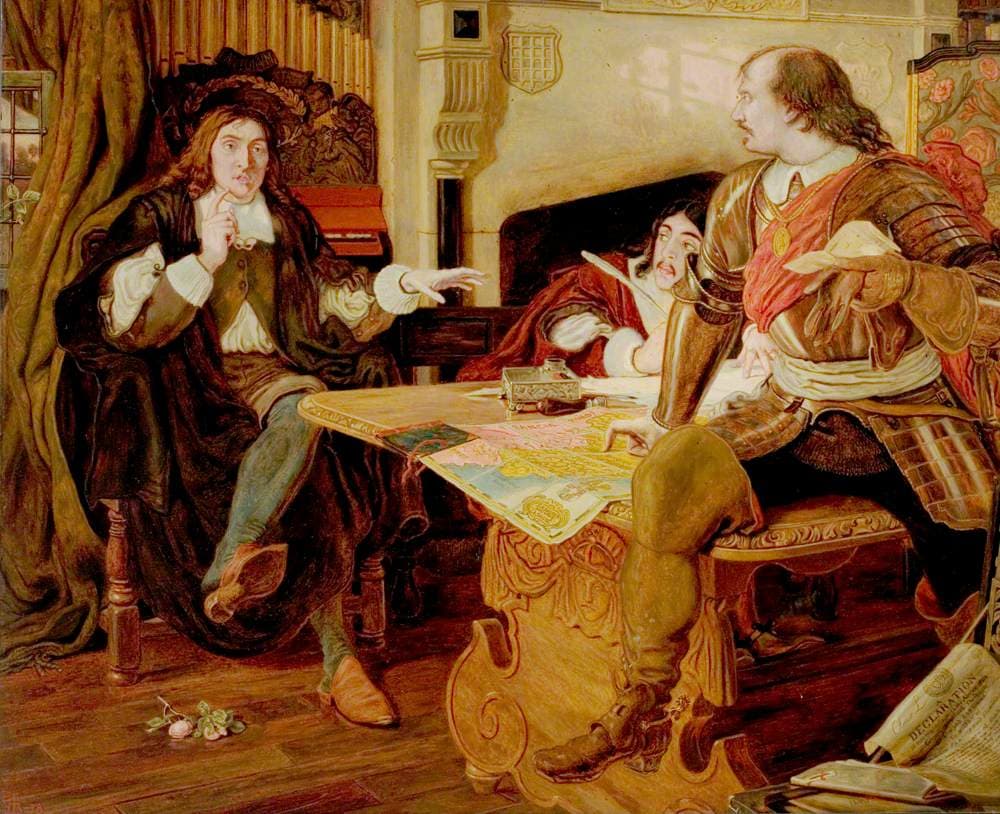
Ford Madox Brown, Cromwell and the Vaudois, 1878. Public domain.
About 1173 to today · The churches · Featured Study
The Waldensians
A movement begun at Lyon about 1173, with congregations today in Piedmont and on the River Plate.
On Saturday, 24 April 1655, at four in the morning, Muston writes, the signal for a general massacre of the Vaudois was given from the tower of the castle of La Torre.
Jesus told him, “If you want to be perfect, go, sell your possessions and give to the poor, and you will have treasure in heaven. Then come, follow Me.”
- Began
- about 1173 at Lyon, as the chronicle of Laon gives it (probable)
- Bodies
- The Tavola Valdese, The Waldensian community in Turin, The Waldensian Church of Pinerolo, The Waldensian Evangelical Church of the River Plate
On Saturday, 24 April 1655, at four in the morning, Muston writes, the signal for a general massacre of the Vaudois was given from the tower of the castle of La Torre.
Summary
The Waldensians take their name from Valdes, a rich citizen of Lyon who gave away his money. Their line runs through eight centuries of lay preaching, exile and return.
- They began as lay preachers in the twelfth century.
- They became a Reformed church in the sixteenth century.
- They were driven from their homes in the seventeenth century and came back.
- Their congregations stand today in Italy and South America.
The Texts the Waldensians Stood On
The texts come from Matthew 19, Matthew 6, Acts 5, John 1 and Revelation 6.
A chronicle written at Laon about 1218, in J. H. Robinson's English of 1905, tells how a master of theology answered Valdes with Matthew 19:21.
Verses the witnesses quote or echo
No one can serve two masters: Either he will hate the one and love the other, or he will be devoted to the one and despise the other. You cannot serve both God and money.
The chronicle has Valdes cry its first words as he cast money among the village poor.
Matthew 6:24BSB
But Peter and the other apostles replied, “We must obey God rather than men.
Peter's answer to the council says what the inquisitor Saccho reports the Waldensians taught.
Acts 5:29BSB
The Light shines in the darkness, and the darkness has not overcome it.
Its opening clause, in Latin, was the motto of the exiles who returned in 1689.
John 1:5BSB
And when the Lamb opened the fifth seal, I saw under the altar the souls of those who had been slain for the word of God and for the testimony they had upheld. And they cried out in a loud voice, “How long, O Lord, holy and true, until You avenge our blood and judge those who dwell upon the earth?”
Samuel Morland borrowed the cry of these souls in 1658 for the dead of the valleys.
The Waldensian Branch of the Family of Churches
From Lyon about 1173 to the churches named in 2015.
The Waldensian line runs from Valdes through Chanforan to the bodies named in 2015.
About 1173 and after
- Valdes at Lyon
- The Valdesii at a council in Rome
1254 to 1467
- The inquisitor's list of their teachings
- The Unity of the Brethren
1532
- The synod of Chanforan
- The Reformed and Presbyterian Churches
1655 to 1689
- The order of Lucerna
- The return under Arnaud
2015
- The Tavola Valdese
- The Waldensian Evangelical Church of the River Plate
Each generation is dated by its earliest witness, from 1173 to 2015.
In 1467, J. E. Hutton writes in his history of the Moravian Church of 1909, the Brethren “applied to Stephen, a Bishop of the Waldenses,” to ordain their first ministers.
The other families of the churches stand together with the dates on which each began.
How the Followers of Valdes Began
A chronicler at Laon and a hostile clerk at Rome tell the beginning.
The chronicle of Laon was written by an unnamed monastic writer some forty-five years after the event. It dates the turning of Valdes to “the 1173d since Lord's Incarnation” and calls him “a certain citizen, Waldo by name, who had made himself much money by wicked usury.”
He heard a troubadour sing of Saint Alexis and went to the schools of theology. He gave his wife the choice of his goods, placed his daughters in the convent of Font Evrard and fed the poor through a famine.
Walter Map, a clerk of the English king, saw the Valdesii at a council in Rome under Pope Alexander III. He called them “homines ydiotas,” men without learning, and wrote that they gave the pope a book in French holding the text and a gloss of the Psalter and of many books of both Testaments.
They asked the council for leave to preach. Map mocked them in his own account, so the two earliest witnesses are a chronicler who calls Valdes a usurer and a clerk who scorned his followers.
Muston's case for older roots3 paragraphs
Muston argued in The Israel of the Alps that Valdes had disciples, “but this does not prove that the Vaudois of the Alps descended from him.”
He rested the claim on a manuscript at Geneva he dated 1100 and one at Cambridge he dated 1120, “forty years anterior to any mention of Valdo.”
The chronicle of Laon and Map, the earliest witnesses, both begin the movement with Valdes of Lyon.
The Truth They Kept: Scripture in the People's Tongue
They read Scripture in French and obeyed God before the prelates.
Reinerius Saccho, an inquisitor writing in 1254, in S. R. Maitland's English of 1832, listed their teachings as errors. One of them reads, “That we are not to obey Prelates; but only God.”
Saccho also reports their belief that the Roman church “apostatized under Sylvester,” the earliest form of the claim to older roots.
Alexis Muston, the Waldensians' own historian, wrote The Israel of the Alps, put into English in 1853.
He records that the first resolution of the synod of Chanforan in 1532 was that “translation into French of the Old and New Testament should be made from the manuscript Romane version.”
What the Synod of Chanforan Decided
The synod of 1532 settled the articles on which the Vaudois and the reformers differed.
Muston writes that the synod met in the hamlet of Chanforans, in the valley of Angrogna, from 12 September 1532 and lasted six days.
Farel and Saulnier came from Switzerland. Muston's is a single account of the day, written for his own church.
The synod allowed the oath and kept mutual confession, as Muston records its answers.
| The question | The synod's answer |
|---|---|
| “Whether it is permissible in a Christian to take an oath” | “the reply was in the affirmative” |
| The second question | “No work should be called good, other than those which God has commanded” |
| Confession | “Auricular confession was rejected, as contrary to scripture; but mutual confession and private reprehension were maintained.” |
| “Does the Bible prohibit us from working on Sundays?” | “Man should on that day occupy himself only with works of charity or edification.” |
Muston says the second answer “introduced a slight modification into the ancient creed of the Vaudois,” so joining the reformers changed part of their older teaching.
The Waldensian Church Today
Four bodies, as Pope Francis named them at Turin in 2015.
Pope Francis's address of 22 June 2015, in the Vatican's English text, greets the Moderator of the Tavola Valdese, Pastor Eugenio Bernardini, and the pastor of the Waldensian community in Turin, Paolo Ribet.
The same address names the Waldensian Evangelical Church of the River Plate and the Waldensian Church of Pinerolo.
Where the Waldensians Lived and Went
From Lyon to the valleys of Piedmont, Geneva and the River Plate.
On the night of Friday, 16 August 1689, Muston writes, Henri Arnaud put himself at the head of his men and crossed the lake of Geneva toward the valleys.
The Waldensians' places run from Lyon in France to the River Plate in South America.
| Place | Year | The witness |
|---|---|---|
| Lyon | About 1173 | The chronicle of Laon |
| Chanforan, in the valley of Angrogna | 1532 | Muston |
| Lucerna, Lucernetta, San Giovanni, La Torre, Bubbiana, Fenile, Campiglione, Bricherasio and San Secondo | 1655 | Gastaldo's order |
| Bobbio, Villaro, Angrogna, Rorata and the country of Bonetti | 1655 | The same order |
| The lake of Geneva | 1689 | Muston |
| Turin and Pinerolo | 2015 | Pope Francis |
| The River Plate | 2015 | Pope Francis |
Milton's Sonnet on the Massacre
The poem John Milton wrote on the killings in Piedmont.
John Milton printed his sonnet “On the late Massacher in Piemont” in his Poems of 1673.
Milton asks God to avenge the dead and to raise a hundredfold from their blood.
| Lines | Milton's words |
|---|---|
| 1 to 4 | Avenge O Lord thy slaughter'd Saints, whose bones / Lie scatter'd on the Alpine mountains cold, / Ev'n them who kept thy truth so pure of old / When all our Fathers worship't Stocks and Stones, |
| 5 to 8 | Forget not: in thy book record their groanes / Who were thy Sheep and in their antient Fold / Slayn by the bloody Piemontese that roll'd / Mother with Infant down the Rocks. Their moans |
| 9 to 11 | The Vales redoubl'd to the Hills, and they / To Heav'n. Their martyr'd blood and ashes sow / O're all th' Italian fields where still doth sway |
| 12 to 14 | The triple Tyrant: that from these may grow / A hunder'd-fold, who having learnt thy way / Early may fly the Babylonian wo. |
The Order of 1655 and the Forgiveness of 2015
The order of Lucerna, Morland's charge and Francis's request.
On 25 January 1655 Andrea Gastaldo, Conservator General of the Holy Faith, ordered every family head of the “pretended Reformed Religion” in nine places to leave within three days, under pain of death. They were to withdraw to the places tolerated, Bobbio, Villaro, Angrogna, Rorata and the country of Bonetti.
It spared those who showed within twenty days that they had become Catholics or had sold their goods to Catholics.
Samuel Morland printed the order in Italian and English in 1658. His title page names him the Protector's Commissioner Extraordinary for the affairs of the valleys, so the persecutor's document reached print through an interested envoy.
In Muston's account the attack was planned “to celebrate the Easter of 1655.”
Morland charged Rome that “the Lord knows how many millions of those innocent Lambs you have most cruelly slaughtered in several parts of the World.”
He gave no count for 1655, and the number killed that year stays unknown.
On 22 June 2015, in the Waldensian Temple at Turin, Pope Francis said, in the Vatican's English text, “On behalf of the Catholic Church I ask your forgiveness.”
He asked it “for unchristian-like and even inhuman attitudes and conduct which, historically, we have had against you.”
Books to Read Next
The Israel of the Alps
Alexis Muston, translated by W. Hazlitt · 1853
Muston tells the church's story from its beginnings to his own century, Chanforan and the return of 1689 included.
Free at the Internet ArchiveThe History of the Evangelical Churches of the Valleys of Piemont
Samuel Morland · 1658
It tells the massacre of 1655 and what followed to 1658, as its title page promises.
Free at the Internet ArchiveReadings in European History
J. H. Robinson · 1905
It holds the chronicle of Laon on Valdes in English.
The chronicle free at the Internet Medieval SourcebookWhat the Waldensians Handed On
The Waldensians handed on the habit of reading Scripture in the people's own tongue, kept through exile and a return across the Alps.
The line through this page
The verse whose work this page shows continuing, then 1 link to other pages, in order of date.
The verse whose work this page shows continuing.
This page
The Waldensians
1532
The Waldensians to The Reformed and Presbyterian Churches
Farel and Saulnier came from Switzerland.
Sources
Scripture is the Berean Standard Bible.
- The Holy Bible, Berean Standard Bible (read 2026)
- The anonymous chronicle of Laon (written about 1218), translated by J. H. Robinson, Readings in European History (Boston: Ginn, 1905), pages 381 to 383.
- Walter Map, De nugis curialium, distinction I, chapter 31, edited by M. R. James (Anecdota Oxoniensia, 1914), page 60.
- Reinerius Saccho, Of the Sects of the Modern Heretics (1254), translated by S. R. Maitland, History of the Albigenses and Waldenses (1832), pages 407 to 413.
- Alexis Muston, The Israel of the Alps, translated by W. Hazlitt (London: Ingram, Cooke, 1853), pages 2 to 3, chapter VII pages 43 to 44, and chapter XXIX pages 208 to 209.
- Samuel Morland, The History of the Evangelical Churches of the Valleys of Piemont (London: Henry Hills, 1658), the title page, Book I and Book II, chapter IV.
- John Milton, Poems (1673), Sonnet 18, On the late Massacher in Piemont.
- J. E. Hutton, A History of the Moravian Church, second edition (1909), Book One, chapter V.
- Pope Francis, Address at the Waldensian Temple, Turin, 22 June 2015, in the Vatican's English text.
Keep Studying
People and groups2
Doctrines1
Church history3
Subjects1