
1908 to today · The churches · Featured Study
The Chinese House Churches
The record runs from Mukden in 1908 to Chengdu in 2019.
On the evening of 7 August 1955 Wang Mingdao was arrested, a pastor who had refused to bring his church into the Three-Self Patriotic Movement.
- Began
- the 1950s, when churches refused the Three-Self Patriotic Movement (probable)
- Bodies
- The house churches, The Three-Self Patriotic Movement, The China Christian Council, The True Jesus Church
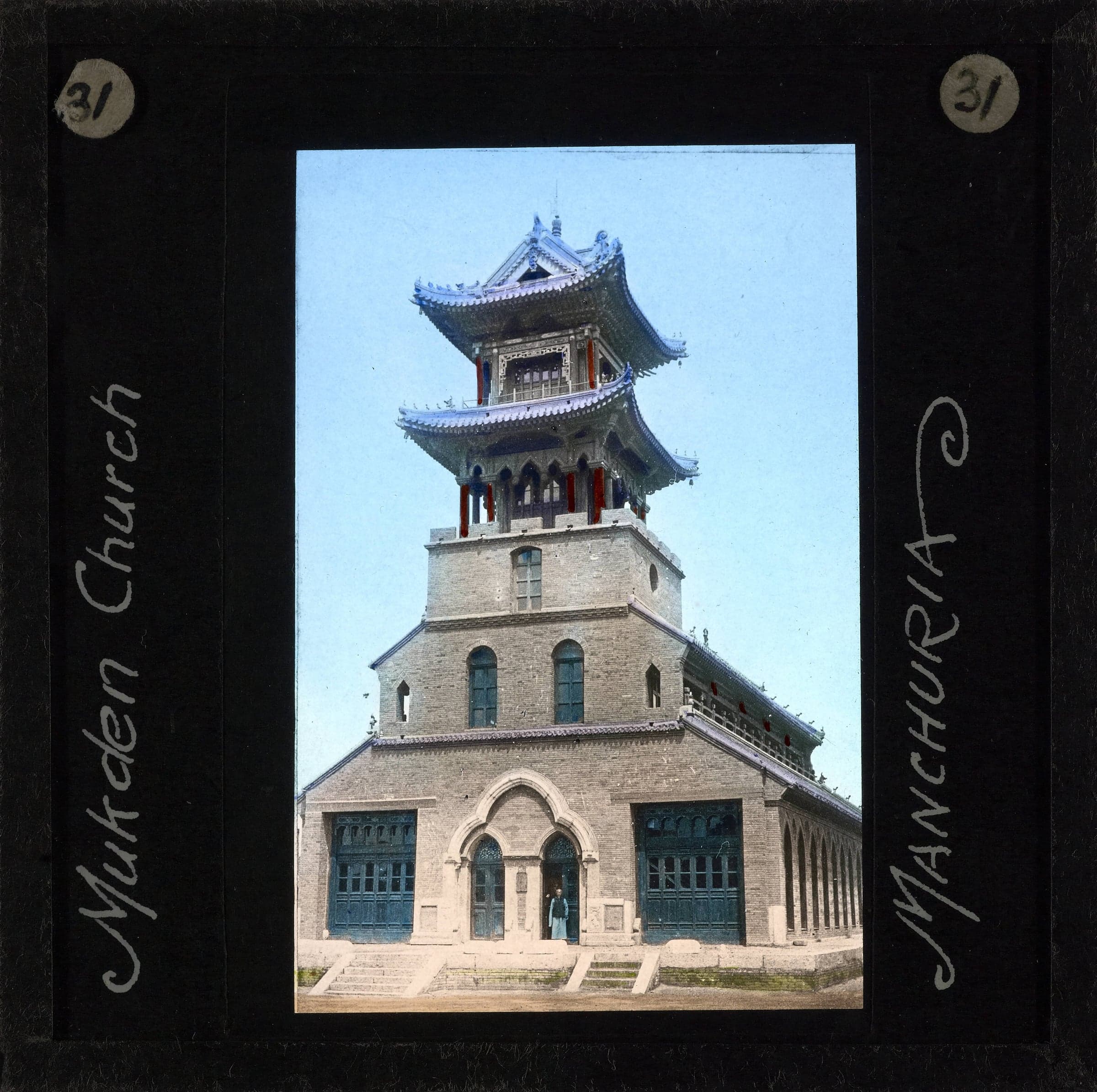
Mukden Church, Manchuria, 1882 to 1936. Public domain.
But Peter and the other apostles replied, “We must obey God rather than men.
Summary
China's Protestants worship in two kinds of church, the registered and the unregistered, often called house churches. Each states its own case.
- The registered churches belong to the state's Three-Self movement, and the house churches stay outside it.
- Revival in Manchuria in 1908 came by way of Korea.
- Pastors who refused paid in prison: Wang Mingdao for more than twenty years, Watchman Nee until his death in 1972.
- A survey, a state paper and a mission's estimate count different people, so no two figures agree.
- One church born in China, the True Jesus Church, teaches a Oneness doctrine outside the Trinity the creeds confess.
The Texts They Stand On
The texts come from Acts 4, 5 and 8, Matthew 22 and Romans 13.
The house churches read Acts 4 and 5, the registered church Romans 13, and both Matthew 22.
What is owed to God and to rulers, and the scattered church
But Peter and John replied, “Judge for yourselves whether it is right in God’s sight to listen to you rather than God. For we cannot stop speaking about what we have seen and heard.”
Peter and John's first answer to the council is the house churches' text for answering to God before the court.
“Caesar’s,” they answered. So Jesus told them, “Give to Caesar what is Caesar’s, and to God what is God’s.”
Both the Three-Self churches and the house churches read Jesus' answer on what belongs to Caesar.
Everyone must submit himself to the governing authorities, for there is no authority except that which is from God. The authorities that exist have been appointed by God.
The registered church reads it for submission to the authorities, beside the apostles' answer in Acts 5:29.
Romans 13:1BSB
Those who had been scattered preached the word wherever they went.
Luke's scattered church, preaching wherever it went, is the pattern read into the growth after the missionaries left.
Acts 8:4BSB
The Greek word for obeying in Acts 5:292 paragraphs
Strong's lexicon defines peitharcheō, the verb of Acts 5:29, as “to be persuaded by a ruler, i.e. (genitive case) to submit to authority.”
The verb sets God and the council in one frame of authority, and Romans 13:1 uses another verb, hypotassō, “to subordinate.”
The Chinese Branch of the Family of Churches
The tree runs from Mukden in 1908 to the appeal of 1998.
China's Protestant churches divided after 1950 into the Three-Self churches and the house churches.
1908 to 1917
- Revival at Mukden
- The True Jesus Church
1930 to 1932
- The revival in Shandong
- Nee's movement
1950 to 1954
- The Three-Self Manifesto
- The Three-Self Patriotic Movement
- Beijing, summer 1954
1955 to 1956
- Wang's refusal
- Nee's trial
1980 to 1998
- The China Christian Council
- The house churches' appeal
Each year is the record's own, and the founding of the True Jesus Church is its own account.
The other families of the churches stand together with the dates on which each began.
How the Revivals Began: Mukden, 1908, and Shandong
The mission press, the mission's book and the visiting preacher.
The Chinese Recorder of April 1908 printed a letter from the host missionary at Liaoyang. George Douglas wrote that he had sent two Christians to Korea, “and they came back on fire,” before Jonathan Goforth came for a week of meetings.
The same issue quotes Graham Lee of Pyongyang, who wrote that the two Chinese visitors “could understand nothing, but they attended all our meetings.”
James Webster's The Revival in Manchuria (1910), the mission's own account, dates the meetings at Mukden to February 1908, in the Chinese congregation under the pastor Liu Ch'uen Yao. Its narrator tells of an ex-elder who confessed in private, on the Monday morning, to keeping money held in trust for the church since the Boxer year.
Goforth, in his undated memoir By My Spirit, tells the same confession as an elder's, made “before the Church” after the morning address. He says he went to Manchuria with a message from God and found “that not one extra prayer-meeting had been held.”
Shandong, 1929 or 1930, as the historian Daniel Bays gives it3 paragraphs
Bays writes that the Norwegian missionary Marie Monsen “was a catalyst for the Shantung revival of the early 1930s.”
She returned to Shandong “in late 1929 or 1930,” and the revival spread to the Southern Baptists, the Presbyterians and others.
He adds that Monsen “seems to have been a quasi-Pentecostal, stressing the baptism or fullness of the Holy Spirit in addition to an initial conversion experience.”
The Truth They Kept: the Church Belongs to Christ
Wang Mingdao's refusal and the house churches' reasons.
Wang Mingdao's Christian Tabernacle in Beijing had grown to 570 members by 1949, as Yading Li records.
J. Visscher, reviewing Tony Lambert's China's Christian Millions (2006), lists the house churches' reasons for not registering. The first is that “the State's ordinances and demands are contrary to the principles of Scripture.”
Their Own Statements: the Manifesto, the Appeal and a Creed
The Three-Self churches, the house churches and the True Jesus Church, each in its own words.
In July 1950 Wu Yaozong, Liu Liangmo and others, forty in all, published the Manifesto 中国基督教在新中国建设中努力的途径, in English “The Direction of Endeavour for Chinese Christianity in the Construction of New China.”
The movement's own page names its Three-Self Principles: “self-governance, self-support and self-propagation.”
Canada's refugee board, citing the United States State Department, reports that house church leaders met in Henan in September 1998. They asked the government for dialogue, for the release of believers imprisoned for their faith and for a new definition of a sect.
In December 1998 they set out a common creed. Visscher, from Lambert's book, calls the confession of that year “remarkably orthodox and in step with the teachings of the historic Christian church.”
The True Jesus Church says it “originated in Beijing, China in 1917” and was “founded by the Holy Spirit.”
It baptizes “in the name of the Lord Jesus Christ” and confesses Jesus as “the only true God.”
The Trinity is an essential of the faith. The True Jesus Church's Oneness teaching stands outside the confession of one God in three persons. The historic creeds hold that confession.
Therefore go and make disciples of all nations, baptizing them in the name of the Father, and of the Son, and of the Holy Spirit,Its threefold name in baptism is the text the confession of the Trinity answers from.
The Churches Today, Counted Four Ways
Each count with its counter, its year and what it measured.
The four counts run from about 20 million to 109.7 million, and each measures a different thing.
| Who counted | Year | What it measured | The count |
|---|---|---|---|
| The China General Social Survey | 2018 | Adults who call themselves Christian | About 20 million, roughly 2 percent |
| The State Council's white paper | 2018 | Protestant followers in the state's count | 38 million |
| The China Family Panel Studies | 2018 | Adults who believe in Jesus Christ or Tianzhu | About 81 million, 7 percent |
| Asia Harvest | 2020 | Protestants of all ages, from published sources and interviews with unregistered church leaders | 109.7 million |
The state's own counts from 1949 to 1997, and Pew's doubt about growth3 paragraphs
The Communist Party's Document 19 of 31 March 1982 counted about 700,000 Protestants at liberation and about 3 million in 1982, the party's own figures with no method stated. The government's paper of October 1997 gave about 10 million, by what it called incomplete statistics.
Pew writes that “recent surveys that measure zongjiao affiliation do not offer much evidence that Christian growth continued after 2010.”
It also writes that Asia Harvest may have overcounted.
Where the Churches Spread
The record moves from Shantou and Shanghai to Beijing, Nanjing and Chengdu.
Watchman Nee, born at Shantou on 4 November 1903, moved to Shanghai in 1926 and gathered the co-workers of what became the Little Flock in 1932. The national Christian conference met in Beijing from 12 July to 6 August 1954 and founded the Three-Self committee, with Wu Yaozong as chairman.
The China Christian Council was founded at Nanjing in 1980. On 30 December 2019 the Chengdu City Intermediate People's Court sentenced the pastor of the Early Rain Covenant Church to nine years, Reuters and Amnesty International report.
Confession Under Duress, and Its Recantation
Wang Mingdao's confession and recantation, Watchman Nee's trial, and the case against the churches.
In prison Wang signed a confession to crimes and a promise to join the Three-Self Patriotic Movement, Li records, and he was released. John Gill dates the release to 29 September 1956.
On 29 April 1957 Wang was arrested again, Gill writes, and he “retracted the confession he had made under duress.”
Both Li and Gill give 1979 as the year he left prison, and Li gives his death as 28 July 1991.
The state's own history, as the United Front Work Department tells it, ties the missions to Western aggression and to the unequal treaties. Bays writes that Monsen's meetings in Shandong were “emotional if not disorderly.”
G. Wright Doyle records that Nee was arrested in Manchuria in April 1952 “on charges of tax evasion and corrupt business practices.”
Four years later a public trial in Shanghai found him “guilty on political grounds,” and he died in 1972 on the way to the prison hospital.
Remember those in prison as if you were bound with them, and those who are mistreated as if you were suffering with them.It is the church's charge toward Wang, Nee and every believer held for the faith.
Books to Read Next
The Revival in Manchuria
James Webster · 1910
Webster wrote it for the Mukden mission two years after the revival.
Free at the Internet ArchiveChina: Its Spiritual Need and Claims, third edition
J. Hudson Taylor · 1868
Taylor makes the mission's case for inland China from figures of March 1865.
Free at the Internet ArchiveA New History of Christianity in China
Daniel H. Bays · 2011
Bays wrote it for Wiley-Blackwell's guides to global Christianity.
In print: find it wherever books are sold.
What the Chinese Churches Hand On
They hand on a church that grew under prison and pressure, counted in tens of millions by every measure. Wang Mingdao's forced confession and his recantation stand in its record together.
The line through this page
The verse whose work this page shows continuing, then 4 links to other pages, in order of date.
The verse whose work this page shows continuing.
1858
The Prayer Meeting Revival to The Ulster Revival
New York's noon meetings in 1857 were read about in Ulster in 1858.
1859 to 1904
The Ulster Revival to The Welsh Revival
Ulster's own memory of 1859 stayed strong enough that Welsh and Irish believers were still praying against it as a standard half a century later, when the 1904 revival broke out over the water.
1906
The Welsh Revival to The Korean Pentecost
Through 1906 the missionaries in Pyongyang kept meeting to pray, sharpened by reports of what God had done in Wales in 1904 and among the Khasi hills of India.
1908
The Korean Pentecost to The Chinese House Churches
George Douglas wrote that he had sent two Christians to Korea, “and they came back on fire,” before Jonathan Goforth came for a week of meetings.
This page
The Chinese House Churches
Sources
Scripture is the Berean Standard Bible.
- The Holy Bible, Berean Standard Bible (read 2026)
- Strong's lexicon, entries G3980 and G5293 (read 2026)
- The Chinese Recorder and Missionary Journal 39, no. 4 (April 1908), Missionary News, Stirring Times in Manchuria, and the editorial, pages 179 and 231 to 232.
- James Webster, The Revival in Manchuria (London: Morgan and Scott, 1910), pages 9 to 12.
- Jonathan Goforth, By My Spirit, chapter The Beginning of the Movement in Manchuria (a transcription with Rosalind Goforth's foreword; undated; read 2026)
- Daniel H. Bays, Monsen, Marie, in Gerald H. Anderson, ed., Biographical Dictionary of Christian Missions (Macmillan Reference USA, 1998), pages 468 to 469.
- G. Wright Doyle, Watchman Nee, Biographical Dictionary of Chinese Christianity (undated online entry; read 2026)
- Yading Li, No Compromise, Christian History 98 (2008)
- John Gill, Wang Ming-Dao: Faithful Under Political Coercion, The Gospel Coalition, 3 August 2018.
- The United Front Work Department, 天主教、基督教开展“三自”爱国运动 (Catholicism and Protestantism launch the Three-Self Patriotic Movement), on the Communist Party news site (undated; read 2026)
- National TSPM and CCC, Introduction to CCC and TSPM (undated; read 2026)
- 中国基督教在新中国建设中努力的途径 (The Direction of Endeavour for Chinese Christianity in the Construction of New China), the header dated 28 July 1950.
- Immigration and Refugee Board of Canada, CHN33638.EX (3 February 2000), citing the United States State Department's report on religious freedom for 1999.
- J. Visscher, Light About the Church in China, Clarion 61, no. 23 (9 November 2012), pages 565 to 566, reviewing Tony Lambert, China's Christian Millions (Monarch, 2006)
- The True Jesus Church, About (undated; read 2026)
- The Central Committee of the Chinese Communist Party, Document 19 (中发〔1982〕19号), 31 March 1982.
- The State Council, 中国的宗教信仰自由状况 (Freedom of Religious Belief in China), October 1997.
- The State Council Information Office, China's Policies and Practices on Protecting Freedom of Religious Belief (3 April 2018)
- Pew Research Center, Christianity, a chapter of Measuring Religion in China (30 August 2023)
- Reuters, as printed by the Tribune, 30 December 2019.
- Amnesty International, statement of 30 December 2019.
- J. Hudson Taylor, China: Its Spiritual Need and Claims, third edition (London: James Nisbet, and S. W. Partridge, 1868), the preface.
- Daniel H. Bays, A New History of Christianity in China (Wiley-Blackwell, 2011)
Keep Studying
People and groups1
Trials of life1
Subjects1