
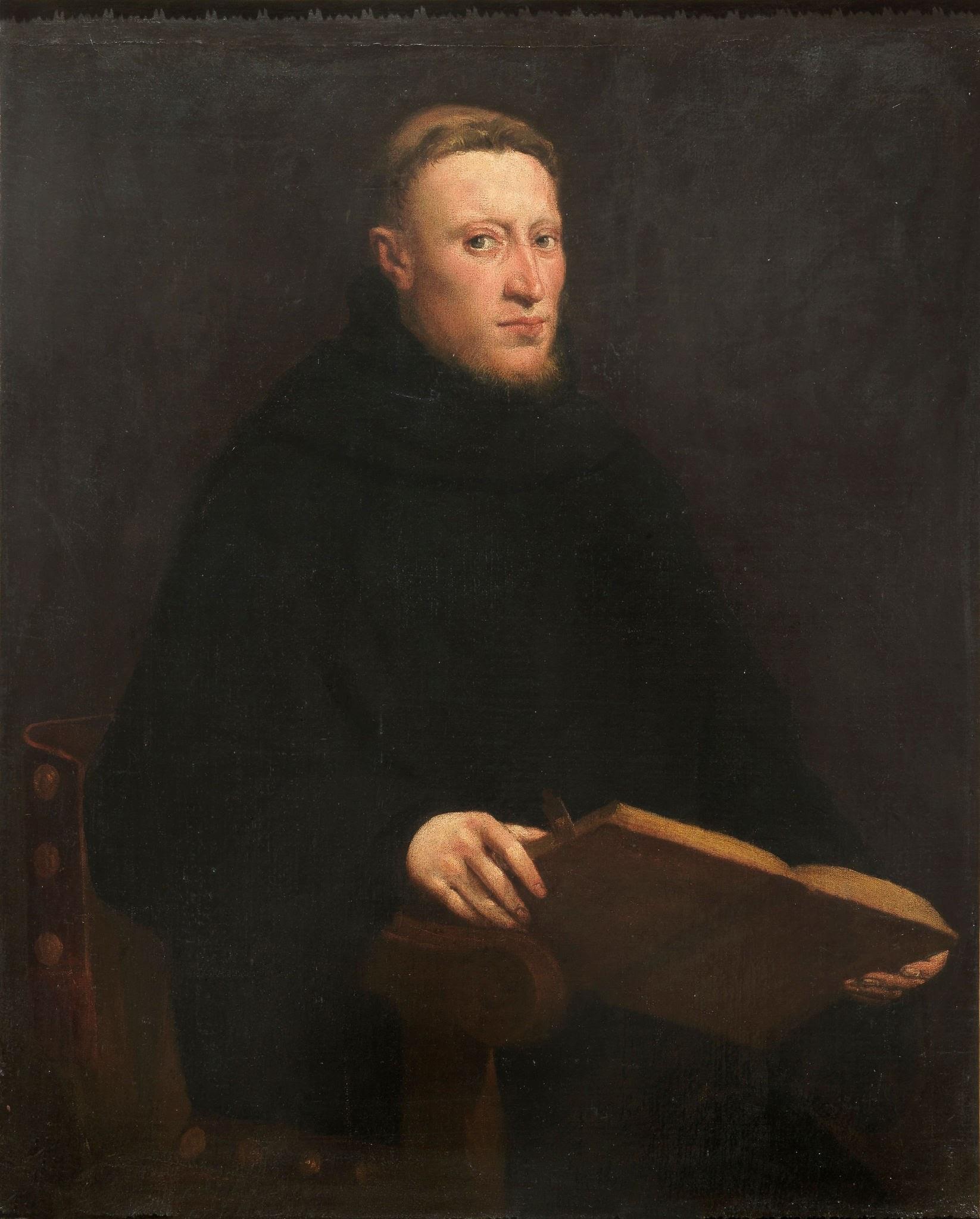
Jacopo Tintoretto, Portrait of Onofrio Panvinio, 1550 to 1555. Public domain.
1595 to 1915 · Subject · Featured Study
The Prophecy of the Popes
The list of papal mottoes Arnold Wion first printed, and the long argument over who wrote it.
Arnold Wion set the list at the end of a short notice of an Irish archbishop, in a book about the famous men of the Benedictine order.
Do not treat prophecies with contempt, but test all things. Hold fast to what is good.
- Books
- Matthew, 1 Thessalonians, Deuteronomy, Acts
- Hold in memory
- 1 Thessalonians 5:20 to 21, Matthew 24:36
Summary
The Prophecy of the Popes is a list of short Latin mottoes. It gives one to each pope from Celestine II to a last pope called Peter the Roman. It bears the name of Saint Malachy, an Irish archbishop of the twelfth century.
- Malachy died in 1148, and no writer is known to cite the list before Wion.
- The notes beside the mottoes stop at Urban VII.
- Thurston counted 111 mottoes, and the Catholic Encyclopedia counts 112.
- Menestrier, Harnack and Thurston held it a forgery, and Cucherat held it a true vision.
The Verses for Weighing a Prophecy and a Date
Scripture tests a prophecy by its fulfilment, and it keeps the day of Christ's return with the Father.
A list that claims to foretell the popes to the end of the age meets two tests from Scripture. The first is the test of every prophecy, and the second is the Lord's own word about the day.
Testing a prophecy
When a prophet speaks in the name of the LORD and the message does not come to pass or come true, that is a message the LORD has not spoken. The prophet has spoken presumptuously. Do not be afraid of him.
Moses gives Israel the test of a word spoken in the Lord's name by whether it comes to pass.
Beloved, do not believe every spirit, but test the spirits to see whether they are from God. For many false prophets have gone out into the world.
John warns believers to try every spirit before they trust it.
1 John 4:1BSB
The day and the hour
No one knows about that day or hour, not even the angels in heaven, nor the Son, but only the Father.
Jesus says the day and hour of His coming are known to the Father alone.
Jesus replied, “It is not for you to know times or seasons that the Father has fixed by His own authority.
Jesus answers the apostles' question about the kingdom just before His ascension.
Acts 1:7BSB
Matthew 24:36, Acts 1:7
The Record of the List
The dated steps run from Malachy's visit to Rome to Thurston's study, each with the record that fixes it.
The record runs from Malachy's death in 1148 to Thurston's study of 1915, and the list itself first appears in print 447 years after his death.
- Malachy before Innocent II at Rome1139Devine, The Catholic Encyclopedia (1911), Prophecy
- Malachy dies2 November 1148Wion, Lignum Vitae (Venice, 1595), page 307
- Panvinio's book on the popes and their arms printed at Venice1557Thurston, The War and the Prophets (1915), pages 137 and 138
- Urban VII, the last pope Wion prints with a note1590Wion, page 311
- Wion prints the list at Venice1595Wion, the title page and pages 307 to 311
- The first refutation, by the Franciscan Carrièreabout 1663Thurston, page 127, who gives the year as seemingly 1663
- Cucherat's defence, in its new edition1873Cucherat, the title page of the Grenoble edition
- O'Brien's critical account1880O'Brien, the title page of the Dublin edition
- Thurston's chapter on the prophecy1915Thurston, the title page of the New York edition
A timeline of dated steps, each row naming the record that fixes its date.
Cucherat's defence, in its new edition, O'Brien's critical account, Thurston's chapter on the prophecy
The era of the Reformation holds the wider story of the Catholic reform in which the list appeared.
Where the Fit Changes
The mottoes match their popes closely to Urban VII and loosely after him.
Thurston found that the mottoes before Wion's book point to a cardinal's life and the later ones need a new kind of reading.
| The question | Mottoes to Urban VII | Mottoes after him |
|---|---|---|
| What the motto points to | The cardinal's arms, family, birthplace, see or title before his election, by Thurston's study | The events of a reign, as the defenders read the later mottoes |
| How many fit | Every one, Thurston judges, allowing for misprints in Wion's copy | Hardly one in six, by Thurston's count |
| Who wrote the notes | Ciacconius, as Wion prints them | Later interpreters, Engelgrave and Moréri among them, as Cucherat lists them |
Thurston traced the early mottoes to the work of Onofrio Panvinio. He found that it explains every detail of the list down to Paul IV, elected in 1555.
Devine, on the other side, found three later mottoes apt for Pius IX, Leo XIII and Pius X. He saw in them “something more than coincidence.”
What Wion Printed at Venice
Wion printed the mottoes with a Dominican's glosses and closed them with a paragraph on Peter the Roman.
Thurston describes Arnold Wion as a Benedictine monk, originally of Douai, whose Lignum Vitae dealt mainly with the glories of his order.
Among the bishops of Down in Ireland, Wion gives a short notice of Malachy, a monk of Bangor and archbishop of Armagh. He writes that Malachy gave up Armagh about 1137 out of humility and kept the see of Down until his death.
Wion adds that Malachy is said to have left some short works, of which he had seen only a prophecy of the popes. He prints it because it is short, unprinted as far as he knows, and asked for by many.
A line under the list says the notes beside the popes are not Malachy's. They belong to Alphonsus Ciacconius, a Dominican, whom Wion calls the prophecy's interpreter.
Thurston reports Menestrier's point that Wion says nothing of where or how he obtained the list.
Seven of the mottoes, as Wion printed them1 table, 1 paragraph
Seven mottoes from the first, middle and last parts of the list, in MannaFest's English, with the pope Wion set beside each and Ciacconius's note.
| Motto | In English | Pope beside it | The note |
|---|---|---|---|
| Ex castro Tiberis | From a castle on the Tiber | Celestine II | Typhernas |
| Lux in ostio | A light in the doorway | Lucius III | Of Lucca, cardinal of Ostia |
| Bos pascens | A grazing ox | Callistus III | A Spaniard whose arms bore a grazing ox |
| De rore coeli | From the dew of heaven | Urban VII | Archbishop of Rossano in Calabria, where manna is gathered |
| Ex antiquitate Urbis | From the antiquity of the city | Gregory XIV | None |
| Crux Romulea | The cross of Romulus | Clement VIII | None |
| Petrus Romanus | Peter the Roman | None | The closing paragraph |
The table shows the notes tying each early motto to a name, a see or a coat of arms, and ending after Urban VII.
Wion's closing paragraph reads, in MannaFest's English: In the last persecution of the Roman Church, Peter the Roman will sit. He will feed the sheep in many tribulations. When these are past, the city of seven hills will be destroyed, and the fearful Judge will judge his people.
Thurston, writing under Benedict XV, counted the mottoes from Ex castro Tiberis and set Religio depopulata, religion laid waste, as the 104th. Devine gives the count as 112, from Celestine II to the end of the world.
Peter the Roman and the Setting of Dates
Reading the last motto as a date for the end of the age runs against the words of Jesus.
The closing paragraph has led readers to count the popes that remain and to reckon the end from the count.
Devine reports that Cornelius a Lapide tried to reckon from the list the years left to the world. He did so in his commentaries on John and on the Apocalypse.
Thurston's note in 1915 left seven mottoes still to come after Benedict XV's before the paragraph on Peter the Roman.
Devine observes that the paragraph never says that no popes come between Gloria olivae and Peter the Roman, so any number may stand between them.
MannaFest's Wesleyan-Pentecostal tradition honours prophecy and tests it. It counts a date read from the list among the dates set for the end, which Matthew 24:36 answers.
In Their Own Words
François Cucherat (1812 to 1887)
La prophétie de la succession des papes, nouvelle édition (Grenoble: Baratier frères et Dardelet, 1873), page 59
Cucherat placed the manuscript in the Roman archives until 1590.
“C'est à Innocent II que saint Malachie remit son manuscrit.”
Roman Catholic
About this saying1 paragraph
Cucherat, an honorary canon of Autun, wrote this in 1873, in the chapter where he places the vision at Rome.
Arnold Wion
Lignum Vitae (Venice, 1595), part I, book II, chapter 40, page 307, Thurston's English, The War and the Prophets (1915), page 122
Wion had seen nothing of Malachy's writings except this list.
“Malachy himself is reported to have been the author of some little tractates, none of which I have seen up to the present time, except a certain prophecy of his concerning the Sovereign Pontiffs. This, as it is short and has never been printed, is inserted here, seeing that many people have asked for it.”
Roman Catholic
About this saying1 paragraph
Wion wrote this in 1595 at the end of his notice of Malachy, here in Thurston's English of 1915.
Herbert Thurston
The War and the Prophets (New York: P. J. Kenedy and Sons, 1915), chapter VI, page 134
Thurston set the early fit beside the late failure.
“If the prophecy were an inspired prediction of St. Malachy in the twelfth century, it is inexplicable why the mottoes should be easily verifiable, systematic, and largely heraldic, down to the date when the prophecies were first printed, and then should suddenly change their character completely. On the supposition, however, that it is a forgery of about the year 1590, this is exactly what we should expect to find.”
Roman Catholic, Jesuit
About this saying1 paragraph
Thurston, a Jesuit, wrote this in 1915 after setting the early mottoes beside the later ones.
M. J. O'Brien
An Historical and Critical Account of the So-called Prophecy of St. Malachy (Dublin: M. H. Gill and Son, 1880), page 110
O'Brien granted that God makes the future known to His servants.
“The principle at starting is admitted on all hands, that God may make known, and has made known, the future to his chosen servants.”
Roman Catholic
About this saying1 paragraph
O'Brien, a Catholic priest, wrote this in 1880 near the close of his account.
Who Wrote the List
Three readings answer the same questions, each with its holders and its work.
The readings divide over where the list lay before Wion and why its notes stop where they do.
| The question | Malachy's vision | A forgery for the conclave of 1590 | A forgery from Panvinio's work |
|---|---|---|---|
| Who wrote it | Malachy, at Rome before Innocent II, by Cucherat's account | Partisans of Cardinal Simoncelli, by Menestrier, Moréri and Harnack | An unknown hand about 1590, perhaps Ciacconius, as Thurston guesses |
| Where it lay before Wion | In the Roman archives until its finding in 1590, Cucherat holds | Nowhere, since it was made in the conclave | Nowhere, since no manuscript or author cites it, Thurston writes |
| Why the notes stop at Urban VII | The interpreter's work ended there | The forger knew the popes to Urban VII and no further | The forger's source and memory ran no further |
| Ex antiquitate Urbis | Read of Gregory XIV by its defenders | Meant for Simoncelli of Orvieto, the old city | Thurston finds no account of the conclave naming Simoncelli as a candidate |
O'Brien judged the list forged and Wion innocent of the forgery, since Wion glossed nothing after Urban VII.
Devine weighs the silence of Bernard, who wrote Malachy's life, as a strong argument against the list. He adds that it is not conclusive if Cucherat's theory of the archives is adopted.
Bernard's own account of the visit to Innocent II tells of Malachy asking with tears to live and die at Clairvaux, and of the refusal.
Books to Read Next
Lignum Vitae
Arnold Wion · 1595
It is the first printing of the list, on pages 307 to 311 of its first volume.
Free scan of the 1595 printingLa prophétie de la succession des papes
François Cucherat · 1873
Cucherat argues in French that Malachy saw the list in a vision at Rome.
Free scan of the 1873 editionAn Historical and Critical Account of the So-called Prophecy of St. Malachy
M. J. O'Brien · 1880
An Irish priest weighs the defenders and the critics and sets out the explanations of the mottoes.
Free at the Internet ArchiveThe War and the Prophets
Herbert Thurston, S.J. · 1915
Its sixth chapter weighs Harnack's theory of the conclave and gives Thurston's own date for the list.
Free at the Internet ArchiveSt. Bernard of Clairvaux's Life of St. Malachy of Armagh
Bernard of Clairvaux, translated by H. J. Lawlor · 1920
It is the life of Malachy by his friend, with the visit to Innocent II in section 38.
Free scan of the 1920 translationWhat the List Leaves
The list fits its popes closely up to the year it was first seen and loosely after. No witness to it stands before Wion's book. Its last motto fixes no day, and the hour of Christ's return stays with the Father.
Sources
Scripture is the Berean Standard Bible.
- The Holy Bible, Berean Standard Bible (read 2026)
- Arnold Wion, Lignum Vitae, Ornamentum et Decus Ecclesiae (Venice: Georgius Angelerius, 1595), part I, book II, chapter 40, pages 307 to 311.
- Herbert Thurston, S.J., The War and the Prophets (New York: P. J. Kenedy and Sons, 1915), chapter VI, pages 120 to 156.
- M. J. O'Brien, An Historical and Critical Account of the So-called Prophecy of St. Malachy Regarding the Succession of Popes (Dublin: M. H. Gill and Son, 1880), pages 96 to 110.
- François Cucherat, La prophétie de la succession des papes, nouvelle édition (Grenoble: Baratier frères et Dardelet, 1873), page 59.
- Arthur Devine, Prophecy, in The Catholic Encyclopedia, volume 12 (New York: Robert Appleton, 1911), Prophecies of St. Malachy.
- Bernard of Clairvaux, The Life of St. Malachy of Armagh, translated by H. J. Lawlor (London: SPCK, 1920), section 38, page 72.
Keep Studying
Read it3
People and groups1
Doctrines7
Church history2