
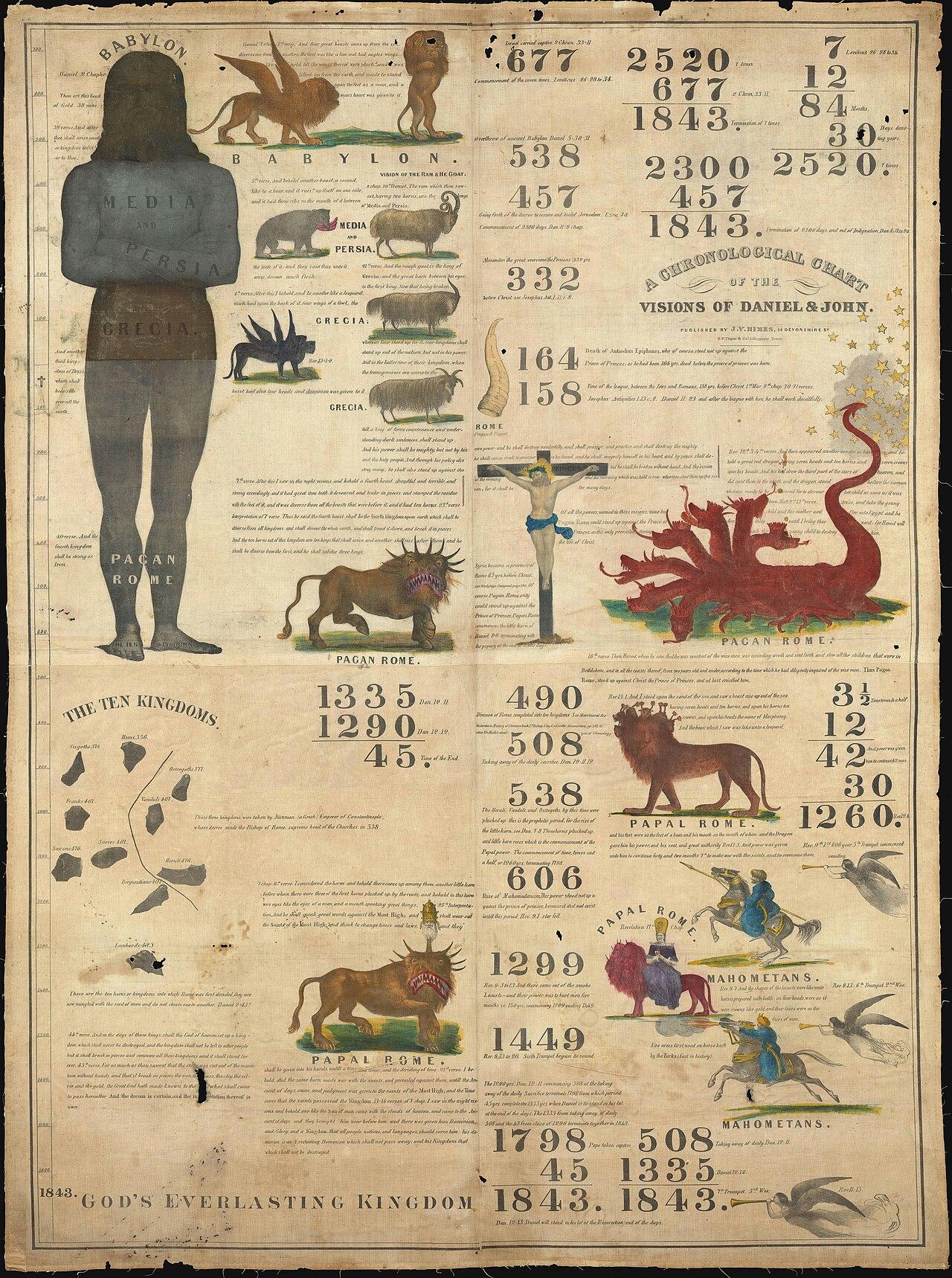
J. V. Himes, publisher, 1843. Public domain.
1843 to 1887 · The churches · Featured Study
The Seventh-day Adventist Church
A church formed from the Millerite movement, organized at Battle Creek, Michigan, in 1863.
William Miller published in December 1842 that the Lord would come between 21 March 1843 and 21 March 1844.
He said to me, “It will take 2,300 evenings and mornings; then the sanctuary will be properly restored.”
He said to me, “It will take 2,300 evenings and mornings; then the sanctuary will be properly restored.”
- Began
- 21 May 1863, the day the General Conference adopted its constitution at Battle Creek
- Bodies
- The General Conference of Seventh-day Adventists
Summary
The Seventh-day Adventists came out of the Millerites after 22 October 1844. They took their name in 1860. They formed a General Conference in 1863.
- Its first members had looked for Christ to return in 1844.
- After 1844 the sanctuary of Daniel 8:14 was read as the sanctuary in heaven.
- Keeping the seventh day as the Sabbath became one of its marks.
- The Present Truth, the body's first paper, ran from 1849 to 1850.
- The body's critics included its own former minister D. M. Canright.
The Texts the Body Names
The body's tract of 1846 and its Declaration of 1872 name these verses for their own teaching.
The Declaration of 1872 calls itself a statement of what Seventh-day Adventists hold. Each verse below is shown as the body cites it.
Remember the Sabbath day by keeping it holy.Joseph Bates opened the preface of his tract of 1846 with this commandment.
Here is a call for the perseverance of the saints who keep the commandments of God and the faith of Jesus.Article XIII of 1872 cites this verse for a reform it expected among believers before the advent.
The Adventist Branch of the Family of Churches
The branch runs from the Millerite movement to the General Conference of 1863.
The Seventh-day Adventists grew out of the Millerite movement between 1844 and 1863.
1842 to 1844
- Miller's published time
- The seventh month movement
1844 to 1846
- Edson's reading of the sanctuary
- Bates's tract on the Sabbath
1849 to 1850
- The Present Truth
1860 to 1863
- The name Seventh-day Adventists
- The General Conference
1872 to 1889
- The Declaration of 1872
- Canright's book of 1889
Each date is read from Miller's Apology, Bates's tract, Loughborough's history of 1892 or the Declaration of 1872.
The Declaration of 1872 sets the body apart from the other Adventists. It names the seventh day and many readings of prophecy.
The Christian Traditions sets the churches of the world in their families, from Ephesus in 431 to the Pentecostals in 1906.
How the Body Began: the Disappointment of 1844
Miller's own defence, an early leader's history and a later critic tell the start.
Miller's Apology and Defence, printed by J. V. Himes at Boston in 1845, is the movement leader's own account. He writes that he joined the seventh month movement two or three weeks before 22 October 1844.
Miller writes that when that day passed he was disappointed a second time.
J. N. Loughborough, a minister of the body, printed its history at Battle Creek in 1892. He records what Hiram Edson of Port Gibson, New York, told him. Edson prayed in a field the day after the time passed. An impression came to him, “The sanctuary to be cleansed is in heaven.”
Loughborough adds that O. R. L. Crosier set out the same reading in the Day Star of Canandaigua early in 1846. On the same page he writes that Ellen Harmon, later Ellen White, travelled in New England telling what she held had been shown her.
What the Body Holds: the Sabbath and the Sanctuary
Loughborough wrote that the name of 1860 set forth the near coming of Christ and the keeping of the seventh day.
Joseph Bates printed The Seventh Day Sabbath, a Perpetual Sign, at New Bedford in 1846. His preface holds the fourth commandment “as binding now as it ever was.”
Article X of 1872 places the sanctuary of the 2,300 days in heaven. Article XII holds that the fourth commandment requires the seventh day of each week.
Then God blessed the seventh day and sanctified it, because on that day He rested from all the work of creation that He had accomplished.This verse stands on the title page of the tract named above.
Their Own Declaration of 1872
The body's publishing house at Battle Creek printed its principles in 1872.
The Declaration states what the body held in 1872.
| Place | Its words |
|---|---|
| The preface, page 3 | “we have no articles of faith, creed, or discipline, aside from the Bible.” |
| Article IX, page 7 | “That the mistake of Adventists in 1844 pertained to the nature of the event then to transpire, not to the time” |
| Article XII, page 8 | “That the fourth commandment of this law requires that we devote the seventh day of each week, commonly called Saturday, to abstinence from our own labor, and to the performance of sacred and religious duties” |
The Body and Its Counts
The General Conference counted its churches and members at its sessions of 1876 and 1887.
The members counted rose from 10,044 to 25,841 in eleven years.
| Session | The count | Who counted, and where it is printed |
|---|---|---|
| September 1876 | 398 churches and 10,044 members | The General Conference, reported in the Review of 5 October 1876; Loughborough, page 304 |
| November 1887 | 889 churches and 25,841 members | The General Conference's report of its session; Loughborough, page 356 |
Where the Body Grew
Each place stands with the year its record gives.
The body took shape in New York, New England and Michigan.
| Year | Place | What happened there |
|---|---|---|
| 1844 | Port Gibson, New York | This was the home of Hiram Edson, whose report Loughborough printed. |
| 1846 | New Bedford, Massachusetts | Benjamin Lindsey's press issued the tract of Joseph Bates. |
| 1849 | Middletown, Connecticut | James White printed the first numbers of The Present Truth. |
| 1850 | Paris, Maine | The eleventh and last number of The Present Truth was printed. |
| 1855 | Battle Creek, Michigan | James and Ellen White settled there for good. |
| 1863 | Battle Creek, Michigan | Delegates from six states met as a General Conference. |
In Their Own Words
James White (died 1881)
His testimony on the disappointment of 1844, as printed in J. N. Loughborough, Rise and Progress of the Seventh-day Adventists, chapter The Disappointment, page 78
The bitter disappointment
“The disappointment at the passing of the time was a bitter one. True believers had given up all for Christ, and had shared his presence as never before.”
Seventh-day Adventist
About this saying1 paragraph
Loughborough gives these words of James White on page 78 of his history of 1892, among the testimonies of those who waited in 1844.
William Miller
Mr. Miller's Apology and Defence, page 25
Faith unchanged
“On the passing of my published time, I frankly acknowledged my disappointment in reference to the exact period; but my faith was unchanged in any essential feature.”
Millerite Adventist
About this saying1 paragraph
Miller wrote these words on page 25 of his Apology and Defence of 1845, after the date had passed.
Joseph Bates
The Seventh Day Sabbath, a Perpetual Sign, the preface, To the Little Flock, page 1
To the little flock
“This commandment I conceive to be as binding now as it ever was, and will be to the entering into the ‘gates of the city.’”
Seventh-day Adventist
About this saying1 paragraph
Bates wrote these words in 1846 under the heading To the Little Flock, holding the commandment still binding.
The Failed Date and the Charges Against the Body
Miller owned the failure of the date, the body gave its own account of it, and a former minister brought charges in 1889.
Miller wrote in 1845 that he owned his disappointment over the exact period while his faith stood in every essential feature.
The body's own account of 1872, in its ninth article, placed the error in the event expected in 1844 and held to the date.
D. M. Canright served the body as a minister for twenty-eight years, by his own count. His Seventh-day Adventism Renounced came out in 1889. On page 79 he listed what he called the mistakes of the Adventists. They run from the dates of 1843 and 1844 to the early refusal of a church name.
“A people who have made as many mistakes as Adventists have, ought to be very modest in their claims, and ought to see that they have been led by men and not by the Lord.”
D. M. Canright · Seventh-day Adventism Renounced, chapter Origin, History and Failures of Adventism, page 79Seventh-day Adventist minister
No one knows about that day or hour, not even the angels in heaven, nor the Son, but only the Father.Miller wrote in his Apology that he had never fixed a day, since no man could know the day and hour.
Books to Read Next
Rise and Progress of the Seventh-day Adventists
J. N. Loughborough · 1892
Loughborough was an early minister of the body, and he gives its history from 1831.
Free at the Internet ArchiveMr. Miller's Apology and Defence
William Miller · 1845
Miller explains his reckoning and owns his disappointment.
Free at the Internet ArchiveThe Seventh Day Sabbath, a Perpetual Sign
Joseph Bates · 1846
Bates sets out the case for the seventh day that the body took up.
Free at Project GutenbergSeventh-day Adventism Renounced
D. M. Canright · 1889
Canright writes against the body after leaving its ministry.
Free at the Internet ArchiveWhat the Body Handed On
The Millerite movement left a church with a name, a General Conference and a printed Declaration within thirty years of 1844. Miller's own account and Canright's charges stand beside the body's record.
Sources
Scripture is the Berean Standard Bible.
- The Holy Bible, Berean Standard Bible (read 2026)
- William Miller, Mr. Miller's Apology and Defence (Boston: J. V. Himes, 1845), pages 24 to 25.
- J. N. Loughborough, Rise and Progress of the Seventh-day Adventists (Battle Creek: General Conference Association, 1892), pages 78, 114, 150 to 151, 226 to 227, 253, 304 and 356.
- Joseph Bates, The Seventh Day Sabbath, a Perpetual Sign (New Bedford: Press of Benjamin Lindsey, 1846), title page and preface.
- A Declaration of the Fundamental Principles Taught and Practiced by the Seventh-day Adventists (Battle Creek: Steam Press of the Seventh-day Adventist Publishing Association, 1872), pages 3 to 8.
- D. M. Canright, Seventh-day Adventism Renounced, fourteenth edition (New York: Fleming H. Revell, copyright 1889), pages 25 and 79.
Keep Studying
Church history2
Doctrines1
Subjects1