
1916 to today · Subject · Featured Study
The Word of Faith Movement
Confession, healing and prosperity in the teaching of Kenneth Hagin and his forerunner.
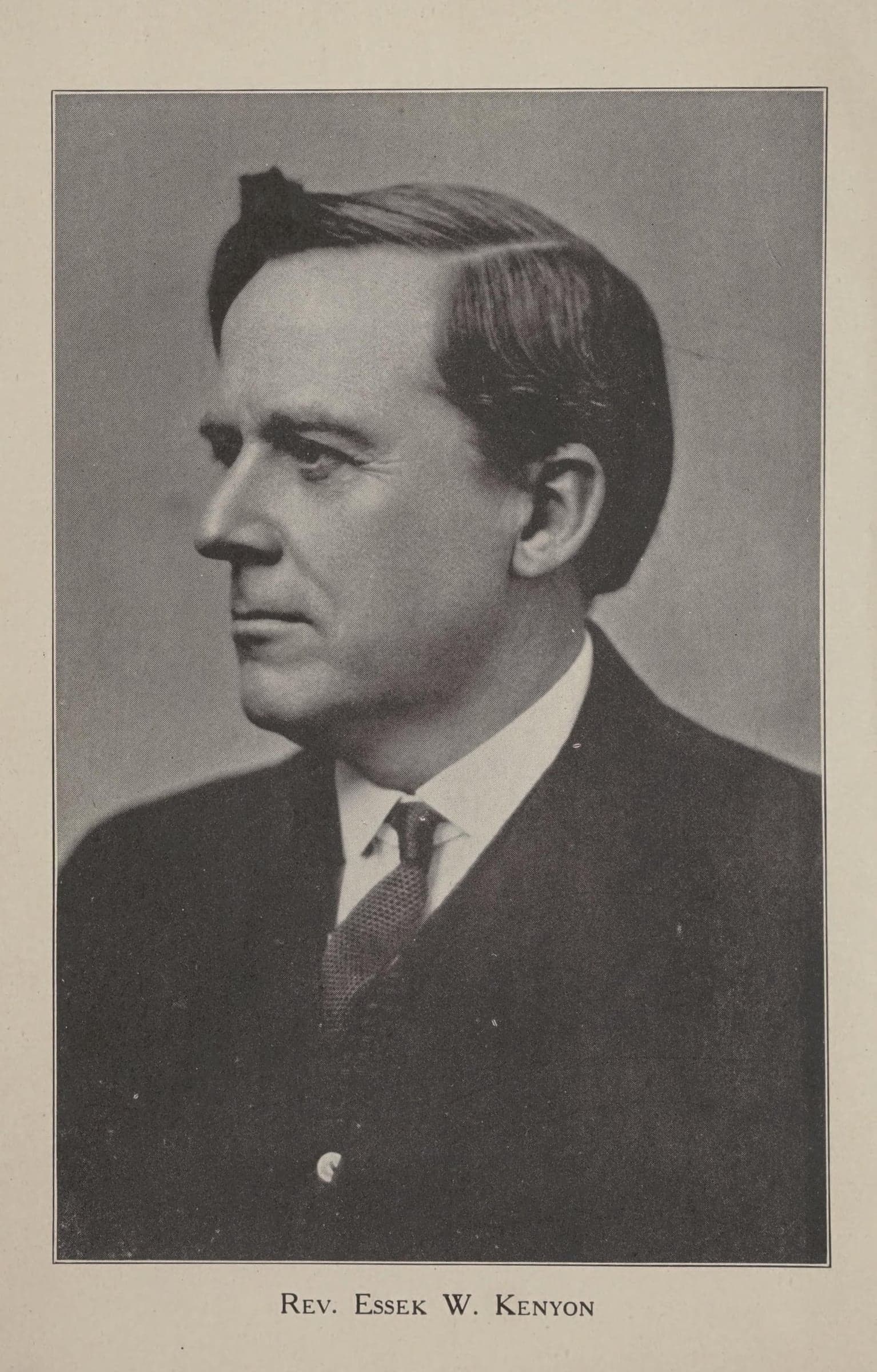
Essek William Kenyon published The Father and His Family in 1916. On page 251 he wrote, “You have as much right to demand healing, as you have to demand the cashing of a check at a bank where you have a deposit.”
- Books
- Romans, Mark, 3 John, 1 Timothy
- Hold in memory
- 1 Timothy 6:6 to 10
Rev. Essek W. Kenyon, the frontispiece of E. W. Kenyon, 1916. Public domain.
But what does it say? “The word is near you; it is in your mouth and in your heart,” that is, the word of faith we are proclaiming:
Summary
Its teachers hold that faith confessed aloud lays claim to health and wealth as legal rights in Christ. The teaching passed from Kenyon's books to Kenneth Hagin's.
- D. R. McConnell charged in 1988 that Hagin had copied Kenyon.
- Pew found in 2006 that most pentecostals in ten countries expect health for enough faith.
- Late in life Hagin rebuked followers who distorted his message, as J. Lee Grady reports.
The Texts the Teaching Stands On
The texts come from Mark 11, Galatians 3, 3 John and Romans 10.
The movement takes its name from Paul's words in Romans 10:8, and its teachers read four more texts as promises a believer may claim.
The texts the teachers read as promises
“Truly I tell you that if anyone says to this mountain, ‘Be lifted up and thrown into the sea,’ and has no doubt in his heart but believes that it will happen, it will be done for him. Therefore I tell you, whatever you ask for in prayer, believe that you have received it, and it will be yours.
Hagin's teaching on faith rests on this verse, by his own account.
Christ redeemed us from the curse of the law by becoming a curse for us. For it is written: “Cursed is everyone who is hung on a tree.” He redeemed us in order that the blessing promised to Abraham would come to the Gentiles in Christ Jesus, so that by faith we might receive the promise of the Spirit.
Hagin's Redeemed from Poverty, Sickness, and Spiritual Death (1983) reads this verse as freeing the believer from poverty and sickness.
Beloved, I pray that in every way you may prosper and enjoy good health, as your soul also prospers.
Hanegraaff reports the Faith teachers reading it as a promise of wealth, and Gordon Fee reading it as a letter's greeting.
3 John 1:2BSB
that if you confess with your mouth, “Jesus is Lord,” and believe in your heart that God raised Him from the dead, you will be saved. For with your heart you believe and are justified, and with your mouth you confess and are saved.
Kenyon's teaching on confession draws on Paul's confession with the mouth in these verses.
The Teaching by Date
Each row with the witness that dates it.
The teaching runs from Kenyon's book of 1916 through Hagin to its critics and a survey of 2006.
| When | What happened | The witness |
|---|---|---|
| 1916 | Kenyon's The Father and His Family is printed at Spencer, Massachusetts. | The book's own title page |
| 1933 to 1934 | Hagin lies sick and is raised, by his own account. | Hagin, I Believe in Visions (1972) |
| 1988 | A Different Gospel is published. | Its publisher, Hendrickson |
| 1993 | Hanegraaff sets the Faith teachings against Scripture. | Hanegraaff, Christianity in Crisis |
| 2000 | Hagin's The Midas Touch is published, as reported. | J. Lee Grady, for CBN |
| 2006 | Spirit and Power is published. | The Pew Forum |
From Kenyon to Hagin
A line of teaching, carried in books, from 1916 to the 1970s.
Essek William Kenyon, who lived from 1867 to 1948, printed The Father and His Family at Spencer, Massachusetts, under a copyright of 1916.
Before his sentence on demanding healing, Kenyon quotes Mark 16:17 to 18 and writes, “Here it is not sufferance or pity, but Legal Authority.”
Kenneth Hagin told his own story in I Believe in Visions (1972). He dated his sickness to 1933 and his raising to 1934, and named Mark 11:24 as the verse he held to.
Two Greek Words the Teaching Turns On
The word of faith in Romans 10:8, and prospering in 3 John 2.
rhēma, a word spoken
Abbott-Smith's lexicon gives the noun of Romans 10:8 the sense “a word,” the thing said and the matter spoken of.
euodoō, to prosper
4 uses in the canon
Abbott-Smith's lexicon glosses the verb of 3 John 2 “to help on the road,” and adds the figurative sense “to succeed in business affairs.”
What the Teaching Claims, and What Scripture Answers
Kenyon's legal rights and the little gods, and the answer from Scripture.
On page 252 of the same book Kenyon held the believer's claim to be a matter of law: “It is not Faith, but Legal Rights that are yours.”
He wrote, “All disease is of the Devil,” and, of Christ's redemption, “In face of this mighty Fact, poverty and weakness of spirit are criminal.”
His Two Kinds of Faith teaches that a confessed fear makes a disease grow. Hank Hanegraaff, in Christianity in Crisis (1993), lists among the Faith teachings the claim that believers are little gods.
MannaFest stands in the Wesleyan-Pentecostal line and holds with the Assemblies of God that “Deliverance from sickness is provided for in the atonement, and is the privilege of all believers.”
It prays for the sick in faith.
It holds the Word of Faith claims contrary to Scripture: that confession secures healing as a law, that wealth is guaranteed to faith, and that believers are little gods.
Of course, godliness with contentment is great gain. For we brought nothing into the world, so we cannot carry anything out of it. But if we have food and clothing, we will be content with these. Those who want to be rich, however, fall into temptation and become ensnared by many foolish and harmful desires that plunge them into ruin and destruction. For the love of money is the root of all kinds of evil. By craving it, some have wandered away from the faith and pierced themselves with many sorrows.Paul's warning to those who want to be rich stands against a promise of wealth to faith.
But Peter said, “Silver or gold I do not have, but what I have I give you: In the name of Jesus Christ of Nazareth, get up and walk!”It stands against tying healing in the name of Jesus to wealth.
Pew's survey Spirit and Power, published on 5 October 2006, asked pentecostals in ten countries about these promises. Majorities in all ten agreed that God grants good health to believers with enough faith, and in nine most said God grants material prosperity.
McConnell's Charge and Hagin's Late Rebuke
A finding of copying in 1988, and Hagin's own correction as Grady reports it.
D. R. McConnell's A Different Gospel (1988) concluded that Hagin had copied Kenyon repeatedly and at length. McConnell credits Dale Simmons, then a graduate student at Oral Roberts University, with finding that Hagin had also drawn on John A. MacMillan.
McConnell also traced Kenyon's ideas to New Thought and Christian Science, and Hanegraaff follows him.
J. Lee Grady, writing for CBN, reports that Hagin summoned many of his colleagues to Tulsa to rebuke them for distorting his message. He adds that The Midas Touch appeared in 2000, a year after that meeting, and quotes it: “There is no spiritual formula to sow a Ford and reap a Mercedes.”
The prosperity question1 paragraph
The debate page sets out the readings of Deuteronomy 28 on which the prosperity question turns.
Books to Read Next
The Father and His Family
E. W. Kenyon · 1916
Kenyon states the legal rights of the believer in his own words.
Free at the Internet ArchiveA Different Gospel
D. R. McConnell · 1988
McConnell sets Hagin's books beside Kenyon's and traces Kenyon's sources.
In print: find it wherever books are sold.
Christianity in Crisis
Hank Hanegraaff · 1993
Hanegraaff was the most widely read of the teaching's critics.
In print: find it wherever books are sold.
What the History Shows
The teaching grew inside the Pentecostal line that runs through Hagin, the line in which MannaFest stands. That line can own both McConnell's charge and Hagin's late rebuke as part of its story.
Sources
Scripture is the Berean Standard Bible.
- The Holy Bible, Berean Standard Bible (read 2026)
- E. W. Kenyon, The Father and His Family (Spencer, Mass.: Reality Press, copyright 1916), pages 251 and 252.
- E. W. Kenyon, Two Kinds of Faith (Kenyon Gospel Publishers; the first edition's year not opened)
- Kenneth E. Hagin, I Believe in Visions (Old Tappan, N.J.: Revell, 1972)
- D. R. McConnell, A Different Gospel (Peabody, Mass.: Hendrickson, 1988), the chapters Hagin's Plagiarism of Kenyon and E. W. Kenyon and the Metaphysical Cults.
- Hank Hanegraaff, Christianity in Crisis (Eugene, Or.: Harvest House, 1993)
- J. Lee Grady, How Can People Have the Wrong Motive for Giving to a Ministry?, CBN (the page prints no date)
- Pew Forum on Religion and Public Life, Spirit and Power: A 10-Country Survey of Pentecostals (5 October 2006)
- The Assemblies of God, Statement of Fundamental Truths, article 12.
- The Greek lexicon, entries G4487 and G2137 (STEP Bible TBESG, Tyndale House, CC BY 4.0, the brief lexicon based on Abbott-Smith, 1922)
Keep Studying
People and groups2
Subjects1
Church history1