
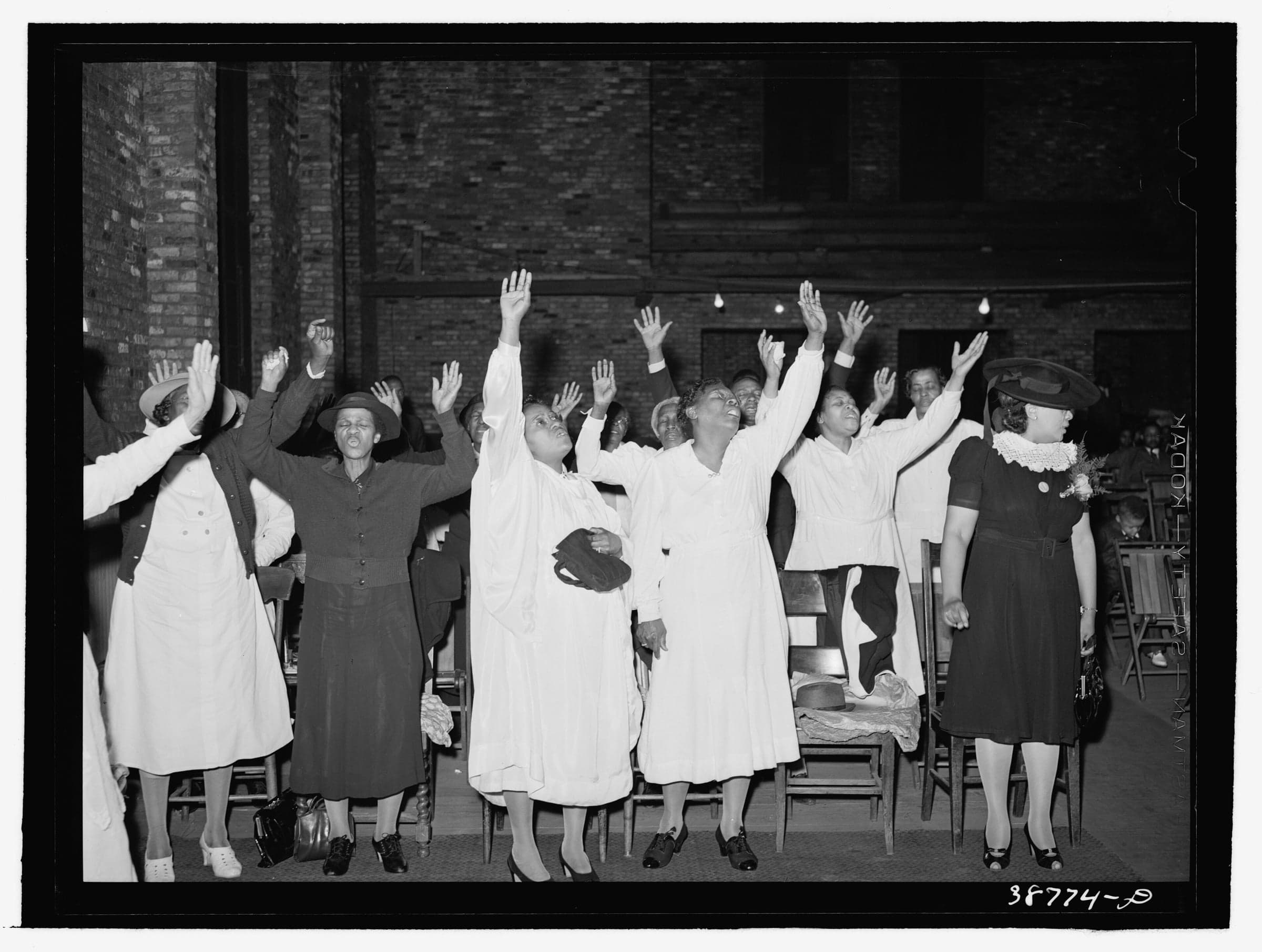
Russell Lee, Members of the Pentecostal church praising the Lord, 1941. Public domain.
1901 to today · The churches · Featured Study
The Pentecostal Churches
Churches born from a Bible school in Kansas in 1901 and a mission on Azusa Street in 1906.
The first issue of The Apostolic Faith, printed in Los Angeles in September 1906, ran the headline “Pentecost Has Come.”
And they were all filled with the Holy Spirit and began to speak in other tongues as the Spirit enabled them.
- Began
- January 1901 at Topeka, as the movement's paper tells it; April 1906 at Azusa Street (probable)
- Bodies
- The Church of God (Cleveland), The Church of God in Christ, The Assemblies of God, The United Pentecostal Church International
The first issue of The Apostolic Faith, printed in Los Angeles in September 1906, ran the headline “Pentecost Has Come.”
Summary
The Pentecostal churches teach a baptism in the Holy Spirit marked by speaking in tongues, as at Pentecost. A mission's own paper is the first record of their revival.
- Holiness churches in the South took up the baptism in the Spirit from 1907.
- Within ten years its churches parted into three streams.
- The Assemblies of God kept a colour line in ordination for twenty-three years, by its archivist's account.
- Its people number in the hundreds of millions by one estimate.
The Texts the Movement Named Itself From
The texts come from Acts 1, Acts 2 and Jude 1:3.
The Apostolic Faith was the paper of the Azusa Street mission in Los Angeles. In September 1906 it printed the mission's creed, which names the evidence of the baptism with the Holy Ghost from Acts 2:3 to 4.
The text at the paper's head
Beloved, although I made every effort to write to you about the salvation we share, I felt it necessary to write and urge you to contend earnestly for the faith entrusted once for all to the saints.
The paper printed it above its first issue in September 1906.
Jude 1:3BSB
The evidence the creed names
They saw tongues like flames of fire that separated and came to rest on each of them.
The creed cites it with Acts 2:4 for the evidence of the baptism.
Acts 2:3BSB
The day the paper said had come
‘In the last days, God says, I will pour out My Spirit on all people. Your sons and daughters will prophesy, your young men will see visions, your old men will dream dreams. Even on My menservants and maidservants I will pour out My Spirit in those days, and they will prophesy.
Peter preached this at Pentecost, the day the paper's first headline said had come to Los Angeles.
The power Jesus promised
But you will receive power when the Holy Spirit comes upon you, and you will be My witnesses in Jerusalem, and in all Judea and Samaria, and to the ends of the earth.”
Jesus promised power when the Holy Spirit comes, the word the creed uses for the baptism.
Acts 1:8BSB
Acts 2:3, Acts 2:17 to 18, Acts 1:8
The Pentecostal Branch of the Family of Churches
From Topeka in 1901 to Memphis in 1994.
The movement runs from Topeka and Azusa Street into Holiness, Finished Work and Oneness streams.
The beginning
- TopekaJanuary 1901, as the paper tells it
- The Azusa Street missionApril 1906
Holiness Pentecostal
- The Church of God (Cleveland)1886, by its own history
- The Church of God in Christ1895 or 1897, by Mason's book
Finished Work
- The Assemblies of GodApril 1914
Oneness
- The Oneness ministers who left1916
- The United Pentecostal Church International1945, by merger
The reversal
- Pentecostal and Charismatic Churches of North AmericaOctober 1994
Each church is dated by its own record, and the Church of God in Christ's own book gives two founding years.
The Christian Traditions dates the Pentecostals to 1906, the youngest of the families of the church it sets out.
How the Movement Began, in Three Kinds of Record
The mission's paper, the daily press and a participant's memoir.
The Apostolic Faith told the beginning at Topeka twice, and the two tellings differ. The September issue says a sister spoke in an unknown tongue after three months of waiting, and twelve students received the Holy Ghost three nights later. The October issue dates the twelve to “the 3rd of January, 1901,” while Parham was away at a meeting.
In the first issue William J. Seymour told how he came from Houston to preach in Los Angeles. He wrote that “one night they locked the door against me,” and that “The beginning of the Pentecost started in a cottage prayer meeting at 214 Bonnie Brae.”
The same issue reported, “The work began among the colored people.” It added that Ethiopians, Chinese, Indians and Mexicans worshipped together at the mission.
The Los Angeles Daily Times reported the meetings on 18 April 1906. Ted Olsen, writing in Christian History in 1998, quotes its opening, “Breathing strange utterances and mouthing a creed which it would seem no sane mortal could understand.”
The Morning Oregonian of 22 October 1906 printed a dispatch from Los Angeles. Its reporter estimated, with no method given, that the new sect had drawn about 800 people, and he wrote that the largest group, at the Azusa Mission, was about equally white and Black.
Frank Bartleman took part in the meetings and wrote his memoir in 1925, nineteen years later. Darrin Rodgers, the archivist of the Assemblies of God, quotes its line that “[t]he ‘color line’ was washed away in the blood.”
The paper's print runs and its own reports2 paragraphs
The paper printed 5,000 copies of its first issue and 10,000 of its second, by its own account, and 30,000 of its fifth in January 1907. In May 1907 it gave the cost of 40,000 papers as about $200. In November 1906 it named 50,000 only as the number it “would consider it a great honor” to send.
The first issue reported that the Lord had given “languages to the unlearned,” from Greek and Latin to Zulu and the languages of India. It also claimed that “something like 13,000 people have received this gospel” in five years, and it gave no method for the count.
Agnes Ozman's writing1 paragraph
The Religion in Kansas Project reports Agnes Ozman's own account of Topeka. By that account she could write only in what was “assumed to be Chinese.”
Parham hailed, then disowned1 paragraph
In September 1906 the paper called Charles Parham “God's leader in the Apostolic Faith Movement” and expected him in Los Angeles. In December it wrote that he “is not the leader of this movement of Azusa Mission” and that the Lord should be its leader.
The Truth They Keep: the Baptism in the Holy Spirit
The creed of 1906 and the division that followed it.
The creed names justification as the first work of grace. It calls sanctification “the second work of grace and the last work of grace.” It calls the baptism with the Holy Ghost “a gift of power upon the sanctified life,” with tongues as its evidence.
The Finished Work division turned on this order. Rodgers writes that most founders of the Assemblies of God held the Finished Work view. Their Statement of 1916 sets entire sanctification as a goal to pursue, where the creed of 1906 had made it a second work of grace.
MannaFest's own tradition is Wesleyan-Pentecostal and continuationist, and it stands in this line.
The Holiness reading Seymour met in Los Angeles1 paragraph
Seymour wrote that the president of the Holiness Association came to the mission “to settle the doctrine of the Baptism with the Holy Ghost, that it was simply sanctification.”
Their Own Statements of Faith
The creed of 1906 and the statements of three churches.
The mission's creed opens by naming the faith it means to restore and the work it does.
| Where | The opening words |
|---|---|
| The Apostolic Faith, volume 1, number 1, September 1906 | Stands for the restoration of the faith once delivered unto the saints - the old time religion, camp meetings, revivals, missions, street and prison work and Christian Unity everywhere. |
The three statements differ on when sanctification comes.
| Church | Sanctification | The baptism in the Spirit |
|---|---|---|
| The Church of God (Cleveland), Declaration of Faith | “subsequent to the new birth” | “subsequent to a clean heart,” with tongues “the initial evidence” |
| The Church of God in Christ, What We Believe | before the baptism | “subsequent to conversion and sanctification,” with tongue-speaking “the consequence” |
| The Assemblies of God, Statement of Fundamental Truths (1916) | entire sanctification “should be earnestly pursued” | “the initial sign of speaking in tongues” |
Article 13 of the text of 1916 confessed a Trinity of three Persons. Rodgers writes that it “resulted in the departure of Oneness advocates.”
The Pentecostal Churches by Their Counts
An estimate for 2010 and three counts by the churches, from 1920 to 2015.
The Pew Research Center analysed the estimates of the Center for the Study of Global Christianity for 2010. In December 2011 it wrote, “there are about 279 million pentecostal Christians and 305 million charismatic Christians in the world.” The figures are estimates.
The counts come from the churches' own records and measure different things.
| Church | Count | Counted by, and the year | What it counts |
|---|---|---|---|
| The Assemblies of God, worldwide | 67,992,330 | The General Secretary's Office of the Assemblies of God, for 2015 | Adherents: all who consider an Assemblies of God church their church home |
| The Assemblies of God, United States | over 3.1 million | The Assemblies of God, as Rodgers gives it, for 2013 | Adherents |
| The Church of God in Christ | 345 churches; more than 25,000 members | Mason's book, compiled by James Courts, 1920 | Churches and members |
Where the Movement Went First
Memphis and Chicago in 1907, Portland in 1908 and Hot Springs in 1914.
In May 1907 G. B. Cashwell wrote to the paper from Memphis that the power was falling in Mason's church. He had met Mason the week before, he wrote, and found him “filled with the blessed Holy Ghost.”
Charles H. Mason dates his own baptism in Los Angeles to March 1907.
The Church of God, begun in 1886 near the Tennessee and North Carolina line, gives no year for the outpouring among its Holiness believers that “included speaking in tongues and divine healing.”
W. H. Durham of Chicago wrote in the paper's issue of February and March 1907 that Seymour “is the meekest man I ever met.”
The paper's fifteenth issue, for July and August 1908, was printed at Portland, Oregon.
About 300 men and women met at Hot Springs, Arkansas, from 2 to 12 April 1914, by Rodgers's count, and formed the Assemblies of God.
Parham's Arrest, the Colour Line and Memphis
San Antonio in 1907, the ban of 1939 to 1962 and the repentance of 1994.
In July 1907 Charles Parham was arrested in San Antonio with J. J. Jordan on a charge of sodomy. The Religion in Kansas Project draws on James Goff's history of 1988. It says no indictment was ever filed and that Parham “was never officially declared innocent.” Parham declared that he was the victim of a scheme by his rival Wilbur Voliva.
Rodgers writes that in 1939 the Assemblies of God adopted “a policy that denied ordination at the national level to African-Americans,” and that it was rescinded in 1962. Searched on 28 October 2026 for the words colored and negro, the General Council minutes of 1939 hold no such resolution, so the policy rests on his account.
On 18 October 1994 in Memphis, Rodgers writes, the Pentecostal Fellowship of North America dissolved itself. It was a predominantly white body formed in 1948. The next day the leaders formed the Pentecostal and Charismatic Churches of North America. Rodgers writes that Donald Evans, an Assemblies of God pastor, washed the feet of Bishop Ithiel Clemmons of the Church of God in Christ.
The second record of Memphis1 paragraph
A release of the new fellowship, written by Leilani Haywood in 2019, puts the foot washing on 18 October 1994. It says the white fellowship was disbanded after the conference, and that the leaders approved the Racial Reconciliation Manifesto.
Books to Read Next
The Apostolic Faith, volumes 1 and 2
The Apostolic Faith Mission, Los Angeles · 1906 to 1908
The mission's paper gives the revival's reports in its own words.
Free at the Apostolic Faith ChurchMinutes of the General Council of the Assemblies of God, 1916
The General Council of the Assemblies of God · 1916
It holds the preamble of 1914 and the Statement of Fundamental Truths.
Free at the Flower Pentecostal Heritage CenterThe History and Life Work of Elder C. H. Mason, Chief Apostle, and His Co-Laborers
compiled by James Courts · 1920
Mason tells of his baptism at Azusa Street and of his church's first years.
Free at the Library of CongressWhat the Movement Handed On
The movement handed on a creed that calls the baptism in the Spirit power for a sanctified life, and a paper that recorded its revival as it happened. Its churches carried that witness and also a colour line, which their leaders renounced together at Memphis.
The line through this page
The verse whose work this page shows continuing, then 1 link to other pages, in order of date.
The verse whose work this page shows continuing.
This page
The Pentecostal Churches
1914
The Pentecostal Churches to The Assemblies of God
About 300 men and women met at Hot Springs, Arkansas, from 2 to 12 April 1914, by Rodgers's count, and formed the Assemblies of God.
Sources
Scripture is the Berean Standard Bible.
- The Holy Bible, Berean Standard Bible (read 2026)
- The Apostolic Faith (Los Angeles), volume 1, numbers 1 to 8 (September 1906 to May 1907), and volume 2, number 15 (July and August 1908), in the Apostolic Faith Church's transcriptions.
- Religion in Kansas Project, Agnes Ozman's “Chinese” Writing (item 4487, undated; read 2026)
- Religion in Kansas Project, The Roots of Pentecostalism in Kansas, Parham's Arrest, citing James R. Goff, Fields White Unto Harvest (1988), pages 136 to 137.
- Ted Olsen, American Pentecost, Christian History 58 (1998)
- The Morning Oregonian, 22 October 1906, page 2.
- Darrin J. Rodgers, Fully Committed: 100 Years of the Assemblies of God, Assemblies of God Heritage 34 (2014), with endnote 2 on Frank Bartleman, How Pentecost Came to Los Angeles (1925), page 54.
- Darrin J. Rodgers, The Memphis Miracle at 30, Influence (18 September 2024)
- Leilani Haywood, PCCNA to Celebrate Memphis Miracle (11 February 2019), a release of the Pentecostal and Charismatic Churches of North America posted by the International Pentecostal Holiness Church.
- The General Council of the Assemblies of God, Minutes 1916, with the preamble of 1914 and the Statement of Fundamental Truths, pages 1 and 10 to 13.
- The General Council of the Assemblies of God, Minutes 1939, searched for the words colored and negro.
- The Assemblies of God, General Secretary's Office, AG Worldwide Churches and Adherents 1987 to 2015 (AdhWW 2015, 1 June 2016)
- Pew Research Center, Global Christianity: Movements and Denominations (19 December 2011)
- James Courts, compiler, The History and Life Work of Elder C. H. Mason, Chief Apostle, and His Co-Laborers (1920), pages 29 to 37 and 63.
- The Church of God (Cleveland, Tennessee), Declaration of Faith (read 2026)
- The Church of God in Christ, What We Believe (posted December 2014)
- The United Pentecostal Church International, About (read 2026)
- The United Pentecostal Church International, Our Beliefs (read 2026)
Keep Studying
Read it1
Studies1
Subjects1
Church history3