
1739 to today · The churches · Featured Study
The Methodist and Wesleyan Churches
A family of churches in the Wesleyan line, from the Methodist Episcopal Church of 1784 to The United Methodist Church of 1968.
On 2 April 1739 John Wesley preached in a field outside Bristol to about three thousand people, by his own estimate.
- Began
- December 1784 at Baltimore, the Methodist Episcopal Church, as Wesley's letter and Allen record
- Bodies
- The United Methodist Church, The African Methodist Episcopal Church, The Free Methodist Church, The Church of the Nazarene, The Salvation Army
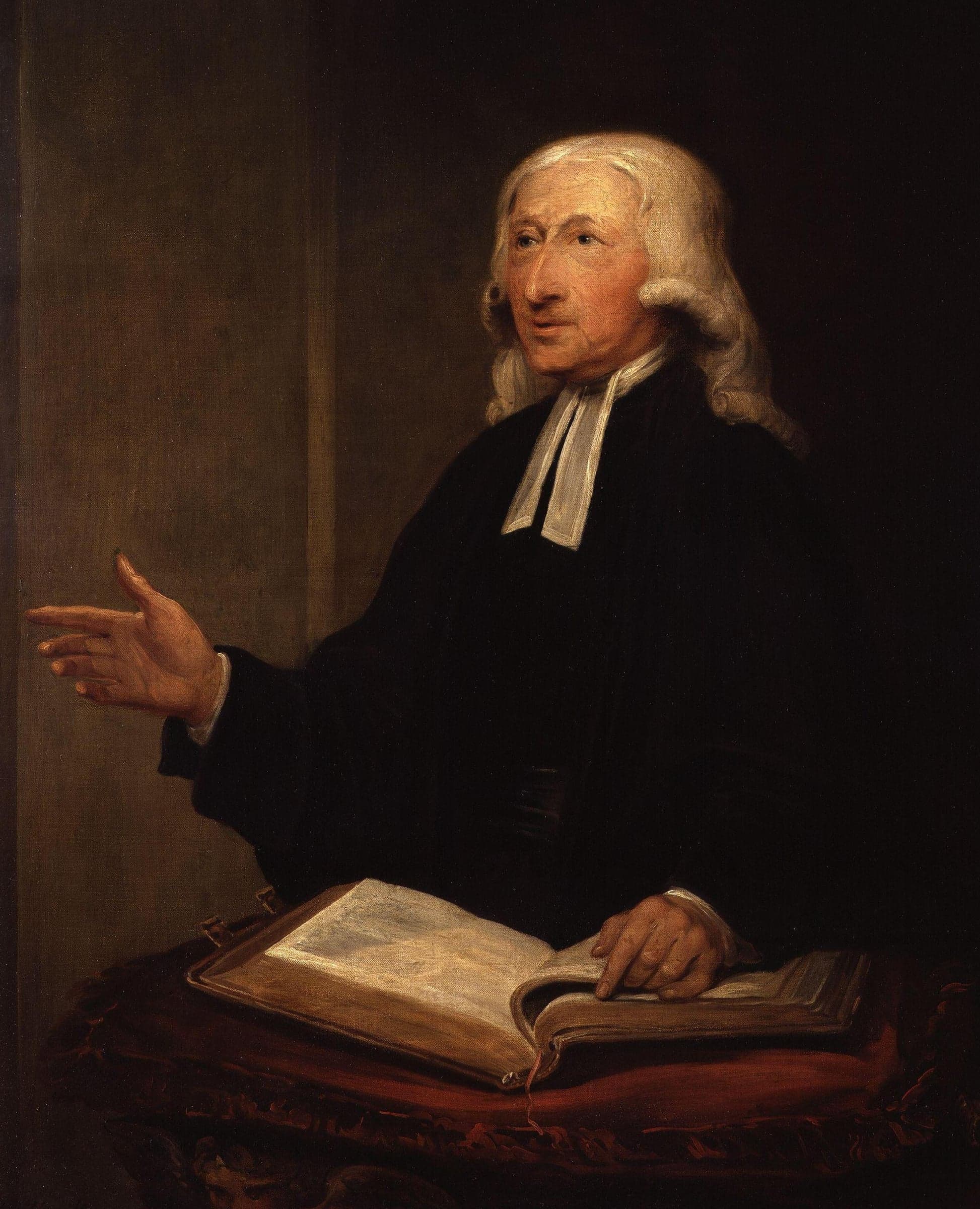
William Hamilton, John Wesley, 1788. Public domain.
The Spirit Himself testifies with our spirit that we are God’s children.
Summary
The Methodists began as societies inside the Church of England that John Wesley led. In America they became a church of their own in 1784.
- Wesley dated his assurance of salvation to an evening in May 1738.
- He taught that love for God and neighbour can rule the heart in this life.
- The Methodist Episcopal Church divided in 1844 over a bishop who owned slaves.
- Black Methodists in Philadelphia formed their own church in 1816.
- Free Methodists, Nazarenes and the Salvation Army descend from the same line.
The Texts the Methodists Stood On
The texts come from Romans 8, 1 John 4, 1 Thessalonians 5 and Matthew 22.
On 7 February 1736 the Moravian August Spangenberg put the question of Romans 8:16 to Wesley. Wesley's Journal records that on 24 May 1738 “an assurance was given me, that he had taken away my sins, even mine.”
Three further texts carry his teaching on perfect love.
In this way, love has been perfected among us, so that we may have confidence on the day of judgment; for in this world we are just like Him. There is no fear in love, but perfect love drives out fear, because fear involves punishment. The one who fears has not been perfected in love.Wesley called the goal of the Christian life perfect love, and this passage gives him the phrase.
Now may the God of peace Himself sanctify you completely, and may your entire spirit, soul, and body be kept blameless at the coming of our Lord Jesus Christ. The One who calls you is faithful, and He will do it.Wesley read this prayer as a promise that God sanctifies the whole person in this life.
Jesus declared, “‘Love the Lord your God with all your heart and with all your soul and with all your mind.’Wesley defined perfection as the love of God with all the heart that this command asks.
The Methodist Branch of the Family of Churches
Eleven names in four dated generations.
The Methodist line runs from Wesley's societies to an American church in 1784, and from it to many bodies.
1738 to 1784
- Aldersgate Street
- The field at Bristol
- The Methodist Episcopal Church
1816 to 1844
- The African Methodist Episcopal Church
- The Methodist Protestant Church
- The Methodist Episcopal Church, South
1860 to 1895
- The Free Methodist Church
- The Salvation Army
- The Church of the Nazarene
1939 to 1968
- The Methodist Church
- The United Methodist Church
Dated from Wesley's Journal and letter, Allen (1833), Roberts (1879), Railton (1912), the Nazarene Manual (1908) and Joe Iovino's history for The United Methodist Church.
The families from the Council of Ephesus to the Pentecostals stand together, each with its date.
How the Methodists Began, in Three Kinds of Witness
Three witnesses tell it: Wesley's Journal, a hostile book of 1749, and Richard Allen.
Wesley's own Journal, which he published himself, is the movement's record of its birth. At Bristol on Saturday 31 March 1739 he met George Whitefield, who was to set him an example of preaching in the fields on the Sunday.
Wesley wrote that he “could scarce reconcile my-self at first to this strange way of preaching in the fields.”
The hostile press answered in print. In 1749 an anonymous book, The Enthusiasm of Methodists and Papists Compar'd, which the Internet Archive catalogues under George Lavington's name, attacked “a set of pretended Reformers among us, call'd Methodists.”
Wesley's preachers met in conference, and his Plain Account prints the minutes of their meetings of 1745 and 1759.
On 10 September 1784 Wesley wrote from Bristol to Coke, Asbury and the Methodists in North America. He had appointed Coke and Asbury “to be joint Superintendents” and Whatcoat and Vasey “to act as Elders.”
He gave his reason: “Lord King's account of the primitive church convinced me many years ago, that Bishops and Presbyters are the same order.”
Richard Allen, who became the first bishop of the African Methodist Episcopal Church, wrote of the founding in his book of 1833. He called the Baltimore conference of December 1784 “the beginning of the Episcopal Church amongst the Methodists.”
The Truth They Kept: Perfect Love
Wesley gives his own definition in the Plain Account.
Wesley's A Plain Account of Christian Perfection, last revised in 1777 by its editor's note and read in Jackson's edition of 1872, gives his teaching in his own words. He and his brother held “That Christian perfection is that love of God and our neighbour, which implies deliverance from all sin.”
They taught that it is “received merely by faith” and “given instantaneously, in one moment.” Wesley also wrote, “sinless perfection is a phrase I never use.”
The Articles of Religion of 1784
Twenty-four articles, printed in The Sunday Service for North America.
Wesley sent the American Methodists The Sunday Service, printed in London in 1784. It carries twenty-four Articles of Religion, from “Of Faith in the Holy Trinity” to “Of a Christian Man's Oath,” and none of their headings treats predestination.
Article XII says that “after we have received the Holy Ghost, we may depart from grace given, and fall into sin.”
It adds that “by the grace of God” we may “rise again, and amend our lives.”
Wesley wrote the same in his Plain Account: “They who are sanctified, yet may fall and perish.”
MannaFest holds eternal security as its own position, and its study of eternal security sets out that reading from John 10:28 to 29.
The Wesleyan Churches Today
Three counts, each with the body that made it.
Two of the counts come from the bodies themselves, and the third comes through another body's page, with no method of counting.
Only the Nazarene count carries a year.
| Body | The count | Who counted | Year |
|---|---|---|---|
| World Methodist Council | 76 member churches, 40 million believers | The World Council of Churches' page on the council | No year given |
| Church of the Nazarene | 2,764,205 members | The church's General Secretary, in a release of 16 January 2026 | 2025 |
| The Salvation Army | 1,250,459 soldiers in 134 countries | The Army's International Headquarters | No year given |
Where the Methodists Went
From Bristol to Baltimore, Philadelphia, Pekin, Vineland and Los Angeles.
In a century and a half the movement crossed from Bristol to the Pacific coast.
| Place | Date | What began there | The record |
|---|---|---|---|
| Bristol, England | 2 April 1739 | Wesley's first open-air sermon | Wesley's Journal |
| Baltimore, Maryland | December 1784 | The Methodist Episcopal Church | Allen (1833) |
| Philadelphia, Pennsylvania | April 1816 | The African Methodist Episcopal Church | Allen (1833) |
| Pekin | August 1860 | The Free Methodist Discipline adopted | Roberts (1879) |
| Vineland, New Jersey | 17 to 26 July 1867 | The first National Camp-Meeting | Penuel (1869) |
| Los Angeles, California | 30 October 1895 | The Church of the Nazarene | The Nazarene Manual (1908) |
The Hymns of 1739 and 1740
Two hymns from the Wesleys' Hymns and Sacred Poems.
John and Charles Wesley published Hymns and Sacred Poems under both their names. The book of 1739 prints the hymn Free Grace on pages 117 to 118, and the book of 1740 prints For the Anniversary Day of One's Conversion from page 120.
The words many sing today, “great Redeemer's,” are a later reading of the seventh stanza of 1740, which prints “dear Redeemer's.”
The lines as the books of 1739 and 1740 print them1 table
Lines from the two hymns, with the edition's capitals and the long s modernized.
| Where | The lines |
|---|---|
| Hymns and Sacred Poems (London, 1739), page 117, Free Grace, first lines | And can it be, that I should gain / An Int'rest in the Saviour's Blood! |
| The same, page 118, the fourth stanza | My Chains fell off, my Heart was free, / I rose, went forth, and follow'd Thee. |
| Hymns and Sacred Poems (London, 1740), from page 120, the seventh stanza | O for a Thousand Tongues to sing / My dear Redeemer's Praise! |
Slavery and the Division of 1844
A slaveholding bishop, a walkout in Philadelphia, and the reunion that followed.
Joe Iovino's history of the bodies behind The United Methodist Church, published by that church, records the failure. It tells how James O. Andrew became a bishop of the Methodist Episcopal Church and says that “Andrew owned slaves, despite the Methodist Episcopal Church's antislavery stance since its founding.”
The Methodist Episcopal Church, South, separated from the northern church in 1844.
Earlier, in a year between 1787 and 1794 that the sources dispute, a trustee of St. George's in Philadelphia pulled Absalom Jones off his knees at prayer, and the Black members “all went out of the church in a body,” as Allen tells it. Allen also judged that after the bishops came in 1784 “religion has been declining in the church ever since.”
The same history carries the southern church of 1844 into The Methodist Church of 1939 and into The United Methodist Church of April 1968.
Books to Read Next
The Works of the Reverend John Wesley, volume III, his Journal
John Wesley · 1831
It holds Aldersgate, the field at Bristol and the mob at Wednesbury in Wesley's words.
Free at the Internet ArchiveA Plain Account of Christian Perfection
John Wesley · 1777
It is Wesley's own account of perfect love, revised until 1777.
Free at the Christian Classics Ethereal LibraryThe Sunday Service of the Methodists in North America
John Wesley · 1784
It opens with Wesley's letter of 1784 to the American preachers.
Free at the Internet ArchiveThe Life, Experience, and Gospel Labours of the Rt. Rev. Richard Allen
Richard Allen · 1833
Allen tells the walkout from St. George's and the founding of 1816.
Read it free at Documenting the American SouthWhat the Methodists Handed On
The Methodists handed on preaching in the open air, the hope of perfect love and a church order made for a new country. Iovino's history and Allen's book set the slaveholding bishop of 1844 and the walkout in Philadelphia beside that record.
MannaFest stands in the Wesleyan-Pentecostal line, which runs from Wesley through the Holiness churches to Azusa Street.
The line through this page
1 link to other pages, in order of date.
This page
The Methodist and Wesleyan Churches
1725 to 1777
The Methodist and Wesleyan Churches to Christian Perfection
Wesley's A Plain Account of Christian Perfection, read in Jackson's edition of 1872, carries the title “As believed and taught by the Reverend Mr. John Wesley, from the year 1725, to the year 1777.”
Sources
Scripture is the Berean Standard Bible.
- The Holy Bible, Berean Standard Bible (read 2026)
- John Wesley, Journal, 1735 to 1743, in The Works of the Reverend John Wesley, A.M. (New York: J. Emory and B. Waugh, 1831), volume III, pages 18, 74, 126 to 127 and 296 to 297.
- The Enthusiasm of Methodists and Papists Compar'd (London: J. and P. Knapton, 1749), the preface, catalogued under George Lavington.
- John Wesley, A Plain Account of Christian Perfection (last revised 1777), in The Works of John Wesley, edited by Thomas Jackson (1872), volume 11, pages 366 to 446.
- The Sunday Service of the Methodists in North America (London, 1784), Wesley's letter of 10 September 1784, pages i to iii, and the Articles of Religion, pages 306 to 314.
- Richard Allen, The Life, Experience, and Gospel Labours of the Rt. Rev. Richard Allen (Philadelphia: Martin and Boden, 1833), pages 12 to 21.
- John and Charles Wesley, Hymns and Sacred Poems (London, 1739), pages 117 to 118, Free Grace.
- John and Charles Wesley, Hymns and Sacred Poems (London: W. Strahan, 1740), from page 120, For the Anniversary Day of One's Conversion.
- Joe Iovino, The roots of the UM family tree: Digging deeper (The United Methodist Church, undated; read 2026)
- World Council of Churches, World Methodist Council (undated; read 2026)
- Nazarene News Staff, General Secretary releases 2025 statistics (16 January 2026)
- The Salvation Army International Headquarters, Global presence (undated; read 2026)
- B. T. Roberts, Why Another Sect (Rochester: The Earnest Christian Publishing House, 1879), appendix, pages 330 to 331.
- Alexander McLean and Joel W. Eaton, editors, Penuel; or, Face to Face with God (New York: W. C. Palmer, Jr., 1869), pages 15 to 16.
- Manual of the Pentecostal Church of the Nazarene (Nazarene Publishing Company, 1908), pages 11 to 12.
- George Scott Railton, The Authoritative Life of General William Booth (1912), chapter IX.
- African Methodist Episcopal Church, Our History (undated; read 2026)
- Historic St. George's United Methodist Church, The Great Walk Out (undated; read 2026)
Keep Studying
Studies5
People and groups3
Doctrines2
Values1