
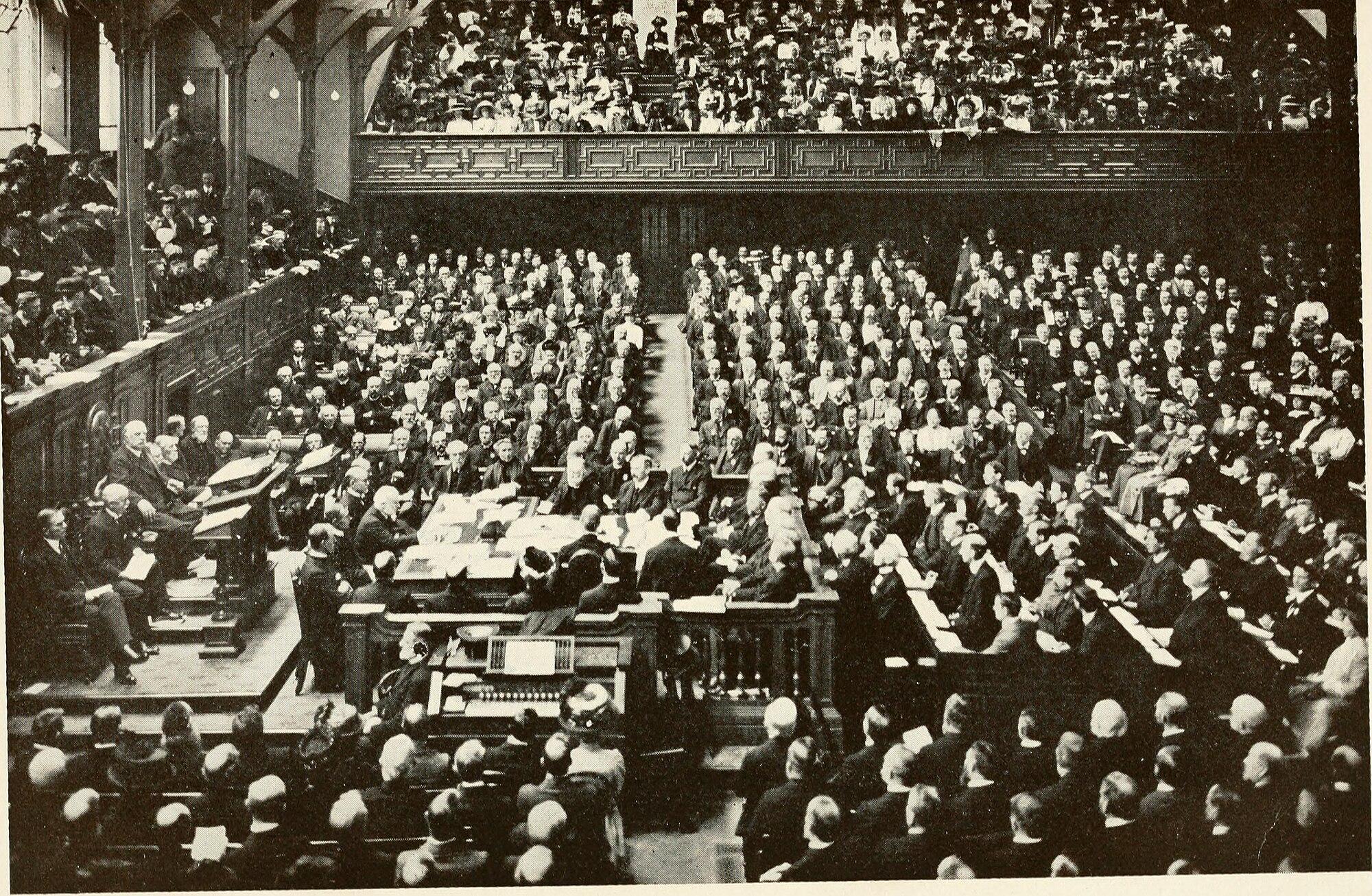
The Conference in Session, unknown photographer, 1910. No restrictions.
1910 and 1974 · The churches · Featured Study
Edinburgh 1910 and Lausanne 1974
Two world conferences of Protestant missions, sixty-four years apart, that took stock of the work of preaching Christ to every nation.
Then Jesus said to them, “Truly I tell you, there are some standing here who will not taste death before they see the kingdom of God arrive with power.”
- Began
- 1910 at Edinburgh and 1974 at Lausanne
- Bodies
- The World Missionary Conference and its Continuation Committee, The International Congress on World Evangelization
The delegates to Edinburgh read eight printed volumes of reports on trains and liners before the Conference opened on 14 June 1910.
Summary
The World Missionary Conference met at Edinburgh in June 1910. John R. Mott chaired its debates. It set up a committee to carry its work on. The Congress at Lausanne met in July 1974. It wrote the Lausanne Covenant.
- Twelve hundred delegates came to Edinburgh.
- V. S. Azariah of South India asked the Conference for friendship between East and West.
- Billy Graham chaired the committee that called the Congress at Lausanne.
- John Stott led the work of writing the Covenant.
The Texts Spoken and Printed
A saying of Jesus closed Edinburgh's opening night, Paul's words closed Azariah's plea, and Luke 4:18 stood on Lausanne's country profiles.
Gairdner records that the Archbishop of Canterbury ended the opening evening at Edinburgh by applying a saying of Christ to the delegates in the hall.
If I give all I possess to the poor and exult in the surrender of my body, but have not love, I gain nothing.Azariah took the words of this verse for the missionaries' gifts and asked for love beside them.
“The Spirit of the Lord is on Me, because He has anointed Me to preach good news to the poor. He has sent Me to proclaim liberty to the captives and recovery of sight to the blind, to release the oppressed,The country profiles prepared for Lausanne in 1974 print its words, in the King James wording, on their pages.
The Branch from the Student Volunteers to Lausanne
The line runs from the students of 1886 through Edinburgh to Lausanne.
The world conferences grew from the student missions movement and met again at Lausanne in 1974.
1886
1908
- The eight Commissions appointed
1910
- The World Missionary Conference, Edinburgh
- The Continuation Committee
1974
- The country profiles for the Congress
- The International Congress on World Evangelization, Lausanne
- The Lausanne Covenant
Gairdner gives the years of Edinburgh, and the paper of 2019 and the profiles give those of Lausanne.
The two conferences answer the same questions with different numbers and different voices.
| The question | Edinburgh 1910 | Lausanne 1974 |
|---|---|---|
| When and where | From 14 June 1910, in the United Free Church Assembly Hall | 16 to 25 July 1974, at the Palais de Beaulieu |
| Who presided | John R. Mott, Chairman of the Committee of the whole Conference | A committee chaired by Billy Graham |
| How many came | Twelve hundred delegates | Over 2,300 evangelical leaders from around 150 countries |
| What it left | A Continuation Committee | The Lausanne Covenant |
| A voice from the churches of the South and East | V. S. Azariah of South India | C. René Padilla of Ecuador and Samuel Escobar of Peru |
How the Conference Met: Edinburgh, June 1910
Gairdner wrote the Conference's account at its committee's request, with an introduction by Mott.
The Conference's committee invited W. H. T. Gairdner of Cairo to write Echoes from Edinburgh, and left him free to present its message as he judged best. He tells how each of the eight Commissions gathered its evidence by correspondence across the world.
John R. Mott took the chair when the House sat in committee, and he presided over the debates on all eight reports. Gairdner wrote that no man from either hemisphere could have filled that chair as Mott did.
The Truth They Pressed: Missions at the Centre of the Church
Both conferences held that preaching Christ to every nation is the church's first work.
Gairdner writes that the Archbishop of Canterbury's address on the opening evening revealed a passionate conviction “that evangelisation is the paramount duty of the Church.”
In Lessa and da Silva's reading, the Covenant keeps evangelism first and calls the whole church to take the whole gospel to the whole world.
Therefore go and make disciples of all nations, baptizing them in the name of the Father, and of the Son, and of the Holy Spirit,It is the command to make disciples of all nations that both conferences gathered to serve.
The Statements the Two Conferences Made
Edinburgh resolved on a committee, and Lausanne signed a covenant.
Each conference set down what it would carry forward.
| Conference | Document | Its words |
|---|---|---|
| Edinburgh 1910 | The resolution moved by Sir Andrew Fraser | “That a Continuation Committee of the World Missionary Conference be appointed, international and representative in character” |
| Lausanne 1974 | The Lausanne Covenant, article 5, on social responsibility | “evangelism and socio-political involvement are both part of our Christian duty” |
The Edinburgh resolution framed the Committee on the Conference's own lines, which it called interdenominational and free of “the idea of organic and ecclesiastical union.”
Stott wrote that the Covenant's first draft went out by post two or three months before the Congress and was revised twice. Many hundreds of submissions from participants were weighed before the final text.
What Each Conference Counted
Edinburgh was given a count of the churches in mission lands, and Lausanne counted its own participants.
Gairdner records that the Conference heard of 1,925,205 registered communicants in the mission lands of Asia, Africa and other parts of the world.
Lessa and da Silva add that about 500 of the Lausanne delegates backed Padilla and Escobar's call for a clearer word on social justice, citing Swartz.
Where the Conferences Looked
Each place stands with the record that names it.
Edinburgh heard of churches across Asia, Africa and the Pacific, and Lausanne profiled the peoples still unreached.
| Year | Place | What the record says |
|---|---|---|
| 1910 | Japan, Korea and Manchuria | Churches with their own constitutions, self-supporting and self-propagating. |
| 1910 | China | Ch'eng Ching-Yi claimed that China should stand with Japan in the independence of its churches. |
| 1910 | Uganda | A church so independent that its society's secretary in London knew little of its finances. |
| 1910 | The South Sea Islands | Fifty-four islanders from a training college had gone as missionaries to New Guinea. |
| 1974 | Andhra Pradesh, India | MARC's profile names the Bakht Singh assemblies among the fastest growing churches. |
In Their Own Words
V. S. Azariah
Address to the World Missionary Conference, as printed in W. H. T. Gairdner, Echoes from Edinburgh, 1910, page 111
Give us friends
“Through all the ages to come the Indian Church will rise up in gratitude to attest the heroism and self-denying labours of the missionary body. You have given your goods to feed the poor. You have given your bodies to be burned. We also ask for love. Give us friends !”
Anglican, South India
About this saying1 paragraph
Gairdner prints the close of V. S. Azariah's evening address on page 111 of his account.
John R. Mott
Closing address to the World Missionary Conference, as printed in W. H. T. Gairdner, Echoes from Edinburgh, 1910, page 267
The end of the Conference
“The end of the Conference is the beginning of the Conquest”
Methodist
About this saying1 paragraph
Mott spoke once from the chair, at the close, and Gairdner records his opening sentences on page 267.
The Archbishop of Canterbury in June 1910
Address on the opening evening of the World Missionary Conference, as printed in W. H. T. Gairdner, Echoes from Edinburgh, 1910, page 43
The central place
“the place of missions in the life of the Church must be the central place, and none other : that is what matters”
Anglican
About this saying1 paragraph
Gairdner prints these words, spoken on the evening of 14 June 1910, on page 43.
Dissent at Edinburgh and Tension at Lausanne
Both conferences heard sharp disagreement, and their own records keep it.
Azariah's plea met what Gairdner calls “a by no means unqualified assent.” Some Indian missionaries in the hall answered him with dissent and murmuring, while others applauded.
On the day of unity a delegate said that American Christians were not ready to apologise for the Protestant Reformation. Gairdner answered that the fellowship of the Conference should go “just exactly as far as it can go.”
At Lausanne, Padilla faulted evangelism that sought growth in numbers alone, as Lessa and da Silva tell it, and called the church to act against injustice. Escobar spoke to the same end.
The Covenant answered both sides. It says social action is not evangelism and political liberation is not salvation, yet it names both evangelism and socio-political involvement a Christian duty.
Books to Read Next
Echoes from Edinburgh, 1910
W. H. T. Gairdner · 1910
Gairdner gives the Conference day by day, with its debates and its speakers.
Free at the Internet ArchiveStatus of Christianity Country Profiles
MARC, for the International Congress on World Evangelization · 1974
The profiles were printed for the Congress to name the unreached peoples of each land.
Free at the Internet ArchivePlace of Discursive Memory and Scenography in the Lausanne Covenant
Alexandre Ribeiro Lessa and Edvania Gomes da Silva · 2019
The paper tells how the Congress met and how the Covenant was drafted.
Free at the Internet ArchiveWhat the Conferences Handed On
Edinburgh handed on a standing committee for cooperation among the Protestant missions, and Lausanne handed on a covenant that its participants signed. Both kept the preaching of Christ to every people as the church's central work.
Sources
Scripture is the Berean Standard Bible.
- The Holy Bible, Berean Standard Bible (read 2026)
- W. H. T. Gairdner, Echoes from Edinburgh, 1910: An Account and Interpretation of the World Missionary Conference, with an introduction by John R. Mott (New York: Laymen's Missionary Movement, 1910), pages 26, 42 to 43, 58, 63, 96 to 97, 109 to 111, 187 to 188, 198 to 199 and 267.
- Alexandre Ribeiro Lessa and Edvania Gomes da Silva, Place of Discursive Memory and Scenography in the Lausanne Covenant, International Journal of Advanced Engineering Research and Science 6, no. 11 (November 2019), pages 99 to 110.
- Status of Christianity Country Profiles, prepared for the International Congress on World Evangelization, Lausanne, July 1974 (Monrovia: MARC, copyright 1974 International Congress on World Evangelization), the profile of Andhra Pradesh.
- Klaus Bockmuehl, Evangelicals and Social Ethics: A Commentary on Article 5 of the Lausanne Covenant (1979), its title.
Keep Studying
Read it1
Studies1
Subjects1
Doctrines2
Church history1