
Matthew 28:19 and Acts 2:38 · Debate · Featured Study
Oneness and Trinitarian Pentecostals
Two Pentecostal answers to who God is and in whose name believers are baptized.
In October 1915 the Assemblies of God resolved that a formula naming “Jesus Christ” in place of “Son” would better join Matthew 28:19 to Acts.
- The question
- Is the one God three Persons, Father, Son and Holy Spirit, or one Person, Jesus, revealed in three ways, and in whose name are believers baptized?
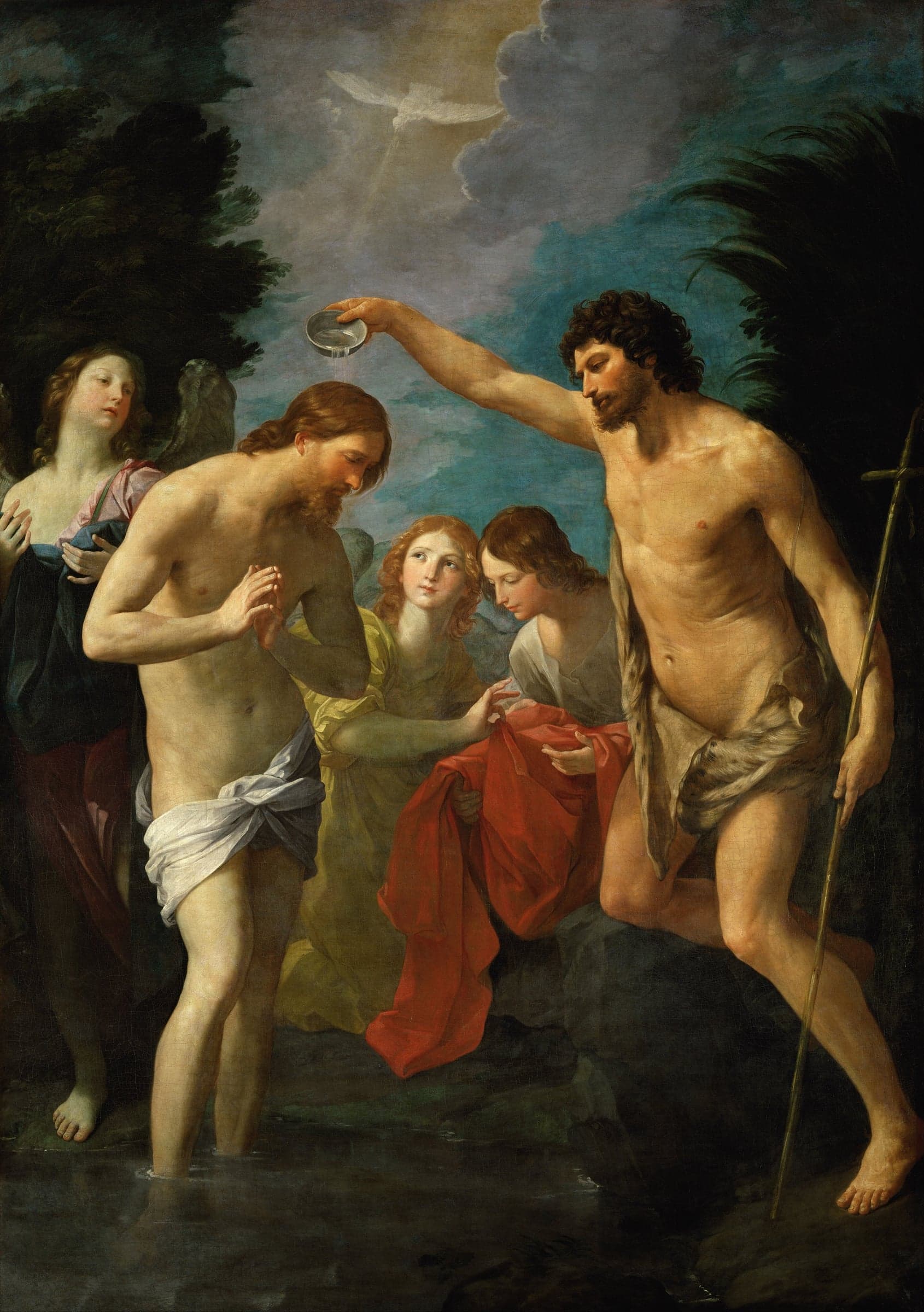
Guido Reni, The Baptism of Christ, 1623. Public domain.
Therefore go and make disciples of all nations, baptizing them in the name of the Father, and of the Son, and of the Holy Spirit,
Summary
From 1913 to 1916 a quarrel over the words spoken at baptism grew into a quarrel over the Godhead. The Assemblies of God confessed the Trinity, and the Oneness ministers went their own way.
- A camp meeting near Los Angeles in 1913 raised the question of the baptismal words.
- The Assemblies of God first let its ministers baptize by either formula.
- Oneness ministers left and in time formed churches of their own.
The Texts Both Sides Read
Acts names Jesus at baptism where Matthew 28:19 names Father, Son and Spirit.
The Assemblies of God's council of 1915 set four texts of Acts beside Matthew 28:19, and both sides still read them with Deuteronomy, Colossians, John and 2 Corinthians.
The words of Acts
Peter replied, “Repent and be baptized, every one of you, in the name of Jesus Christ for the forgiveness of your sins, and you will receive the gift of the Holy Spirit.
Peter's call at Pentecost is the text the Oneness ministers baptized by.
Acts 2:38BSB
For the Holy Spirit had not yet fallen upon any of them; they had simply been baptized into the name of the Lord Jesus.
The council of 1915 listed it among the four texts of Acts that name Jesus at baptism.
Acts 8:16BSB
So he ordered that they be baptized in the name of Jesus Christ. Then they asked him to stay for a few days.
It is the third of the four texts the council of 1915 set beside Matthew 28:19.
Acts 10:48BSB
On hearing this, they were baptized into the name of the Lord Jesus.
It is the last of the four texts of Acts the council of 1915 named.
Acts 19:5BSB
The one God
Hear, O Israel: The LORD our God, the LORD is One.
Both sides confess this text, and the 1916 article on the one true God cites it.
For in Christ all the fullness of the Deity dwells in bodily form.
It places all the fullness of the Deity in Christ, which both answers must account for.
Jesus replied, “Philip, I have been with you all this time, and still you do not know Me? Anyone who has seen Me has seen the Father. How can you say, ‘Show us the Father’?
Both answers must explain how the one who has seen Jesus has seen the Father.
John 14:9BSB
Father, Son and Spirit together
As soon as Jesus was baptized, He went up out of the water. Suddenly the heavens were opened, and He saw the Spirit of God descending like a dove and resting on Him. And a voice from heaven said, “This is My beloved Son, in whom I am well pleased!”
The Trinitarian side sets it against the Oneness reading, since Son, Spirit and Father appear in one scene.
The grace of the Lord Jesus Christ, and the love of God, and the fellowship of the Holy Spirit be with all of you.
Paul names the Lord Jesus Christ, God and the Holy Spirit in one blessing, a text the council of 1916 cited.
Deuteronomy 6:4, Colossians 2:9, John 14:9, Matthew 3:16 to 17, 2 Corinthians 13:14
The Greek of the five baptism texts uses three words for “in” or “into”: eis in Matthew 28:19, Acts 8:16 and Acts 19:5, epi in Acts 2:38, and en in Acts 10:48. A preposition alone does not settle whether “in the name” means words spoken or the authority under which the act is done.
The Two Answers Side by Side
The United Pentecostals and the Church of God (Cleveland) on the Godhead, and two bodies on baptism.
The first row turns on the word persons, and the second on the name spoken over the water.
| The question | The Oneness answer | The Trinitarian answer |
|---|---|---|
| Who is the one God? | The United Pentecostal Church International: “There is one God, who has revealed Himself as Father; through His Son, in redemption; and as the Holy Spirit, by emanation.” | The Church of God (Cleveland): “In one God eternally existing in three persons; namely, the Father, Son, and Holy Ghost.” |
| In whose name are believers baptized? | The United Pentecostal Church International teaches “water baptism in the name of Jesus Christ.” | The Church of God in Christ uses the Trinitarian words of Matthew 28:19. |
Each Answer in Its Own Words, and the Site's Tradition
Haywood and the United Pentecostals, the council of 1916, and the Trinitarian confession.
G. T. Haywood, a Oneness teacher, collected his articles in The Victim of the Flaming Sword, dated about 1923. He taught that there is but one God, manifested in a threefold manner, and he rejected the idea of a God in three persons.
The United Pentecostal Church International confesses that “Jesus Christ is God manifested in flesh” and ties obeying the gospel to repentance, water baptism in His name and the baptism of the Holy Spirit.
The Assemblies of God's statement of 1916 held that the terms Trinity and Persons are in harmony with Scripture, though Scripture does not use them. It allowed the Lord our God to be spoken of as one Being of three Persons.
The Church of God in Christ and the Foursquare Church confess the Trinity in their own statements, and the Foursquare Declaration names Father, Son and Spirit “three, equal in every divine perfection.”
MannaFest stands in the Wesleyan-Pentecostal tradition, which confesses one God in three Persons, the Father, the Son and the Holy Spirit, and holds the Trinity as an essential of the faith.
The New Issue, 1913 to 1916
A camp meeting, a rebaptism, and two councils at St. Louis.
In April 1913 a world-wide camp meeting gathered at Arroyo Seco near Los Angeles. Wayne Warner, writing in the Assemblies of God's own Heritage magazine in 1983, records that R. E. McAlister told a baptismal service there that the apostles baptized in the name of Jesus.
Warner adds that Frank J. Ewart began about a year later to teach that believers should be baptized with the shorter formula.
E. N. Bell, who had chaired the founding council of 1914, was rebaptized in 1915. Thomas Fudge's study of 2001 holds that both sides have misread what Bell's rebaptism meant.
At St. Louis in October 1915 the General Council refused to bind consciences or to draw any line of fellowship over the baptismal formula.
A year later, at St. Louis again, the Council adopted a Statement of Fundamental Truths, and its article 13 set out the essentials as to the Godhead. Darrin J. Rodgers, the denomination's archivist, writes that the Statement “resulted in the departure of Oneness advocates.”
After 1916: the United Pentecostals and the True Jesus Church3 paragraphs
The United Pentecostal Church International dates itself to 1945, when the Pentecostal Church Incorporated merged with the Pentecostal Assemblies of Jesus Christ. Its own page counts 521 churches in that year.
The True Jesus Church says it originated in Beijing in 1917, baptizes “in the name of the Lord Jesus Christ for the remission of sins,” and confesses Jesus as “the only true God.”
The True Jesus Church's statement departs from the Trinity, an essential of the Christian faith.
Where the Answers Are Contested
Five positions, each with its holders, its source and the strongest objection to it.
The council of 1916 settled both questions for the Assemblies of God, and the ministers who left carried the other answers into bodies of their own.
Books to Read Next
Minutes of the General Council of the Assemblies of God, 1915 and 1916
The General Council of the Assemblies of God · 1915 and 1916
The councils' own record of the formula debate and the Statement of Fundamental Truths.
Free at the Flower Pentecostal Heritage CenterThe Victim of the Flaming Sword
G. T. Haywood · about 1923
Haywood's articles on the Godhead, collected for his readers.
Free at the Internet ArchiveOne God and One Baptism
The New Issue began with the words spoken over the water. It ended in two families of Pentecostal churches, which still divide where the first Pentecostals divided.
Sources
Scripture is the Berean Standard Bible.
- The Holy Bible, Berean Standard Bible (read 2026)
- United Pentecostal Church International, Our Beliefs (read 2026)
- United Pentecostal Church International, About (read 2026)
- Church of God (Cleveland, Tennessee), Declaration of Faith (read 2026)
- Church of God in Christ, What We Believe (PDF, 2014)
- The Foursquare Church, Declaration of Faith, compiled by Aimee Semple McPherson (PDF, 2023), article II.
- G. T. Haywood, The Victim of the Flaming Sword (Indianapolis, about 1923)
- Assemblies of God, General Council Minutes, St. Louis, October 1915, pages 5 to 6.
- Assemblies of God, General Council Minutes, St. Louis, October 1916, Statement of Fundamental Truths, pages 10 to 13.
- Darrin J. Rodgers, Fully Committed: 100 Years of the Assemblies of God, Assemblies of God Heritage 34 (2014)
- Wayne Warner, The 1913 Worldwide Camp Meeting, Assemblies of God Heritage (Spring 1983)
- Kenneth Gill, Dividing Over Oneness, Christian History 58 (1998)
- Thomas A. Fudge, Did E. N. Bell Convert to the New Issue in 1915?, Journal of Pentecostal Theology 18 (2001), pages 122 to 140, the abstract.
- True Jesus Church, About (no date given; read in 2026)
Keep Studying
Studies1
Subjects1
People and groups1
Church history1
Doctrines2