
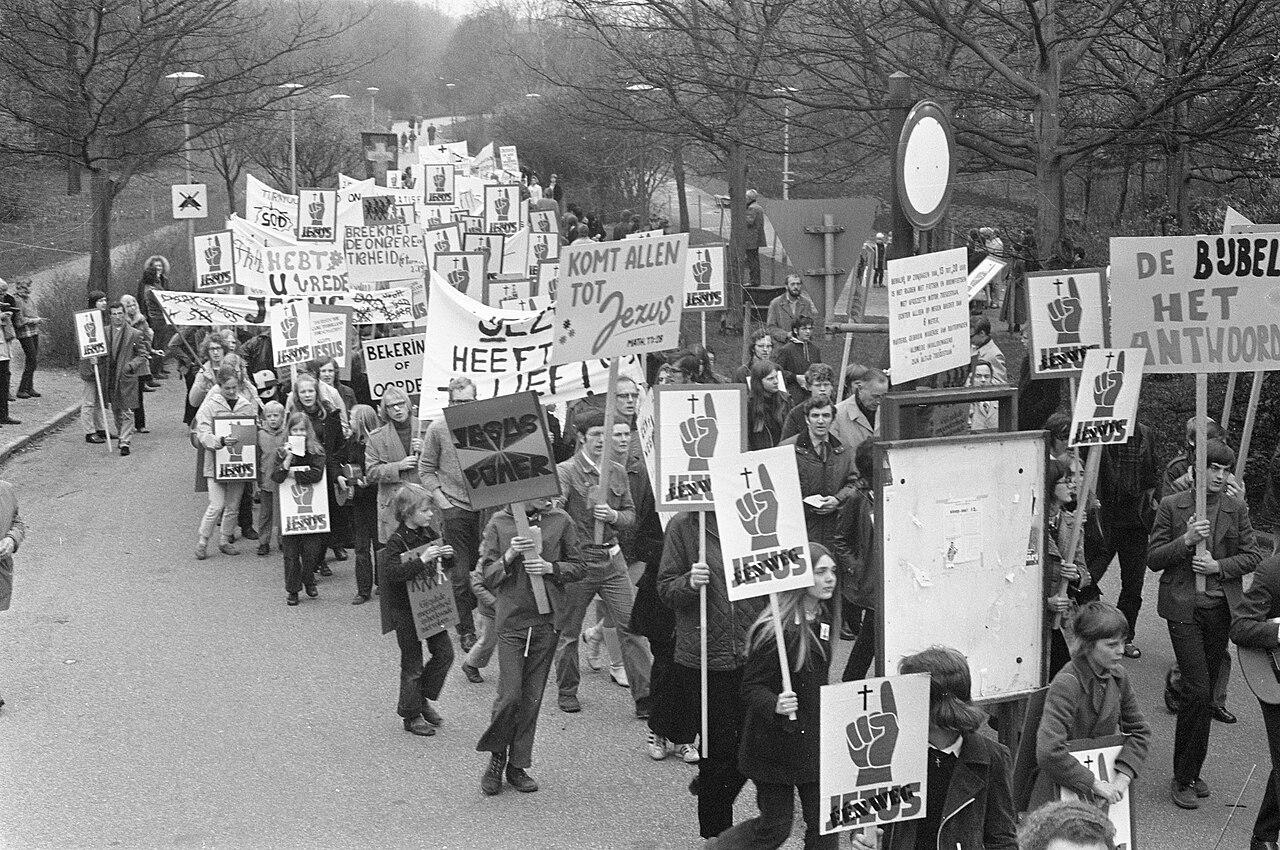
W. Punt for Anefo, Jesus movement march in Amsterdam, 1972. CC0.
1965 to 1974 · The churches · Featured Study
The Jesus Movement
Young people of the counterculture turned to Christ in California and beyond in the late 1960s and early 1970s.
Jesus answered, “I am the way and the truth and the life. No one comes to the Father except through Me.
- Began
- the late 1960s, in California (probable)
- Bodies
- Calvary Chapel, The Jesus People, The Hollywood Free Paper
In May 1968 a California church rented a little two-bedroom house on 19th Street, and within two weeks thirty-five young converts had moved in.
Summary
The Jesus movement was a wave of conversions whose centre was Calvary Chapel of Costa Mesa, and its message was the simple gospel.
- Chuck Smith took a church of twenty-five people.
- Converts were baptized in the Pacific by the hundreds.
- Its newspapers and its One Way sign spread the message.
- Time magazine called it the Jesus Revolution in 1971.
- Its critics named its anti-intellectual temper and its legalist fringe.
The Texts of the One Way
The movement's sign and its beach baptisms each had their verse.
Enroth's study of 1972 names One Way buttons and fish necklaces among the movement's well-known symbols. A chaplain's paper of 1973 quotes Enroth that its single most important teaching was the simple gospel, Jesus saves.
Those who embraced his message were baptized, and about three thousand were added to the believers that day.Calvary Chapel's beach services baptized converts in numbers the early church knew on the first Pentecost.
The Branch of the Movement
The branch runs from Brooklyn in 1958 to the studies of the early 1970s.
The Jesus movement drew on the Pentecostal street work of the 1950s and grew through Chuck Smith's church.
1958 to 1965
- Teen Challenge in Brooklyn
- Calvary Chapel, Costa Mesa
1968 to 1971
- Calvary's first home for new believers
- The Hollywood Free Paper
1971 to 1974
- The Jesus People in the press
- The Children of God
The dates come from two Army chaplains and the church's own retrospective.
The site's tradition is Wesleyan-Pentecostal, and the charismatic renewal of the same years carried the gifts of the Spirit into the older churches.
How the Movement Began: A Small Church and a House of Converts
The church's own magazine tells its start, and it is the church's account of itself.
Chuck Smith became pastor of Calvary Chapel in 1965, by the church's own magazine. Smith recalls that they built bunks out into the garage to hold the young people who came.
A chaplain's paper of 1974 traces the movement back to 1958 in Brooklyn. It begins with the conversion of the gang leader Nicky Cruz under the preaching of David Wilkerson.
The Truth They Pressed: Jesus Saves
The movement preached conversion in the plain words of the street.
Enroth wrote that the word for the mystique of Calvary Chapel would be love, Christian love. He named Lonnie Frisbee, once a student at the San Francisco Academy of Art, as a leading Jesus Freak.
that if you confess with your mouth, “Jesus is Lord,” and believe in your heart that God raised Him from the dead, you will be saved.The simple gospel Enroth names, Jesus saves, is the confession this verse asks for.
Its Own Papers
The movement spread its message through street newspapers.
The Hollywood Free Paper led the movement's press.
| What the record says | Who says it |
|---|---|
| Jesus newspapers had grown up around the country to advertise meetings and Bible studies. | Kochanek, 1973, chapter IV |
| The Hollywood Free Paper was one of the first and largest, printing more than 450,000 copies a month. | Kochanek, 1973, chapter IV |
| Duane Pederson, a magician turned editor, ran it. | Enroth, 1972 |
The Crowds and Their Counts
Each count stands with the one who made it and its year.
Smith's church grew from 25 people in 1965 to crowds of 2,000 in the early 1970s.
| What was counted | The count | Who counted, and for when |
|---|---|---|
| The congregation | 25 | The church's own history, for 1965 |
| New believers who moved in, within two weeks | 35 | Chuck Smith, for May 1968 |
| Young people baptized | about 500 a month | Kochanek, 1973, reporting Enroth, 1972 |
| The congregation | 2,000 | The church's own history, for the early 1970s |
Where the Movement Went
Each place stands with the year its record gives.
The movement ran from Costa Mesa to the beaches and across the sea.
| Year | Place | What happened there |
|---|---|---|
| 1965 | Costa Mesa, California | Smith took a small congregation that grew into the movement's centre. |
| 1968 | Costa Mesa | The church opened its first house for new converts. |
| Around 1970 | Pirate's Cove and Corona del Mar | Baptisms moved from the church building to the ocean shore. |
| 1972 | Amsterdam | A Jesus movement march carried placards of the raised finger through the city. |
In Their Own Words
Chuck Smith and Jeff Johnson, a convert who later began the Calvary Chapel at Downey, remember the movement in the church's own magazine, which also retells Smith's words to his church board.
Chuck Smith (1927 to 2013)
Jessica Russell, Debra Smith and Tom Price, They Called It the Jesus Movement, Calvary Chapel Magazine, issue 58 (no year printed in the text read), his words to the church board
We will love these kids
“We will love these kids and teach them God's Word”
Independent
About this saying1 paragraph
Smith put this vision to his church board after a Sunday in the late 1960s, and the magazine gives no year for the meeting.
Chuck Smith
Jessica Russell, Debra Smith and Tom Price, They Called It the Jesus Movement, Calvary Chapel Magazine, issue 58 (no year printed in the text read), Hippie Houses: Recollections by Pastor Chuck Smith
A place to live
“But the Lord caused us to realize that one of the big needs was a place for these kids to live. Having accepted Christ, they really had no place to go.”
Independent
About this saying1 paragraph
In the same issue Smith recalled the first converts who stayed in his home, and the piece gives no year of its own.
Jeff Johnson
Jessica Russell, Debra Smith and Tom Price, They Called It the Jesus Movement, Calvary Chapel Magazine, issue 58 (no year printed in the text read), Grace Changes Everything
Saved that night
“I got saved that night, and I went home and flushed all my drugs.”
Independent
About this saying1 paragraph
Jeff Johnson, who had gone to Hawaii in 1968 in search of psychic powers, told the magazine of the night a former dealer took him to a little church.
The Critics and the Fringe
Writers of the time named the movement's weaknesses and its darker branch.
Enroth described the Children of God as anti-establishment and rigidly legalistic. He asked in one chapter whether the movement was a Great Awakening or a Gentle Stir.
Kochanek's paper names the anti-intellectualism of the Jesus People as the other side of a faith built on experience. Time had judged the movement “something quite a bit larger than a theological Hula-Hoop, something more lasting than a religious Woodstock,” as Smith's paper of 1974 quotes it.
Books to Read Next
The Jesus People: Old-Time Religion in the Age of Aquarius
Ronald M. Enroth, Edward E. Ericson and C. Breckinridge Peters · 1972
Three scholars studied the movement in the year after Time's cover story.
In print: find it wherever books are sold.
The Jesus People
Donald R. Kochanek · 1973
An Army chaplain set out the movement's teaching and press for other chaplains.
Free at the Internet ArchiveThe Jesus Movement: Its Development and Its Relationship to the Army Chapel and Chaplains
Billy T. Smith · 1974
A chaplain traced the movement's roots and gathered the press of its peak years.
Free at the Internet ArchiveWhat the Movement Handed On
The movement handed on a church that counts itself in more than 1,500 congregations, colleges and conference centres, and a plain call to come to Jesus.
Sources
Scripture is the Berean Standard Bible.
- The Holy Bible, Berean Standard Bible (read 2026)
- Ronald M. Enroth, Edward E. Ericson and C. Breckinridge Peters, The Jesus People: Old-Time Religion in the Age of Aquarius (Grand Rapids: William B. Eerdmans, 1972)
- Jessica Russell, Debra Smith and Tom Price, They Called It the Jesus Movement, Calvary Chapel Magazine, issue 58 (no year printed in the text read)
- Chuck Smith, Hippie Houses: Recollections by Pastor Chuck Smith, and Grace Changes Everything, on Jeff Johnson, in Jessica Russell, Debra Smith and Tom Price, They Called It the Jesus Movement, Calvary Chapel Magazine, issue 58 (no year printed; the issue names a conference of 2012)
- Donald R. Kochanek, The Jesus People, a paper for the United States Army Chaplain School, Career Course C-22 (May 1973), chapters II to IV.
- Billy T. Smith, Chaplain (Major), The Jesus Movement: Its Development and Its Relationship to the Army Chapel and Chaplains, United States Army Chaplains School (3 December 1974), quoting The New Rebel Cry: Jesus Is Coming, Time (June 1971)
Keep Studying
People and groups3
Subjects1
Church history1