
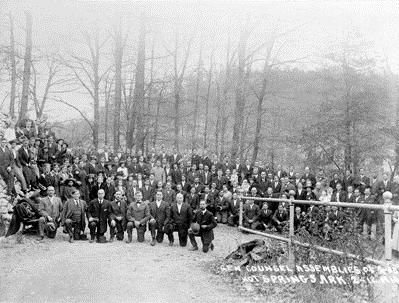
Visitors and delegates to the First General Council, Hot Springs, Arkansas, April 1914, the General Council of the Assemblies of God. Public domain.
1911 to 1961 · The churches · Featured Study
The Assemblies of God Missions
The Assemblies of God sent missionaries abroad from its founding, and a worker among orphans in Egypt became the best known of them.
And this gospel of the kingdom will be preached in all the world as a testimony to all nations, and then the end will come.
- Began
- 1914, the gathering at Hot Springs, Arkansas
- Bodies
- The Assemblies of God Foreign Missions Department, The Lillian Trasher Orphanage, Assiut
Lillian Trasher opened her orphanage at Assiut three years before the fellowship that would one day send her was formed.
Summary
The fellowship sent workers overseas from its first years. Its historian Gary McGee says it began small, and the work grew.
- Pentecostals met at Hot Springs, Arkansas, to work as one body.
- Its workers abroad wrote home through its papers.
- Noel Perkin led the work abroad as missionary secretary.
- Melvin Hodges wrote The Indigenous Church in 1953.
The Texts of the Missions
McGee's history takes its title from the promise that the gospel will be preached to all nations.
Gary McGee named his history of the fellowship's foreign missions to 1959 This Gospel Shall Be Preached, after the words of Jesus in Matthew 24:14.
Pure and undefiled religion before our God and Father is this: to care for orphans and widows in their distress, and to keep oneself from being polluted by the world.Trasher's orphanage, which also took in widows, kept this command for fifty years.
The Branch of the Missions
The branch runs from Azusa Street to Hodges's book.
The fellowship's missions grew from the Pentecostal revival into a department of their own.
1906 to 1911
- Azusa Street
- The orphanage at Assiut
1914 to 1919
- The Assemblies of God
- Trasher's appointment
1927 to 1953
- Perkin in office
- The Indigenous Church
Each date is read from McGee's history of 1986 or from Letters from Lillian (1983).
The site's tradition is Wesleyan-Pentecostal, the line that runs through Azusa Street to the fellowship that met at Hot Springs.
How the Missions Began: Hot Springs and the Papers
McGee's history of 1986 tells the start.
McGee writes that the Assemblies of God began on an unassuming scale in 1914, when independent Pentecostals gathered in Hot Springs, Arkansas, to organize their efforts. His book came from the Gospel Publishing House of Springfield, Missouri.
The fellowship printed the letters of its missionaries in its papers, the Christian Evangel and the Word and Witness. The Christian Evangel took the name Pentecostal Evangel after 1919.
The Truth They Pressed: The Indigenous Church
The missions came to teach that a church planted abroad should stand on its own.
McGee records that the writings of Roland Allen, William Owen Carver and John L. Nevius shaped the fellowship's missions. Noel Perkin, appointed missionary secretary in 1927, was another exponent of these indigenous church principles.
Melvin L. Hodges set the principles down in The Indigenous Church in 1953. McGee writes that others, led by the prolific Hodges, have further set out a Pentecostal teaching of missions.
Paul and Barnabas appointed elders for them in each church, praying and fasting as they entrusted them to the Lord, in whom they had believed.A church led by elders of its own people is the pattern the indigenous church principles name.
The Orphanage at Assiut in Its Own Record
The orphanage's own dates run from 1909 to 1961.
Trasher's letters say that in 1909 she went back to help Mattie Perry with her orphanage. The work at Assiut began on 10 February 1911, the date both her letters and Howell's life of her give.
She was appointed an Assemblies of God missionary on 18 November 1919. She died at Assiut on 17 December 1961, still in charge of the house she had opened fifty years before.
The Children Counted
Trasher's letters give two counts of the children in her care.
Trasher's orphanage cared for 1,400 children and widows in the year she died.
| What was counted | The count | Who counted, and for when |
|---|---|---|
| Children and widows in her care | 1,400 | Letters from Lillian, for 1961 |
| Children she reared | more than 8,000 | Letters from Lillian, over her years at Assiut |
Where the Missions Went
Each place stands with the year its record gives.
The record runs from Arkansas to Egypt, with Assiut at both ends of it.
| Year | Place | What happened there |
|---|---|---|
| 1911 | Assiut, Egypt | The orphanage began its work, and the fellowship took it into its missions eight years later. |
| 1914 | Hot Springs, Arkansas | The council that met there gave scattered Pentecostal missions one fellowship to send and support them. |
| 1985 | Assiut, Egypt | The Lillian Trasher Orphanage marked its seventy-fifth year, still at work twenty-four years after her death. |
In Their Own Words
The General Council spoke as one body in 1914, and Lillian Trasher wrote of her orphanage in 1919 and 1924.
Lillian Trasher (1887 to 1961)
It Shall Not Come Nigh Thy Dwelling, The Latter Rain Evangel, September 1919, page 18
I cannot leave these children
“Leave Assiout? I leave Assiout? Indeed I'll not do that. Why, can't you see that I cannot leave these children?”
Pentecostal
About this saying1 paragraph
In the riots of March 1919, English soldiers reached the bridge by the orphanage near Assiut and told Trasher she would have to leave, for the Government had sent steamers to take all foreigners away. She gave them this answer, as she told it in The Latter Rain Evangel of Chicago in September 1919.
Lillian Trasher
Some Practical Lessons from Orphanage Work, as the Flower Pentecostal Heritage Center's index titles the article, The Latter Rain Evangel (Chicago, September 1924), page 19
Why the children obey
“The most of my children are obedient because they love me. They love me because I love them, and because I am kind and just toward them. They would do anything for a kiss or a smile, and are so appreciative.”
Pentecostal
About this saying1 paragraph
In September 1924 The Latter Rain Evangel printed Trasher's account of how she ran the orphanage.
General Council of the Assemblies of God
A Co-operative Evangelism, a resolution moved by L. C. Hall and adopted at the Stone Church, Chicago, on 23 November 1914, in the proceedings of the General Council printed in The Christian Evangel (Findlay, Ohio), 5 December 1914, page 3
The greatest evangelism
“As a Council, we hereby express our gratitude to God for His great blessing upon the movement in the past. We are grateful to Him for the results attending this forward movement and we commend ourselves and the movement to Him for the greatest evangelism that the world has ever seen. We pledge our hearty co-operation, prayers and help to this end.”
Pentecostal
About this saying1 paragraph
The General Council met again in November 1914, at the Stone Church in Chicago. On 23 November L. C. Hall moved this resolution, and the Council adopted it unanimously.
The Strain on a Young Fellowship
McGee records the fellowship's struggle to carry its work in its first years.
McGee writes that the mission program of the Assemblies of God struggled in the years after 1914 to support its administrative work.
The editors of Trasher's letters had no letters from her first years at Assiut except one of 1927, so those years stand on later accounts.
Books to Read Next
This Gospel Shall Be Preached
Gary B. McGee · 1986
He sets out what the fellowship taught about missions and how its work grew.
In print: find it wherever books are sold.
Letters from Lillian
Lillian Trasher · 1983
It gathers what she wrote from Assiut.
In print: find it wherever books are sold.
Lady on a Donkey
Beth Prim Howell · 1960
It tells Trasher's life at Assiut while she was still living.
In print: find it wherever books are sold.
What the Missions Handed On
The missions handed on a teaching that churches abroad should govern themselves, and an orphanage at Assiut that outlived the woman who opened it.
Sources
Scripture is the Berean Standard Bible.
- The Holy Bible, Berean Standard Bible (read 2026)
- Gary B. McGee, This Gospel Shall Be Preached: A History and Theology of Assemblies of God Foreign Missions to 1959 (Springfield, Missouri: Gospel Publishing House, 1986)
- Lillian Trasher, Letters from Lillian (Springfield, Missouri: Assemblies of God Division of Foreign Missions, 1983)
- Beth Prim Howell, Lady on a Donkey (New York: Dutton, 1960)
- The Christian Evangel (Findlay, Ohio), 5 December 1914, page 3, the proceedings of the General Council held at the Stone Church, Chicago, from 15 November 1914, with the resolution A Co-operative Evangelism under Monday, 23 November.
- Lillian Trasher, God's Protection Through a Reign of Terror: It Shall Not Come Nigh Thy Dwelling, The Latter Rain Evangel (Chicago, September 1919), pages 14 to 18.
- Lillian Trasher, Some Practical Lessons from Orphanage Work, as the Flower Pentecostal Heritage Center's index titles the article, The Latter Rain Evangel (Chicago, September 1924), pages 17 to 19.
Keep Studying
People and groups3
Doctrines1
Church history1
Subjects1