
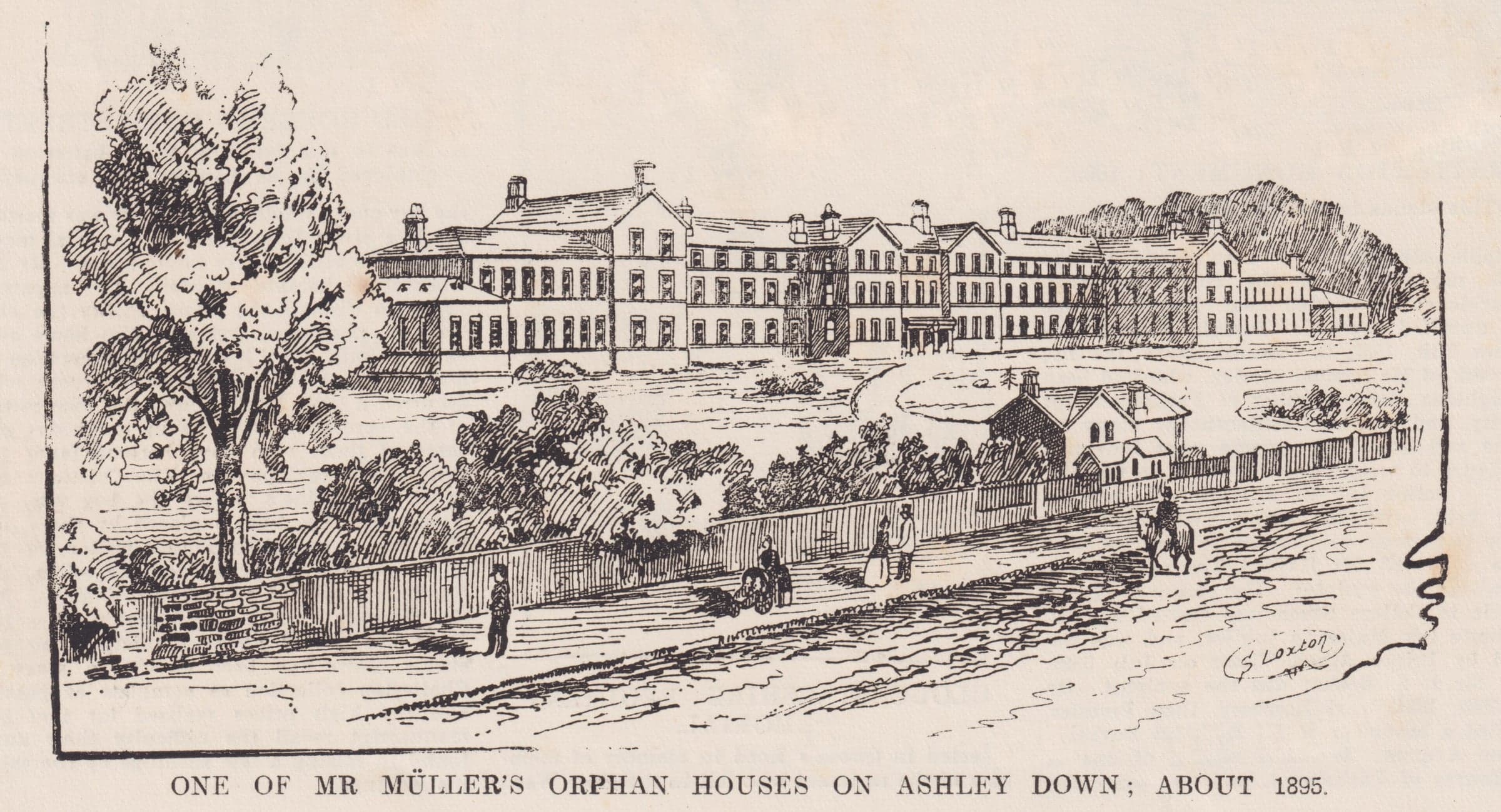
Samuel Loxton, Muller Orphan House, Ashley Down, Bristol, 1895. Public domain.
The late 1820s to today · The churches · Featured Study
The Brethren
The Brethren of Dublin, Plymouth and Bristol, who gathered to the Lord's name alone.
John Gifford Bellett remembered, as Neatby quotes him, “In a private room we had the Lord's Supper with, I believe, three others,” while Darby was still a clergyman in County Wicklow.
For where two or three gather together in My name, there am I with them.”
- Began
- The winter of 1827 to 1828 in Dublin, by Miller's narrative as Neatby gives it (probable)
- Bodies
- The Open Brethren, The Exclusive Brethren
John Gifford Bellett remembered, as Neatby quotes him, “In a private room we had the Lord's Supper with, I believe, three others,” while Darby was still a clergyman in County Wicklow.
Summary
The Brethren of Dublin and Bristol gathered each Lord's day to break bread with no clergy. They started in Dublin in the late 1820s and divided at Bristol in 1848.
- John Nelson Darby wrote his first papers on the Church in Dublin in 1827 and 1828.
- George Müller came to Bristol in 1832 and took Bethesda chapel.
- Anthony Norris Groves warned Darby in 1836 that his witness would turn against all but his own.
- Dave MacPherson holds that Darby's reading of the rapture came from a vision of 1830, and Thomas Ice denies it.
The Texts the Brethren Gathered On
The texts come from Matthew 18 and Acts 20.
The Brethren read their gathering and their weekly table from two verses.
The gathering and the breaking of bread
For where two or three gather together in My name, there am I with them.”
Darby's tract of 1828 reads it for believers gathered in the Lord's name.
On the first day of the week we came together to break bread. Since Paul was ready to leave the next day, he talked to them and kept on speaking until midnight.
Müller takes the meeting of this verse as the principal meeting of the week.
Acts 20:7BSB
The Greek verb the two verses share2 paragraphs
Both verses carry the Greek verb synágō, Strong's 4863, which its entry glosses “to lead together, i.e. collect or convene” and counts 59 times.
The verb runs from gathering grain to the council of the priests, so its sense in each verse comes from the verse.
The Brethren's Branch of the Family of Churches
The branch runs from the meetings in Dublin to the Open and the Exclusive Brethren.
The Brethren grew from a few leaders in Dublin to two bodies, the Open and the Exclusive Brethren.
About 1825 to 1828
- Anthony Norris Groves
- John Gifford Bellett
1827 to 1828
- John Nelson Darby
1832
- George Müller
- The assembly at Bethesda, Bristol
1848
- The Letter of the Ten
- The division at Bristol
Today
- The Open Brethren
- The Exclusive Brethren
Each generation is dated from the record that names it.
The other families of the churches stand together with the dates on which each began.
How the Brethren Began
The witnesses dispute the first dates, and one historian weighs them.
W. Blair Neatby weighs the dates of the beginning in A History of the Plymouth Brethren (1901). He calls Darby's tract of 1828 what “passes with good right for ‘the Brethren's first pamphlet.’”
He puts Groves's entry to Trinity College, Dublin, “probably in 1825,” and a correspondent of 1901 put it in 1827.
Neatby dates Darby's first breaking of bread from Andrew Miller, whose narrative was, he says, “principally based on statements that Darby made to its author.”
By Miller's account Darby first kept the Lord's Supper at one of the informal meetings in the winter of 1827 to 1828. Neatby rejects Miller's picture of that meeting as the movement's seed.
He assigns Darby's resignation of his curacy to 1828, “and probably to the latter half of the year.”
The first papers of the Brethren come from inside the movement.
| Witness | What he left | His interest |
|---|---|---|
| Darby, writing to the Archbishop of Dublin | Not published at the time; he later called it “the first germing of truth which has since developed itself in the Church of God.” | The movement's own paper, judged by its author years later |
| Darby, on the nature and unity of the Church | Printed in Dublin in 1828. | The movement's own paper |
| Müller's journal, printed from 1837 (ninth edition, 1865) | His turn to believers' baptism, with the objections he weighed, and his years at Bristol. | A leader's own journal |
The Truth They Recovered: the Unity of the Spirit at One Table
Darby wrote of the unity of the Spirit and the Lord's table, and his reading of the rapture is debated.
In his tract of 1828 Darby holds that “true unity is the unity of the Spirit, and it must be wrought by the operation of the Spirit.”
The tract calls the Lord's supper “the outward symbol and instrument of unity.”
Because there is one loaf, we who are many are one body; for we all partake of the one loaf.Darby quotes it, in the King James form, beside his words on the supper as the sign of unity.
The rapture, and where Darby's reading came from1 verse, 5 paragraphs
The question of the rapture turns on 1 Thessalonians 4:16 to 17, and the origin of Darby's reading has two named sides.
For the Lord Himself will descend from heaven with a loud command, with the voice of an archangel, and with the trumpet of God, and the dead in Christ will be the first to rise. After that, we who are alive and remain will be caught up together with them in the clouds to meet the Lord in the air. And so we will always be with the Lord.It is the passage the timing of the rapture is read from.
Dave MacPherson, in The Unbelievable Pre-Trib Origin (1973) and later books, holds that Darby took the idea from Margaret MacDonald's vision of 1830.
Thomas D. Ice, a pre-tribulation writer and so an interested witness, replies in an article dated May 2009 whose title asks whether the pre-trib rapture is a Satanic deception. On page 1 he writes, “First, it is doubtful that Margaret Macdonald's ‘prophecy’ contains any elements related to the pre-trib rapture.”
On page 2 Ice adds, “Darby clearly held to an early form of the pre-trib rapture by January 1827.”
Ice quotes the Brethren scholar F. F. Bruce's review of MacPherson in the Evangelical Quarterly of 1975, “direct dependence by Darby on Margaret Macdonald is unlikely.”
Their Own Statements: Darby's Tract and Müller's Narrative
Two leaders of the first years set out the gathering and the gifts in their own words.
Darby and Müller ground the gathering in the Lord's name and the gifts in the Spirit.
| Who | The words |
|---|---|
| Darby, Considerations (Dublin, 1828), in the Collected Writings | “Where two or three are gathered together in His name, His name is recorded there for blessing.” |
| Müller, Narrative, First Part (ninth edition, 1865) | “That the disciples of Jesus should meet together, on the first day of the week, for the breaking of bread, and that that should be their principal meeting.” |
| Müller, the same page | “Those, whether one or several, who are truly gifted by the Holy Spirit for service, be it for exhortation, or teaching, or rule, &c., are responsible to the Lord for the exercise of their gifts.” |
The Brethren Today
One archive gives estimates, and one body counts itself.
No count of the Brethren carries a year, and the one body that counts itself gives two figures.
| Body | The count | Who counted, and how | Year |
|---|---|---|---|
| The Open Brethren | An estimated 2 million members worldwide | The University of Manchester Library's Christian Brethren Archive, with no method stated | Not given |
| The Exclusive Brethren | Approximately 46,000 | The same archive, with no method stated | Not given |
| The Plymouth Brethren Christian Church | Over 54,000 members, and just over 55,000 | The body itself, on its home page | Not given |
Where the Brethren Went
The record moves from Dublin and County Wicklow to Bristol, Milford Haven and Leeds.
The record moves the Brethren from Dublin to Bristol, where they divided.
| Place | Year | The record |
|---|---|---|
| Trinity College, Dublin | About 1825 | Neatby, with the date disputed |
| County Wicklow | Before 1828 | Bellett, through Neatby |
| Dublin | 1827 and 1828 | Darby's first two papers |
| Bristol | 25 May 1832 | Müller's Narrative: “This evening we arrived in Bristol” |
| Milford Haven | 1836 | Groves's letter |
| Leeds | 1848 | Henry Groves, through Neatby |
The Warning of 1836 and the Division of 1848
Groves warned Darby, and Darby's circular cut off Bethesda twelve years later.
On 10 March 1836, held by the weather at Milford Haven, Anthony Norris Groves wrote to Darby, and Neatby prints the letter from Groves's Memoir.
On 29 June 1848, Neatby reports, the elders of Bethesda read “the famous Letter of the Ten” to a church meeting. After an interview with Müller and Craik, Darby issued a circular from Leeds.
The assemblies that did not take up the circular's discipline came to be called the Open Brethren, and those that kept it the Exclusive Brethren.
Groves's warning of 1836 and Henry Groves's account of the circular of 1848, side by side.
| Who | The words |
|---|---|
| The warning of 1836 | “You will be known more by what you witness against than what you witness for, and practically this will prove that you witness against all but yourselves as certainly as the Walkerites or the Glassites: your Shibboleth may be different, but it will be as real.” |
| Henry Groves, Darbyism, a witness hostile to Darby, on the circular of 1848 | “On reaching Leeds, he issued his lithographic circular, bearing the post mark of August 26, 1848, cutting off not only Bethesda, but all assemblies who received any one who went there.” |
Books to Read Next
A History of the Plymouth Brethren
W. Blair Neatby · 1901
Neatby weighs the witnesses from Dublin to the division of 1848.
Free at the Internet ArchiveA Narrative of Some of the Lord's Dealings with George Müller, First Part
George Müller · ninth edition, 1865
Müller kept a journal of his years at Bristol and of the order of the meeting.
Free at Project GutenbergThe Collected Writings of J. N. Darby, Ecclesiastical 1
John Nelson Darby · 1827 and 1828 for the first two papers
It is the first volume of Darby's writings on the Church.
Free at STEM PublishingWhat the Brethren Kept
The Brethren kept a weekly table open to the Lord's gathered people and a ministry of gifts in place of a clergy. Their own history became the test of the unity Darby's tract had set out.
Sources
Scripture is the Berean Standard Bible.
- The Holy Bible, Berean Standard Bible (read 2026)
- W. Blair Neatby, A History of the Plymouth Brethren (London, 1901), the chapters on the beginnings and chapter VIII, The Strife at Bristol in 1848.
- John Nelson Darby, Considerations addressed to the Archbishop of Dublin (Dublin, 1827), with his later preface, in the Collected Writings, Ecclesiastical 1.
- John Nelson Darby, Considerations on the Nature and Unity of the Church of Christ (Dublin, 1828), in the Collected Writings, Ecclesiastical 1.
- George Müller, A Narrative of Some of the Lord's Dealings with George Müller, First Part, ninth edition (London, 1865)
- University of Manchester Library, Christian Brethren Collections (undated; read 2026)
- Plymouth Brethren Christian Church, home page (undated; read 2026)
- Thomas D. Ice, Is the Pre-Trib Rapture a Satanic Deception? (Pre-Trib Research Center; Liberty University, Scholars Crossing, Article Archives 52, dated May 2009), pages 1, 2 and 4 and notes 4 and 29.
- James Strong, Greek Dictionary of the New Testament (1890), entry 4863, synágō, and the verses tagged with it.
Keep Studying
Values1
People and groups1
Subjects1