
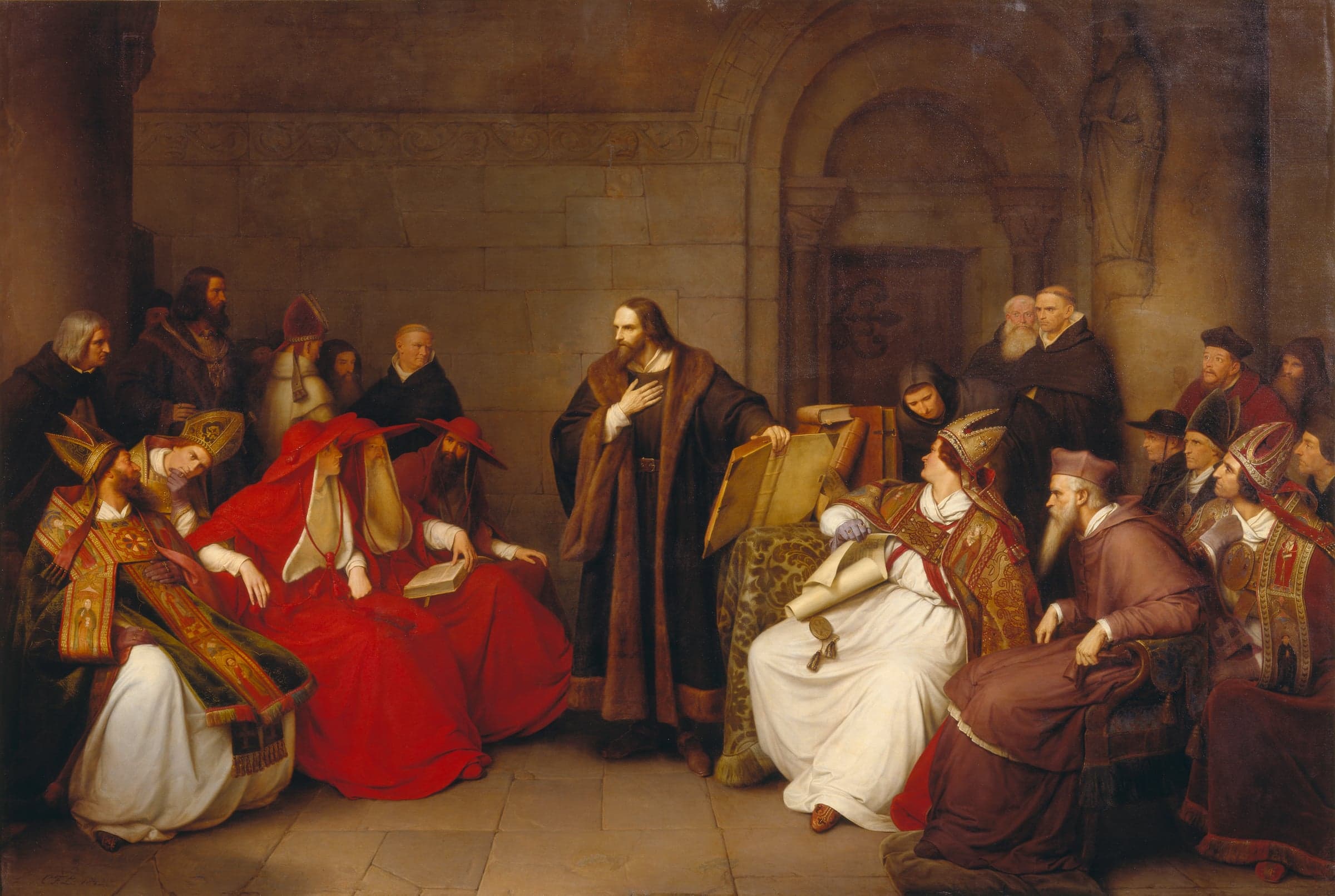
Carl Friedrich Lessing, Jan Hus at Constance, 1842. Public domain.
1457 or 1458 to today · The churches · Featured Study
The Moravian Church
A church begun in Bohemia in the fifteenth century, with provinces today in Africa, the Americas and Europe.
Jan Hus was burned at Constance on Saturday, 6 July 1415, and Hutton's history of the church gives him its second chapter.
But I tell you, love your enemies and pray for those who persecute you,
- Began
- 1457 or 1458 at Kunwald, as Hutton gives it (probable)
- Bodies
- Tanzania (Southern), Tanzania (Western), South Africa, Nicaragua, Tanzania (Mbozi), America (North), European Continental, Czech Province, Great Britain
Jan Hus was burned at Constance on Saturday, 6 July 1415, and Hutton's history of the church gives him its second chapter.
Summary
The Unity of the Brethren was crushed in Bohemia after 1620. Refugees from Moravia brought it back to life at Herrnhut from 1722.
- Its first members would not swear oaths or go to war, on the word of Matthew 5.
- In 1467 they chose their own ministers by lot after a night of prayer.
- In 1732 two of them left Herrnhut for St Thomas.
- Moravians at sea in 1735 and in London in 1738 shaped Wesley.
- Its largest provinces today are in Tanzania, South Africa and Nicaragua.
The Texts the Brethren Stood On
The texts come from Matthew 5, Acts 4 and Luke 6.
J. E. Hutton, a Moravian minister, published the second edition of the standard English history of the church in 1909. He lists in a footnote six commands of the Sermon on the Mount that Gregory the Patriarch made the Brethren's rule. The sixth is Matthew 5:44.
Five of the six commands
But I tell you that anyone who is angry with his brother will be subject to judgment. Again, anyone who says to his brother, ‘Raca,’ will be subject to the Sanhedrin. But anyone who says, ‘You fool!’ will be subject to the fire of hell.
Hutton's footnote lists it first of the six commands Gregory enforced.
Matthew 5:22BSB
But I tell you that anyone who looks at a woman to lust after her has already committed adultery with her in his heart.
It is the second command in Hutton's list.
Matthew 5:28BSB
But I tell you that anyone who divorces his wife, except for sexual immorality, brings adultery upon her. And he who marries a divorced woman commits adultery.
It is the third command in Hutton's list.
Matthew 5:32BSB
But I tell you not to swear at all: either by heaven, for it is God’s throne;
It is the fourth command in Hutton's list.
Matthew 5:34BSB
But I tell you not to resist an evil person. If someone slaps you on your right cheek, turn to him the other also; if someone wants to sue you and take your tunic, let him have your cloak as well;
It is the fifth command in Hutton's list.
A passage the Brethren loved
The multitude of believers was one in heart and soul. No one claimed that any of his possessions was his own, but they shared everything they owned.
Hutton names it among the passages the first Brethren loved most.
Acts 4:32BSB
The prayer before the choosing
In those days Jesus went out to the mountain to pray, and He spent the night in prayer to God. When daylight came, He called His disciples to Him and chose twelve of them, whom He also designated as apostles:
The synod of 1467 prayed through the night before it chose its ministers, as Jesus did before He chose the twelve.
Acts 4:32, Luke 6:12 to 13
The Unity's Branch of the Family of Churches
From Constance in 1415 to the provinces of 2024.
The Unity runs in one line from Hus to today, broken after 1620 and renewed at Herrnhut.
1415
- Jan Hus
- The council at Constance
1457 or 1458
- The Unity of the Brethren
- The Society at Kunwald
1467
- Ministers of its own
- Episcopal orders of its own
After 1620
- The Hidden Seed
- The exiles in Poland
1722 to 1727
1732 to 1735
- The mission to St Thomas
- The renewed Unity's first bishop
1857 to 1899
- Four provinces
- One General Synod
2024
- Unity Provinces
- Mission Provinces
- Mission Areas
Hutton's history of 1909 dates every generation but the last.
The other families of the churches stand together with the dates on which each began.
How the Unity Began and How Herrnhut Renewed It
Kunwald, the exile of 1628 and the refugees of 1722.
Hutton dates the settlement of Gregory the Patriarch and his followers at Kunwald to 1457 or 1458. The church's traditional day for it, he writes, “is only a pious imagination.”
After the battle of the White Hill on 8 November 1620 the Unity was suppressed in Bohemia. In 1628 Comenius led the last band of ministers to Poland. Hutton writes, “He prayed that in the old home God would preserve a ‘Hidden Seed,’ which would one day grow to a tree.”
On 27 May 1722 Christian David led a small band out of Sehlen in Moravia. On 17 June they felled the first tree on the Hutberg, the Watch-Hill, and the steward Heitz hoped the town would “abide under the Lord's Watch (Herrnhut).”
The Brethren dated their renewed church from a communion at Berthelsdorf church on 13 August 1727, and only the community's own paper describes what happened inside. Hutton, writing from inside the church in 1909, reports their belief that “on them, as on the twelve disciples on the Day of Pentecost, had rested the purifying fire of the Holy Ghost.”
The hostile Henry Rimius, in his Candid Narrative of 1753, says nothing of that day. John Wesley, the first outsider to describe the community at length, came eleven years later.
On 13 March 1735 Bishop Daniel Ernest Jablonsky consecrated David Nitschmann a bishop of the renewed church.
The synod of Lhota, 14671 paragraph
In 1467 the Brethren met in a synod at Lhota and drew lots to choose three ministers from nine men nominated by ballot. Stephen, a Waldensian bishop, consecrated Michael Bradacius, who ordained the three and consecrated Matthias of Kunwald a bishop. Hutton writes that the lot was used “simply to confirm that faith in their cause which had already been gained in prayer.”
Spangenberg on 13 August, and four counts of Herrnhut1 table, 1 paragraph
August Spangenberg, the Count's colleague and successor, wrote a life of Zinzendorf, translated into English in 1838. After the sacrament, he says, “seven different little companies formed themselves, without premeditation,” and the love-feasts of the early church were revived.
Every early count of Herrnhut comes from a Moravian or a guest of the Moravians, and none is a census.
| Year | The count | Who counted |
|---|---|---|
| 1728 | 34 houses | Le Long, a member of the community, in a hostile book of 1753 |
| 1732 | 600 inhabitants | Le Long, in the same book |
| 1736 | about a thousand souls | Spangenberg, speaking to Wesley, as Wesley's Journal records it |
| 1738 | about a hundred houses | Wesley, on his own visit in August |
The Truth They Kept: the Sermon on the Mount as a Rule of Life
The Brethren lived by Gregory's rule, the lot and the washing of feet.
Gregory enforced the six commands “with a rod of iron,” Hutton writes. No Brother could be a judge, take an oath, keep an inn or trade beyond the barest needs of life, and no peasant of the Brethren could render military service.
The renewed church kept the lot. The Constitution of 1733 says the Brethren use lots “to decide points of importance, when the reasons brought on each side appear to be of equal weight.”
Zinzendorf brought back the washing of feet. “No man,” he declared, “can read John xiii. without being convinced that this should be done.”
So if I, your Lord and Teacher, have washed your feet, you also should wash one another’s feet.It is the verse behind the custom the Count revived.
Peter of Chelčice and Comenius in their own lines2 paragraphs
Peter of Chelčice, whom Hutton places between 1419 and 1450, taught that believers “must never take an oath, for oaths were invented by the devil.” Hutton adds, “He hated war like a Quaker.”
In Comenius's Labyrinth of the World, in Count Lützow's English of 1901, Christ tells the pilgrim that his religion is “to serve me in quiet,” bound by no ceremonies.
Their Own Statements of Faith and Life
The community signed a compact and presented a Constitution of its own.
On 12 May 1727 Zinzendorf “lectured them for over three hours on the sin of schism,” Hutton writes, and laid “Statutes” before them. On 4 July he signed a further agreement, the “Brotherly Union and Compact,” and invited all the rest to sign it.
In 1733 the community laid its Constitution before the theologians of Tübingen, and Wesley printed an extract under August 1738. Item 18 says that “Two men keep watch every night in the street,” and two women in the women's apartment.
The Unity Today
Nine of the provinces, as the Missionshilfe table lists them.
The Unity Board reported on 30 September 2024 that the church has 25 Unity Provinces, 8 Mission Provinces and some 12 Mission Areas.
The same message records that the Board took up “Unity statistics including the concept of membership.”
Four of the five largest provinces in the table are in Africa.
| Province | Where | Begun | Members |
|---|---|---|---|
| Tanzania, Southern | Africa | 1891 | 305,000 |
| Tanzania, Western | Africa | 1897 | 112,863 |
| South Africa | Africa | 1737 | 103,000 |
| Nicaragua | Central America | 1849 | 102,084 |
| Tanzania, Mbozi | Africa | 2021 | 100,221 |
| America, North | North America | 1741 | 17,944 |
| European Continental | Europe | 1727 | 12,840 |
| Czech Province | Europe | 1457 | 3,894 |
| Great Britain | Europe | 1742 | 1,105 |
European Continental, Czech Province, Great Britain
Where the Brethren Went
St Thomas in 1732, Greenland in 1733 and Georgia in 1735.
At Copenhagen in 1731 Zinzendorf met Antony Ulrich, a baptized slave from the West Indies, whose story moved Leonard Dober to offer himself. Dober and the carpenter David Nitschmann departed from Herrnhut at three in the morning on 21 August 1732.
Greenland followed in 1733 under Matthew Stach and Christian David. On 14 October 1735 Wesley boarded the Simmonds for Georgia with “six and twenty” Germans, among them “David Nitschman, Bishop of the Germans.”
In London in February 1738 Wesley met the Moravian Peter Böhler, who told him, “Preach faith till you have it; and then, because you have it, you will preach faith.”
On 24 May, in Aldersgate Street, Wesley felt his heart “strangely warmed.”
The legend of the slaves, and who went first3 paragraphs
Asked by the King's Chamberlain how they would live, “We shall work,” replied Nitschmann, “as slaves among the slaves.”
Hutton corrects the legend that they became slaves, since “white slavery was not allowed in any of the West Indian islands.”
Hutton calls 1732 the first time in Protestant Europe that a congregation “had deliberately resolved” to preach to the heathen. He names the Danish state's earlier missionaries, Egede and Ziegenbalg.
Spangenberg's question to Wesley, 17361 verse, 2 paragraphs
On 7 February 1736 Spangenberg asked Wesley, “Does the Spirit of God bear witness with your spirit, that you are a child of God?”
Wesley wrote that he answered with what he feared were “vain words.”
The Spirit Himself testifies with our spirit that we are God’s children.Spangenberg's question to Wesley takes its words from this verse.
The Hymn, the Watch and the Daily Text
Wesley translated Zinzendorf's hymn, and the community prayed hour by hour.
Julian's Dictionary of Hymnology (1907) says Zinzendorf wrote “Christi Blut und Gerechtigkeit” in 1739, returning from St Thomas. Wesley printed a free version in Hymns and Sacred Poems in 1740, page 177, as “The Believers Triumph.”
In the last days of August 1727 the Brethren began to pray by turns, hour by hour. Three witnesses from inside the community tell its beginning in three ways.
The three agree that the watch began in 1727, kept by men and women in turn, and differ on its number and length.
| Witness | What it says | Its interest |
|---|---|---|
| The Herrnhut Constitution, 1733 | In 1727 “four-and-twenty men, and as many women” each took an hour a day, and “this perpetual intercession has never ceased day or night since its first beginning.” | The community's own statement, six years on |
| Spangenberg (English, 1838) | “At first, twenty-four brethren and sisters bound themselves to continue in unceasing prayer,” and the number soon rose to seventy-seven. | He served the community and published the Count's life |
| Hutton, 1909 | The Hourly Intercession began on 27 August 1727. “It is said to have lasted without interruption for over a hundred years.” | The church's historian, reporting its tradition |
The hymn's first lines, as Wesley printed them in 17401 table
The opening couplet of The Believers Triumph, with the long s modernized.
| Where | The first lines |
|---|---|
| Hymns and Sacred Poems (London, 1740), page 177 | Jesu, Thy Blood and Righteousness / My Beauty are, my glorious Dress |
The singing in the storm, 17361 paragraph
Wesley's Journal for 25 January 1736 records the storm at sea: “A terrible screaming began among the English. The Germans calmly sung on.” Asked whether their women and children were afraid, one answered, “No; our women and children are not afraid to die.”
The daily text, from 17282 paragraphs
Spangenberg dates the first watchword, a hymn verse the Count gave for the next day, to 3 May 1728. Hutton writes that the Elders drew each day's text from a box, and that in 1731 the Count had the year's texts printed.
Of the first Text-book, which he had before him, Hutton says, “It has only one text for each day, and all the texts are taken from the New Testament.”
Bonhoeffer's mother and the Moravians4 paragraphs
Paula von Hase, born at Königsberg on 30 December 1876, was the mother of Dietrich Bonhoeffer. A 2016 extract of chapter 1 of a Bonhoeffer life from James Clarke and Co., whose pages carry no author's name, says, “Paula herself had attended a Moravian boarding school in Gnadau.”
The Fortress Press extract of chapter 1 of Christiane Tietz's Theologian of Resistance says, “A Moravian woman, Maria Horn, was much loved by the children and helped raise them.”
A Moravian review on moravian.org in January 2025 says Paula spent time learning in Herrnhut, and that Bonhoeffer “grew up using the Moravian Daily Text (Die Losungen).”
Gnadau or Herrnhut stays unsettled between the Clarke extract and the review.
What Wesley's Journal records of prayer at Herrnhut1 paragraph
Wesley's pages on his two weeks at Herrnhut in August 1738 record an “Intercession day” and a monthly day of general intercession, and they do not mention the hourly watch.
The Sifting Time, the Break With Wesley and Slavery
The excesses of 1743 to 1750, Wesley's doubts, and slavery.
Hutton, the church's own historian, dates the Sifting Time from 1743 to 1750, “the saddest period in the history of the Brethren's Church,” and he cites Zinzendorf's own Litany of the Wounds of 1743. His verdict reads, “The chief sinner was the Count himself.”
Spangenberg, who served under the Count, writes that he “had no clear perception of the sifting,” checked it where he saw it, and afterward warned against “the extravagances which had occasioned it.”
In September 1738, the month after his visit, Wesley began a letter to the Brethren's church and printed it in his Journal in 1741. He asked, “Is not the Count all in all?”
Hutton tells how the Methodists and the Moravians parted between 1739 and 1741 over the teaching of “stillness.”
The Unity Board's message of 30 September 2024 records a Unity Synod resolution on the church's “Complicity in the Institution of Slavery,” and the Board's intent to research slavery within the Moravian Church.
Hutton's answer to Rimius2 paragraphs
Hutton, writing as a minister of the church, calls Rimius “this scribbler.” He answers that the charges fell on “sins which had only been committed by a few fanatics at Marienborn and Herrnhaag.”
The Count, Hutton reports, contended that once misunderstood “he had cut out all doubtful phrases from his discourses.”
Books to Read Next
A History of the Moravian Church
J. E. Hutton · 1909
Hutton tells the whole story from Hus to 1908, the Sifting Time included.
Free at Project GutenbergThe Life of Nicholas Lewis Count Zinzendorf
August Gottlieb Spangenberg, translated by Samuel Jackson · 1838
Spangenberg worked beside the Count at Herrnhut.
Free at the Internet ArchiveThe Labyrinth of the World and the Paradise of the Heart
Jan Amos Comenius, translated by Count Lützow · 1901
It sets out the inward religion Comenius taught.
Free at the Internet ArchiveThe Works of the Reverend John Wesley, volume III, his Journal
John Wesley · 1831
It holds the storm, Böhler, Aldersgate, the visit to Herrnhut and his doubts.
Free at the Internet ArchiveWhat the Unity Handed On
The Unity handed on a rule of life taken from Matthew 5, a habit of prayer by turns and a church that sends its own people. Its historian and its own synod set its failures, from the Sifting Time to slavery, beside that record.
The line through this page
The verse whose work this page shows continuing, then 3 links to other pages, in order of date.
The verse whose work this page shows continuing.
1710 to 1716
The Pietists to The Moravian Church
Spangenberg reports the Count saying that his institutions in Upper Lusatia began from Spener's idea of little churches inside the great church.
This page
The Moravian Church
1628
The Moravian Church to The Moravian Revival at Herrnhut
Hutton writes, “He prayed that in the old home God would preserve a ‘Hidden Seed,’ which would one day grow to a tree.”
1738
The Moravian Church to The Great Awakenings
In London in February 1738 Wesley met the Moravian Peter Böhler, who told him, “Preach faith till you have it; and then, because you have it, you will preach faith.”
Sources
Scripture is the Berean Standard Bible.
- The Holy Bible, Berean Standard Bible (read 2026)
- J. E. Hutton, A History of the Moravian Church, second edition (1909), Book One, chapters II to XVI and footnotes 9 to 15; Book Two, chapters II to XIII and footnotes 80 and 87; Book Three, chapter VII.
- August Gottlieb Spangenberg, The Life of Nicholas Lewis Count Zinzendorf, written 1772 to 1775, translated by Samuel Jackson (London: Samuel Holdsworth, 1838), pages 88 to 95.
- John Wesley, Journal, 1735 to 1741, in The Works of the Reverend John Wesley (New York: J. Emory and B. Waugh, 1831), volume III.
- The Constitution of the Brethren at Hernhuth (1733), items 10, 16 and 18, in Wesley's Journal (1831), volume III, pages 100 to 102.
- Henry Rimius, A Candid Narrative of the Rise and Progress of the Herrnhuters, second edition (London: A. Linde, 1753), pages 17 to 18.
- Jan Amos Comenius, The Labyrinth of the World and the Paradise of the Heart, translated by Count Lützow (London: Swan Sonnenschein, 1901), chapter XXXIX, section 8, page 287.
- John Julian, A Dictionary of Hymnology, revised edition (London: John Murray, 1907), volume 1, Christi Blut und Gerechtigkeit.
- John and Charles Wesley, Hymns and Sacred Poems (London: W. Strahan, 1740), page 177, The Believers Triumph.
- Unity Board, Message to the Unitas Fratrum, Antigua, 30 September 2024.
- Herrnhuter Missionshilfe, worldwide Unity (undated; read 2026)
- International Bonhoeffer Society, Paula Bonhoeffer (no date given; read in 2026)
- James Clarke and Co., a Bonhoeffer life, chapter 1, Sacred Space (2016), the publisher's extract.
- Christiane Tietz, Theologian of Resistance (Fortress Press, ISBN 9781506408446), chapter 1, the publisher's extract read in October 2026.
- Moravian Church in America, a film review, Bonhoeffer: Pastor, Spy, Assassin (January 2025)
Keep Studying
People and groups1
Subjects1
Doctrines2