
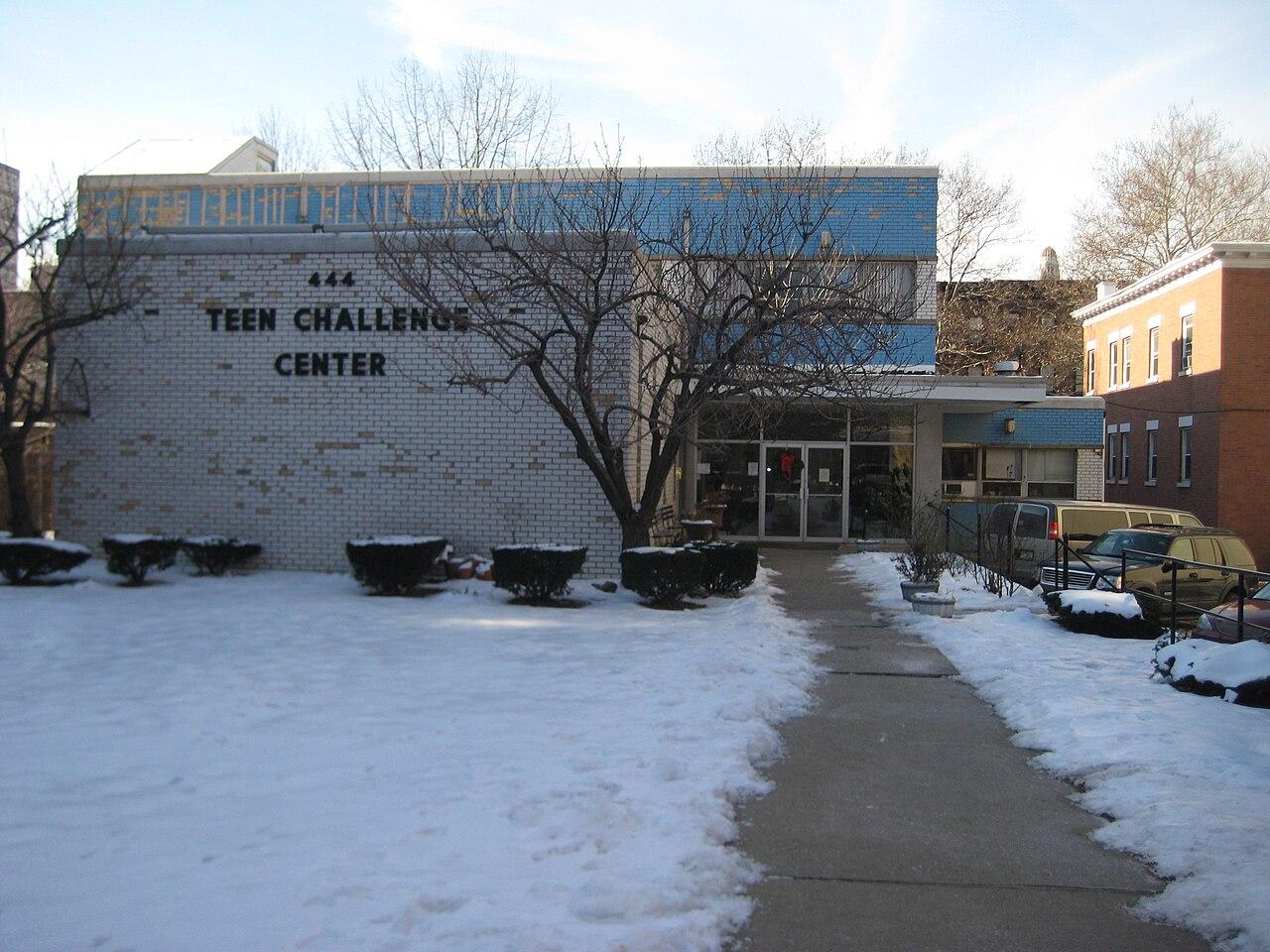
Timothy Shields, Brooklyn Teen Challenge, 2008. CC BY 3.0.
1958 to 1978 · The churches · Featured Study
Teen Challenge
A Pentecostal work among drug addicts and street gangs that David Wilkerson began in New York City in 1958.
But you will receive power when the Holy Spirit comes upon you, and you will be My witnesses in Jerusalem, and in all Judea and Samaria, and to the ends of the earth.”
- Began
- 1958, in New York City
- Bodies
- Teen Challenge
A country preacher in Pennsylvania turned a page of Life magazine one night and found a pen drawing of seven boys on trial for murder.
Summary
Teen Challenge is a Christian programme of homes for the addicted, and it took no state or federal money. It grew to more than eighty centres in twenty years.
- Wilkerson went to New York to reach the boys of the Michael Farmer trial.
- His centre on Clinton Avenue opened its doors by 1961.
- The work started as a programme of the Assemblies of God.
- A federal study of 1977 measured its results at one centre.
- A Marine Corps report of 1978 named that study's limits.
The Texts of Power from on High
Wilkerson's book cites the Spirit's promise in Acts and its fulfilment at Pentecost.
Wilkerson's book of 1963 quotes the New English Bible for its passages from Acts. It reports a preacher's teaching that the Holy Spirit could get inside people.
And they were all filled with the Holy Spirit and began to speak in other tongues as the Spirit enabled them.The same list names Acts 2:2 to 4, where the promise is kept.
The Branch of Teen Challenge
The tree runs from the Assemblies of God through Wilkerson's centre to the centres overseas.
The programme grew from one Assemblies of God pastor's ministry into centres on four continents.
1914 to 1958
- The Assemblies of God
- A mountain pulpit in Pennsylvania
1958 to 1961
- Teen Challenge in New York City
- Teen Challenge Center, Clinton Avenue
1961 to 1978
- The training phase
- Centres in Europe, Australia, South Africa and Brazil
The dates come from Wilkerson's book and Peters's report.
The site's tradition is Wesleyan-Pentecostal, the line that runs through Azusa Street to the fellowship under which Wilkerson's work began.
How the Work Began: A Drawing and a Courtroom
Wilkerson's own book of 1963 tells the start, so it is the account of the man who began the work.
Wilkerson served a little mountain church in Philipsburg, Pennsylvania. He wrote that he was sitting in his study reading Life when he turned a page, and that tears were streaming down his face.
The seven boys had stabbed Michael Farmer, a fifteen-year-old polio victim, seven times in the back. Wilkerson went to New York and was told that the one man who could let him see them was Judge Davidson himself.
His book tells of shouting in the press section of the courtroom, as photographers raced each other to the exit.
The Truth They Pressed: The Spirit Frees the Addict
The programme taught that a man is freed from drugs by conversion and the Spirit's baptism.
Wilkerson wrote that the mainline addict, who injects heroin into the vein, was held to be almost without hope. Its men went off heroin cold turkey, by instantaneous withdrawal, which he wrote the centre preferred on its own merits.
His book tells of a man whose drug held the mind more than the body, and who received the baptism of the Holy Spirit.
Therefore if anyone is in Christ, he is a new creation. The old has passed away. Behold, the new has come!Peters reports that the programme put its first emphasis on the spirit, the new life this verse names.
Its Own Method
Peters set out the programme's two phases and its spiritual aim.
Peters records that the work received no state or federal funds and lived on gifts. The programme ran in two phases, induction and then training.
Its first emphasis fell on the spirit, beside the body and the mind. A man who disagreed with its religious emphasis could still stay as long as he chose.
The Centres and Their Counts
The count is Peters's, for 1978.
The work ran 84 centres twenty years after it began.
| Where | The count | Who counted, and for when |
|---|---|---|
| The United States | 57 induction centres | Peters, Marine Corps report, 1978 |
| Europe, the Middle East, Australia, South Africa and Brazil | 27 centres | Peters, Marine Corps report, 1978 |
Where the Work Went
Each place stands with the year its record gives.
The work moved from a Pennsylvania pulpit to Brooklyn and then across the world.
| Year | Place | What happened there |
|---|---|---|
| 1958 | Philipsburg, Pennsylvania | Wilkerson's church stood here when the call came. |
| 1958 | New York City | Wilkerson's ministry to the city's young people opened. |
| 1961 | 416 Clinton Avenue, Brooklyn | Teen Challenge Center was in full operation by late spring. |
| By 1977 | Rehrersburg, Pennsylvania | The training centre gave the federal study its men. |
In Their Own Words
Wilkerson wrote in 1963, and the work's executive director spoke to a committee of Congress in 2001.
David Wilkerson (1931 to 2011)
The Cross and the Switchblade (Old Tappan, New Jersey: Fleming H. Revell, 1963), Internet Archive crossswitchblade00wilk, read by full-text search fragments on 2026-11-11, the page not seen
Born again to a new life
“The heart of the Gospel is change. It is transformation. It is being born again to a new life.”
Pentecostal
About this saying1 paragraph
Wilkerson set down this answer of his in The Cross and the Switchblade in 1963.
David Wilkerson
The Cross and the Switchblade (Old Tappan, New Jersey: Fleming H. Revell, 1963), Internet Archive crossswitchblade00wilk, read by full-text search fragments on 2026-11-11, the page not seen
Other churches on the committee
“We started pretty much as an Assemblies of God program, and before we knew it, we had an Episcopalian and a Presbyterian and a Baptist and a Dutch Reformed committee member.”
Pentecostal
About this saying1 paragraph
In the same book of 1963 he told how members of other churches joined the work's committee.
John Castellani
Effective Faith-Based Treatment Programs, hearing before the Subcommittee on Criminal Justice, Drug Policy and Human Resources of the Committee on Government Reform, House of Representatives, 23 May 2001, Serial No. 107-48 (Washington: U.S. Government Printing Office, 2002), his answer to the subcommittee
Sin or disease
“And so whether it is a sin problem, whether it is a disease problem, we know that the Gospel works, and we are firm in that area.”
Christian
About this saying1 paragraph
John Castellani, executive director of Teen Challenge International, named Psalm 103 as his premise before a House subcommittee on 23 May 2001.
John Castellani
Effective Faith-Based Treatment Programs, hearing before the Subcommittee on Criminal Justice, Drug Policy and Human Resources of the Committee on Government Reform, House of Representatives, 23 May 2001, Serial No. 107-48 (Washington: U.S. Government Printing Office, 2002), his answer on accountability
The records and the cure
“I can have great records, but I still do no cure. And so I don't think the records, itself, verify what I do as a person or as a group.”
Christian
About this saying1 paragraph
Asked at the same hearing of 2001 for his work's rate of success, he answered with this.
The Results Claimed and Their Limits
Each claim of success stands here with the caution its own source gives.
Peters called it a highly successful rehabilitation program. He drew his figures from a study for the National Institute on Drug Abuse, An Evaluation of the Teen Challenge Treatment Program, published by the Department of Health, Education, and Welfare in 1977.
He reported that the study found the programme especially successful with those who “found the power in God to change.”
Peters also warned that the study's men came from the training centre at Rehrersburg, most of them sent from New York City, so that its sample did not represent the overall Teen Challenge program.
Books to Read Next
The Cross and the Switchblade
David Wilkerson · 1963
Wilkerson tells the drawing, the courtroom and the first centre in his own words.
In print: find it wherever books are sold.
Rehabilitation of USDB Inmates: A Fresh Look
William C. Peters · 1978
Peters wrote this report to compare the programme with a military prison, and he named the limits of its study.
Free at the Internet ArchiveWhat the Work Handed On
The work handed on a house for the addict that rests on conversion, and a record whose best known study measured one centre's men.
Sources
Scripture is the Berean Standard Bible.
- The Holy Bible, Berean Standard Bible (read 2026)
- David Wilkerson, The Cross and the Switchblade (Old Tappan, New Jersey: Fleming H. Revell, 1963)
- William C. Peters, Major, United States Marine Corps, Rehabilitation of USDB Inmates: A Fresh Look, final report, 9 June 1978, Defense Technical Information Center AD-A058202, pages 24, 26, 54 and 62 to 63.
- House of Representatives, Effective Faith-Based Treatment Programs, hearing before the Subcommittee on Criminal Justice, Drug Policy and Human Resources of the Committee on Government Reform, 23 May 2001, Serial No. 107-48 (Washington: U.S. Government Printing Office, 2002), the statements and answers of John Castellani.
Keep Studying
Doctrines1
Subjects1