
The story
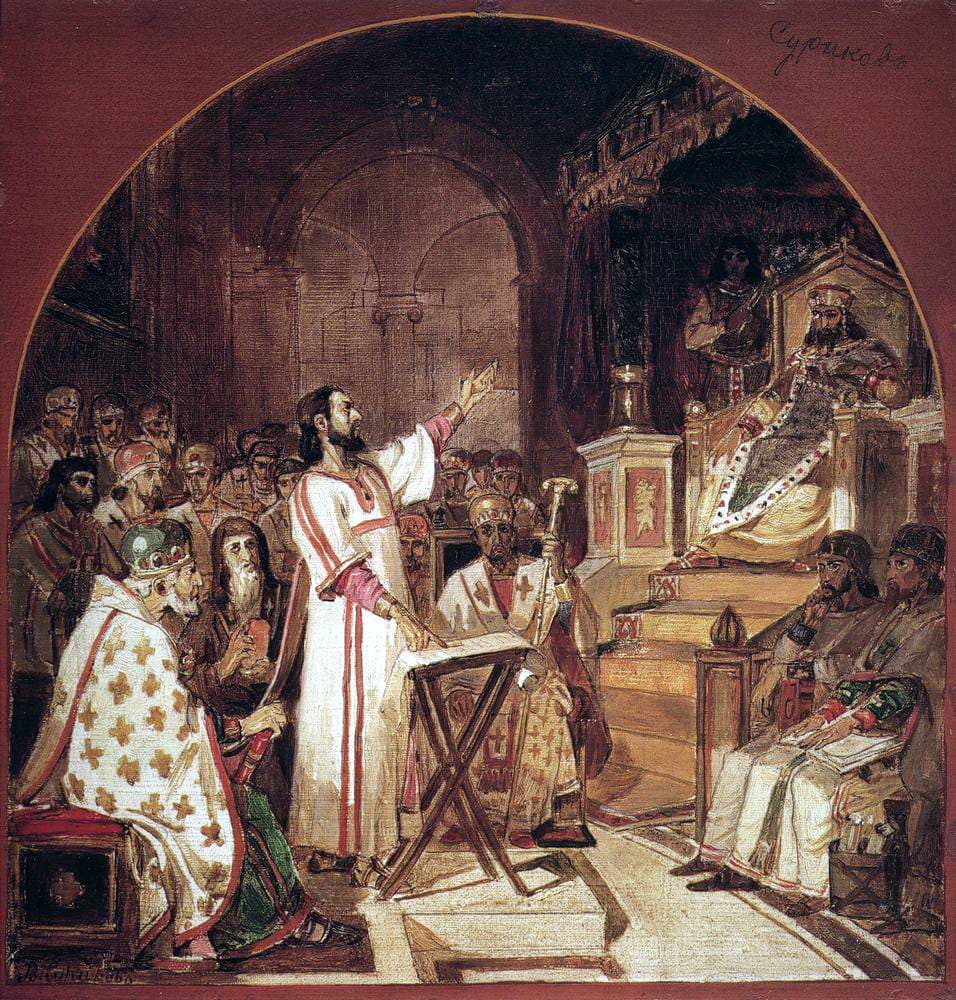
A bishop in 325 travelled to a church council at the emperor's expense, on the imperial post, to settle a question about the nature of Christ. Twelve years earlier the same man could have been arrested for holding a service.
The change came fast enough to give the church whiplash. Diocletian's persecution ended in 311; the Edict of Milan legalized the faith in 313; within a lifetime Christianity was the empire's official religion. Bishops who still carried scars from the mines were suddenly riding in imperial carriages. Men who had been hunted were now consulted.
In the beginning was the Word, and the Word was with God, and the Word was God."The Word was God" was the verse the whole Arian fight turned on, and the sentence Nicaea's homoousios was written to protect.
Be honest about what that cost. The church gained peace, buildings, schools, the freedom to think out loud, and the leisure to do serious theology. Nicaea would have been unimaginable in a prison. But it lost some of its edge. Becoming a Christian stopped costing anything and started helping a career, and crowds came in who had not counted any cost at all.
It also began an entanglement the church has never fully undone. In 380 Theodosius commanded his subjects to hold the Nicene faith. In 385 a Spanish teacher named Priscillian was executed at Trier for heresy, the first such execution by a Christian state, and to their credit Ambrose of Milan and Martin of Tours protested it loudly. The sword that had struck the church was now available to the church, and that is a dangerous thing to hold.
The Word became flesh and made His dwelling among us. We have seen His glory, the glory of the one and only Son from the Father, full of grace and truth."The Word was made flesh" is the plain statement Chalcedon spent a council learning how to fence: one person, truly God and truly man.
The great fight of the era was not politics dressed up as theology. Arius taught that the Son was the highest and first of all creatures, magnificent, before all worlds, but made, and if he was right, the church at prayer had been worshiping a creature. Athanasius would not let it go, for one reason: only God can save, so if Jesus saves, then Jesus is God. At Nicaea in 325 the bishops reached for a word that is not in the Bible in order to protect what the Bible says, homoousios, of the same being: whatever the Father is, the Son is. Arius's supporters could sign almost anything else; they could not sign that.
Nicaea did not end it. For half a century the emperors leaned back toward Arius, and Athanasius, bishop of Alexandria from 328, was driven out five separate times, banished to Germany, hiding in the desert with monks, once hunted by soldiers up the Nile. The phrase that stuck to him is Athanasius contra mundum, Athanasius against the world. He outlived his opponents and died in his own city in 373, and the truth he defended outlived them all.
The Son is the radiance of God’s glory and the exact representation of His nature, upholding all things by His powerful word. After He had provided purification for sins, He sat down at the right hand of the Majesty on high.Athanasius returned to this line about the Son being the exact expression of God's own being every time he was told the Son was merely the greatest creature.
The finishing work belonged to three friends from Cappadocia in central Turkey: Basil the Great, his brother Gregory of Nyssa, and Gregory of Nazianzus. They gave the church language careful enough to say what it meant, one being, three persons, and they pressed the argument through to the Holy Spirit, who is worshiped, not used. The Council of Constantinople in 381 wrote their work into the creed, and that is the version most congregations still recite.
The New Testament settled in these same years, and it settled by recognition rather than by decree. Churches from Gaul to Syria had been reading the same books for generations; what the fourth century did was write the list down. Athanasius's Easter letter of 367 names our exact twenty-seven, and the councils at Hippo and Carthage confirmed it in the 390s. No council handed the church a Bible it did not already have.
Therefore go and make disciples of all nations, baptizing them in the name of the Father, and of the Son, and of the Holy Spirit,Every Christian was baptized into one name held by Father, Son, and Holy Spirit, the church was confessing the Trinity in water long before it wrote the creed.
Then there is Augustine, the era's giant. A gifted, restless North African who chased philosophy, ambition, and pleasure across the Mediterranean while his mother Monica prayed and followed; who lived with a woman for years and fathered a son; who sat in Ambrose's congregation in Milan arguing with the sermon and losing. He broke in a garden in 386 at the sound of a child's voice telling him to take up and read.
He gave the church two books it has never put down. The Confessions told his own story as a prayer, and it still reads like someone speaking in the next room. The City of God, written while the empire came apart, argued that history runs on two loves building two cities, and only one of them is permanent. He died in 430 with Vandal armies at the walls of his own town of Hippo.
The era's writings, 1 to 3 of 9: each with its date and one line on what it holds.
| Writing | Date | What it holds |
|---|---|---|
| On the Incarnation (De Incarnatione) | c. 318 | Athanasius's short, blazing argument that only God Himself could undo death in us, so the Word had to take a real human body. |
| The Nicene Creed | 325, expanded 381 | The church's shortest answer to the biggest question, that Jesus Christ is "God of God, Light of Light, very God of very God, begotten, not made, being of one substance with the Father." |
| Te Deum Laudamus | late 4th century | An ancient Latin hymn of praise ("We praise Thee, O God") long attributed to Ambrose and Augustine, though most scholars now credit Niceta of Remesiana; it is still sung. |
Meanwhile another movement was going the other direction. When faith turned respectable, thousands walked out into the Egyptian desert to keep it costly: Antony alone in the wilderness, Pachomius organizing the first communities, Basil writing rules for the East, Benedict at Monte Cassino writing the rule that shaped the West. Monasticism began as a protest against a comfortable church, and by accident it became the West's memory: monks copied the books that would otherwise have burned.
Chalcedon in 451 said the last hard thing in plain words: Jesus is one person, not two, fully God and fully man, and neither nature swallows the other. He is not God wearing a man's costume, and He is not a good man with God poured in. Honesty requires adding that the churches of Egypt, Syria, and Armenia read the wording differently and did not accept it, the first lasting split in Christendom, and one that modern dialogue suggests was more about language than about Christ. East and West were drifting apart as well, as Greek and Latin scholars stopped reading each other. Western councils even began adding "and the Son" to the creed's line about the Spirit, starting locally at Toledo in 589, a change the East never agreed to and never forgot.
The era's writings, 4 to 6 of 9: each with its date and one line on what it holds.
| Writing | Date | What it holds |
|---|---|---|
| The Latin Vulgate | 382–405 | Jerome's translation of the whole Bible into everyday Latin, made from Hebrew and Greek rather than from older Latin versions. |
| Confessions | c. 397–400 | Augustine's account of his own conversion, written as a prayer, the first great spiritual autobiography. |
| The City of God | 413–426 | Augustine's answer to the fall of Rome: two cities are being built in history, and the one that lasts is not any empire. |
Honor these men as witnesses without making them more than that. They fought for the deity of Christ, the reliability of Scripture, and the gospel of grace, and every believer since has lived off their work. But the church of AD 400 is not the church of AD 1400; the papal claims, the practices, and the accumulated tradition of later centuries should not be read backward onto Athanasius or Augustine. They pointed to Scripture and Christ. That is where they wanted us looking.
The era's writings, 7 to 9 of 9: each with its date and one line on what it holds.
| Writing | Date | What it holds |
|---|---|---|
| The Chalcedonian Definition | 451 | The statement that Jesus is one person in two complete natures, divine and human, neither blended together nor pulled apart. |
| The Apostles' Creed | developed over centuries; final wording c. 700s | A baptismal confession that grew out of the older Roman creed of the second and third centuries; the story that the twelve apostles each wrote a line is a later legend, but the content is ancient. |
| The Rule of Benedict | c. 530 | A brief, surprisingly gentle rule for community life, hours for prayer, hours for work, hours for reading, that shaped Europe's monasteries for centuries. |
Hebrews 1:3, Matthew 28:19