
1525 to today · The churches · Featured Study
The Anabaptist Churches Today
The Mennonite, Amish, Hutterite and Brethren churches, the Mennonite confession of 1632, and who counts them today.
The Brethren who baptized eight believers in the river Eder in 1708 left no record of the month or the day.
- Began
- January 1525 at Zurich, the day not recorded (probable)
- Bodies
- Mennonites, Amish, Hutterites, Church of the Brethren, Brethren in Christ
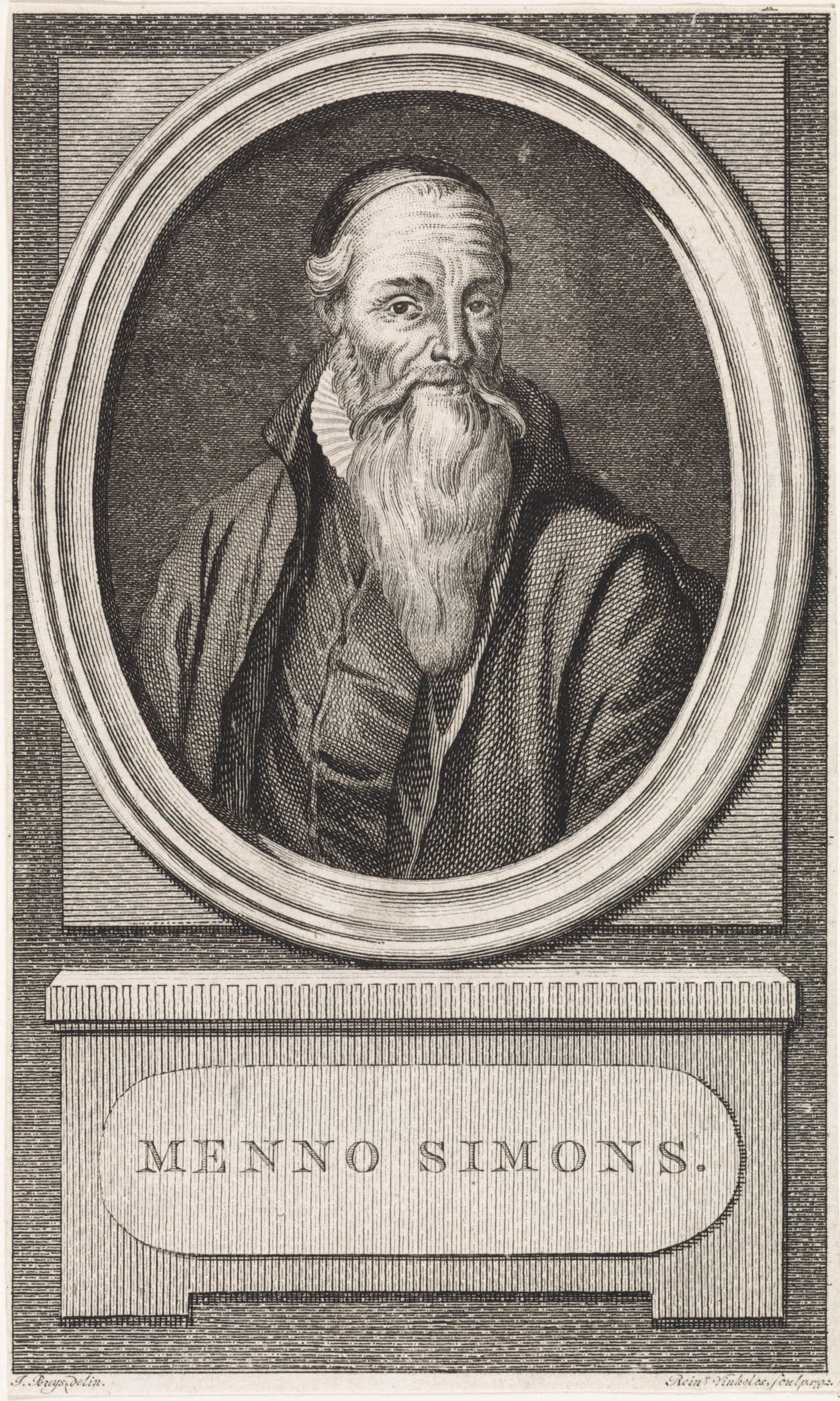
Unknown printmaker, Portrait of Menno Simons, 1792. Public domain.
But I tell you not to resist an evil person. If someone slaps you on your right cheek, turn to him the other also;
Summary
These churches come from the Anabaptists of the sixteenth century. They baptize those who confess faith.
- The Mennonites take their name from Menno Simons, a priest in Friesland who left the Church of Rome.
- The Hutterites live in colonies that hold their goods in common.
- The Amish parted from the Swiss Mennonites in 1693 over shunning.
- Africa now holds the largest share of the family's baptized members.
The Texts These Churches Stand On
Their verses come from the margins of Dordrecht and from the Hutterites' own chronicle.
Each article of the Mennonite confession carries its verses in the margin.
The sword and the oath
But I tell you not to resist an evil person. If someone slaps you on your right cheek, turn to him the other also;
Dordrecht article XIV cites it for putting the sword into the sheath.
Matthew 5:39BSB
But I tell you not to swear at all: either by heaven, for it is God’s throne;
Dordrecht article XV cites it for the refusal of every oath.
Matthew 5:34BSB
The common purse
All the believers were together and had everything in common. Selling their possessions and goods, they shared with anyone who was in need.
The Hutterite chronicle cites Acts 2 for the goods its people laid down in 1528.
The multitude of believers was one in heart and soul. No one claimed that any of his possessions was his own, but they shared everything they owned.
The same chronicle cites Acts 4 with Acts 2 and 5.
Acts 4:32BSB
Shunning and the washing of feet
But now I am writing you not to associate with anyone who claims to be a brother but is sexually immoral or greedy, an idolater or a verbal abuser, a drunkard or a swindler. With such a man do not even eat.
Its words stand behind the practice of shunning a separated member.
Take note of anyone who does not obey the instructions we have given in this letter. Do not associate with him, so that he may be ashamed. Yet do not regard him as an enemy, but warn him as a brother.
The Mennonite confession closes its rule of shunning on these verses.
So if I, your Lord and Teacher, have washed your feet, you also should wash one another’s feet.
The washing of feet at communion was one of the practices the Amish division turned on.
John 13:14BSB
Acts 2:44 to 45, Acts 4:32, 1 Corinthians 5:11, 2 Thessalonians 3:14 to 15, John 13:14
The Anabaptist Branch of the Family of Churches
The branch runs from the Swiss Brethren of Zurich to the Brethren in Christ of Pennsylvania.
The Anabaptist line runs through six branches, the earliest in Switzerland and the latest in Pennsylvania.
1525 and 1528
- The Swiss Brethren
- The Hutterites
Before 1554, and 1693
- The congregations of Menno Simons
- The Amish
1708, and 1775 to 1788
- The Church of the Brethren, Anabaptist and Pietist
- The Brethren in Christ
Each generation joins two branches and gives the years in which they began, in the order in which they began.
The other families of the churches stand together with the dates on which each began.
How Each Branch Began
Each branch began in a record its own people kept, and each record is dated.
The movement began in Zurich in January 1525, when believers baptized one another on their confession of faith. The council's records, Zwingli's attack and the Hutterite chronicle are its first witnesses.
The Hutterite chronicle dates their common purse to 1528, when about two hundred people besides their children left Nikolsburg in Moravia. Between Dannowitz and Muschau the men spread a cloak, and each laid down what he had for the needy.
The chronicle is the community's own record, compiled after the events.
Alexander Mack the younger, writing for his own church at Germantown in 1774, tells of the first baptisms at Schwarzenau, five brethren and three sisters. He wrote sixty-six years after the event.
The Brethren in Christ say on their own history page that they began sometime between 1775 and 1788 near Marietta, Pennsylvania, and that outsiders called them River Brethren. They name four emphases that shape their teaching, Anabaptism, Pietism, Wesleyanism and Evangelicalism.
The Truth They Keep: Peace and the Plain Word
Mennonite ministers signed a confession in 1632 that lays down the sword and every oath and honours the magistrate.
Article XIV of the Dordrecht Confession says Christ commanded His disciples “to put the sword into the sheath, or, as the prophets have predicted, to beat the swords into ploughshares.”
Article XV holds “that all oaths, high and low, are forbidden,” and that a promise is confirmed with a plain yes or no.
Article XIII honours rulers as ordained by God, so that believers “may not despise, revile or resist the same,” and must pay their taxes and pray for them.
The Westminster Confession holds against this that “a lawful oath, being imposed by lawful authority, in such matters ought to be taken,” in matters of weight and moment.
Peter Riedemann defended the Hutterite common purse to Philip of Hesse, in a work Plough dates to 1542. In John J. Friesen's English of 2019, God's gifts “have been given so that they not be kept but be shared with each other.”
The Dordrecht Confession of 1632
The Martyrs Mirror of 1660 printed the eighteen articles whole.
McGlothlin writes that the confession was drawn up at Dordrecht on 21 April 1632 and signed by fifty-one ministers from sixteen Dutch cities and two from the upper country.
He wrote in 1911 that it was still, with some verbal changes, the confession of the Mennonites of America.
Article VII gives baptism to “all penitent believers” upon their “scriptural confession of faith, and renewing of life,” and cites Acts 2:38, Matthew 28:19 to 20 and Mark 16:16.
The Churches Today and Who Counted Them
The Mennonite World Conference counts the whole family, and others count three of its churches.
The Mennonite World Conference's map of 2025 counts 2,063,272 baptized members in the Anabaptist family, down from 2,126,786 in 2022. It says, “Statistics include estimates.”
The Conference's own membership, as of September 2026, is close to 950,000 baptized believers in 109 Mennonite and Brethren in Christ national churches. It prints no method beside that figure.
The Amish, counted with their children, outnumber the Hutterites seven to one.
| Church | Count | Year | Who counted, and what |
|---|---|---|---|
| The Amish of North America | 421,200 | June 2026 | The Young Center's estimate of adults and children in horse-and-buggy groups |
| The Hutterites of North America | 58,392 in 544 colonies | 2024 directory | A Young Center census from a Hutterite directory, published in January 2026 |
| The Church of the Brethren in the United States | 81,345 members | 2022 | The denomination's Yearbook, from the 45 percent of churches that reported |
The Brethren in Christ print no count on their history page, and the Conference counts them among its member churches.
Where the Anabaptist Family Lives
The Conference gives each region's share of the family.
Africa and North America hold three in four of the family's baptized members.
| Region | Share of baptized members |
|---|---|
| Africa | 45 percent |
| North America | 29 percent |
| Asia and the Pacific | 13 percent |
| Latin America and the Caribbean | 10 percent |
| Europe | 3 percent |
By country and continent, the same map gives 957,137 in Africa, 458,418 in the United States and 126,174 in Canada.
Shunning and the Division of 1693
The ban that kept the churches pure also split them.
Article XVII of Dordrecht asks that a member separated by the church be shunned “in eating, drinking, and other similar intercourse,” so the sinner may be made ashamed and brought to reformation.
The same article limits the ban. If the separated is needy, hungry or sick, the church must help him, and “we must not count them as enemies, but admonish them as brethren.”
In 1693 Jakob Ammann urged communion twice a year, foot washing and the shunning of excommunicated members. The Young Center for Anabaptist and Pietist Studies, on one page of its site, says, “This issue drove a divisive wedge.”
Books to Read Next
Martyrs Mirror
Thieleman J. van Braght, translated by Joseph F. Sohm · 1660
It prints the Dordrecht Confession whole beside the accounts of the martyrs.
The Complete Works of Menno Simon
Menno Simons, translated by John F. Funk · 1871
Menno writes on baptism, the sword and his own renunciation of Rome.
Free at the Internet ArchiveBaptist Confessions of Faith
W. J. McGlothlin · 1911
McGlothlin prints the early Anabaptist and Mennonite confessions with their history.
Free at the Internet ArchiveA History of the German Baptist Brethren in Europe and America
Martin G. Brumbaugh · 1899
Brumbaugh prints the Germantown account of the baptisms at Schwarzenau.
Free at the Internet ArchiveWhat These Churches Keep
These churches keep the believers' baptism, the refusal of the sword and the plain yes or no of the first Anabaptists. The Mennonite confession holds the ban in check with the duty to help the separated.
The line through this page
The verse whose work this page shows continuing, then 1 link to other pages, in order of date.
The verse whose work this page shows continuing.
January 1525
The Anabaptists to The Anabaptist Churches Today
The movement began in Zurich in January 1525, when believers baptized one another on their confession of faith.
This page
The Anabaptist Churches Today
Sources
Scripture is the Berean Standard Bible.
- The Holy Bible, Berean Standard Bible (read 2026)
- Emil Egli, Actensammlung zur Geschichte der Zürcher Reformation (Zürich, 1879), numbers 621 to 624 and 1109.
- The Dordrecht Confession (Dordrecht, 21 April 1632), articles VII, XIII, XIV, XV and XVII, in Thieleman J. van Braght, Martyrs Mirror (1660), translated by Joseph F. Sohm (1886), Introduction, pages 38 to 44, in the Herald Press printing of 2012.
- W. J. McGlothlin, Baptist Confessions of Faith (Philadelphia, 1911), the Mennonite confessions, item 5, page 49.
- The Complete Works of Menno Simon, translated by John F. Funk (Elkhart, 1871), the Renunciation, pages 3 to 5.
- Geschicht-Buch der Hutterischen Brüder, edited by the Hutterian Brethren in America (Standoff Colony, 1923), page 63 and the register entry for 1528.
- The Westminster Confession of Faith, chapter XXII (UPCUSA), Of Lawful Oaths and Vows, section 2, paragraph 6.121, an American church text (undated on the page; read 2026)
- Peter Riedemann, Hutterite Confession of Faith (1542), translated by John J. Friesen (Plough, 2019), page 119, as quoted in Plough, Anabaptist Readings on Community of Goods.
- Alexander Mack Jr., account printed at Germantown, 30 January 1774, in Martin G. Brumbaugh, A History of the German Baptist Brethren in Europe and America (Mount Morris, 1899), pages 34 to 40.
- Brethren in Christ U.S., Our History (undated; read 2026)
- Young Center for Anabaptist and Pietist Studies, Elizabethtown College, Amish Origins (undated; read 2026)
- Young Center for Anabaptist and Pietist Studies, Amish Population Profile 2026.
- Anabaptist World, Census documents growth of Hutterite population, colonies (3 April 2026)
- Church of the Brethren Newsline, Yearbook reports statistics for 2022 (31 January 2024)
- Mennonite World Conference, Anabaptists around the world 2025 (map, May 2025)
- Mennonite World Conference, Membership, map and statistics (as of September 2026)