
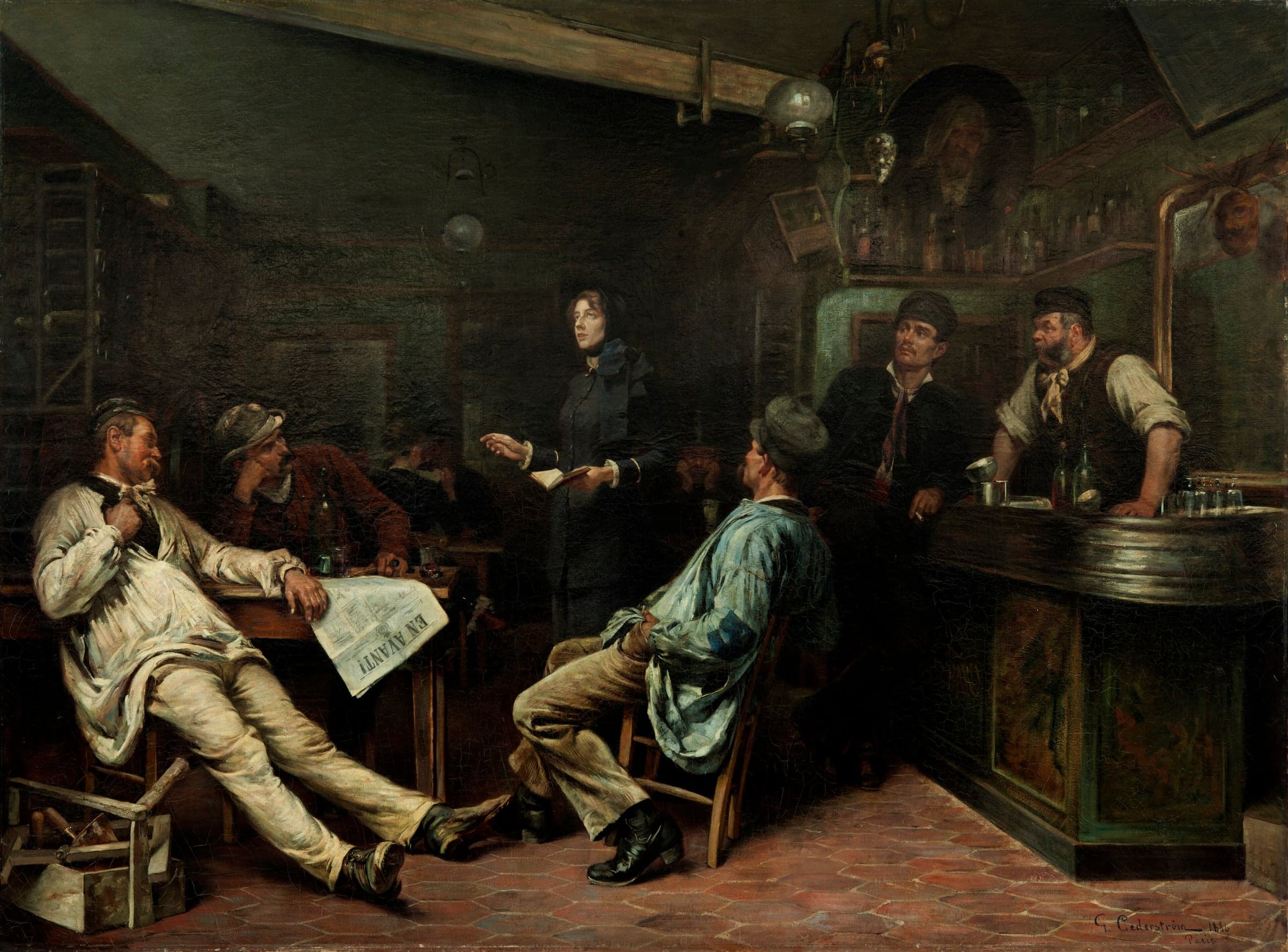
Gustaf Cederström, The Salvation Army, 1886. CC BY 4.0.
1865 to today · The churches · Featured Study
The Salvation Army
A church with soldiers, corps and a General, which began as a mission to the poor of East London.
Now may the God of peace Himself sanctify you completely, and may your entire spirit, soul, and body be kept blameless at the coming of our Lord Jesus Christ. The One who calls you is faithful, and He will do it.
- Began
- 5 July 1865 in the East of London, as Railton's table of events gives it
- Bodies
- The Salvation Army
“O Kate, I have found my destiny!” William Booth told his wife in 1865, as Railton's life of Booth (1912) records, after services in a tent in an old burial-ground in Whitechapel.
Summary
The Salvation Army grew out of William Booth's work in Whitechapel into a church with its own ranks and flags. It teaches that every believer may be wholly sanctified.
- Booth was a travelling revivalist before his work in London.
- Samuel Logan Brengle taught the Army's holiness doctrine.
- It counts more than a million soldiers today.
The Texts of the Army
The Army's tenth doctrine rests on Paul's prayer, and the churches that keep the two ordinances read them from two other texts.
The Army's tenth doctrine follows the King James wording of 1 Thessalonians 5:23.
Therefore go and make disciples of all nations, baptizing them in the name of the Father, and of the Son, and of the Holy Spirit,The Methodist churches baptize by this command.
and when He had given thanks, He broke it and said, “This is My body, which is for you; do this in remembrance of Me.” In the same way, after supper He took the cup, saying, “This cup is the new covenant in My blood; do this, as often as you drink it, in remembrance of Me.” For as often as you eat this bread and drink this cup, you proclaim the Lord’s death until He comes.Paul gives the words said over the bread and the cup.
The Army's Branch of the Family of Churches
The branch runs from Booth's mission of 1865 to the Army's holiness teaching of the 1890s.
A mission in the East of London became an army in thirteen years.
1859 to 1865
- Female Ministry
- The mission in the East of London
1867 to 1878
- The Holiness churches
- The Christian Mission's Deed Poll
- The Salvation Army
1879 to 1896
- The first War Cry
- In Darkest England
- Helps to Holiness
Railton gives the dates to 1883, and the books give the rest.
The Christian Traditions sets this church among the other families, from Ephesus in 431 to the Pentecostals in 1906.
How the Army Began: a Tent and a New Name
Railton's life of Booth tells the start in the Army's own words.
George Scott Railton's Authoritative Life of General William Booth (1912) is the Army's own account.
Railton writes that Booth was invited to take services in the tent, “the expected missioner having fallen ill.” Booth said the poor people there “so readily and eagerly listened to me.”
Railton dates the new name to the end of 1878: “It was only at the end of 1878, during which year the ‘Stations,’ which we now call Corps, had increased from thirty to eighty, that in a brief description of the work we called the Mission a ‘Salvation Army.’”
His table of events records that at Christmas 1878 the name of the Christian Mission was altered to The Salvation Army, and Booth took the title of General.
The same table dates Catherine Booth's first pamphlet, Female Ministry, to 1859.
The Truth It Preaches: a Clean Heart After Conversion
The Army teaches holiness as a privilege of every believer, received after conversion.
The Army's tenth doctrine says, “We believe that it is the privilege of all believers to be wholly sanctified.”
Samuel Logan Brengle taught the doctrine for the Army in Helps to Holiness, whose preface by Bramwell Booth is dated 1896 in the scanned text. He wrote that “neither the Bible nor experience proves that a man gets a clean heart when he is converted.”
The doctrine before it reads, “We believe that continuance in a state of salvation depends upon continued obedient faith in Christ.”
The site's own teaching on eternal security stands on the other side of that question, on the words of Jesus in John 10:28 to 29.
The Army's Own Statement on the Sacraments
The Army's International Spiritual Life Commission set out its answer on baptism and communion.
The Army's statement on Holy Communion, from its International Spiritual Life Commission, reads, “God's grace is freely and readily accessible to all people at all times and in all places. No particular outward observance is necessary to inward grace.”
Its statement on baptism opens, “Only those who confess Jesus Christ as Saviour and Lord may be considered for soldiership in The Salvation Army.”
The same page leaves Salvationists free to take communion where another church allows it.
The Methodist churches keep both ordinances: Wesley's letter of 1784 appointed elders for America “by baptizing and administering the Lord's supper.”
The Army Today in Its Own Count
The Army's International Headquarters counts its countries, its congregations and its soldiers.
All three counts come from one page that names no year.
| What the Army counts | The count | Counted by |
|---|---|---|
| Countries where the Army serves | 134 | International Headquarters |
| Worshipping communities | 14,067 | International Headquarters |
| Salvation Army soldiers | 1,250,459 | International Headquarters |
Where the Army Went
Railton's table of events dates its work country by country.
The first headquarters opened in Whitechapel Road in 1865, and the work reached Scotland in 1868.
In 1880 the Army opened in the United States and Australia, and in 1881 in France.
In 1882 it reached Switzerland, Canada, Sweden and India, and in 1883 South Africa and New Zealand.
Who Wrote In Darkest England, and Did the Scheme Work
A secularist questioned the book's authorship, and The Times weighed the Army's results.
In his book In Darkest England, Booth set his own figure for the poor between two others: “Between Mr. Chamberlain's four millions and a half, and Mr. Giffen's 1,800,000, I am content to take three millions as representing the total strength.”
Booth's preface of October 1890 thanks “a friend of the poor, who, though not in any way connected with the Salvation Army, has the deepest sympathy with its aims,” for literary help. It calls the proposals those “for which I am alone responsible.”
G. W. Foote, a secularist hostile to the Army, answered in Salvation Syrup (1891), “The friend is Mr. Stead. This gentleman has ‘written up’ the scheme in the manner of ‘the born journalist.’”
The Times, in the leader on Booth's death in 1912 that Railton reprints, wrote that the social schemes “have met with only moderate success, as all cool observers foretold in 1890.”
It added, “Everywhere we hear that The Army is not bringing in Recruits as fast as of old.”
The same leader still called Booth's success, “partial though it has been,” “an astonishing fact.”
Books to Read Next
The Authoritative Life of General William Booth
George Scott Railton · 1912
Railton tells the mission and the Army from inside, with a table of its dates.
Free at Project GutenbergHelps to Holiness
Samuel Logan Brengle · c. 1896
Brengle sets out the Army's teaching of a clean heart after conversion.
Free at the Internet ArchiveIn Darkest England, and the Way Out
William Booth · 1890
Booth proposes his social scheme and counts the poor it would serve.
Free at Project GutenbergSalvation Syrup; or, Light on Darkest England
G. W. Foote · 1891
A secularist answers Booth's book and names Stead as its writer.
Free at the Internet ArchiveWhat the Army Handed On
The Army handed on a holiness preached to the poor in their own streets, carried within five years of its new name to four continents beyond Europe.
Sources
Scripture is the Berean Standard Bible.
- The Holy Bible, Berean Standard Bible (read 2026)
- George Scott Railton, The Authoritative Life of General William Booth (1912), the table of important events and chapters VII and IX.
- The Salvation Army International Headquarters, What we believe, doctrines 9 and 10 (read October 2026)
- The Salvation Army, India, Faith and Beliefs, A Statement on Holy Communion and A Statement on Baptism, from the International Spiritual Life Commission (undated; read in October 2026)
- The Salvation Army International Headquarters, Global presence (no year on the page; read October 2026)
- Samuel Logan Brengle, Helps to Holiness, The Red-Hot Library number IV, edited by Bramwell Booth (London: The Salvation Army Book Department), preface dated 1896 in the scanned text, page 8.
- William Booth, In Darkest England, and the Way Out (New York: Funk and Wagnalls, 1890), the preface of October 1890 and Part I, chapter 2, pages 22 to 23.
- G. W. Foote, Salvation Syrup; or, Light on Darkest England, second edition (London: Progressive Publishing Company, 1891)
- John Wesley, letter dated Bristol, 10 September 1784, To Dr. Coke, Mr. Asbury, and our Brethren in North-America, in The Sunday Service of the Methodists in North America (London, 1784), pages i to iii.
- The Times, leader on the death of General Booth (August 1912), reprinted in Railton, The Authoritative Life of General William Booth (1912), chapter XXV.