
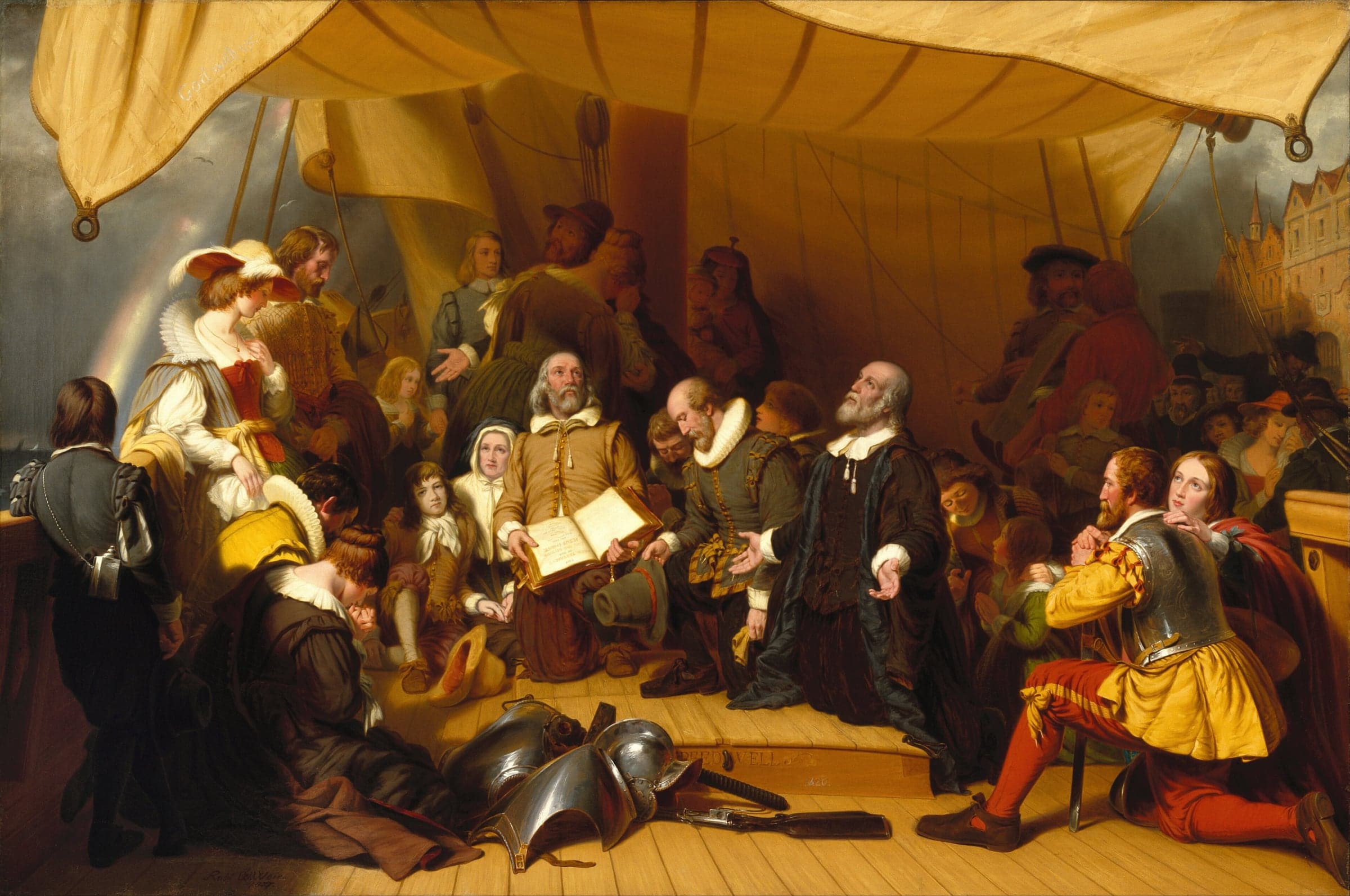
Robert Walter Weir, Embarkation of the Pilgrims, 1857. Public domain.
1580 to today · The churches · Featured Study
The Congregational Churches
From Robert Browne's Norwich and the Scrooby church to the Pilgrims of 1620 and four bodies today.
John Robinson, the Pilgrims' pastor, stayed at Leyden until his death in March 1625.
Truly I tell you, whatever you bind on earth will be bound in heaven, and whatever you loose on earth will be loosed in heaven.
- Began
- 1580 or 1581 at Norwich, as Walker gives it (probable)
- Bodies
- United Church of Christ, National Association of Congregational Christian Churches, Conservative Congregational Christian Conference, Congregational Federation
John Robinson, the Pilgrims' pastor, stayed at Leyden until his death in March 1625.
Summary
In these churches each congregation is a church under Christ alone. Its members join it by a covenant. The first ones were English Separatists, and the line took root in New England.
- Robert Browne wrote that believers need not wait for the state to reform the church.
- Part of the Scrooby church sailed on the Mayflower in 1620.
- In 1648 New England's churches gave the magistrate power over heresy.
- The four bodies today count different things, so there is no single total.
The Texts the Congregational Documents Cite
Their documents cite Matthew 18 for the keys of the church and for its discipline.
The Congregational documents of 1582, 1589 and 1648 set Matthew 18 in their margins, and Browne answered his opponents from Luke 9.
The keys and the discipline
If your brother sins against you, go and confront him privately. If he listens to you, you have won your brother over. But if he will not listen, take one or two others along, so that ‘every matter may be established by the testimony of two or three witnesses.’ If he refuses to listen to them, tell it to the church. And if he refuses to listen even to the church, regard him as you would a pagan or a tax collector.
The Cambridge Platform of 1648 sets these verses beside its steps of admonition and telling the church.
Truly I tell you, whatever you bind on earth will be bound in heaven, and whatever you loose on earth will be loosed in heaven.
The London Separatists' confession of 1589 cites it for the keys given to the church and to every member.
The Cambridge Platform of 1648
Now if you will indeed obey My voice and keep My covenant, you will be My treasured possession out of all the nations—for the whole earth is Mine.
The Platform's margin cites it beside the church covenant.
Exodus 19:5BSB
Keep watch over yourselves and the entire flock of which the Holy Spirit has made you overseers. Be shepherds of the church of God, which He purchased with His own blood.
The Platform cites it where it holds that no church is greater than one congregation.
Acts 20:28BSB
Such a prophet or dreamer must be put to death, because he has advocated rebellion against the LORD your God, who brought you out of the land of Egypt and redeemed you from the house of slavery; he has tried to turn you from the way in which the LORD your God has commanded you to walk. So you must purge the evil from among you.
The Platform's margin cites Deuteronomy 13 beside its rule on heresy.
So the apostles and elders met to look into this matter.
John Allin of Dedham took Acts 15 as his text before the synod voted the Platform.
Acts 15:6BSB
Browne's Treatise, 1582
Then Jesus declared, “No one who puts his hand to the plow and then looks back is fit for the kingdom of God.”
Browne used it against those who would wait for the magistrate to reform the church.
Luke 9:62BSB
Exodus 19:5, Acts 20:28, Deuteronomy 13:5, Acts 15:6, Luke 9:62
The Congregational Branch of the Family of Churches
The branch runs from Norwich to four bodies formed between 1945 and 1972.
The Congregational line runs from one gathered church at Norwich to four bodies of today.
1580 to 1593
- Browne's church at Norwich
- The Separatist church in London
1605 to 1620
- The church at Scrooby
- The church in exile at Leyden
1648 and 1658
- The churches of New England
- The churches of the Savoy
1945 and 1955
- The Conservative Congregational Christian Conference
- The National Association of Congregational Christian Churches
1957 and 1972
- The United Church of Christ
- The Congregational Federation
Each generation joins two branches and gives the years in which they began.
How the Separatists Began
Browne gathered a church at Norwich, and his followers and the London Separatists paid with their lives.
Williston Walker, a Congregational historian writing in 1893, says Robert Browne gathered at Norwich in 1580 or 1581 the first of the long series of Congregational churches that continued after him.
Browne took his company to Middelburg in the Netherlands, in the autumn of 1581 by Walker's account and in January 1582 by the 1911 Britannica's. There he printed three tracts in 1582.
Two of his followers, John Coppin and Elias Thacker, were hanged at Bury St Edmunds in the summer of 1583 for spreading the tracts, as Walker and the 1911 Britannica record. The Britannica says the early Separatists were “hence sometimes called Brownists.”
Henry Barrowe and John Greenwood, leaders of the Separatist church in London, were both hanged on 6 April 1593, by Walker's notes.
Did the Separatists learn from the Anabaptists?1 paragraph
Walker writes that Browne's system took shape at Norwich, perhaps through contact with Anabaptist views, and adds that the proof is lacking. He traces most early Congregationalists to the Puritans, who sought to purge the Church of England from within.
The Truth They Kept: the Church Gathered by Covenant
A church is formed when believers bind themselves to God and to one another, without waiting for the state.
Browne's Treatise of Reformation without Tarying for Anie, printed at Middelburg in 1582, denies that the magistrates may “compell religion, to plant churches by power.”
It closes the point, “Let vs not therfore tarie for the Magistrates.”
In his Booke of the same year Browne defines Christians as believers joined by a willing covenant with God, and makes every member a king, a priest and a prophet under Christ.
William Bradford, one of the Scrooby company, wrote that the Scrooby people “joyned them selves (by a covenant of the Lord) into a church estate.”
Walker notes that Bradford wrote at least a quarter of a century later.
Their Own Statements: Cambridge 1648 and the Savoy 1658
New England's synod wrote a church order in 1648, and English Congregationalists a declaration in 1658.
The synod of the New England churches met in 1646 and 1647 and opened its final session at Cambridge on 15 August 1648. Its preface dates the vote to the last of the sixth month, 1648.
The Platform calls the church covenant the form of a church: “This Form is the Visible Covenant, Agreement, or consent” by which the members give themselves to the Lord.
For doctrine the synod accepted the Westminster Assembly's confession, “for the substance therof,” as Walker quotes it. The Platform was printed at Cambridge in 1649.
In England the elders and messengers of about a hundred and twenty churches met at the Savoy in London from 29 September to 12 October 1658. Increase Mather gave the number of churches in 1700.
Their Declaration added a platform of church polity, vesting all power over the church in Christ as King and Head. Walker writes that American Congregationalists never adopted that platform of polity, holding to the Cambridge Platform.
The Congregational Bodies Today
Each body counts its own, and the counts are of two kinds.
The United Church of Christ counts members, and the other three count churches.
| Body | Count | Who counted, and what |
|---|---|---|
| United Church of Christ | 683,936 members in 4,485 congregations | The church's Statistical Profile 2024, for the end of 2023, from data its congregations report |
| National Association of Congregational Christian Churches | 268 member churches, 220 of them active | The Association's membership list for July 2025 to June 2026, sorted by giving |
| Conservative Congregational Christian Conference | 301 member churches | The Conference's flyer of 2022, with no method stated |
| Congregational Federation, in Britain | 235 churches in 10 regions | The Federation's church finder, undated, read in October 2026 |
From Scrooby to Leyden to Cape Cod
The Scrooby church went into exile in Holland in 1607 and reached Cape Cod in November 1620.
Walker writes that part of a Separatist church met from 1605 or 1606 at the house of William Brewster, the postmaster at Scrooby, later their elder. They reached Amsterdam in 1607 and 1608 and moved to Leyden in 1609.
Bradford tells of “a combination made by them before they came ashore,” because some strangers aboard said none had power to command them under a patent for Virginia.
The signers bound themselves to “covenant & combine our selves togeather into a civill body politick, for our better ordering & preservation.”
Bradford dates it at Cape Cod, 11 November 1620.
Walker calls the Compact “in no sense a creed or a religious covenant,” and yet “the direct fruit of the teachings of Congregationalism.”
The original is not known to survive, and the text rests on three early copies.
The Magistrate's Sword in New England
The churches that began by refusing the magistrate's power gave it back to him in 1648.
Sixty-six years after Browne's Treatise, chapter XVII, section 8, of the Cambridge Platform named idolatry, blasphemy and heresy among the offences that “are to be restrayned, & punished by civil authority.”
Section 9 adds that if a church grows schismatic, “the Magistrate is to put forth his coercive powr, as the matter shall require.”
The Salem church renewed its covenant in 1660 and bound its members to beware the doctrine of the Quakers, citing Matthew 16.
Walker wrote in 1893 as a historian from inside the tradition. Of the Platform he says, “It urges the right of the civil magistrate to interfere in matters of doctrine and practice, because Congregationalism then believed that such rights were his.”
Browne himself made his peace with the Church of England in 1586 and held the parish of Achurch from 1591 until his death, Walker records.
Books to Read Next
The Creeds and Platforms of Congregationalism
Williston Walker · 1893
Walker prints the Cambridge Platform, the Savoy Declaration and the covenants with their history.
Free at the Internet ArchiveOf Plimoth Plantation
William Bradford · printed 1898
It tells Scrooby, Leyden and the first years at Plymouth, printed from Bradford's manuscript in 1898.
Free at Project GutenbergA Treatise of Reformation without Tarying for Anie
Robert Browne, edited by T. G. Crippen · 1582
It sets out Browne's case for gathering churches without the magistrate, and was reprinted in 1903.
Free at the Internet ArchiveWhat the Congregational Churches Hold
The Congregational churches hold that believers bound by covenant make a church, ruled by Christ through His word. Their own platform of 1648 gave the magistrate the power over heresy that Browne had refused him.
Sources
Scripture is the Berean Standard Bible.
- The Holy Bible, Berean Standard Bible (read 2026)
- Williston Walker, The Creeds and Platforms of Congregationalism (New York: Scribner's, 1893), pages 3, 9 to 13, 29 to 30, 38 to 39, 81 to 92, 118, 154 to 155, 182 to 186, 207 to 208, 237 and 340 to 404.
- Encyclopaedia Britannica, eleventh edition (1911), volume 4, Browne, Robert.
- Robert Browne, A Treatise of Reformation without Tarying for Anie (Middelburg, 1582), edited by T. G. Crippen for the Congregational Historical Society (London, 1903), page 27.
- Robert Browne, A Booke which sheweth the life and manners of all true Christians (Middelburg, 1582), in Walker (1893), pages 19 to 22.
- William Bradford, Of Plimoth Plantation, printed from the manuscript (Boston: Wright and Potter, for the Commonwealth of Massachusetts, 1898), manuscript pages 6 and 54.
- A Platform of Church-Discipline (Cambridge, 1649), the preface and chapters III, IV, X and XVII, in Walker (1893), pages 194 to 237.
- A Declaration of the Faith and Order Owned and practised in the Congregational Churches in England (London: John Field, 1658), Of the Institution of Churches, in Walker (1893), pages 403 to 404.
- United Church of Christ, Statistical Profile 2024.
- John H. Thomas, The First President of the United Church of Christ (United Church of Christ, 1 April 2019)
- National Association of Congregational Christian Churches, Church Membership, July 2025 to June 2026 (updated 11 June 2026)
- Conservative Congregational Christian Conference, information flyer (2022)
- Congregational Federation, Who we are and Church Finder (undated; read 2026)
- Association of Religion Data Archives, group profiles 557 and 246 (undated; read 2026)
Keep Studying
Studies1
Subjects2
People and groups1
Church history3
Doctrines2
Values1