
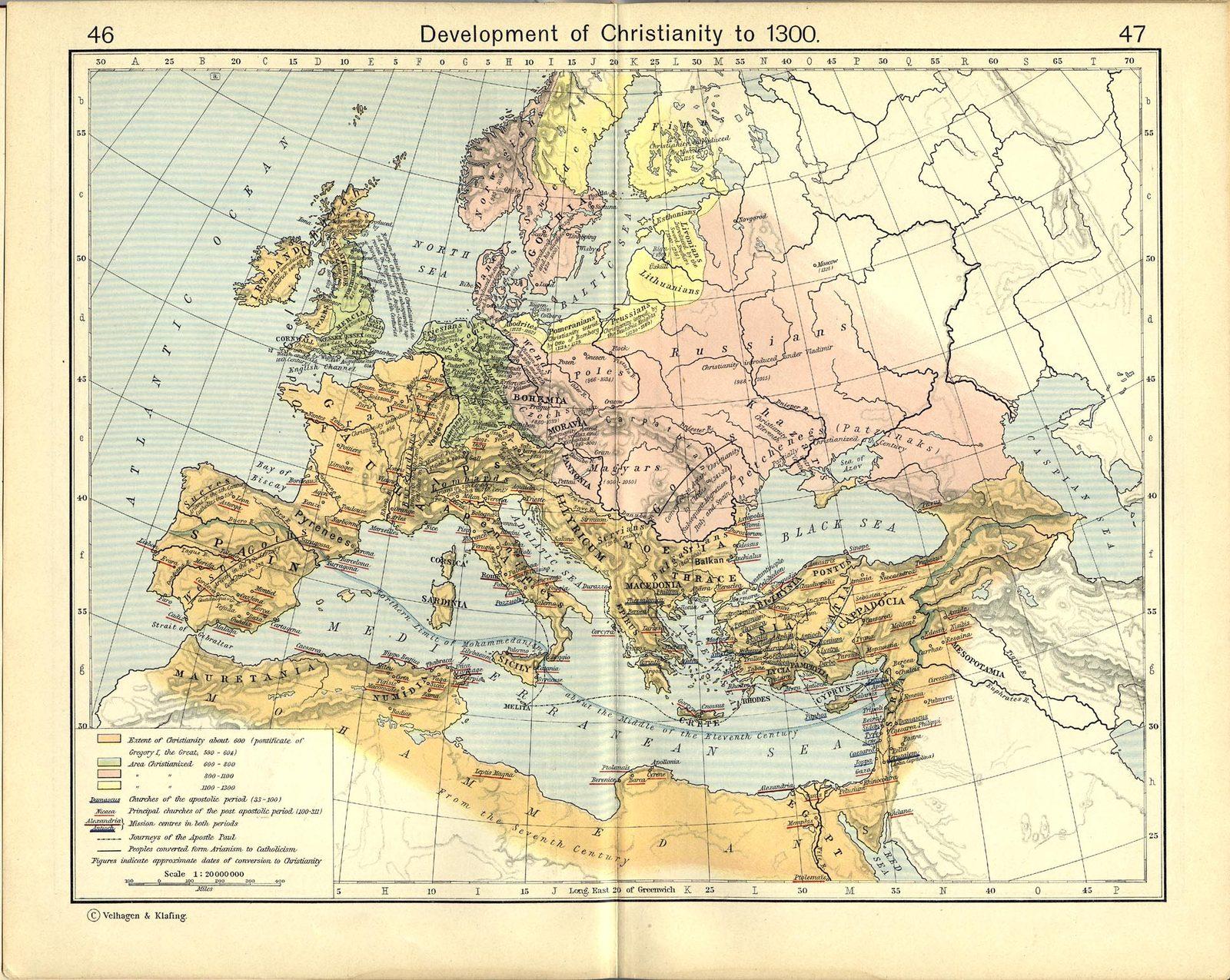
William R. Shepherd, Development of Christianity to 1300, Historical Atlas, 1911. Public domain.
About AD 30 to today · Subject · Featured Study
The Church Through Two Thousand Years
The church has passed through ten eras from Pentecost to the present, and each era has its own page.
- Books
- Matthew, Acts, Hebrews
- Hold in memory
- Matthew 16:18, Acts 1:8
The church began in Jerusalem about AD 30, and in the last century most Christians came to live outside Europe and North America.
And I tell you that you are Peter, and on this rock I will build My church, and the gates of Hades will not prevail against it.
Summary
The ten eras of the church stand here on one line, from the first preaching in Jerusalem to the churches of the present day. Each era has its own page, and each turning point carries the printed record that dates it.
- The line begins in Jerusalem about AD 30.
- The ten turning points run from the fire at Rome in AD 64 to the Barmen Declaration of 1934.
- Each era page names its boundary, its turning points and its hard part.
- The church's own failures stand on the line beside its witness.
The Verses That Frame the Line
The four verses give Christ's promise, His commission, the first church and the cloud of witnesses.
Four verses frame the line. The first is a promise, the second a commission, the third a pattern and the fourth a charge to those who come after.
The promise and the commission
But you will receive power when the Holy Spirit comes upon you, and you will be My witnesses in Jerusalem, and in all Judea and Samaria, and to the ends of the earth.”
Jesus sends His witnesses from Jerusalem to the ends of the earth, the order the line follows.
Acts 1:8BSB
The first church and those who follow
They devoted themselves to the apostles’ teaching and to the fellowship, to the breaking of bread and to prayer.
Luke sets down what the first church in Jerusalem gave itself to after Pentecost.
Acts 2:42BSB
Therefore, since we are surrounded by such a great cloud of witnesses, let us throw off every encumbrance and the sin that so easily entangles, and let us run with endurance the race set out for us.
The letter calls the faithful of the past a cloud of witnesses around those who run now.
Hebrews 12:1BSB
Acts 2:42, Hebrews 12:1
Ten Eras on One Line
Each row is one era of the church, with one turning point and the record that dates it.
The ten eras run from about AD 30 to today, and each turning point is fixed by a record a reader can open.
- The Apostolic AgeThe fire at Rome, AD 64Tacitus, Annals 15.44
- The Martyrs' ChurchDecius's order to sacrifice, AD 250A certificate of sacrifice dated 17 June 250
- The Fathers and the CreedsThe council of Nicaea, AD 325Percival, The Seven Ecumenical Councils (1899)
- The Long MiddleJan Hus burned at Constance, 1415Lutzow, The Life and Times of Master John Hus (1909)
- The ReformationLuther writes against the indulgence preaching, 31 October 1517Works of Martin Luther, volume 1 (1915)
- The Puritans and PietistsThe communion at Herrnhut, 13 August 1727Hutton, A History of the Moravian Church (1909)
- The Great AwakeningsWesley's heart is warmed, 24 May 1738Wesley's Journal, Curnock's edition
- The Missionary CenturyCarey prints his Enquiry, 1792Carey's Enquiry (1792)
- The Revival StreamsThe mission at 312 Azusa Street, April 1906Bartleman, How Pentecost Came to Los Angeles (1925)
- The Church Under FireThe Barmen Declaration, 31 May 1934The Evangelical Church in the Rhineland's text of the Declaration
A timeline of the ten eras of the church. Each row is a door to its era page.
The Great Awakenings, The Missionary Century, The Revival Streams, The Church Under Fire
What the Line Also Holds
The era pages record persecution by Christians and the defence of slavery as well as faithfulness.
The era pages do not tell the line as one unbroken triumph. Once the persecution ended, the emperors who now favoured the church turned the law against those who dissented.
In the century of the Reformation, rulers on every side put people to death for their faith. In New England the Puritans also drove out and hanged others for theirs.
Whitefield pressed for slavery in Georgia in the same years that Wesley, Newton and Equiano wrote against the slave trade. In the last century churches have owned the failures of their own members in Germany and Rwanda.
The Eras in Turn
Each era is told in a few sentences of fact from its own page.
The Apostolic AgeAbout AD 30 to 100
The followers of Jesus began to preach Him as risen in Jerusalem. Within seventy years churches met in houses from Judea to Asia, Greece and Rome.
Read The Apostolic Age 13 sections, 9 verses set out
The Martyrs' ChurchAD 100 to 313
Twice an emperor told every province to sacrifice, first Decius and then Diocletian. The church kept its own record of the trials, and at the end it got its buildings back.
Read The Martyrs' Church 13 sections, 10 verses set out
The Fathers and the CreedsAD 313 to 600
Councils of bishops put the faith of John 1:1 into creeds. Letters and local synods wrote down the books of the Bible.
Read The Fathers and the Creeds 13 sections, 12 verses set out
The Long MiddleAD 600 to 1500
Monks and missionaries took the faith to the peoples of the north, and the churches of Rome and Constantinople drew apart. At the end a council at Constance condemned Wycliffe's books and burned Hus.
Read The Long Middle 13 sections, 13 verses set out
The Reformation1500 to 1600
The western church split over how a sinner is made right with God and who has the last word on Scripture. Printers put the Bible in German and in English into common hands.
Read The Reformation 13 sections, 13 verses set out
The Puritans and Pietists1600 to 1730
The Puritans asked the Church of England to reform its worship and its people's lives, and the Pietists asked the same of the Lutheran church. The king of Denmark sent men to preach in India, and Herrnhut sent its own across the sea.
Read The Puritans and Pietists 13 sections, 12 verses set out
The Great Awakenings1730 to 1800
Preachers in New England, Britain and America called people to be born again, and Whitefield and Wesley preached in the fields. The Methodists counted 25,911 members in 1767 and 120,073 in 1790, by their own returns.
Read The Great Awakenings 13 sections, 11 verses set out
The Missionary Century1790 to 1910
Translators put the Bible into the tongues of India, Burma, China and southern Africa. Many who went out died young.
Read The Missionary Century 13 sections, 15 verses set out
The Revival Streams1900 to 1950
Revivals came to Wales, India, California, Korea and East Africa. At the Azusa Street mission people spoke in tongues, and new churches grew from it.
Read The Revival Streams 13 sections, 13 verses set out
The Church Under Fire1930 to today
Some believers went to prison or died rather than obey, and some churches gave way. Counts of the martyrs differ by method, from thousands a year to millions.
Read The Church Under Fire 13 sections, 12 verses set out
The Martyrs' Church (AD 100 to 313), The Fathers and the Creeds (AD 313 to 600), The Long Middle (AD 600 to 1500), The Reformation (1500 to 1600), The Puritans and Pietists (1600 to 1730), The Great Awakenings (1730 to 1800), The Missionary Century (1790 to 1910), The Revival Streams (1900 to 1950) and 1 more
In Their Own Words
Jan Hus (1372 to 1415)
Letter 73, to his friends at Constance, letter 73, the eve of St. John Baptist, 1415, page 253
Hus prayed for a brave spirit.
“O loving Christ, draw me, a weakling, after Thyself; for if Thou drawest me not, I cannot follow Thee. Grant me a brave spirit that it may be ready.”
Pre-Reformation reformer
About this saying1 paragraph
He sent this prayer to his friends in June 1415, in the last days of his imprisonment.
Martin Luther (1483 to 1546)
Letter to Pope Leo X accompanying the Resolutions (1518), in Works of Martin Luther, vol. 1 (Philadelphia, 1915), the letter sent with the Resolutions
Luther called the uproar over his theses a fire.
“Lo, this is the fire with which they complain that all the world is now ablaze!”
Other
About this saying1 paragraph
In 1518 he told the pope that the uproar began with a set of theses he had published for the learned to dispute.
George Whitefield (1714 to 1770)
A Continuation of the Reverend Mr Whitefield's Journal, page 31, the fourth edition (London, 1739)
Whitefield found the open field his best pulpit.
“I believe I never was more acceptable to my Master than when I was standing to teach those Hearers in the open Fields.”
Calvinistic Methodist
About this saying1 paragraph
He set this down in his journal of 1739, on the day he first preached to the colliers.
John Wesley (1703 to 1791)
Journal, Curnock's edition, volume 2 (1909 to 1916), page 218
Wesley took the whole world for his parish.
“I look upon all the world as my parish; thus far I mean, that, in whatever part of it I am, I judge it meet, right, and my bounden duty to declare unto all that are willing to hear the glad tidings of salvation.”
Evangelical
About this saying1 paragraph
He wrote this in 1739 to a friend who had questioned his preaching in other men's parishes.
William Carey (1761 to 1834)
An Enquiry, Section I (1792)
Carey held that the commission still bound the church.
“This commission was as extensive as possible, and laid them under obligation to disperse themselves into every country of the habitable globe, and preach to all the inhabitants, without exception, or limitation.”
Particular Baptist
About this saying1 paragraph
In 1792 he argued that Christ's command to the apostles reached every later generation of believers.
Frank Bartleman (1871 to 1935)
How Pentecost Came to Los Angeles (Los Angeles: F. Bartleman, 1925), on the Azusa Street meetings, p. 58
Bartleman saw lives remade at Azusa Street.
“In that old building, with its low rafters and bare floors, God took strong men and women to pieces, and put them together again, for His glory.”
Pentecostal
About this saying1 paragraph
Looking back in 1925, he told what the meetings of 1906 did to the men and women who came.
One Story or Many
Readers differ on whether the eras tell one church's story or the stories of many churches.
The site's tradition, Wesleyan-Pentecostal, reads the line as one church carried by the Spirit through every era, as Acts 1:8 sends it. The estate records each passing of the faith from one page to the next as a dated link with its source.
Other readers tell the eras as the story of separate churches, each with its own line of descent. The Moravian page traces its church to Kunwald in 1457 or 1458, and the Roman Catholic page to Irenaeus's list of the bishops of Rome.
Books to Read Next
History of the Christian Church
Philip Schaff and David S. Schaff · 1907 to 1910 printings
The era page of the Long Middle reads its volumes 4 to 7 for the years from Gregory to the Reformation.
Free at CCELThe Seven Ecumenical Councils
Henry R. Percival · 1899
It gives the canons and creeds of the councils from Nicaea on, as the era of the Fathers reads them.
Free at CCELA History of the Moravian Church
J. E. Hutton · 1909
It carries one church from Hus to Herrnhut and the missions, and it dates the communion of 1727.
Free at Project GutenbergWhere the Line Leads
Each era page takes the reader from this line into its own years, its people and its record.
Sources
Scripture is the Berean Standard Bible.
- The Holy Bible, Berean Standard Bible (read 2026)
- Tacitus, Annals 15.44, translated by A. J. Church and W. J. Brodribb.
- The certificate of Aurelius Sakis, P.Mich. III 157, and Lactantius, On the Deaths of the Persecutors, ANF volume 7 (1886)
- H. R. Percival, The Seven Ecumenical Councils, NPNF second series volume 14 (1899)
- Count Lutzow, The Life and Times of Master John Hus (London: Dent, 1909)
- Works of Martin Luther, volume 1 (Philadelphia: A. J. Holman, 1915)
- J. E. Hutton, A History of the Moravian Church, second edition (1909)
- John Wesley, Journal, ed. Nehemiah Curnock, Standard Edition (1909 to 1916)
- William Carey, An Enquiry (1792), Project Gutenberg 11449.
- Frank Bartleman, How Pentecost Came to Los Angeles (1925)
- The Evangelical Church in the Rhineland, Barmer Theologische Erklärung.
- Jan Hus, The Letters of John Hus, translated by Herbert B. Workman and R. Martin Pope (London: Hodder and Stoughton, 1904), letter 73, page 253.
- John Wesley, The Journal of the Rev. John Wesley, A.M., sometime Fellow of Lincoln College, Oxford, ed. Nehemiah Curnock (London: R. Culley), volume 2, page 218; the Internet Archive's record dates the set [1909?] to 1916 and gives volume 2 no year of its own.
- George Whitefield, A Continuation of the Reverend Mr. Whitefield's Journal: from his arrival at London, to his departure from thence on his way to Georgia, the fourth edition (London: J. Hutton, 1739), page 31.
- William Carey, An Enquiry into the Obligations of Christians, to use Means for the Conversion of the Heathens (1792), section I.
- Frank Bartleman, How Pentecost Came to Los Angeles: As It Was in the Beginning (Los Angeles: F. Bartleman, 1925), page 58.
Keep Studying
People and groups2
Doctrines1