
1517 to today · The churches · Featured Study
The Lutheran Churches
A family of churches born in the German Reformation, with more members today in Africa than in Europe.
Bente compared five Dresden copies of the Book of Concord of 1580 and found that they “differ from one another, both as to typography and contents.”
- Began
- 25 June 1530 at Augsburg, as Bente dates the Confession
- Bodies
- The Lutheran World Federation, 150 member churches, The Ethiopian Evangelical Church Mekane Yesus, The Evangelical Lutheran Church in America, The Lutheran Church Missouri Synod
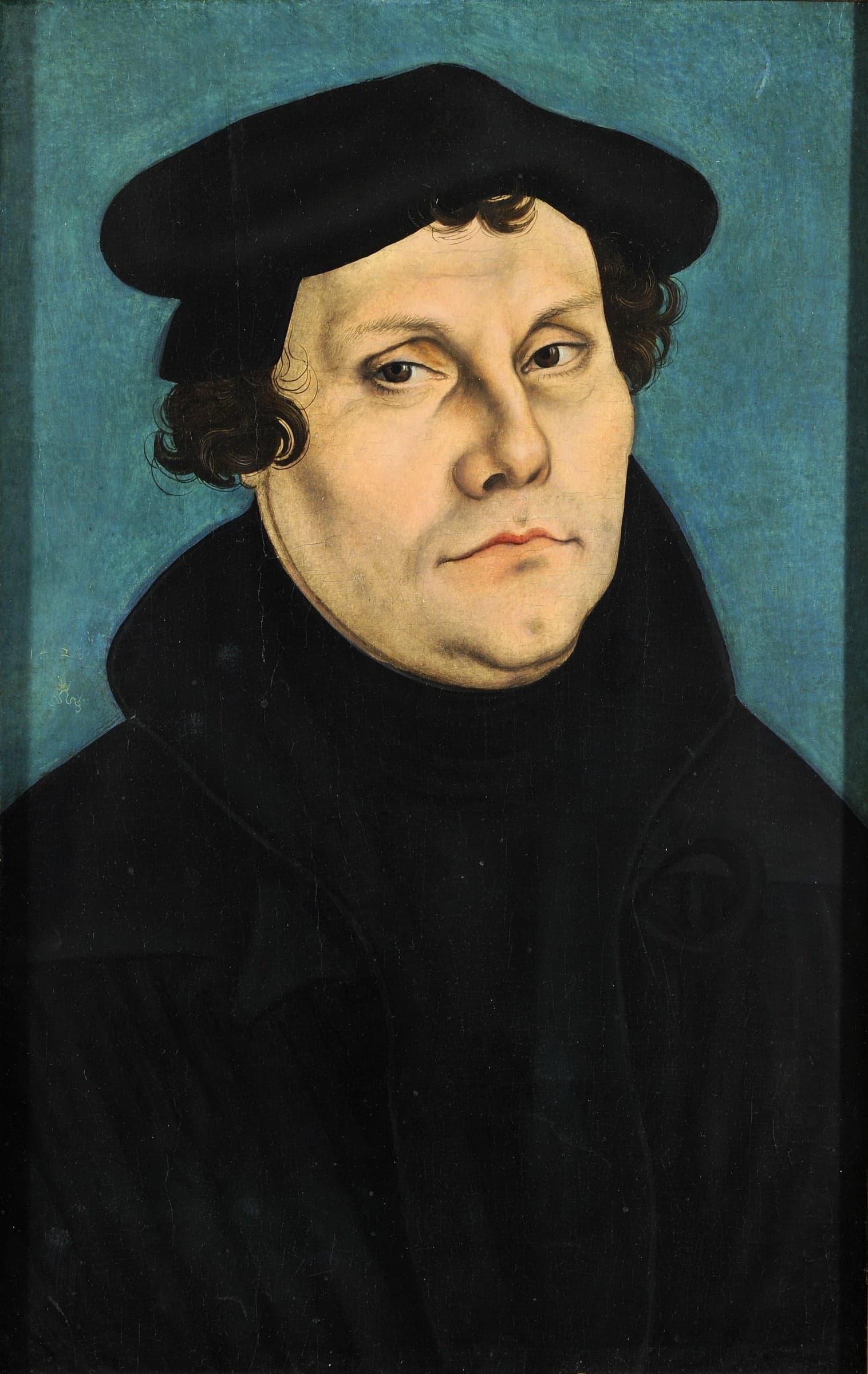
Lucas Cranach the Elder, Martin Luther, 1528. Public domain.
For it is by grace you have been saved through faith, and this not from yourselves; it is the gift of God, not by works, so that no one can boast.
Summary
The Lutheran churches are the churches of the Augsburg Confession of 1530. They teach that a sinner is justified freely for Christ's sake, through faith, and not by his own works.
- Rome's reply came that August, and the talks that followed failed.
- Their confessions, catechisms and creeds are printed together in the Book of Concord.
- Their largest church today worships in Ethiopia.
The Texts the Lutheran Churches Stand On
Four verses read on both sides at Augsburg in 1530.
The chapters the Confession names
For we maintain that a man is justified by faith apart from works of the law.
It stands in Romans 3, the first of the two chapters the fourth article cites.
Romans 3:28BSB
However, to the one who does not work, but believes in Him who justifies the wicked, his faith is credited as righteousness.
Its faith credited as righteousness is what the article means when it says God imputes faith for righteousness.
Romans 4:5BSB
The verses the Confutation answered with
I have fought the good fight, I have finished the race, I have kept the faith. From now on there is laid up for me the crown of righteousness, which the Lord, the righteous Judge, will award to me on that day—and not only to me, but to all who crave His appearing.
The Confutation read Paul's crown of righteousness as proof that works done by grace are meritorious.
For we must all appear before the judgment seat of Christ, that each one may receive his due for the things done in the body, whether good or bad.
The Confutation cited it before its line that where there are wages there is merit.
2 Timothy 4:7 to 8, 2 Corinthians 5:10
The Lutheran Branch of the Family of Churches
Eight records, from Kidd's documents to the federation's figures.
The Confession of 1530 stands at the centre of the Lutheran line.
1517
- Luther's letter to Albert of Mainz
- The Ninety-five Theses, dated 31 October 1517 by Kidd
1521
1530
- The Augsburg Confession
- The Roman Confutation, read publicly on 3 August 1530
1580
- The Book of Concord
Today
- The Lutheran Church Missouri Synod
- The Lutheran World Federation
Kidd (1911), Bente (1921), the Lutheran World Federation and the Missouri Synod's Reporter date the generations.
The other families of the churches stand together with the dates on which each began.
How the Lutheran Churches Began
A letter of 1517, a confession of 1530 and the reply it drew.
B. J. Kidd dates both Luther's Theses and his letter to Albert, Archbishop of Mainz, to 31 October 1517. He printed them in 1911 in his Documents Illustrative of the Continental Reformation.
The Book of Concord's own preface of 1580 is printed in the Triglot English of 1921. It says the Confession was “offered to the Emperor Charles V in the great assembly of the Empire at Augsburg in the year 1530.”
F. Bente, the Lutheran scholar who wrote the historical introductions to the Triglot edition of 1921, called 25 June 1530 the real birthday of the Lutheran Church. He wrote as a member of the church he dated.
The emperor's theologians, led by John Eck, answered with the Roman Confutation, read publicly to the Lutheran princes on 3 August 1530. BookOfConcord.org, a Lutheran site, records that the emperor had rejected all but twelve of the 280 pages of their drafts.
The same account says a conference met from 13 to 21 August to reconcile the two sides and failed.
The Truth They Recovered: Justified Freely Through Faith
The fourth article and the Confutation's answer to it.
Article IV rests justification on Christ's merit received through faith.
| Article | Its words |
|---|---|
| IV. Of Justification | Also they teach that men cannot be justified before God by their own strength, merits, or works, but are freely justified for Christ’s sake, through faith, when they believe that they are received into favor, and that their sins are forgiven for Christ’s sake, who, by His death, has made satisfaction for our sins. This faith God imputes for righteousness in His sight. Rom. 3 and 4. |
The Confutation, in J. M. Reu's English of 1930, accepted the article's condemnation of the Pelagians and rejected the rest: “For it is entirely contrary to holy Scripture to deny that our works are meritorious.”
The Book of Concord
The confessions were published together at Dresden in 1580.
Bente records, in the first of his Historical Introductions, that the twenty-fifth of June 1580 “was chosen as the date for its official publication at Dresden and its promulgation to the general public.”
The printer's line reads, “Printed by Matthes Stoeckel, Dresden, 1580.”
The Book of Concord gathers the three creeds, four confessions of the Reformers and Luther's two catechisms.
| Part | The document | Its year, as Bente gives it |
|---|---|---|
| 1 | The title page | Dresden, 1580 |
| 2 | The preface, as the estates signed it at Jueterbock | 1579 |
| 3 | The three Ecumenical Symbols | Not given |
| 4 | The Augsburg Confession | 1530 |
| 5 | The Apology | 1530 |
| 6 | The Smalcald Articles, with the treatise on the power of the Pope | 1537 |
| 7 | Luther's Small Catechism | Not given |
| 8 | Luther's Large Catechism | Not given |
| 9 | The Formula of Concord, its Epitome and Solid Declaration | Title pages dated 1580 |
| 10 | The signatures of theologians, preachers and schoolteachers | About 8,000 names |
| 11 | The Catalogus Testimoniorum, in some copies only | Not given |
7, 8, 9, 10, 11
The Lutheran Churches Today
The federation's figures for 2023, and the Missouri Synod's own.
The Lutheran World Federation's figures for 2023 count 78,431,111 members in its 150 member churches.
Its Office for Communication compiled them from data received by the end of April 2024, and some rows carry its mark for figures from 2019.
Seven regions, from 30,753,298 members in Africa to 720,230 in Latin America and the Caribbean.
| Region | Members in 2023 | Share of the total |
|---|---|---|
| Africa | 30,753,298 | 39.2 percent |
| Nordic Countries | 17,177,471 | 21.9 percent |
| Asia | 13,774,760 | 17.6 percent |
| Central Western Europe | 11,941,116 | 15.2 percent |
| North America | 2,944,857 | 3.8 percent |
| Central Eastern Europe | 1,119,379 | 1.4 percent |
| Latin America and the Caribbean | 720,230 | 0.9 percent |
The Lutheran Church Missouri Synod stands outside the federation's figures. Its Reporter gave baptized membership for 2012 as 2,196,788.
For 2013, the Reporter wrote, only 59 percent of the Synod's congregations sent in their figures. Its office fills the gaps with “the most recently reported figures, regardless of the year for which they were reported.”
Where the Lutheran Churches Stand
From Ethiopia and Germany to the Nordic countries, Asia and America.
The largest member church of the federation in 2023 is in Ethiopia.
| Place | Year | The record | Its source |
|---|---|---|---|
| Ethiopia | 2023 | The Ethiopian Evangelical Church Mekane Yesus, 12,000,000 members | LWF, 2023 |
| Germany | 2023 | 10,002,632 members, the most of any country in Europe | LWF, 2023 |
| The Nordic countries | 2023 | Lutherans are 51 to 71 percent of the population. | LWF, 2023 |
| Asia | 2023 | 55 member churches | LWF, 2023 |
| The United States | 2023 | The Evangelical Lutheran Church in America, 2,904,686 members | LWF, 2023 |
A Mighty Fortress
Luther's hymn on Psalm 46, in Hedge's English.
Hymnary.org gives “A mighty fortress is our God” as Luther's hymn of 1529 in the English of Frederic Henry Hedge, dated 1852. Its notes say Luther wrote it between 1527 and 1529 as a paraphrase of Psalm 46.
God is our refuge and strength, an ever-present help in times of trouble.Luther's hymn paraphrases the psalm this verse opens.
Hymnary's notes say Hedge's English was published in Furness's Gems of German Verse in 1852 and in Hymns for the Church of Christ in 1853, a hymnal Hedge, a Unitarian minister, edited with Frederick Huntington.
Hedge's translation opens, “A mighty fortress is our God, A bulwark never failing.”
Luther's Writings Against the Jews and the Church Council's Answer
A declaration of 1994, revised and reaffirmed in 2021.
Luther's later writings against the Jews are the failure his own heirs name. The Evangelical Lutheran Church in America's Church Council adopted its declaration to the Jewish community as a statement on Lutheran-Jewish relations.
It says, “we who bear his name and heritage must with pain acknowledge also Luther’s anti-Judaic diatribes and the violent recommendations of his later writings against the Jews.”
Like many of Luther's own companions in the sixteenth century, the declaration says, the church rejects “this violent invective.”
Books to Read Next
Historical Introductions to the Lutheran Confessions
F. Bente · 1921
Bente tells how each confession came to be, from Augsburg to the Dresden printing.
Free at BookOfConcord.orgDocuments Illustrative of the Continental Reformation
B. J. Kidd · 1911
Kidd prints the Theses, the letter to Albert of Mainz and the Edict of Worms in their own languages.
Free at the Internet ArchiveWhat the Lutheran Churches Hand On
The Lutheran churches hand on Luther's two catechisms and a confession on justification that churches in every region of the federation still hold.
Sources
Scripture is the Berean Standard Bible.
- The Holy Bible, Berean Standard Bible (read 2026)
- The Augsburg Confession (1530), Article IV, Of Justification, in the Triglot Concordia English (St. Louis: Concordia, 1921)
- The Preface to the Book of Concord (1580), in the Triglot Concordia English (1921)
- F. Bente, Historical Introductions to the Lutheran Confessions (St. Louis: Concordia, 1921), sections I and III.
- The Roman Confutation (3 August 1530), translated by J. M. Reu, The Augsburg Confession: A Collection of Sources (1930), pages 349 to 383, with BookOfConcord.org's introduction.
- B. J. Kidd, Documents Illustrative of the Continental Reformation (Oxford: Clarendon Press, 1911), the table of contents, numbers 11, 12 and 45.
- The Lutheran World Federation, 2023 Membership Figures (2024), compiled by the Office for Communication.
- Reporter (the Lutheran Church Missouri Synod), Congregations report record financial offerings for 2012, and Lower response clouds 2013 statistics for congregations.
- Hymnary.org, A mighty fortress is our God, a bulwark never failing (Hedge), the text, translator and notes (read 2026)
- The Evangelical Lutheran Church in America, A Declaration of the Evangelical Lutheran Church in America to the Jewish Community (1994; revised 2021)
Keep Studying
Studies1
Subjects1
Church history2