
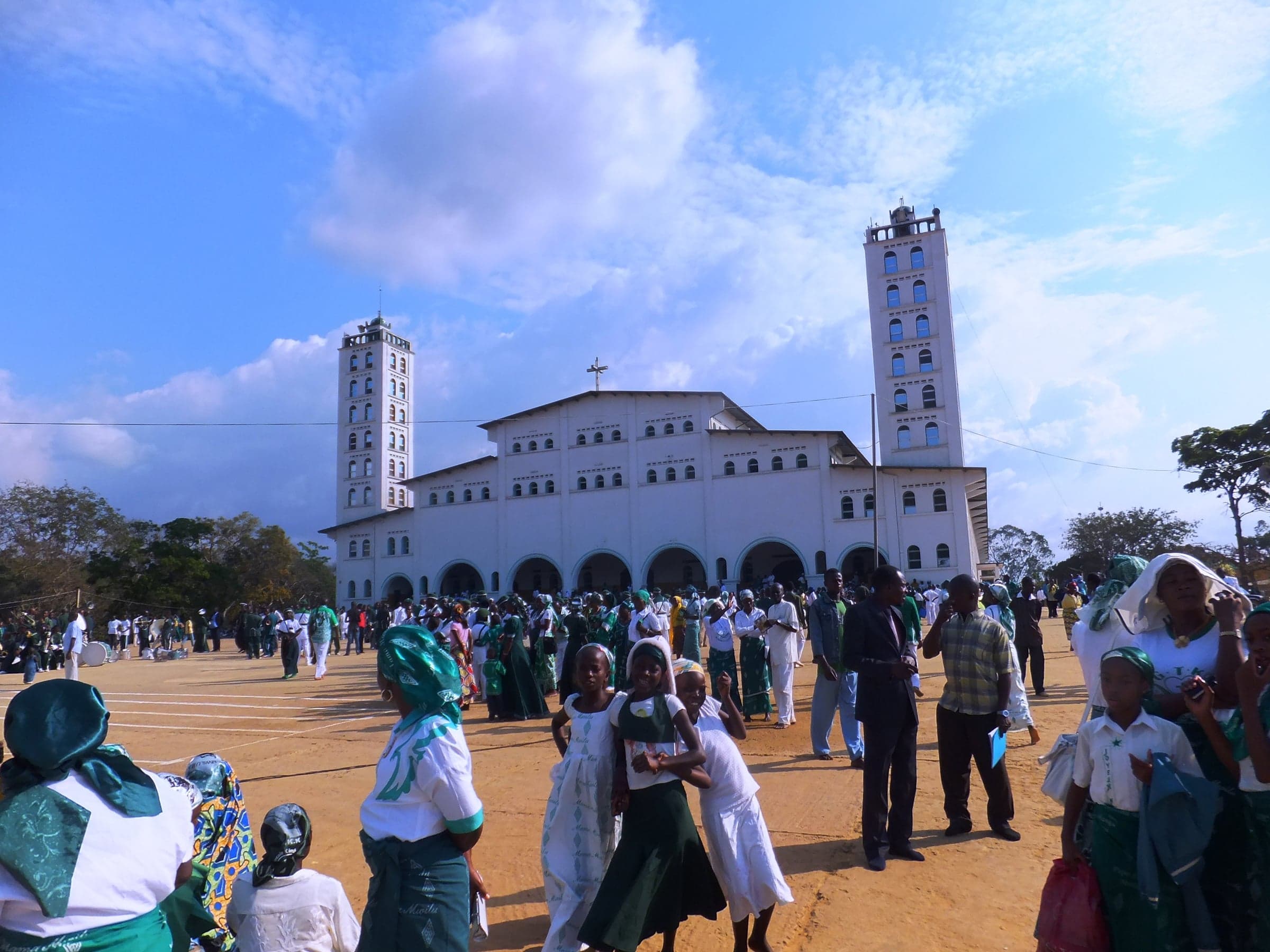
Pandries, Temple de Nkamba, 2013. CC BY-SA 3.0.
1913 to today · The churches · Featured Study
The African Instituted Churches
The Kimbanguist, Aladura and Zionist churches and their kin, from Harris's preaching of 1913 to today.
On 3 October 1921 a Belgian council of war condemned Simon Kimbangu, finding that by posing as God's envoy he had alarmed the African population.
“Caesar’s,” they answered. So Jesus told them, “Give to Caesar what is Caesar’s, and to God what is God’s.”
- Began
- 1913 to 1930, by the dates their first leaders began (probable)
- Bodies
- The Kimbanguist church, The Zion Christian Church, The Christ Apostolic Church, The Cherubim and Seraphim, The Church of the Lord (Aladura)
On 3 October 1921 a Belgian council of war condemned Simon Kimbangu, finding that by posing as God's envoy he had alarmed the African population.
Summary
Africans founded these churches in Africa, most of them between 1913 and 1930. Prophets and praying bands led them, often against colonial courts and mission churches.
- The French expelled the prophet William Wadé Harris in January 1915, eighteen months after he set out from Cape Palmas.
- Revival broke out at Oke-Oye, Ilesa, during a meeting of July 1930.
- The Zion Christian Church dates its birth to 1910, and South African History Online to 1924.
The Texts They Stood On
The texts come from John 11, Psalm 133, Acts 8 and James 5.
Two of these texts were spoken by the churches' own leaders before a court and a commission.
Texts from the churches' trials, worship and beginnings
So they took away the stone. Then Jesus lifted His eyes upward and said, “Father, I thank You that You have heard Me.
Vellut identifies it as the second text Kimbangu answered with at his trial in 1921.
John 11:41BSB
Behold, how good and pleasant it is when brothers live together in harmony!
Bishop B. E. Lekganyane closed his church's submission to the Truth and Reconciliation Commission with Psalm 133, in Sepedi.
Psalm 133:1BSB
So he started out, and on his way he met an Ethiopian eunuch, a court official in charge of the entire treasury of Candace, queen of the Ethiopians. He had gone to Jerusalem to worship,
Luke's Ethiopian official, baptized by Philip later in the chapter, is the first African the New Testament names as baptized.
Acts 8:27BSB
Is any one of you sick? He should call the elders of the church to pray over him and anoint him with oil in the name of the Lord.
James calls the elders to pray over the sick, the practice at stake in the healing debate at Ilesa in 1930.
James 5:14BSB
The African Branch of the Family of Churches
From Harris's departure of 1913 to the council of these churches in 1978.
Africans founded churches across the continent from 1913, and a council of these churches was founded in 1978.
1913 to 1915
- Harris leaves Cape Palmas
- The French expel Harris
1921
- Kimbangu at Nkamba
- Kimbangu's trial
1910 to 1925
- The Zion Christian Church
- The Cherubim and Seraphim at Lagos
1929 to 1930
- The Church of the Lord at Ogere
- The revival at Oke-Oye
1943 to 1959
- The Christ Apostolic Church registered
- The Kimbanguist church recognised
1969 to 1978
- The Kimbanguists in the World Council
- The Organization of African Instituted Churches
Where the witnesses give two years for one founding, both stand.
The other families of the churches stand together with the dates on which each began.
Who named the family, and with which word3 paragraphs
Andrew F. Walls wrote in 1979 that Harold Turner's work of 1967 and a study of 1963 made “independent churches” the common phrase. He credits Bengt Sundkler with telling the Ethiopian churches from the Zionist ones.
John S. Pobee wrote in 2002 that the word “Instituted” marks churches that came into being by the initiative of Africans. The Organization of African Instituted Churches was founded at Cairo in 1978.
C. A. Olowola, glossing Kofi Appiah-Kubi's definition, writes that it “prefers to identify the African Independent Churches as Indigenous African Christian Churches.”
How the Churches Began: Harris, Kimbangu and Lagos
A prophet's preaching, a trial before a council of war and a trance at Corpus Christi.
David A. Shank, writing in 1986, reports that Harris left Cape Palmas on 27 July 1913. The French authorities arrested him, beat him and expelled him in January 1915. Shank gives more than 100,000 baptized in eighteen months, a figure whose counter he does not name.
The Kimbanguist church takes a healing at Nkamba on 6 April 1921 as its founding, as Aurélien Mokoko Gampiot reports it. Jules Chômé, a lawyer who had published Kimbangu's defence, dates his vision to 18 March 1921.
J.-L. Vellut's edition of the sources (2010) dates the trial from 1 to 3 October 1921, before a council of war under Commandant A. de Rossi, which refused the defence the missionaries offered. Vellut notes that the church's official history, by Diangienda Kuntima (1984), takes 29 September 1921 for the first hearing.
On 30 October the Baptist missionary G. Thomas, of the society that had taught Kimbangu, made a deposition. He recorded that “Kimbangu denied at his trial that he had taught his followers not to pay taxes,” citing Jesus' teaching on what is owed to Caesar.
The colonial paper L'Avenir colonial belge, on 16 October, called his trembling in court “pure simulation” and reported the twelve lashes he was given. Chômé records that King Albert commuted the death sentence to forced labour for life at the end of November 1921.
Two dates for the arrest, and two for the death1 paragraph
Chômé gives the arrest as 15 September 1921 and the death as 10 October 1951. Mokoko Gampiot gives 12 September and 12 October, and Jean-Claude Loba Mkole also gives 12 October.
The Cherubim and Seraphim, 19252 paragraphs
Christiana Abiodun went to watch the Catholic procession of Corpus Christi on 18 June 1925 and fell into a trance, by the accounts of the order and of Ebeye Boniface. The order's own site says Moses Orimolade named the band of Seraph on 9 September 1925, while Ebeye writes that Abiodun called on the seraphim that day.
Michael Ogunewu and Deji Ayegboyin say the two founded the order together. The Orimolade line says Orimolade separated her from the order on 8 March 1929 and refused to name her as founding the order with him.
The Truth They Pressed: Prayer and Healing
Praying churches that sought healing from God by prayer.
Harold W. Turner glosses Aladura as the Yoruba word for “praying.”
The Faith Tabernacle leaders met at Ilesa on 9 and 10 July 1930 over the baptism of a man with many wives and over divine healing against drugs like quinine.
Joseph Ayodele Babalola, whose call Olayiwola dates to the night of 25 September 1928, led the meetings that followed. Pastor Adegboyega, in an account Olayiwola quotes, wrote that “suddenly a mighty sweeping revival broke out at Faith Tabernacle Congregation Church at Oke-Oye, Ilesa.”
Three witnesses gave the size of the revival at Oke-Oye, each with his own interest.
| Witness | What he says | His interest |
|---|---|---|
| D. O. Odubanjo, letter of 4 March 1931 | About 100 lepers, 60 blind and 50 lame cured in three weeks | The church's leader |
| The assistant district officer at Ilesa, 1930 | A crowd of hundreds, many lame and blind, and the whole affair orderly | The colonial government |
| The Christ Apostolic Church's memory | About forty thousand at one meeting | The church's own tradition |
Their Own Statements of Faith
The Zion Christian Church's bishop spoke to a commission, and a Kimbanguist theologian wrote on the Trinity.
Bishop B. E. Lekganyane told the Truth and Reconciliation Commission that his church “was born after the Anglo Boer War just before union in 1910.”
He quoted the words Engenas Lekganyane spoke in 1924.
“We are made in the image of God, and if this is true, then I assure you friends that when you enter the kingdom of heaven you will find a God of your colour.”
Léon Nguapitshi Kayongo stated in 2010 the written theology of the Kimbanguist church, whose initials he gives as EJCSK, as Loba Mkole quotes him.
“The EJCSK believes in the Trinity, yet the Trinity is symbolized by Simon Kimbangu's three sons, paths to the Trinitarian God.”
Mokoko Gampiot reports that “popular Kimbanguism holds that Simon Kimbangu is the incarnation of the Holy Spirit; his three sons are the Holy Trinity.”
The Trinity is an essential of the faith. The popular belief that Kimbangu is the Holy Spirit stands outside the confession of one God in three persons, Father, Son and Holy Spirit, which the historic creeds hold.
The Churches Today
Each count with the one who made it, and the claims beside the scholars' figures.
The Church of the Lord claimed over a million members by 2002, and Turner counted never more than 15,000.
| Church | The count | Year | Who counted |
|---|---|---|---|
| The Zion Christian Church | About 120,000 | 1948 | The church itself, in its submission to the commission |
| The Zion Christian Church | Between 2 million and 6 million | The 1990s | The Library of Congress country study of 1996, as South African History Online cites it |
| The Kimbanguist church | 5 million | Claimed by 2002 | The church's own claim, as Pobee reports it |
| The Church of the Lord (Aladura) | Never more than 15,000 | Undated | Harold W. Turner, 1998 |
| The Church of the Lord (Aladura) | Over 1 million | Claimed by 2002 | The church's own claim, as Pobee reports it |
Where the Churches Spread
The record places the churches at Axim, Elisabethville, Ogere, Moria and across Nigeria.
J. E. Casely Hayford met Harris at Axim in July 1914, Shank reports. Kimbangu died a prisoner at Elisabethville, far from Nkamba.
Josiah Oshitelu began a congregation at Ogere in 1929, and the Christ Apostolic Church was registered in Nigeria in May 1943. South African History Online records that the Zion Christian Church moved from Thabakgone to Moria.
Polygamy and the Churches' Judgments
Leaders who kept many wives, and a doctrine the other churches refused.
Shank reports that Harris accepted polygamy. Turner writes of Oshitelu that “although polygamy was forbidden for the ministry, Oshitelu was allowed seven wives.”
Loba Mkole reports that the Protestant Church in the Congo ceased to recognise the Kimbanguist church as Christian in 2002, and that the Catholic Church there suspended its spiritual ecumenism with it in 2004.
Mokoko Gampiot records that the World Council of Churches, which the church had joined in 1969, withdrew its membership on doctrinal grounds in June 2021. The Belgian state, which condemned Kimbangu in 1921, had recognised his church on 24 December 1959.
The Wesleyan general superintendent of the time, a witness from another mission, called the reports from Oke-Oye “grotesquely inaccurate accounts of the operations of Babalola.”
What These Churches Hand On
Andrew Walls, writing in 1979, set these churches inside one history: “In the end, the history of African Christianity will be a single story, in which the missionary period is only an episode.”
Sources
Scripture is the Berean Standard Bible.
- The Holy Bible, Berean Standard Bible (read 2026)
- J.-L. Vellut, ed., Simon Kimbangu 1921: de la prédication à la déportation. Les Sources, volume I (2) (Brussels: Académie royale des sciences d'outre-mer, 2010), the editor's summary and note 153; G. Thomas's deposition of 30 October 1921, page 70, with L'Avenir colonial belge of 16 October 1921 in note 149.
- Jules Chômé, Kimbangu (Simon), Biographie Belge d'Outre-Mer, volume VI (1968), columns 576 to 579.
- Aurélien Mokoko Gampiot, Kimbanguist Church, World Religions and Spirituality Project (30 April 2023)
- Jean-Claude Loba Mkole, Kimbangu, Simon, Dictionary of African Christian Biography (2016), quoting Léon Nguapitshi Kayongo, Cambridge Dictionary of Christianity (2010), page 689.
- David A. Shank, The Legacy of William Wadé Harris, International Bulletin of Missionary Research 10, no. 4 (1986), pages 170 to 176, as the Dictionary of African Christian Biography reprints it.
- Bishop B. E. Lekganyane, the Zion Christian Church's submission to the Truth and Reconciliation Commission, pages 1 to 2 (the year of the hearing not printed in the submission; read 2026)
- South African History Online, Zion Christian Church (ZCC), 16 August 2016, citing Rita M. Byrnes, ed., South Africa: A Country Study (Library of Congress, 1996)
- David O. Olayiwola, Babalola, Joseph Ayodele, Dictionary of African Christian Biography, from J. A. Omoyajowo, ed., Makers of the Church in Nigeria (Lagos, 1995), pages 137 to 149, notes 15 to 21.
- The Eternal Sacred Order of the Cherubim and Seraphim, the history on its home page (undated; read 2026)
- Ebeye Boniface, Abiodun Emmanuel, Christiana, Dictionary of African Christian Biography (2004)
- Michael Ogunewu and Deji Ayegboyin, Abiodun Emmanuel, Christiana (B), Dictionary of African Christian Biography, first in the Journal of African Christian Biography (October 2018)
- Harold W. Turner, Oshitelu, Josiah Olunowo, in Gerald H. Anderson, ed., Biographical Dictionary of Christian Missions (1998)
- John S. Pobee, African Instituted (Independent) Churches, Dictionary of the Ecumenical Movement, revised edition (WCC and Eerdmans, 2002)
- Andrew F. Walls, The Challenge of African Independent Churches, Occasional Bulletin (April 1979), reprinted in Evangelical Review of Theology 4, no. 2 (October 1980), pages 225 and 233.
- Cornelius Abiodun Olowola, An Introduction to Independent African Churches, Africa Journal of Evangelical Theology 3, no. 2, page 22 (the year not printed; read 2026)
Keep Studying
Studies1
Subjects1
People and groups1
Doctrines1
Trials of life1