
Acts 7:55
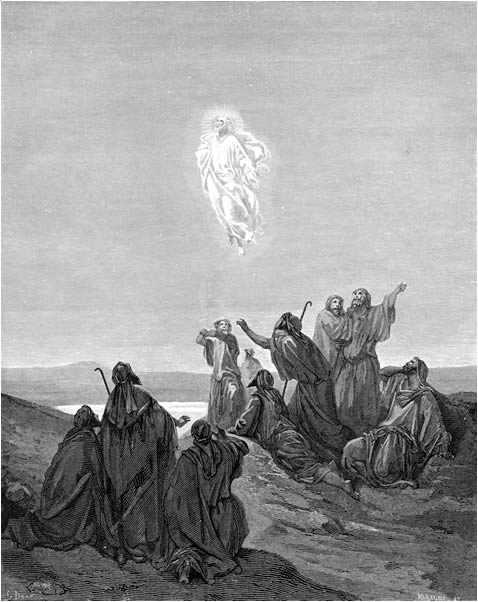
in Acts 7But Stephen, full of the Holy Spirit, looked intently into heaven and saw the glory of God and Jesus standing at the right hand of God.
BSB
The same verse in ASV and KJV ▾
ASV
But he, being full of the Holy Spirit, looked up stedfastly into heaven, and saw the glory of God, and Jesus standing on the right hand of God,
KJV
But he, being full of the Holy Ghost, looked up stedfastly into heaven, and saw the glory of God, and Jesus standing on the right hand of God,
⋯
This verse in Acts 7
Commentary
14 notes on this verseHe is seen by Stephen, at his martyrdom by stoning, still sitting at the right hand of God [Acts 7:55] where He will continue to sit, until the Father shall make His enemies His footstool. [Hebrews 10:12-13] He will come again on the clouds of heaven, just as He appeared when He ascended into heaven. [Acts 1:11]
The record, by era
The Church Fathers4 voices
"He sitteth at the Father's right hand " -not the Father at His own. He is seen by Stephen, at his martyrdom by stoning, still sitting at the right hand of God where He will continue to sit, until the Father shall make His enemies His footstool.
A commentator
Theodoret of CyrusDIALOGUE (DEMONSTRATIONS BY SYLLOGISMS) 11 · Written before 458.
proposed
The divine nature is invisible, but the thrice blessed Stephen said that he saw the Lord, so even after the resurrection the Lord's body is a body, and it was seen by the victorious Stephen, since the divine nature cannot be seen.
And when he said, "I see the heavens opened, they stopped their ears, and ran upon him with one accord." And yet in what respect are these things deserving of accusation? "Upon him," the man who has wrought such miracles, the man who has prevailed over all in speech, the man who can hold such discourse! As if they had got the very thing they wanted, they straightway give full scope to their rage.
He mentions the cause of his angelic appearance: "But he, being full of the Holy Ghost, looked up steadfastly into heaven, and saw the glory of God, and Jesus standing on the right hand of God." And in this manner He appeared to him: that, were it but so, the Jews might receive Him: for since the idea of His sitting at the right hand of God was offensive to them, for the present he brings forward only what relates to His Resurrection. This is the reason also why his face was glorified. For God, being merciful, desired to make their machinations the means of recalling them unto Himself.
The Medieval Church1 voice
We must consider what it means that Mark says: He sits at the right hand of God; while Stephen says: I see the heavens opened, and the Son of man standing at the right hand of God. What does it mean that Mark testifies he is sitting, while Stephen testifies that he saw him standing? But you know, brothers, that sitting belongs to one who judges, while standing belongs to one who fights or helps. Therefore, because our Redeemer, having been taken up into heaven, both now judges all things and at the end comes as judge of all, Mark describes him as sitting after his assumption, because after the glory of his Ascension he will be seen as judge at the end. But Stephen, placed in the labor of struggle, saw him standing whom he had as helper, because in order that Stephen might overcome on earth the unbelief of his persecutors, his grace fought for him from heaven.
8 more voices on this verse
The Puritans and the Awakening3 voices
But he looking steadfastly up to heaven, saw the glory of God - Doubtless he saw such a glorious representation, God miraculously operating on his imagination, as on Ezekiel's, when he sat in his house at Babylon, and saw Jerusalem, and seemed to himself transported thither, chap. viii, 1-4.
1 Then said the high priest, Are these things so? 2 And he said, Men, brethren, and fathers, hearken; The God of glory appeared unto our father Abraham, when he was in Mesopotamia, before he dwelt in Charran, 3 And said unto him, Get thee out of thy country, and from thy kindred, and come into the land which I shall show thee.
quarantine:scripture (2026-07-29) — scripture-overlap:98%@v1-3
But he being full of the Holy Ghost,....
The Nineteenth Century5 voices
A commentator
Albert Barnes1798–1870
Notes, Explanatory and Practical, on the Old and New Testaments (1832-1869)
Full of the Holy Ghost - See the notes on Act 2:4. Looked up stedfastly - Fixed his eyes intently on heaven. Foreseeing his danger, and the effect his speech had produced; seeing that there was no safety in the Great Council of the nation, and no prospect of justice at their hands, he cast his eyes to heaven and sought protection there. When dangers threaten us, our hope of safety lies in heaven. When people threaten our persons, reputation, or lives, it becomes us to fix our eyes on the heavenly world; and we shall not look in vain.
A commentator
Jamieson, Fausset & Brown1802–1910
Commentary Critical and Explanatory on the Whole Bible (1871)
As the sight was witnessed by Stephen alone, the opened heavens are to be viewed as revealed to his bright beaming spirit. and Jesus standing on the right hand of God--Why "standing," and not sitting, the posture in which the glorified Saviour is elsewhere represented?
TRUE Christian zeal will seek to do the highest work of which sanctified humanity is capable. Stephen is first heard of as a distributor of the alms of the Church to needy widows. He exercised what was virtually, if not nominally, the deacon's office. Being grave, and not double-tongued, and holding the mystery of the faith in a good conscience, he was well fitted for his work. Doubtless he used the office of a deacon well, and so purchased to himself a good degree and great boldness in the faith which is in Christ Jesus. Although the burdensome duty of serving tables might well have excused him from other service, we soon find him, full of faith and power, doing great wonders and miracles among the people. And not content with that, we see him defending the faith against a synagogue of subtle philosophical deniers of the Truth of God. These, with their allies, made the valiant deacon the object of their attack, and he at once rose to be an irresistible witness for the Gospel. Stephen the deacon became Stephen the preacher! This holy man not only used such gifts as he had in one department, but having abilities for a more spiritual form of service, he laid them at once upon the altar of Christ. Nor is this all, he had a higher promotion yet—when he had thus become Stephen the wise apologist and brave defender of the faith he did not stop there—he mounted to the highest rank of the Christian army! He gained the peerless dignity, the foremost nobility, the brightest glory—I mean the martyr's name and honor. Stephen the deacon is first Stephen the preacher, and afterwards Stephen, God's faithful and true witness, laying down his life that he may seal his testimony with his blood. Put a man without zeal into the front place and he will gradually recede into his native insignificance, or only linger in the front to be an impediment and a nuisance.
TRUE Christian zeal will seek to do the highest work of which sanctified humanity is capable. Stephen is first heard of as a distributor of the alms of the Church to needy widows. He exercised what was virtually, if not nominally, the deacon's office. Being grave, and not double-tongued, and holding the mystery of the faith in a good conscience, he was well fitted for his work. Doubtless he used the office of a deacon well, and so purchased to himself a good degree and great boldness in the faith which is in Christ Jesus.
Saw the glory of God - The Shekinah, the splendor or manifestation of the Divine Majesty. And Jesus standing on the right hand of God - In his official character, as Mediator between God and man. Stephen had this revelation while in the Sanhedrin; for as yet he had not been forced out of the city. See Act 7:58.
The words behind it
19 Greek wordsEvery Greek word of this verse in the order it stands, with what it means and the door to its own study. The last column counts the times a word stands in the whole Bible: the rarer the word, the more the places it appears belong together.
| Greek | Sound | Meaning | Word study | In the Bible |
|---|---|---|---|---|
| Ὑπάρχων | huparchon | He being | G5225 → | 60 times |
| δὲ | de | however | G1161 → | 2765 times |
| πλήρης | pleres | full | G4134 → | 16 times |
| πνεύματος | pneumatos | of [the] Spirit | G4151 → | 378 times |
| ἁγίου, | hagiou | Holy, | G40 → | 220 times |
| ἀτενίσας | atenisas | having looked intently | G816 → | 14 times |
| εἰς | eis | into | G1519 → | 1755 times |
| τὸν | ton | <the> | G3588 → | 19766 times |
| οὐρανὸν | ouranon | heaven | G3772 → | 272 times |
| εἶδεν | eiden | saw | G1492 → | 374 times |
| δόξαν | doxan | [the] glory | G1391 → | 165 times |
| θεοῦ | theou | of God | G2316 → | 1312 times |
| καὶ | kai | and | G2532 → | 9120 times |
| Ἰησοῦν | iesoun | Jesus | G2424 → | 908 times |
| ἑστῶτα | hestota | already standing | G2476 → | 153 times |
| ἐκ | ek | at | G1537 → | 911 times |
| δεξιῶν | dexion | [the] right hand | G1188 → | 53 times |
| τοῦ | tou | <the> | G3588 → | 19766 times |
| θεοῦ | theou | of God | G2316 → | 1312 times |
ὙπάρχωνHe being
huparchonG5225 →60 times
δὲhowever
deG1161 →2765 times
πλήρηςfull
pleresG4134 →16 times
πνεύματοςof [the] Spirit
pneumatosG4151 →378 times
ἁγίου,Holy,
hagiouG40 →220 times
ἀτενίσαςhaving looked intently
atenisasG816 →14 times
εἰςinto
eisG1519 →1755 times
τὸν<the>
tonG3588 →19766 times
οὐρανὸνheaven
ouranonG3772 →272 times
εἶδενsaw
eidenG1492 →374 times
δόξαν[the] glory
doxanG1391 →165 times
θεοῦof God
theouG2316 →1312 times
καὶand
kaiG2532 →9120 times
ἸησοῦνJesus
iesounG2424 →908 times
ἑστῶταalready standing
hestotaG2476 →153 times
ἐκat
ekG1537 →911 times
δεξιῶν[the] right hand
dexionG1188 →53 times
τοῦ<the>
touG3588 →19766 times
θεοῦof God
theouG2316 →1312 times
A shaded row is a word that stands 400 times or fewer in the Bible.
The walk
8 stopsEach card is a verse this one points to, and under it the verses that one points to in turn. Where several paths arrive at the same place, that place is listed first: the text keeps returning to it.
Through
Hebrews 1:3The Son is the radiance of God’s glory and the exact representation of His nature, upholding all things by His powerful word. After He had provided purification for sins, He sat down at the…
it leads to
- Colossians 1:15–17
The Son is the image of the invisible God, the firstborn over all creation.
- Revelation 4:11
“Worthy are You, our Lord and God, to receive glory and honor and power, for You created all things; by Your will they exist and came to be.”
- Colossians 1:15–17
Through
2 Corinthians 4:6For God, who said, “Let light shine out of darkness,” made His light shine in our hearts to give us the light of the knowledge of the glory of God in the face of…
it leads to
- Isaiah 60:2
For behold, darkness covers the earth, and thick darkness is over the peoples; but the LORD will rise upon you, and His glory will appear over you.
- Genesis 1:3
And God said, “Let there be light,” and there was light.
- 1 Peter 2:9
But you are a chosen people, a royal priesthood, a holy nation, a people for God’s own possession, to proclaim the virtues of Him who called you out of darkness into His marvelous light.
- 2 Peter 1:19
We also have the word of the prophets as confirmed beyond doubt. And you will do well to pay attention to it, as to a lamp shining in a dark place, until the day…
- Ephesians 5:8
For you were once darkness, but now you are light in the Lord. Walk as children of light,
- Isaiah 60:2
Through
Hebrews 8:1The point of what we are saying is this: We do have such a high priest, who sat down at the right hand of the throne of the Majesty in heaven,
it leads to
- Hebrews 1:3
The Son is the radiance of God’s glory and the exact representation of His nature, upholding all things by His powerful word. After He had provided purification for sins, He sat down at the…
Reached by 2 separate paths from here.
- Hebrews 1:3
Where this verse is studied
About Acts
Who and where
1 name in this verse with a page on the site.
This page draws on 12 works. Open the list of works
This page draws on Adam Clarke, Commentary on the Bible; Albert Barnes, Notes, Explanatory and Practical, on the Old and New Testaments (1832-1869); Charles Spurgeon, The Metropolitan Tabernacle Pulpit, Sermon No. 740: “Stephen's Martyrdom” (lightly modernized text, CCEL edition); Gregory the Dialogist, Forty Gospel Homilies, Homily 29; Jamieson, Fausset & Brown, Commentary Critical and Explanatory on the Whole Bible; John Chrysostom, Homily on Acts 18; John Gill, Exposition of the New Testament (1746-1748); John Wesley, Explanatory Notes upon the New Testament; Matthew Henry, Commentary on the Whole Bible; Tertullian, Against Praxeas, Chapter 30; Tertullian, Against Praxeas and Theodoret of Cyrus, DIALOGUE (DEMONSTRATIONS BY SYLLOGISMS) 11.