
Acts 7 to Revelation 2 · Subject · The Cloud of Witnesses
The Witnesses of the First Century
Stephen, the two Jameses, Antipas, Peter, Paul and the Christians of Rome under Nero, each named in a record of the first or second century.
Every witness of the first century whose death is recorded by name is named by a Christian, a Jew or a Roman who lived within a lifetime of it.
I know where you live, where the throne of Satan sits. Yet you have held fast to My name and have not denied your faith in Me, even in the day when My faithful witness Antipas was killed among you, where Satan dwells.
- Books
- Acts, Revelation
- Hold in memory
- Revelation 2:13
Summary
Acts and Revelation name the first Christians who died for Christ. Three writers outside the Bible add more.
- Acts tells of Stephen, stoned at Jerusalem, and of James, whom Herod killed.
- Revelation names Antipas, who was killed for his faith.
- Tacitus says Nero killed Christians after the great fire at Rome.
- Josephus says the Jewish council had James, the brother of Jesus, stoned.
- A letter from the church at Rome names Peter and Paul.
The Witnesses the New Testament Names
Acts names two of the dead and Revelation names a third.
The New Testament records the deaths of three believers by name. Luke tells two of them in Acts, and the risen Christ names the third in His letter to the church at Pergamum.
Acts
While they were stoning him, Stephen appealed, “Lord Jesus, receive my spirit.” Falling on his knees, he cried out in a loud voice, “Lord, do not hold this sin against them.” And when he had said this, he fell asleep.
Stephen prays to the Lord Jesus as he dies, and Acts gives no year for his death.
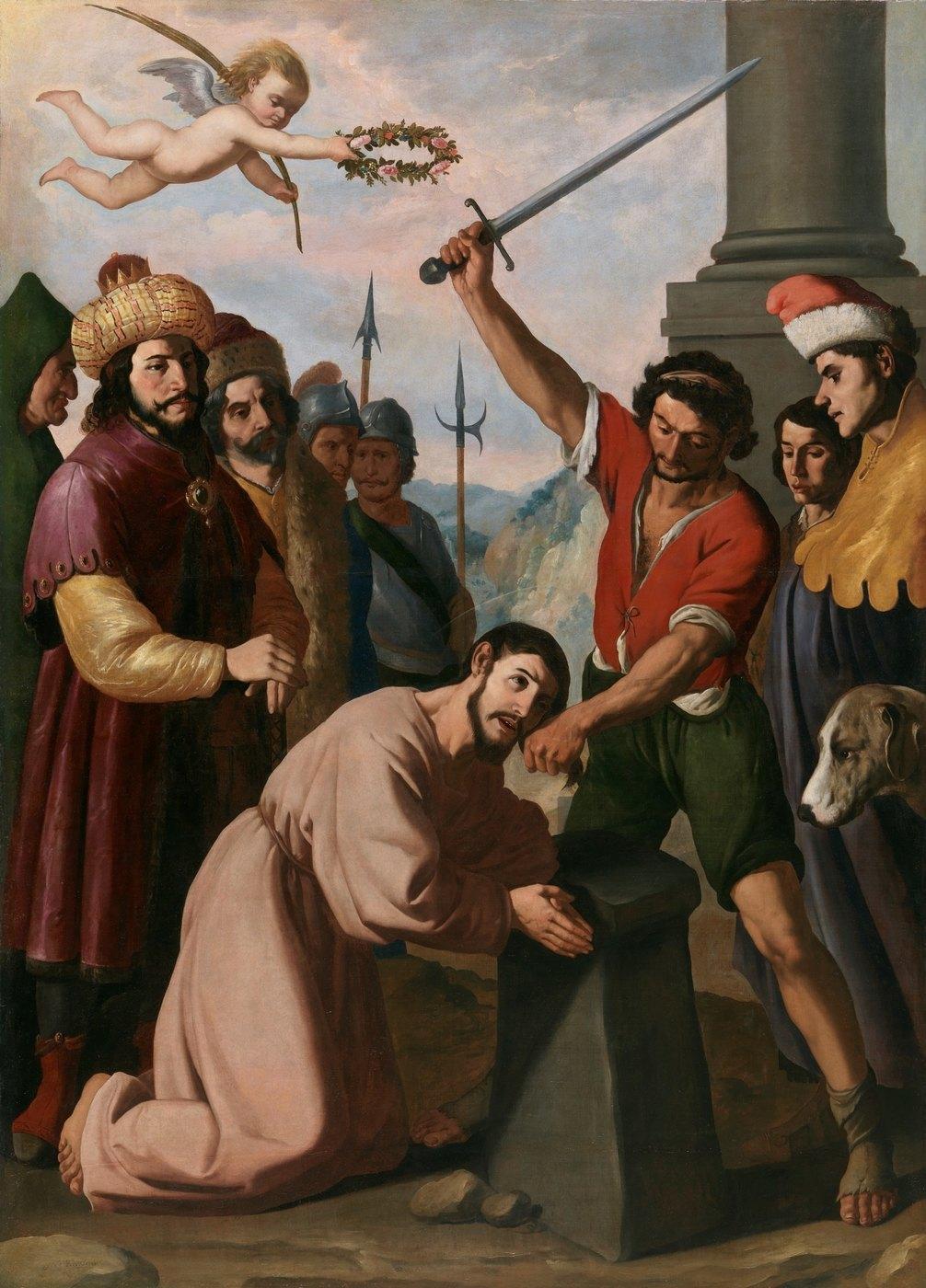
About that time, King Herod reached out to harm some who belonged to the church. He had James, the brother of John, put to death with the sword.
Luke gives one sentence to the death of James, the first of the Twelve whose death the New Testament records.
The Dead of the First Century
Each row names a death and the record that fixes it.
Six deaths of the first century are named in records of that century or the next, from Stephen at Jerusalem to Peter and Paul at Rome.
- Stephen is stoned outside JerusalemActs gives no yearActs 7:54 to 60
- James, the brother of John, is put to the swordUnder Herod, who dies in the same chapterActs 12:1 to 2 and Acts 12:23
- James, the brother of Jesus, is stoned at JerusalemAfter Festus died, before Albinus arrivedJosephus, Antiquities 20.200, as Eusebius quotes it
- Christians are put to death at RomeAfter the fire of AD 64Tacitus, Annals 15.44
- Peter and Paul are named among the deadThe letter gives no year for either1 Clement 5
- Antipas is killed at PergamumBefore Revelation was writtenRevelation 2:13
The witnesses run in the order the sources allow, and only the deaths at Rome after the fire carry a year.
What Tacitus, Josephus and Clement Add
A Roman, a Jew and the church at Rome each wrote of the century's dead.
Tacitus, a Roman senator and historian, tells of the fire in his Annals. He says Nero laid the blame for the fire of Rome on the Christians and had a great number of them put to death. He thought them criminals who deserved their punishment, and he still records that the crowd came to pity them.
Josephus, a Jewish historian of the same century, tells of the high priest Ananus, who called the Sanhedrin while the province had no governor. Festus had died and Albinus was still on the road. Ananus brought James before the council, and it condemned him. Eusebius copied the passage into his Church History in the fourth century.
1 Clement is a letter of the church at Rome to the church at Corinth. In its fifth chapter it sets the two apostles before its readers as the greatest and most righteous pillars of the church. It names no place for the first of them and says the second died under the prefects.
Eusebius, writing in the fourth century, places both deaths at Rome under Nero. He draws this from two older writers, Gaius, a member of the church at Rome, and Dionysius, bishop of Corinth.
In Their Own Words
Clement of Rome (died 99)
The First Epistle of Clement to the Corinthians, chapter 5
The church at Rome named Peter and Paul among the martyrs of its own generation.
“Peter, through unrighteous envy, endured not one or two, but numerous labours and when he had at length suffered martyrdom, departed to the place of glory due to him.”
Early Church
About this saying1 paragraph
The letter dates from near the end of the first century, within a lifetime of the deaths it names.
Clement of Rome
The First Epistle of Clement to the Corinthians, chapter 6
The same letter joined a great multitude to the apostles.
“To these men who spent their lives in the practice of holiness, there is to be added a great multitude of the elect, who, having through envy endured many indignities and tortures, furnished us with a most excellent example. Through envy, those women, the Danaids and Dircæ, being persecuted, after they had suffered terrible and unspeakable torments, finished the course of their faith with stedfastness, and though weak in body, received a noble reward.”
Early Church
About this saying1 paragraph
In the next chapter, written in the same first-century letter, the church at Rome turns from the apostles to the many who died with them.
Tertullian (died 220)
Apology, chapter 5
A Christian of Carthage named Nero as the first persecutor.
“Consult your histories; you will there find that Nero was the first who assailed with the imperial sword the Christian sect, making progress then especially at Rome.”
Early Church
About this saying1 paragraph
Tertullian wrote his defence of the Christians at Carthage at the turn of the third century and pointed the Romans to their own histories.
Tacitus
Annals 15.44
A Roman historian recorded the crowd's pity for the Christians Nero killed.
“Hence, even for criminals who deserved extreme and exemplary punishment, there arose a feeling of compassion; for it was not, as it seemed, for the public good, but to glut one man's cruelty, that they were being destroyed.”
Roman historian
About this saying1 paragraph
Tacitus wrote this early in the second century, about fifty years after the fire.
Where Historians Differ on Nero
Brent Shaw doubts that Nero's killings happened as Tacitus tells them, and Christopher Jones answers him.
In 2015 Brent Shaw argued in the Journal of Roman Studies that Tacitus read the persecution of his own day back into Nero's reign. In 2017 Christopher Jones answered him in New Testament Studies and held that the account stands. The page on the fire of Rome sets out both arguments with their sources.
Tertullian and Eusebius both name Nero as the first emperor to put Christians to death, and 1 Clement speaks of a great multitude who suffered at Rome in the apostles' generation.
Books to Read Next
The Ante-Nicene Fathers, volume 1
Alexander Roberts and James Donaldson, editors · 1885
It holds 1 Clement in English, with the chapters on Peter, Paul and the multitude who died with them.
Free at the Christian Classics Ethereal LibraryThe Church History of Eusebius
Eusebius of Caesarea, translated by Arthur Cushman McGiffert · 1890
In book 2 Eusebius quotes Josephus on James and names his witnesses to the deaths of Peter and Paul.
Free at the Christian Classics Ethereal LibraryWhat the First Century Left
The first century left a short list of names and one large unnamed company at Rome. The second century kept their memory and began to write down the deaths of its own witnesses at length.
Sources
Scripture is the Berean Standard Bible.
- The Holy Bible, Berean Standard Bible (read 2026)
- 1 Clement 5 and 6, The Ante-Nicene Fathers, volume 1 (1885)
- Eusebius, Church History 2.23, quoting Josephus, Antiquities 20.200, and 2.25, translated by A. C. McGiffert, Nicene and Post-Nicene Fathers, second series, volume 1 (1890)
- Tertullian, Apology 5, The Ante-Nicene Fathers, volume 3 (1885)
- Brent D. Shaw, The Myth of the Neronian Persecution, Journal of Roman Studies 105 (2015); Christopher P. Jones, The Historicity of the Neronian Persecution, New Testament Studies 63 (2017), each from its abstract.
Keep Studying
People and groups1
Subjects10