
Lyon and Vienne, AD 177 · Story · Featured Study
The Martyrs of Lyon, 177
Their letter to Asia and Phrygia tells the arrests, the trials and the arena, and the mercy the confessors showed the fallen.
A deacon of Vienne would not tell the court his name, his city or whether he was slave or free.
- Where
- Lyon, Vienne
- Who
- Blandina, Pothinus, Sanctus, Attalus, Irenaeus
- When
- AD 177 (probable)
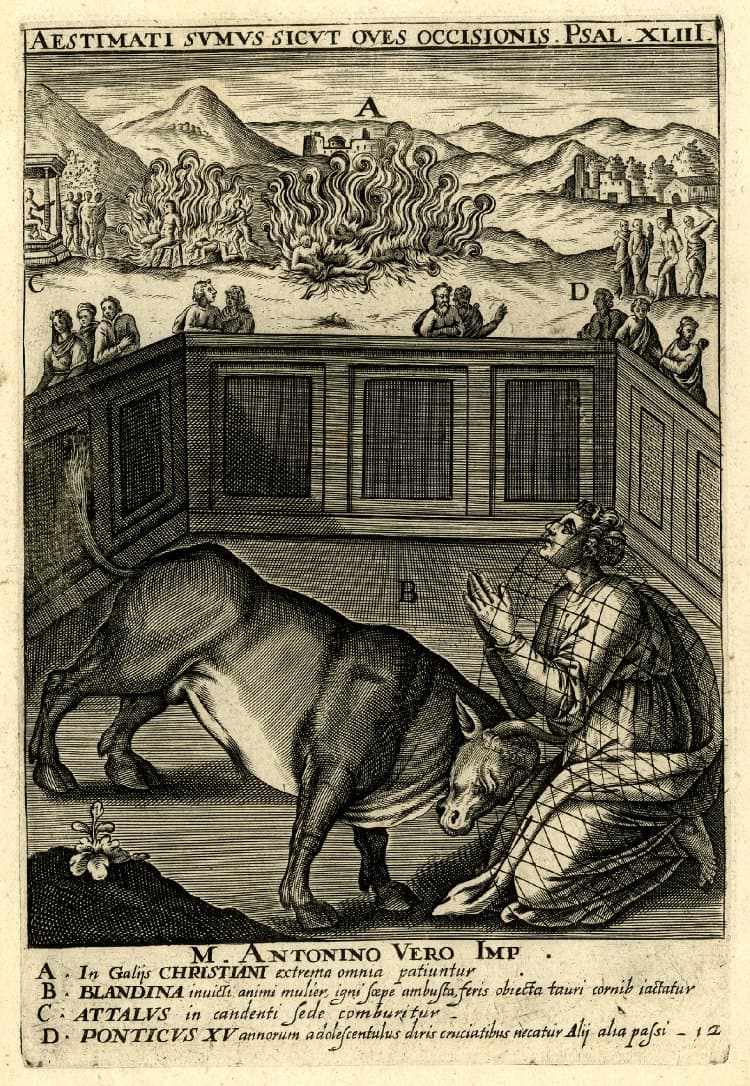
Jan van Haelbeck, Blandina, Attalus and Ponticus, 1600 to 1620. Public domain.
I consider that our present sufferings are not comparable to the glory that will be revealed in us.
Summary
In 177 the Christians of Lyon and Vienne were put to death for the name of Christ. The two cities stood on the Rhone in Gaul. Their churches wrote down what their members suffered, and Eusebius kept much of the letter in his Church History.
- Caesar ordered that those who confessed should die and that those who denied should go free.
- The letter as Eusebius keeps it gives no total of the dead, and the number is not known.
- Irenaeus carried the confessors' letter to Rome and later became bishop of Lyon.
The Texts the Letter Reads
The churches told their story through the words of Jesus, Paul, Luke and John.
The letter reads the persecution through Scripture from its first lines. It sets the sufferings of the confessors beside Paul's word on the glory to come, and the crowd's rage beside a saying of Jesus in John.
The world rages and God chooses
They will put you out of the synagogues. In fact, a time is coming when anyone who kills you will think he is offering a service to God.
The letter says this word of the Lord was fulfilled when the slanders of the slaves were believed.
John 16:2BSB
But God chose the foolish things of the world to shame the wise; God chose the weak things of the world to shame the strong.
The letter says Christ showed in Blandina that what men despise is of great glory with God.
Christ is the faithful witness
Who, existing in the form of God, did not consider equality with God something to be grasped,
The confessors refused the name of witness in imitation of Christ, who did not grasp at equality with God.
Falling on his knees, he cried out in a loud voice, “Lord, do not hold this sin against them.” And when he had said this, he fell asleep.
The letter calls Stephen the perfect witness and holds up his prayer for those who stoned him.
Acts 7:60BSB
Both of them were righteous in the sight of God, walking blamelessly in all the commandments and decrees of the Lord.
The letter compares the young Vettius Epagathus to Zacharias, who walked blameless in the commandments.
Luke 1:6BSB
Let the unrighteous continue to be unrighteous, and the vile continue to be vile; let the righteous continue to practice righteousness, and the holy continue to be holy.”
The letter cites it of the persecutors who raged at the bodies, and McGiffert notes it as Scripture cited at that date.
Philippians 2:6, Acts 7:60, Luke 1:6, Revelation 22:11
Who the Letter Names
Nine people of the persecution stand in the letter, each with what it says of them.
The letter names its people by who they were.
| Name | Who the letter says they were | Where the letter tells of them |
|---|---|---|
| Vettius Epagathus | A young man of distinction in the church | Church History 5.1.9 to 5.1.10 |
| Sanctus | The deacon from Vienne | Church History 5.1.17, 5.1.20 to 5.1.24 and 5.1.37 to 5.1.40 |
| Maturus | A late convert | Church History 5.1.17 and 5.1.37 to 5.1.40 |
| Attalus | A native of Pergamum, where he had been a pillar of the church | Church History 5.1.17, 5.1.43 to 5.1.44 and 5.1.50 to 5.1.52 |
| Blandina | A slave woman whose mistress was also accused | Church History 5.1.17 to 5.1.19, 5.1.41 to 5.1.42 and 5.1.53 to 5.1.56 |
| Biblias | A woman who had denied at first | Church History 5.1.25 to 5.1.26 |
| Pothinus | The bishop of Lyon, more than ninety years old | Church History 5.1.29 to 5.1.31 |
| Alexander | A Phrygian physician long settled in Gaul | Church History 5.1.49 to 5.1.51 |
| Ponticus | A boy about fifteen years old | Church History 5.1.53 to 5.1.54 |
Pothinus, Alexander, Ponticus
From the Forum to the Amphitheatre
The persecution moved from the crowd to the governor's court and then to the games.
The crowd moved first. Christians were shut out "from houses and baths and markets", then struck, robbed and stoned, and the city's officers examined them in the forum and held them in prison until the governor came.
Before the governor, Vettius Epagathus asked to testify for his brethren, and the governor only asked whether he too was a Christian. He said that he was and was taken among the accused.
About ten of the accused denied the faith. Pagan servants of the Christians, seized and afraid of the torture, then charged their masters with eating children and with incest, and the city turned against the church.
The torturers worked hardest on four of them, Sanctus, Maturus, Attalus and Blandina. Blandina's torturers took turns from morning to evening and owned at last that they could do nothing more to her.
Sanctus gave in Latin the one answer to every question, that he was a Christian. Asked who the God of the Christians was, the bishop Pothinus told the governor that he would know it if he were worthy, and he died in prison two days after the crowd beat him.
The prison1 paragraph
Many died of suffocation in the prison, the letter says, and some who had been tortured nearly to death lived on and encouraged the rest. Those who were young and newly arrested could not bear the confinement and died there.
On a day set apart for the beasts, Maturus, Sanctus, Blandina and Attalus were led into the amphitheatre. Maturus and Sanctus ran the gauntlet, faced the beasts and died at last in the iron chair.
Blandina was hung on a stake "as if hanging on a cross", and the letter says the others saw in her the one who was crucified for them. No beast touched her, and she was taken back to prison.
Attalus was led round the arena behind a tablet reading "This is Attalus the Christian". The governor learned that Attalus was a Roman citizen, returned him to prison and wrote to Caesar about all the prisoners.
When Caesar's answer came, the governor beheaded the citizens at the festival and sent the rest to the beasts.
On the last day of the contests Blandina was brought in with Ponticus, who died first while she encouraged him. She was scourged, set on the roasting seat, wrapped in a net and thrown before a bull, and the letter reports that the pagans themselves said no woman among them had endured so much.
The bodies were left unburied under guard for six days, then burned and swept into the Rhone. The letter gives the reason in the persecutors' own words, "Now let us see if they will rise again".
The Letter and the Historian Who Kept It
The churches wrote the account, and Eusebius copied the parts he chose.
The account opens as a letter from "the servants of Christ residing at Vienne and Lyons, in Gaul" to the believers of Asia and Phrygia. Eusebius copies it in his Church History, book 5, chapters 1 and 2, and he passes over parts of it, writing "having related some other matters" and "after certain other words".
Eusebius dates the persecution to "the seventeenth year of the Emperor Antoninus Verus". McGiffert, his translator, reads that as 177 under Marcus Aurelius, answers the Chronicle's earlier year and finds no reason to doubt the date.
Eusebius says the letter held the catalogue of the witnesses and the number of the confessors still living, and he declined to copy them.
McGiffert renders the Greek word for martyr as "witness" throughout the letter, "its original significance", because the letter uses it of all who suffered, whether they died or not.
The same confessors wrote to Eleutherus, bishop of Rome, and commended to him the presbyter who carried their letter as "zealous for the covenant of Christ".
Irenaeus had been a boy in lower Asia, and in a letter Eusebius keeps he told Florinus that he could still describe the place where Polycarp sat as he taught.
The Confessors Received the Fallen
The letter tells how those who had denied came back, and how the confessors treated them.
Those who denied gained nothing by it at first, the letter says, because they were held in prison as murderers while the confessors were held only as Christians. The confessors went out to the arena rejoicing, and the deniers went out downcast.
While the prisoners waited for Caesar's answer, many who had denied were restored and learned to confess. Examined again as men about to be set free, they confessed, and the letter says they were added to the order of the witnesses.
The letter says the confessors "defended all, but accused none" and "absolved all, but bound none". They prayed for those who had tortured them, and the letter asks how much more they would pray for their own brethren.
How the Key Verse Was Taught
Three writers of three centuries on the verse the letter set over the sufferers.
Augustine of Hippo (died 430)
LETTER 111
Augustine of Hippo wrote that God's servants who suffer with the wicked still have their own comfort.
“The humble and holy servants of God who suffer doubly when temporal evils befall them, because they suffer with the wicked as well as at their hands, have their own consolations and the hope of the world to come.”
on Romans 8:18Patristic
In Their Own Words
The witnesses of Lyon as their churches reported them, in McGiffert's English.
Blandina (died 177)
the letter of the churches of Vienne and Lyons, in Eusebius, Church History, 5.1.19
Nothing vile done by us
“I am a Christian, and there is nothing vile done by us.”
Martyr
About this saying1 paragraph
Blandina said this under torture in 177, as the letter of the churches reports her words.
Biblias (died 177)
the letter of the churches of Vienne and Lyons, in Eusebius, Church History, 5.1.26
The blood of animals
“could those eat children who do not think it lawful to taste the blood even of irrational animals?”
Martyr
About this saying1 paragraph
Biblias said this in 177 when her torturers pressed her to slander the church.
Attalus (died 177)
the letter of the churches of Vienne and Lyons, in Eusebius, Church History, 5.1.52
We do not devour men
“Lo! this which ye do is devouring men; but we do not devour men; nor do any other wicked thing.”
Martyr
About this saying1 paragraph
Attalus spoke to the crowd in Latin from the iron seat in 177, as the fumes rose from his body.
The churches of Vienne and Lyons
the letter of the churches of Vienne and Lyons, in Eusebius, Church History, 5.2.3
Lowly and humble confessors
“They are already witnesses whom Christ has deemed worthy to be taken up in their confession, having sealed their testimony by their departure; but we are lowly and humble confessors.”
Church
About this saying1 paragraph
The confessors of Lyon said this in 177 when their brethren called them witnesses, as their churches' letter reports it.
Attalus, The churches of Vienne and Lyons
When It Happened, and Whether the Letter Is Genuine
One historian of 1912 argued for a century later, and Harnack and Allard answered him.
McGiffert wrote in 1890 that the letter's "genuineness is in fact questioned by no one so far as I am aware".
In 1912 James Westfall Thompson argued in the American Journal of Theology that "the account in Eusebius is of third-century, not second-century, origin". He concluded that "the persecution cannot be attributed to the reign of Marcus Aurelius" and offered the reign of Aurelian, 270 to 275.
Harnack and Paul Allard answered him in 1913, as Thompson's own reply of that year reports. In that reply Thompson narrowed his claim to say the persecution cannot be certainly ascribed to that reign.
Thompson granted that the argument from silence was "a very heavy one", and he held that if he was right the early tradition that Marcus Aurelius was no persecutor was the truer history. Against him, Eusebius, who held the whole letter, set it under Eleutherus of Rome, whom McGiffert, after Lipsius, has made bishop no earlier than 174.
Books to Read Next
The Church History of Eusebius
Eusebius of Caesarea, translated by Arthur Cushman McGiffert · 1890
Book 5, chapters 1 to 5, holds the letter and the notes on its date.
Read Eusebius free at CCELThe Alleged Persecution of the Christians at Lyons in 177
James Westfall Thompson · 1912
Thompson sets out the case for a later date at full length.
Read Thompson free at the Internet ArchiveWhat the Churches of Lyon Left
The churches of Lyon and Vienne wrote so that the believers of Asia would know what their members had suffered for Christ, and Eusebius copied their letter so that every later church could read it.
Sources
Scripture is the Berean Standard Bible.
- The Holy Bible, Berean Standard Bible (read 2026)
- Eusebius, Church History, translated by Arthur Cushman McGiffert, Nicene and Post-Nicene Fathers, second series, volume 1 (1890), book 5, the introduction and chapters 1, 2, 4, 5 and 20, with McGiffert's notes 1347, 1351, 1352 and 1386.
- James Westfall Thompson, "The Alleged Persecution of the Christians at Lyons in 177", American Journal of Theology 16 (1912), pages 359 to 384.
- James Westfall Thompson, "The Alleged Persecution of the Christians at Lyons in 177: A Reply to Certain Criticisms", American Journal of Theology 17 (1913), pages 249 to 250.
Keep Studying
Studies5
People and groups6