
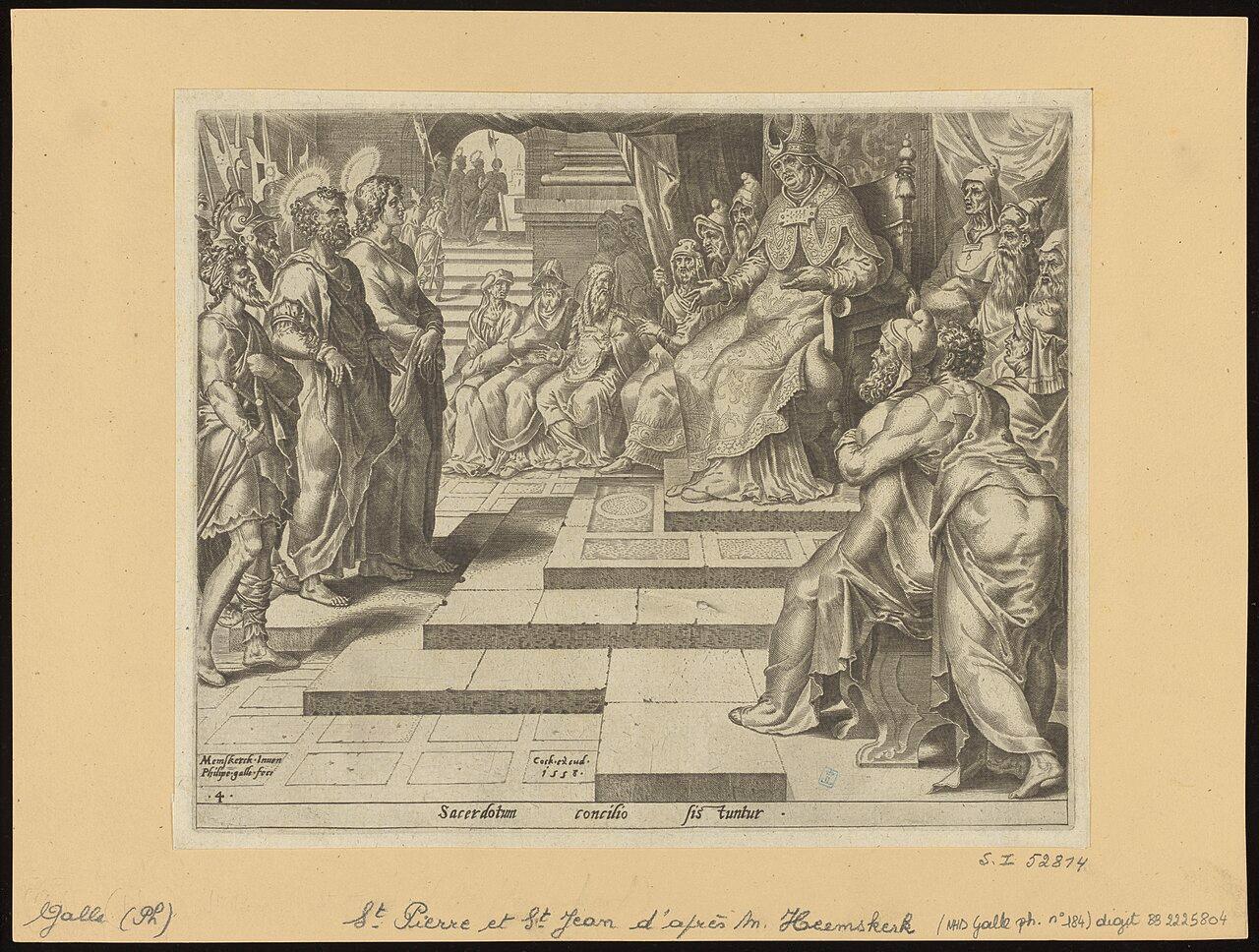
Philip Galle after Maarten van Heemskerck, Peter and John before the High Priest and the Council, 1558. Public domain.
Matthew 10 to AD 203 · Subject · Featured Study
The Spirit and the Persecuted
Jesus promised that the Spirit would speak through His followers on trial, and the persecuted of the first centuries reported that promise kept.
- Books
- Matthew, Acts, 2 Timothy
- Hold in memory
- Matthew 10:20, Acts 6:10
Jesus told His disciples not to prepare their defence before kings, because the Spirit of their Father would speak through them.
For it will not be you speaking, but the Spirit of your Father speaking through you.
Summary
Three Gospels record that Jesus promised the Spirit would give His followers words before governors. Acts records two trials at Jerusalem where the promise was kept. Two writings from the second and third centuries report the same help.
- Peter and Stephen were tried before the council at Jerusalem, and Acts records the promise kept.
- The church at Smyrna wrote that the Lord was with its martyrs in their torments.
- Perpetua died at Carthage in 203. Her prison diary tells of the Spirit's direction and of a vision.
- Each account is given as its writer's own report.
The Promise and Its Keeping
The promise stands in three Gospels, and Acts and Paul record it kept.
Matthew, Mark and Luke each record the promise in a warning of trials to come. Luke then shows it kept in Acts, and Paul wrote of it from his own trial.
The promise
But beware of men; for they will hand you over to their councils and flog you in their synagogues. On My account, you will be brought before governors and kings as witnesses to them and to the Gentiles. But when they hand you over, do not worry about how to respond or what to say. In that hour you will be given what to say.
Jesus gave this warning to the twelve as He sent them out, and the next verse names the Spirit as the speaker.
But when they arrest you and hand you over, do not worry beforehand what to say. Instead, speak whatever you are given at that time, for it will not be you speaking, but the Holy Spirit.
Mark records the promise in Jesus' teaching on the last things, with the Holy Spirit named as the speaker.
Mark 13:11BSB
But before all this, they will seize you and persecute you. On account of My name they will deliver you to the synagogues and prisons, and they will bring you before kings and governors. This will be your opportunity to serve as witnesses. So make up your mind not to worry beforehand how to defend yourselves. For I will give you speech and wisdom that none of your adversaries will be able to resist or contradict.
Luke places the promise in Jesus' words on the temple's coming fall, and calls the trial an opportunity to serve as witnesses.
The promise kept
Then Peter, filled with the Holy Spirit, said to them, “Rulers and elders of the people!
Peter and John had been seized for teaching the people and proclaiming the resurrection in Jesus.
Acts 4:8BSB
but they could not stand up to his wisdom or the Spirit by whom he spoke.
Men of the Synagogue of the Freedmen argued with Stephen before they brought him to the council.
Acts 6:10BSB
But Stephen, full of the Holy Spirit, looked intently into heaven and saw the glory of God and Jesus standing at the right hand of God.
Stephen saw this at the end of his defence before the council, as his hearers rushed at him.
Acts 7:55BSB
At my first defense, no one stood with me, but everyone deserted me. May it not be charged against them. But the Lord stood by me and strengthened me, so that through me the message would be fully proclaimed, and all the Gentiles would hear it. So I was delivered from the mouth of the lion.
Paul writes that at his first defence everyone deserted him, and the Lord stood by him.
Acts 4:8, Acts 6:10, Acts 7:55, 2 Timothy 4:16 to 17
The Reports
Scripture, a church's letter and a prisoner's own writing each carry part of the account.
The reports of the Spirit's help before judges run from Acts to Perpetua's diary of 203, each from a named source.
| What was reported | Who reported it | The record | The kind of record |
|---|---|---|---|
| Peter spoke to the council filled with the Holy Spirit | Luke | Acts 4:8 | Scripture |
| Stephen's opponents could not resist the Spirit by whom he spoke | Luke | Acts 6:10 | Scripture |
| The Lord stood by Paul at his first defence | Paul | 2 Timothy 4:17 | Scripture, in the first person |
| The Lord stood by the martyrs of Smyrna and communed with them | The church at Smyrna | The Martyrdom of Polycarp, chapter II | A church's letter |
| The Spirit directed Perpetua at her baptism, and she reports that she asked for a vision and saw one | Perpetua | Her diary, chapter I | A prisoner's own writing |
The Preface's Claim for the Spirit
The editor of the Passion held that the Spirit's gifts continue in the church.
The unnamed editor who finished Perpetua's account opens it by quoting Joel's promise that God would pour out His Spirit on all flesh. He calls the visions and the other powers of the Holy Spirit gifts of the church. He says they were written down so that no one would think God's grace was given only to the ancients.
The editors' notes in the Ante-Nicene Fathers mark the quotation from Joel as a sign of Montanist leanings in the writer. They cite Routh for the same view.
MannaFest's tradition, Wesleyan-Pentecostal, reads the preface's claim as the promise of Acts 2 kept in the church. It holds that the Spirit gives His gifts and speaks through the persecuted today.
What the Church at Smyrna Reported
The letter on Polycarp's death reports a voice in the stadium and the bishop's calm at his trial.
As Polycarp entered the stadium, the letter reports, a voice from heaven said, “Be strong, and show thyself a man, O Polycarp!” The brethren who were present heard the voice. No one saw who spoke.
While he answered the proconsul, the letter says, Polycarp was “filled with confidence and joy, and his countenance was full of grace.”
In Their Own Words
Perpetua of Carthage (182 to 203)
The Passion of the Holy Martyrs Perpetua and Felicitas, her own narrative, chapter I, section 2
The Spirit told her what to seek in baptism.
“In that same interval of a few days we were baptized, and to me the Spirit prescribed that in the water of baptism nothing else was to be sought for bodily endurance.”
Early church martyr
About this saying1 paragraph
Perpetua, about twenty-two and arrested as a catechumen, wrote this of her baptism in prison in 203.
Perpetua of Carthage
The Passion of the Holy Martyrs Perpetua and Felicitas, her own narrative, chapter I, section 3
She asked for a vision and received one.
“And I, who knew that I was privileged to converse with the Lord, whose kindnesses I had found to be so great, boldly promised him, and said, ‘To-morrow I will tell you.’ And I asked, and this was what was shown me.”
Early church martyr
About this saying1 paragraph
In the same weeks of 203 her brother asked her to seek a vision of whether she would suffer or be freed.
Cyprian (died 258)
Treatise XI Exhortation to Martyrdom Addressed to Fortunatus
Cyprian wrote that God opens the mouth of His confessor.
“Nor is it difficult for God to open the mouth of a man devoted to Himself, and to inspire constancy and confidence in speech to His confessor; since in the book of Numbers He made even a she-ass to speak against the prophet Balaam.”
on 2 Peter 2:16Patristic
About this saying1 paragraph
Cyprian wrote this in 258 in his Exhortation to Martyrdom, where he likens the speech God gives His confessor to the speech He gave Balaam's donkey.
How Far the Promise Reaches
Commentators differ on whether Matthew 10:20 was given to the apostles alone or to every believer on trial.
Albert Barnes read the verse as a full promise of inspiration to the apostles, poor and unknown men who would stand before kings.
Adam Clarke held that the promise was literally fulfilled to the first preachers. He also held that in a measure the Holy Spirit still enables true disciples to speak.
Gregory the Great applied the promise to every weak member of Christ who comes to the contest. Jerome applied it to every believer brought before judges for Christ's sake.
“‘For I will give you a mouth and wisdom, which all your adversaries will not be able to resist or contradict.’ As if He openly says to His weakening members: Do not be terrified, do not be afraid; you approach the contest, but I fight; you utter the words, but I am the one who speaks.”
Gregory the Dialogist · Forty Gospel Homilies, Homily 35 · on Matthew 10:20Patristic
“(Verse 19, 20.) But when they hand you over, do not worry about how or what you should say. For it will be given to you in that hour what you should say. For it is not you who speak, but the Spirit of your Father who speaks in you. Above, he said: For they will hand you over to councils and flog you in their synagogues, and you will be brought before governors and kings for my sake. Therefore, when we are brought before judges because of Christ, we should only offer our own will for Christ.”
Jerome · Commentary on Matthew · on Matthew 10:19 to 20Patristic
The strongest objection to the narrow reading is the record itself. Stephen was no apostle, and the church at Smyrna reported the Lord standing by ordinary believers. The strongest objection to the wide reading is that Matthew 10 is addressed to the twelve as they are sent out.
Books to Read Next
The Passion of the Holy Martyrs Perpetua and Felicitas
Perpetua and an unnamed editor, translated by R. E. Wallis · 1885
It holds the Passion of Perpetua and Felicitas with its preface on the Spirit, from page 699.
Free at the Christian Classics Ethereal LibraryThe Martyrdom of Polycarp
The church at Smyrna, in the Ante-Nicene Fathers, volume 1 · 1885
It gives the trial and death of Polycarp, pages 39 to 44.
Free at the Christian Classics Ethereal LibraryThe Promise Stands
The Gospels give the promise and Acts gives its first keeping. The letter from Smyrna and Perpetua's diary carry the record into the second and third centuries, each in its writer's own words.
Sources
Scripture is the Berean Standard Bible.
- The Holy Bible, Berean Standard Bible (read 2026)
- The Martyrdom of Polycarp, Ante-Nicene Fathers, volume 1 (originally printed 1885), pages 39 to 44, chapters II, IX and XII.
- The Passion of the Holy Martyrs Perpetua and Felicitas, translated by R. E. Wallis, Ante-Nicene Fathers, volume 3 (1885), the preface with the editors' notes 8974 to 8976, and chapter I, pages 699 to 700.
- Albert Barnes, Notes, Explanatory and Practical (1832 to 1869), on Matthew 10:19.
- Adam Clarke, Commentary on the Bible (1832), on Matthew 10:20.
- Jerome, Commentary on Matthew, on Matthew 10:19 to 20.
- Gregory the Great, Forty Gospel Homilies, Homily 35.
- Cyprian, Treatise XI, Exhortation to Martyrdom, Addressed to Fortunatus (258)
Keep Studying
People and groups2
Trials of life1
Doctrines1
Church history2