
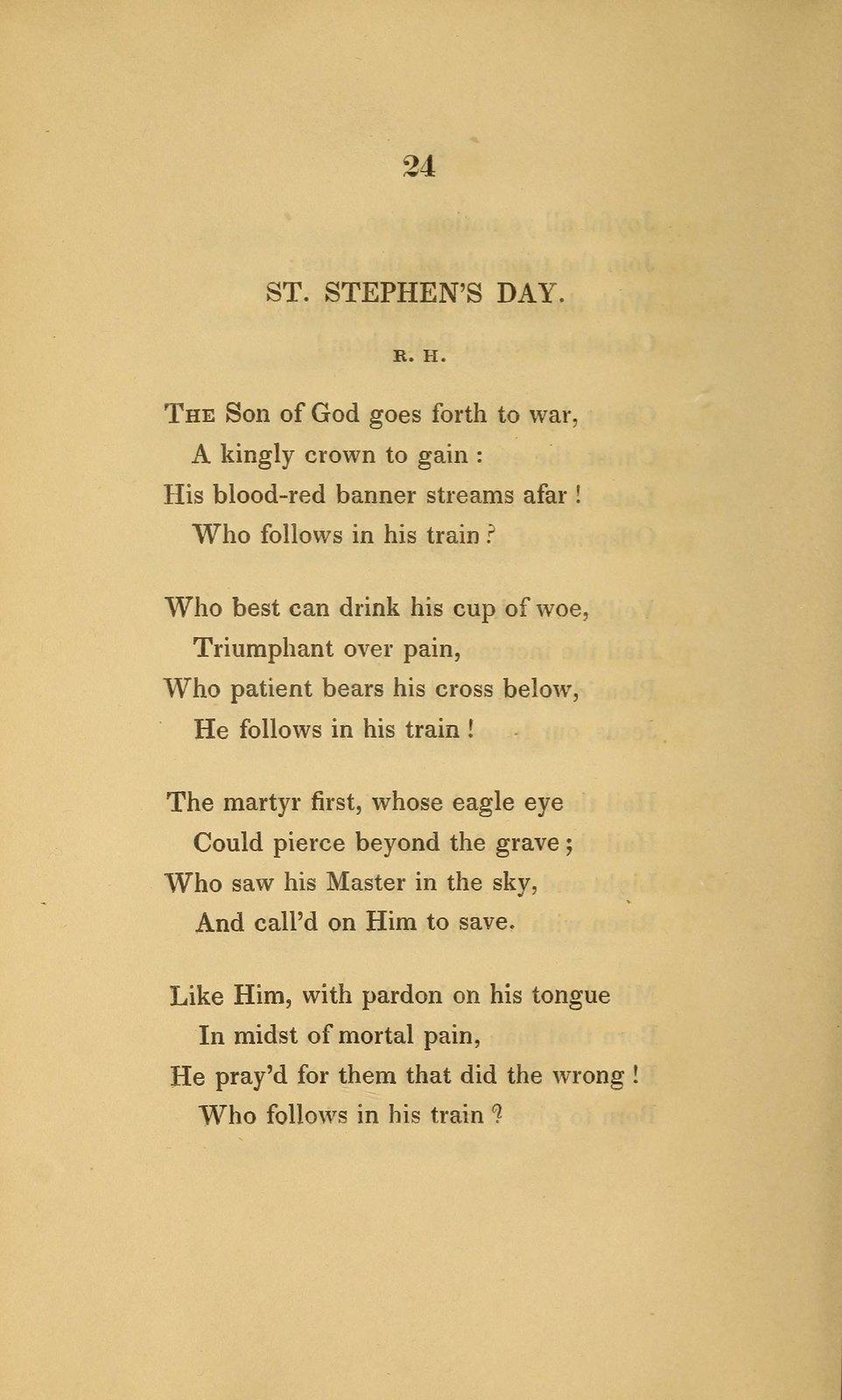
Reginald Heber, The Son of God Goes Forth to War, 1827. Public domain.
The Te Deum to For All the Saints · Subject · Featured Study
Hymns of the Martyrs
Nineteenth-century English hymnbooks added new songs on the noble army the old morning hymn names.
The Te Deum names the martyrs among those who praise God, after the apostles and the prophets.
“Sir,” I answered, “you know.” So he replied, “These are the ones who have come out of the great tribulation; they have washed their robes and made them white in the blood of the Lamb.
“Sir,” I answered, “you know.” So he replied, “These are the ones who have come out of the great tribulation; they have washed their robes and made them white in the blood of the Lamb.
- Books
- Acts, Revelation, Matthew
- Hold in memory
- Acts 7:59 to 60, Revelation 7:14
Summary
The churches have sung of their martyrs from the early centuries to the parish hymnbooks of Victorian England.
- Julian's dictionary of 1907 dates the Te Deum's use in the West from the early 500s.
- Julian holds that no one can name the Te Deum's author.
- Heber, Faber and How each wrote an English hymn on the martyrs and saints.
- Faber's hymn came to stand in Catholic and Unitarian hymnbooks in two texts.
The Verses the Martyr Hymns Sing
The martyr hymns use words close to Acts, Revelation, Matthew and Hebrews.
Heber wrote his hymn for St. Stephen's Day, and its third and fourth stanzas follow the account of Stephen's death in Acts. The other martyr hymns sing in words close to the verses below.
The first martyr
While they were stoning him, Stephen appealed, “Lord Jesus, receive my spirit.” Falling on his knees, he cried out in a loud voice, “Lord, do not hold this sin against them.” And when he had said this, he fell asleep.
Heber's fourth stanza tells of the martyr who prayed for those who did the wrong, as Stephen does here.
The army of martyrs
Do not be afraid of those who kill the body but cannot kill the soul. Instead, fear the One who can destroy both soul and body in hell.
Hedge's English of Luther's hymn says the body they may kill, in words close to these.
Still others endured mocking and flogging, and even chains and imprisonment. They were stoned, they were sawed in two, they were put to death by the sword. They went around in sheepskins and goatskins, destitute, oppressed, and mistreated. The world was not worthy of them. They wandered in deserts and mountains, and hid in caves and holes in the ground.
Hebrews tells of chains, prisons and the sword, the things Faber's first two stanzas name.
Matthew 10:28, Hebrews 11:36 to 38
From the Morning Hymn to For All the Saints
The dated steps run from the Te Deum's first known use to How's hymn on the saints.
The martyr hymns on this page span about thirteen centuries, from the Te Deum to How's hymn.
- The Te Deum in use in the WestFrom the beginning of the sixth centuryJulian, Dictionary of Hymnology, 1907, page 1119
- Luther's Ein feste Burg in print at Wittenberg1529Julian, Dictionary of Hymnology, 1907, the article Ein feste Burg
- Heber's The Son of God Goes Forth to War1827The first printing's title page
- Faber's Faith of Our Fathers1849The first printing's title page
- Hedge's English of Luther's hymn and his change to Faber1853The hymnbook's title page
- How's For All the Saints1864Julian, Dictionary of Hymnology, 1907, page 380
A timeline of dated steps, each row naming the record that fixes its date.
Who Wrote the Morning Hymn
A tradition gives the Te Deum to Ambrose and Augustine, and Julian finds no early witness for it.
Three accounts of who wrote the Te Deum, and what Julian's dictionary says of each.
| The account | What Julian says of it |
|---|---|
| Ambrose and Augustine sang it in turn at Augustine's baptism in 387 | The story rests on a passage in the Chronicon of Dacius, about 550, which Julian holds spurious, and Augustine's Confessions are silent on it. |
| Nicetas of Remesiana wrote it | Dom G. Morin first named Nicetas as the author in 1894. |
| It was gathered from older pieces in the fifth century, perhaps at Lerins | Julian's article on Ambrose calls the hymn essentially a compilation and gives this view to Merati. |
Julian's long article on the hymn ends its section on authorship by calling it impossible to fix.
The Te Deum and Luther's Hymn
The Prayer Book's English of the Te Deum speaks of the martyrs, and Luther's hymn of what a believer gives up.
Julian calls the Te Deum the most famous hymn of the Western Church outside the Bible. He writes that it was first a Sunday hymn at mattins, sung before the lesson from the Gospel.
In the English of the Book of Common Prayer the hymn names the apostles and the prophets, then the martyrs.
The site's page on A Mighty Fortress gives Luther's hymn, its history and its English versions.
Three English Hymns by Heber, Faber and How
Heber and How were bishops of the Church of England, and Faber was a Catholic priest.
Reginald Heber was born at Malpas in 1783, became Bishop of Calcutta in 1823 and died at Trichinopoly in 1826. His Hymns were published in London in 1827, after his death, and The Son of God Goes Forth to War stands on page 17 under St. Stephen's Day.
The hymn runs to eight stanzas of four lines. After Christ and the first martyr it names the twelve apostles, then a noble army of men and boys, the matron and the maid, around the Saviour's throne.
Frederick William Faber was born at Calverley in Yorkshire in 1814 and died in 1863, a priest of the Oratory of St. Philip Neri in London. He printed Faith of Our Fathers in his Jesus and Mary, or Catholic Hymns, in 1849.
Julian records that it was the first of two hymns, one for England and one for Ireland. Its fathers are chained in prisons dark, and still in heart and conscience free.
William Walsham How was born at Shrewsbury in 1823 and became Bishop of Wakefield in 1888. His hymn on the saints was first printed in 1864 in Earl Nelson's Hymns for Saints' Days, in eleven stanzas of three lines with an Alleluia after each.
Julian writes that it then passed into nearly every hymnal of importance in Great Britain. The opening most hymnals print, For All the Saints, is How's own revised reading.
In Their Own Words
Martin Luther (1483 to 1546)
A mighty fortress is our God, in Hymns for the Church of Christ, ed. F. H. Hedge and F. D. Huntington, number 852, the fourth stanza, lines 5 to 9
Hedge's English of Luther lets goods and kindred go.
“Let goods and kindred go, This mortal life also; The body they may kill, God's truth abideth still, His kingdom is for ever.”
Other
About this saying1 paragraph
Hedge printed this English of Luther's last stanza at Boston in 1853.
Reginald Heber (1783 to 1826)
The Son of God goes forth to war, St. Stephen's Day, in Hymns, Written and Adapted to the Weekly Church Service of the Year, page 17, the first stanza
Heber's hymn asks who follows in Christ's train.
“The Son of God goes forth to war, A kingly crown to gain: His blood-red banner streams afar! Who follows in his train?”
Church of England
About this saying1 paragraph
Heber's first stanza, printed in 1827, sets Christ at the head of an army and asks who follows Him.
Frederick William Faber (1814 to 1863)
Faith of our Fathers, number XXIX, in Jesus and Mary, or Catholic Hymns, page 133, the first stanza
Faber's fathers were chained in prisons dark.
“Faith of our Fathers! living still In spite of dungeon, fire, and sword: Oh how our hearts beat high with joy Whene'er we hear that glorious word: Faith of our Fathers! Holy Faith! We will be true to thee till death!”
Roman Catholic
About this saying1 paragraph
Faber printed this first stanza and its refrain in 1849.
The Te Deum
Te Deum Laudamus, in the Order for Morning Prayer, The Book of Common Prayer, Morning Prayer, Te Deum Laudamus, verses 7 to 9
The morning hymn sets the martyrs after the apostles and the prophets.
“The glorious company of the Apostles: praise thee. The goodly fellowship of the Prophets: praise thee. The noble army of Martyrs: praise thee.”
Western liturgy
About this saying1 paragraph
The Book of Common Prayer, in its Scottish printing of 1912, gives these lines of the sixth-century hymn.
Faber's Hymn in Two Churches
Faber asked for Mary's prayers in his third stanza, and a Unitarian hymnbook changed the line.
Julian quotes both forms of the stanza's opening, Faber's own and the one Unitarian editors made for their hymnbook.
Julian writes that with this change the hymn was sung by Unitarians on the one hand and by Roman Catholics on the other. He saw in it how in hymnody, as in other things, extremes meet.
The two texts stand in print side by side, and each church sang its own.
The table sets Faber's own opening of his third stanza beside the Boston hymnbook's change.
| The printing | The first two lines of the third stanza |
|---|---|
| Faber's own, 1849 | Faith of our Fathers! Mary's prayers / Shall win our country back to thee. |
| Hedge and Huntington's change, 1853, number 455 | Faith of our Fathers! Good men's prayers / Shall win our country all to thee. |
Books to Read Next
A Dictionary of Hymnology
John Julian · 1907
Julian gives the first printing of each martyr hymn.
Free at the Internet Archive, volume 1Hymns, Written and Adapted to the Weekly Church Service of the Year
Reginald Heber · 1827
It is the first printing of Heber's hymn for St. Stephen's Day.
Free at the Internet ArchiveJesus and Mary, or Catholic Hymns
Frederick William Faber · 1849
It is the first printing of Faith of Our Fathers.
Free at the Internet ArchiveHymns for the Church of Christ
Frederic Henry Hedge and Frederic Dan Huntington · 1853
It prints Hedge's English of Luther's hymn and the altered text of Faber's.
Free at the Internet ArchiveWhat the Martyr Hymns Handed On
The Te Deum set the martyrs in the church's praise, and the parish hymnbooks of the nineteenth century gave them songs of their own.
Sources
Scripture is the Berean Standard Bible.
- The Holy Bible, Berean Standard Bible (read 2026)
- John Julian, A Dictionary of Hymnology, second revised edition with new supplement (London: John Murray, 1907), volume 1 pages 56, 362, 380, 503 and 540, and volume 2 pages 1119 to 1134 and 1157.
- The Book of Common Prayer (Edinburgh: Cambridge University Press, the Scottish printing approved November 1912), Morning Prayer, Te Deum Laudamus.
- Reginald Heber, Hymns, Written and Adapted to the Weekly Church Service of the Year (London: John Murray, 1827), St. Stephen's Day, pages 17 to 19.
- Frederick William Faber, Jesus and Mary, or Catholic Hymns (London: James Burns, 1849), number XXIX, pages 133 to 134.
- John Julian, A Dictionary of Hymnology (London: John Murray, 1907), volume 1, the article Ein feste Burg ist unser Gott.
- F. H. Hedge and F. D. Huntington, eds., Hymns for the Church of Christ (Boston: Crosby, Nichols, 1853), numbers 455 and 852.
Keep Studying
Doctrines1
Go further1
Church history5
Trials of life1