
Smithfield to Canterbury · Story · Featured Study
The English Martyrs Under Mary
England burned Protestants for heresy under Mary I, and John Foxe's book keeps their record.
John Rogers was told on the morning of 4 February 1555 to prepare himself for the fire, and Foxe calls him the first of Mary's martyrs.
- When
- 4 February 1555 to 10 November 1558
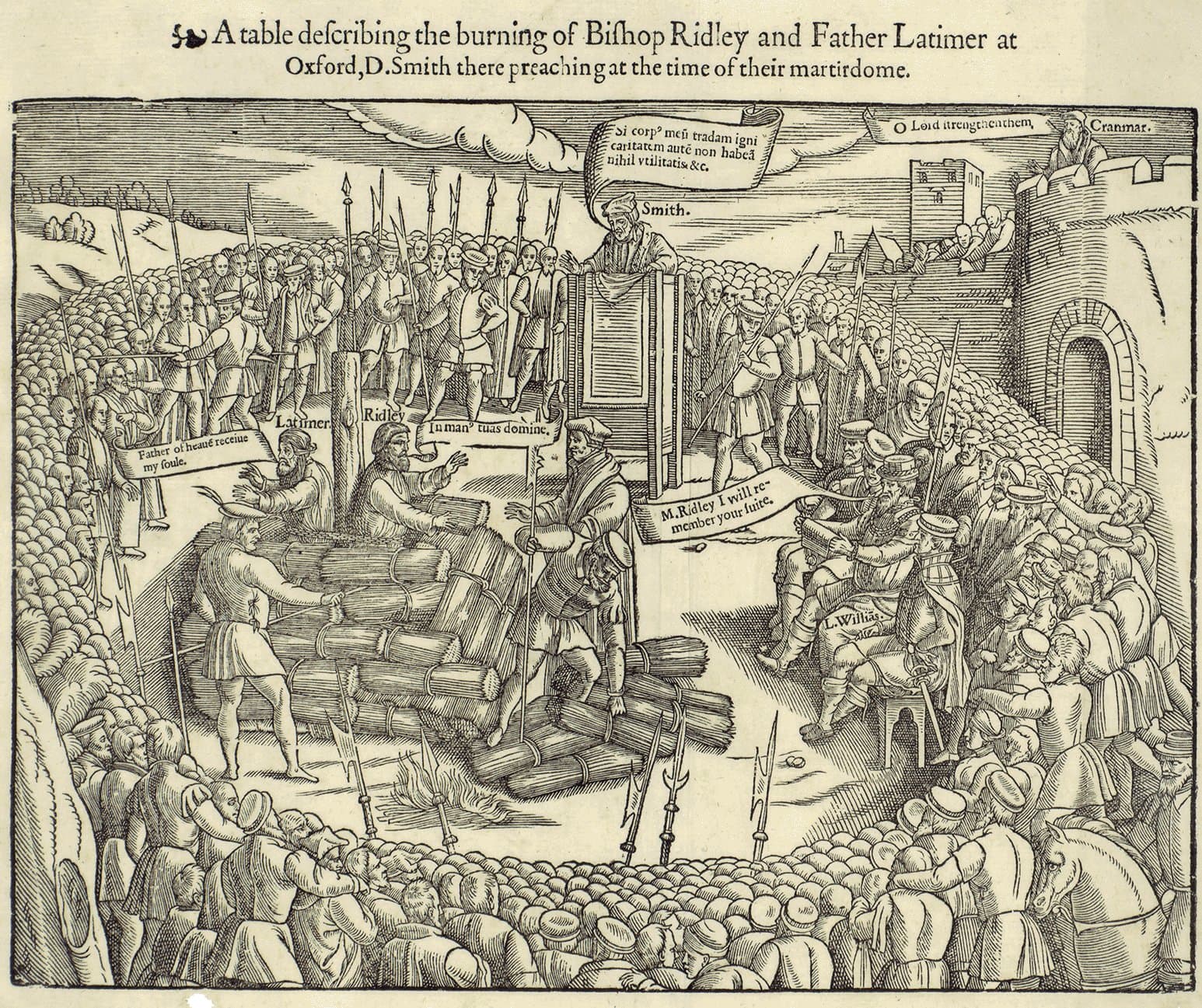
Foxe's woodcut, the burning of Ridley and Latimer at Oxford, 1563. Public domain.
While they were stoning him, Stephen appealed, “Lord Jesus, receive my spirit.”
Summary
About 280 Protestants were burned in England for their faith under Mary I. Parliament had revived the old heresy laws. John Foxe gathered their trials and deaths, and his book is the main record.
- Speed counts five bishops among the burned.
- By his tally twenty-six wives and twenty widows were burned.
- Mary died on 17 November 1558.
The Verses in the Record of the Burnings
Foxe records the Scripture the martyrs prayed and wrote, and the text preached against them.
Foxe records Scripture in the martyrs' mouths, Cranmer using “the words of Stephen” in the fire.
Have mercy on me, O God, according to Your loving devotion; according to Your great compassion, blot out my transgressions.Foxe says Rogers said the psalm Miserere on the way to Smithfield, and Taylor said it in English at the stake; it opens with these words.
For it is time for judgment to begin with the family of God; and if it begins with us, what will the outcome be for those who disobey the gospel of God?Rogers quoted this warning of Peter in a writing Foxe prints.
Into Your hands I commit my spirit; You have redeemed me, O LORD, God of truth.Ridley cried out in Latin the words Foxe prints as In manus tuas, Domine, commendo spiritum meum.
If I give all I possess to the poor and exult in the surrender of my body, but have not love, I gain nothing.Foxe's second edition says the preacher Smith took these words of Paul as his text before the fire was lit.
Psalm 31:5, 1 Corinthians 13:3
How Many Were Burned
The tallies were made by different men from different reports.
Each count was made in its own way, so no two agree.
| Counter | Count | Method |
|---|---|---|
| Lord Burghley, Execution of Justice in England, 1583 | Near 400 | Counted every death by prison, torment, famine and fire |
| A paper among Burghley's manuscripts, printed by Strype | 288 | The burned by year and county |
| Bishop Burnet, as Strype reports him | 284 | The burned by year, over four years |
| John Speed, as Strype reports him | 277 | The burned by rank and calling |
| Cooper's chronicle, as Strype reports it | 233 for three years | The burned in the first three years |
| Thurston's encyclopedia article | 277 | No method given |
Strype, who printed most of these tallies in 1721, wrote that “the exact number I perceive is not known.”
From the Absolution to the Last Fires
The heresy laws returned in January, and the burnings began within three weeks.
Parliament met on 12 November 1554 and revived the old statutes against heretics. The Act says they “shall from the twentieth day of January next coming be revived.”
Cardinal Pole, the pope's legate, absolved the kingdom and received it back into the Roman church. King Philip's letter, dated 30 November, says it was done “this day, which is the feast of St. Andrew.”
On Monday 4 February John Rogers was led from Newgate to Smithfield. Foxe writes that a pardon was brought to the stake if he would recant, and he refused it.
Laurence Saunders was burned in the park outside Coventry on 8 February. On 9 February John Hooper, bishop of Worcester and Gloucester, was burned at Gloucester, before a crowd Foxe puts at seven thousand.
The same day Rowland Taylor was burned on Aldham Common by Hadleigh. Foxe writes that he told the people he had come “to seal it with my blood.”
On 16 October Nicholas Ridley and Hugh Latimer were burned together at Oxford, “in the ditch over against Balliol-college.” Cranmer, who had been archbishop of Canterbury, was burned there on 21 March 1556.
At St. Mary's church Cranmer renounced the recantations he had signed. At the stake, Foxe writes, he put his right hand into the flame, “that all men might see his hand burned before his body was touched.”
The Venetian ambassador's letter of 24 March reports the same act, so a second witness stands beside Foxe.
The last were five at Canterbury on 10 November, “burnt about six days before the death of queen Mary.”
Foxe as the Witness, and the Other Side
Foxe's book is the main record, and a Catholic writer weighs the burnings otherwise.
Foxe's book is a Protestant martyrology, and Foxe knew Latimer in person, as the variorum's editors note. His book went through four editions in his lifetime, in 1563, 1570, 1576 and 1583, and they differ.
Herbert Thurston, a Catholic writer, judged in 1910 that no “vindictive thirst for blood” drove the burnings and laid them to Mary's “conscientious but misguided zeal for the peace of the Church.”
He also charged that Cranmer, Latimer and Ridley “had had a principal hand” in burnings for religion under Henry VIII and Edward VI. Pollard grants Foxe's boast that under Edward only Joan Bocher and George van Parris died for religion.
Catholics died for their faith in England in the same century, Thomas More on 6 July 1535 under Henry VIII and Edmund Campion under Elizabeth, as Pollen's article lists them.
What Foxe's First Edition Leaves Unsaid
Latimer's most famous words stand in a later edition.
Foxe's edition of 1570 prints Latimer's words to Ridley. The edition of 1563, at the pages on either side of the fire, has Ridley comforting Latimer, “bee of good hearte brother.”
So the words cannot be shown in print before that edition, fifteen years after the burning.
How the Key Verse Was Taught
Three writers of three centuries taught Stephen's prayer.
John Chrysostom (died 407)
Homilies on the Acts of the Apostles, Homily 18, on Acts 7:59
From the early church, a homily on Acts.
“This is meant to show them that he is not perishing, and to teach them.”
Patristic
John Wesley (1703 to 1791)
Explanatory Notes upon the New Testament, on Acts 7:59
From the Methodist revival, two centuries after Cranmer.
“such a solemn prayer to Christ, in which a departing soul is thus committed into his hands, is such an act of worship, as no good man could have paid to a mere creature”
Evangelical
Albert Barnes (1798 to 1870)
Notes, Explanatory and Practical, on the Old and New Testaments, on Acts 7:59
From a nineteenth-century commentary on the whole Bible.
“That is, he was engaged ‘in prayer’ to the Lord Jesus.”
Presbyterian
In Their Own Words
Foxe reports these five sayings of the martyrs, each named here with its edition.
John Rogers (died 1555)
in John Foxe, Acts and Monuments, the story of John Rogers, volume 6, page 611
Sealed with blood
“That which I have preached I will seal with my blood.”
Marian martyr
About this saying1 paragraph
John Rogers answered the sheriff on the way to Smithfield on 4 February 1555, as Cattley's edition of Foxe gives it in 1838.
Laurence Saunders (died 1555)
in John Foxe, Acts and Monuments, the story of Laurence Saunders, volume 6, page 628
Welcome the cross
“Welcome the cross of Christ! welcome everlasting life!”
Marian martyr
About this saying1 paragraph
Laurence Saunders kissed the stake at Coventry on 8 February 1555, Foxe writes, in Cattley's edition of 1838.
Rowland Taylor (died 1555)
in John Foxe, Acts and Monuments, the story of Rowland Taylor, volume 6, page 698
Even at home
“Thanked be God, I am even at home”
Marian martyr
About this saying1 paragraph
Rowland Taylor came to Aldham Common on 9 February 1555 and was told the crowd had come to look upon him, as Cattley's edition of 1838 gives it.
Hugh Latimer (1487 to 1555)
in John Foxe, Actes and Monuments, book 11, the death of Ridley and Latimer, page 1937
Such a candle
“Be of good comfort M. Ridley, and play the man: we shall this day lyght such a candle by Gods grace in England, as (I trust) shall neuer be put out.”
English Reformation
About this saying1 paragraph
To Ridley at the stake at Oxford on 16 October 1555, as the edition of 1570 gives it.
Thomas Cranmer (1489 to 1556)
in John Foxe, Acts and Monuments, the martyrdom of Thomas Cranmer, volume 8, page 88
The hand that offended
“forasmuch as my hand offended, writing contrary to my heart, my hand shall first be punished there-for”
English Reformation
About this saying1 paragraph
Thomas Cranmer renounced his recantations at St. Mary's on 21 March 1556, as Cattley's edition of 1839 gives it.
Rowland Taylor, Hugh Latimer, Thomas Cranmer
Where Historians Disagree
Historians differ on two questions of the Marian burnings.
How many died?2 paragraphs
Strype wrote in 1721 that “The Papists have studiously laboured to lessen the charge,” and Thurston, a Catholic writer, gives 277 with no method.
Burghley's count of near 400 takes in those who died in prison, and Pollard puts the burned at “something short of three hundred.”
Can Foxe be trusted?2 paragraphs
S. R. Maitland faulted Foxe's “careless mode of compiling” in letters of 1837 to 1841 and listed close to three hundred errors. George Townsend answered him in a life of Foxe printed in 1841.
On Cranmer's death a Catholic eyewitness, writing on 23 March 1556, praised his courage, Pollard writes.
Books to Read Next
The Acts and Monuments of John Foxe, volume 6
John Foxe, edited by S. R. Cattley · 1838
It holds the stories of Rogers, Saunders, Hooper and Taylor.
Free at the Internet ArchiveEcclesiastical Memorials, volume 3, part 2
John Strype · 1822
Strype sets the old tallies of the burned side by side.
Free at the Internet ArchiveDocuments Illustrative of English Church History
Henry Gee and William John Hardy · 1896
It prints the Act that revived the heresy statutes.
Free at the Internet ArchiveWhat the Fires Left
Foxe's book kept the martyrs' names and their last words for the English churches.
Sources
Scripture is the Berean Standard Bible.
- The Holy Bible, Berean Standard Bible (read 2026)
- Henry Gee and William John Hardy, Documents Illustrative of English Church History (London: Macmillan, 1896), numbers LXXV and LXXVI.
- John Foxe, Acts and Monuments, edited by S. R. Cattley (London: Seeley and Burnside), volume 6 (1838), pages 569 to 700, volume 7 (1838), pages 547 to 550, and volume 8 (1839), pages 88 to 90 and 504 to 505.
- John Foxe, Actes and Monuments (1570), book 11, pages 1936 to 1937 and 2066.
- John Foxe, Actes and Monuments (1563), pages 1376 and 1503.
- The Unabridged Acts and Monuments Online (the variorum, HRI Online Publications, Sheffield), the commentary on the 1563 edition.
- John Strype, Ecclesiastical Memorials, volume 3, part 2 (Oxford: Clarendon Press, 1822; first printed 1721), chapter 64 and appendix LXXXV.
- A. F. Pollard, Thomas Cranmer and the English Reformation (New York and London: Putnam, 1904)
- Herbert Thurston, Mary Tudor, The Catholic Encyclopedia, volume 9 (New York: Robert Appleton, 1910)
- John Hungerford Pollen, English Confessors and Martyrs (1534 to 1729), The Catholic Encyclopedia, volume 5 (New York: Robert Appleton, 1909)
- S. R. Maitland, Twelve Letters (London: J. G. F. and J. Rivington, 1841)
- George Townsend, The Life and Vindication of John Foxe, in Foxe, Acts and Monuments, ed. Cattley, volume 1 (London, 1841)
- John Chrysostom, Homilies on the Acts of the Apostles, Homily 18, in Nicene and Post-Nicene Fathers, first series, volume 11, ed. Philip Schaff (Edinburgh: T. and T. Clark)
- John Wesley, Explanatory Notes upon the New Testament (1755), on Acts 7:59.
- Albert Barnes, Notes, Explanatory and Practical, on the Old and New Testaments (1832 to 1869), on Acts 7:59.
Keep Studying
Read it1
Studies5
People and groups11
Symbols1
Values1
Church history2
Trials of life1