
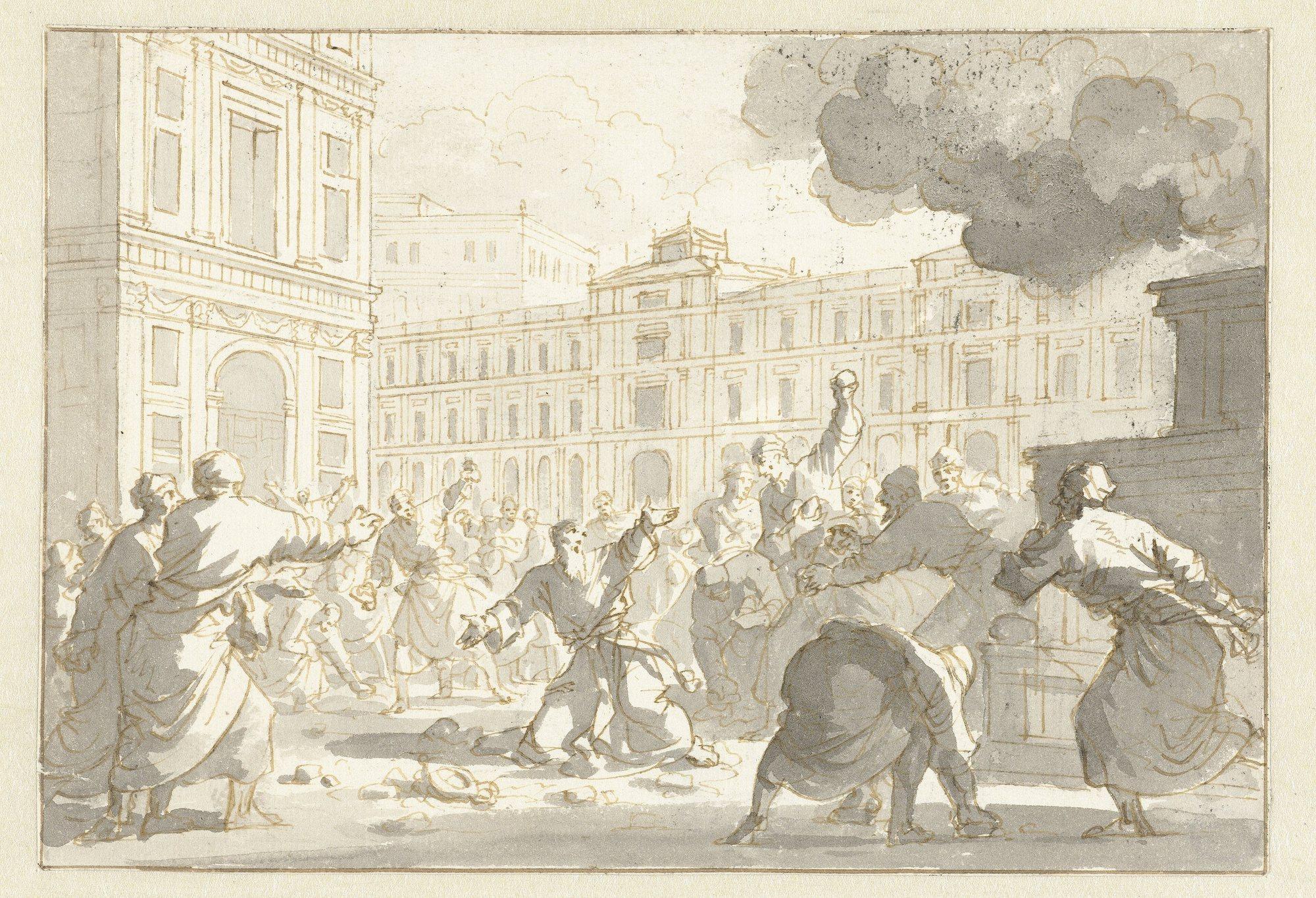
Jan Luyken, The Stoning of the Prophet Zechariah, 1698 to 1700. Public domain.
2 Chronicles 24 · Person · Featured Study
Zechariah son of Jehoiada
Jehoiada's son spoke a word from God against Judah's idols and died for it in the temple court.
Then the Spirit of God came upon Zechariah son of Jehoiada the priest, who stood up before the people and said to them, “This is what God says: ‘Why do you transgress the commandments of the LORD so that you cannot prosper? Because you have forsaken the LORD, He has forsaken you.’”
- Family
- father: Jehoiada the priest
- Places
- Jerusalem
- First named
- 2 Chronicles 24:20 “…Spirit of God came upon Zechariah son of…”
- Last named
- 2 Chronicles 24:25 “And when the Arameans had withdrawn, they left…”
King Joash ordered the death of the son of the priest who had instructed him.
Summary
Zechariah was the son of Jehoiada the priest, who had guided King Joash. After Jehoiada died, the officials of Judah turned the king to the Asherah poles and idols. The Spirit of God came on Zechariah, and he spoke against the people's sin. He was stoned at the king's command.
- His father Jehoiada died at 130 and was buried among the kings.
- Readings of Matthew 23:35 name three different men.
- Jewish teachers remembered his blood as a sign of judgment.
Where Zechariah Stands in Scripture
His story stands in one chapter of Chronicles.
Second Kings 12 tells the reign of Joash and his death at the hands of his servants, and it names no Zechariah. Chronicles gives his death three verses.
From Jehoiada's Grave to the King's Bed
The account runs from Jehoiada's burial to the death of Joash.
Aram came against Joash after Zechariah's death.
- Jehoiada dies and is honoured in deathThe City of David2 Chronicles 24:15 to 16
- The king listens to new advisersJerusalem2 Chronicles 24:17
- Judah serves the Asherah poles and idolsJudah and Jerusalem2 Chronicles 24:18
- The LORD sends prophets, and the people will not listenJudah2 Chronicles 24:19
- The Spirit of God comes on Zechariah, and he speaksBefore the people2 Chronicles 24:20
- He is stoned at the king's commandThe temple court2 Chronicles 24:21
- His dying words call for an accountThe temple court2 Chronicles 24:22
- A small Aramean army defeats JudahJudah and Jerusalem2 Chronicles 24:23 to 24
- Joash's servants kill him on his bedJerusalem2 Chronicles 24:25
The last two turns took place after Zechariah's death, in the spring and after the Arameans withdrew.
His dying words call for an account, A small Aramean army defeats Judah, Joash's servants kill him on his bed
The Word and the Stones
The story runs through 2 Chronicles 24:17 to 22.
The turn came when Jehoiada died and the king took new counsel.
The word2 Chronicles 24:20, with Albert Barnes
Albert Barnes takes the place where Zechariah stood to be a raised one, perhaps the steps of the inner court above the outer court where the people stood.
The stones2 Chronicles 24:21, with Jamieson, Fausset and Brown
But they conspired against Zechariah, and by order of the king, they stoned him in the courtyard of the house of the LORD.Two hands are named in the deed, the people's and the king's.
Jamieson, Fausset and Brown count the deed an outrage on a prophet of the LORD and an unrighteous use of the king's power.
The dying word2 Chronicles 24:22
Thus King Joash failed to remember the kindness that Zechariah’s father Jehoiada had extended to him. Instead, Joash killed Jehoiada’s son. As he lay dying, Zechariah said, “May the LORD see this and call you to account.”The Chronicler names the king's forgotten debt before he gives Zechariah's last words.
After Jehoiada
The priest's death left the king to new counsellors.
And Jehoiada was buried with the kings in the City of David, because he had done what was good in Israel for God and His temple.The Chronicler gives the reason for the honour in the same verse.
John Gill calls Jehoiada the oldest man recorded since Moses, and older than Moses by ten years. Albert Barnes reports that most critics suppose the number corrupt and suggest 103 or 83 in its place.
Matthew Henry holds that the little religion Joash had was buried in Jehoiada's grave, and that king and kingdom degenerated after his death.
The People Around Zechariah
His father, the king and the king's killers stand around him.
Jehoiada is the only kin of Zechariah the text names.
Generation 1
- JehoiadaHis father, the priest whose kindness Joash forgot
Generation 2
- ZechariahThe priest's son stoned in the temple court
- JoashKing of Judah, who ordered his stoning
- The officials of JudahThey turned the king to the Asherah poles
- Zabad son of ShimeathOne of the two conspirators against the king
- Jehozabad son of ShimrithThe other conspirator
Jehoiada stands above, and the others stand in Zechariah's own day.
The Places of His Death
He died in Jerusalem, and the plunder of Judah went to Damascus.
Zechariah died in the temple courtyard, and Judah's plunder went north to the king of Aram.
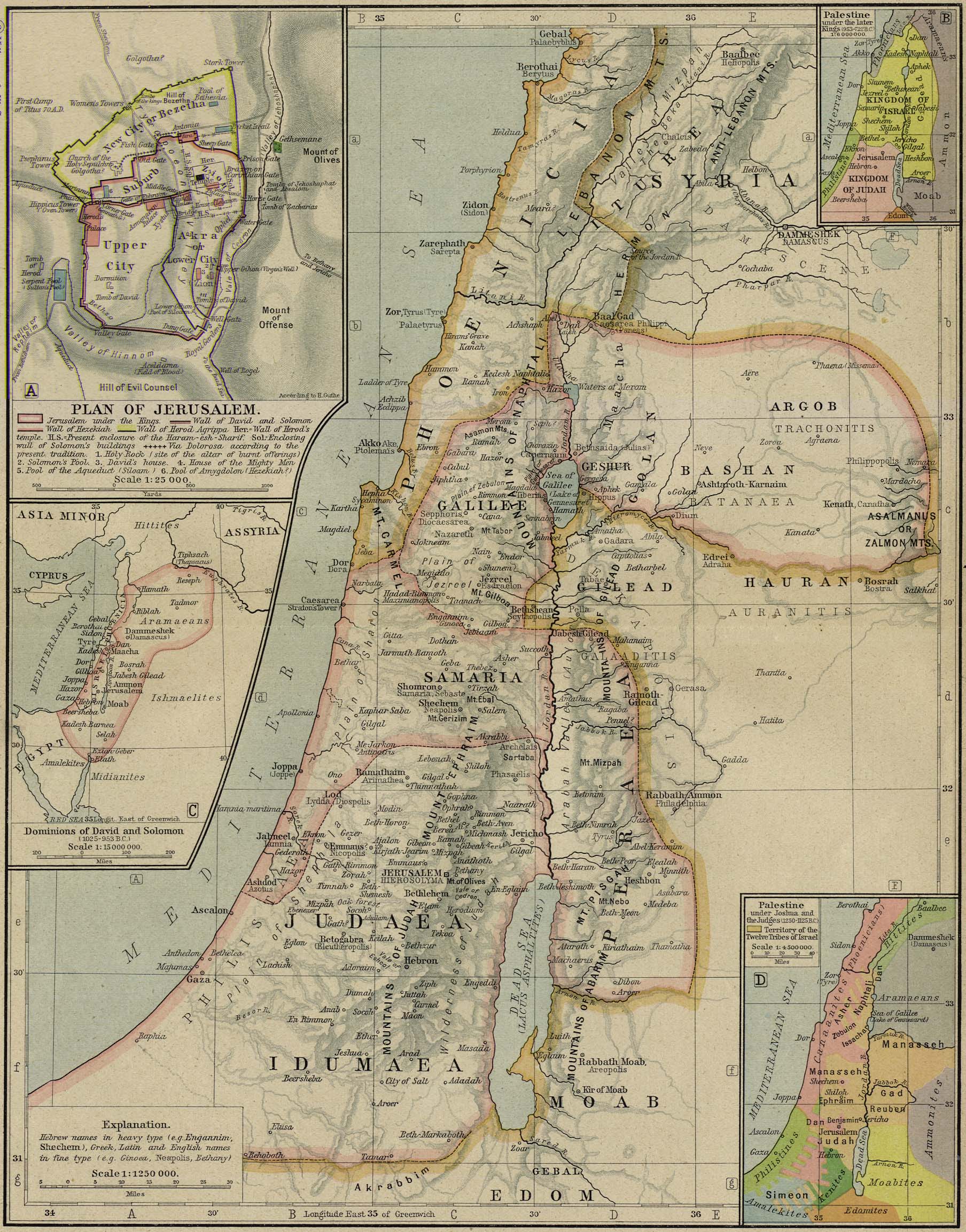
- 1Jerusalem, The temple court saw his death. 2 Chronicles 24:21
- 2Damascus, The Arameans sent the plunder of Judah to their king there. 2 Chronicles 24:23
Base map: Reference map of ancient Palestine, Rand McNally reference map (1926), public domain. Each place stands at its place page's coordinates, set on the plate by Jerusalem and Damascus, as the plate prints them.
Jerusalem and Damascus, each with the verse that names it in the account.
Questions His Death Raises
Two questions follow from his last words and from the Jewish memory of his blood.
Was his dying word a curse?2 Chronicles 24:22, with John Wesley, Albert Barnes and Jamieson, Fausset and Brown
John Wesley notes that the words may be rendered as a statement, that the LORD will look upon it and require it. Albert Barnes calls the prayer prophetic and points to the war and the murder that followed in 2 Chronicles 24:23 and 2 Chronicles 24:25. C. F. Keil holds that the last words became a prophecy that soon began to be fulfilled.
Jamieson, Fausset and Brown contrast the words with the spirit of the first Christian martyr, if they implied a vindictive curse.
Falling on his knees, he cried out in a loud voice, “Lord, do not hold this sin against them.” And when he had said this, he fell asleep.The first Christian martyr answers the same death with a different prayer.
What did later Jewish teachers say of his blood?John Wesley, Albert Barnes and the Jewish Encyclopedia, reporting Jewish tradition
John Wesley reports a Jewish teaching that the killing joined seven transgressions in one, on the day of atonement. Albert Barnes reports a belief that the blood could not be effaced and bubbled on the stones of the court until Nebuzaradan entered the temple. The Jewish Encyclopedia gives the sources of that legend as Gittin 57b, Sanhedrin 96b and Lamentations Rabbah.
What the Text Leaves Unsaid
Four things the text does not tell about him.
Second Chronicles 24:20 calls Jehoiada the priest and gives Zechariah no title. Albert Barnes names Zechariah the high priest, and Josephus, in his Antiquities, calls him the son of the high priest Jehoiada; the text does not say whether Zechariah held that office.
The text gives no age for Zechariah and names no one who mourned or buried him.
From Abel to Zechariah
Jesus closed a line of the righteous dead with a Zechariah.
And so upon you will come all the righteous blood shed on earth, from the blood of righteous Abel to the blood of Zechariah son of Berechiah, whom you murdered between the temple and the altar.Matthew's patronymic is the root of the dispute below.
from the blood of Abel to the blood of Zechariah, who was killed between the altar and the sanctuary. Yes, I tell you, all of it will be charged to this generation.Luke's saying sets the place without the patronymic.
Bede and Remigius of Rheims, as Thomas Aquinas gathers them in the Catena Aurea, read Abel and Zechariah as a pair. A shepherd was killed in the field and a priest in the court of the temple, and the two stand for martyrs of the people and of the altar.
Voices on Zechariah
One commentary note is set out in full.
Matthew Henry (1662 to 1714)
Commentary on the Whole Bible
The note weighs the reproof of 2 Chronicles 24:20 against the stones of 2 Chronicles 24:21.
“The reproof was just, the warning fair, both backed with scripture, and the delivery very gentle and tender; and yet so impudently and daringly do they defy God himself that nothing less than the blood of the prophet can satisfy their indignation at the prophecy.”
on 2 Chronicles 24:21Puritan
Which Zechariah Did Jesus Name?
Matthew 23:35 says son of Berechiah, and commentators have named three men.
Zechariah son of JehoiadaJerome, Bede, C. F. Keil and Adam Clarke
Jerome, as the Catena Aurea gives him, names the Zechariah killed by Joash in the court of the temple. He reads Barachias as Blessed of the Lord, a name for the righteousness of Jehoiada, and reports that the gospel the Nazarenes use reads son of Joiada. Bede writes that the Lord bore witness to the stoning of Jehoiada's son, and Keil and Adam Clarke take the same view.
The objection: Matthew 23:35 names his father Berechiah, and 2 Chronicles 24:20 names Jehoiada.
Zechariah the father of John the BaptistOrigen of Alexandria, the Protevangelium of James, and some reported by Gregory of Nyssa
Origen reports a tradition that Zacharias let Mary stand in the place of the temple kept for virgins after the Saviour's birth, and was slain for it. The Protevangelium of James tells his death at the vestibule of the temple, and Gregory of Nyssa reports that some say the same of the father of John.
The objection: Jerome answers that the tradition has no Scripture authority and is as readily despised as offered.
Zechariah the prophet, son of BerechiahWilliam Whiston, and some reported by Jerome
In the eighth month of the second year of Darius, the word of the LORD came to the prophet Zechariah son of Berechiah, the son of Iddo, saying:The prophet's father bears the name Matthew gives.
William Whiston, in a note to his translation of Josephus, holds that the prophet of Zechariah 1:1 was really the son of Barachiah, and that Matthew gives the only account of his death.
The objection: Jerome notes that Scripture does not record his death between the temple and the altar, and that in his time there were scarce even the ruins of the temple.
Books to Read Next
Both works are in the public domain, and each has a free copy to read.
The Books of the Chronicles
C. F. Keil · 1872
Keil's commentary covers both books of Chronicles.
Read at the Internet ArchiveThe Protevangelium of James, in Ante-Nicene Fathers, volume 8
Translated by Alexander Walker · 1886
The apocryphal gospel gives the story behind the second reading of Matthew 23:35.
Read at New AdventThe LORD Sees
Zechariah spoke the word God gave him and died for it.
And when the Arameans had withdrawn, they left Joash severely wounded. His own servants conspired against him for shedding the blood of the son of Jehoiada the priest, and they killed him on his bed. So he died and was buried in the City of David, but not in the tombs of the kings.The Chronicler ends the reign with the cost of the stoning.
Sources
Scripture is the Berean Standard Bible.
- John Gill, Exposition of the Old Testament (1748 to 1763), on 2 Chronicles 24:15.
- Albert Barnes, Notes, Explanatory and Practical, on the Old and New Testaments (1832 to 1869), on 2 Chronicles 24:15.
- Matthew Henry, Commentary on the Whole Bible (1710), on 2 Chronicles 24:15.
- Albert Barnes, Notes, Explanatory and Practical, on the Old and New Testaments (1832 to 1869), on 2 Chronicles 24:20.
- Jamieson, Fausset and Brown, Commentary Critical and Explanatory on the Whole Bible (1871), on 2 Chronicles 24:21.
- Matthew Henry, Commentary on the Whole Bible (1710), on 2 Chronicles 24:21.
- John Wesley, Explanatory Notes upon the Old Testament (1765), on 2 Chronicles 24:21.
- Albert Barnes, Notes, Explanatory and Practical, on the Old and New Testaments (1832 to 1869), on 2 Chronicles 24:21.
- John Wesley, Explanatory Notes upon the Old Testament (1765), on 2 Chronicles 24:22.
- Albert Barnes, Notes, Explanatory and Practical, on the Old and New Testaments (1832 to 1869), on 2 Chronicles 24:22.
- Jamieson, Fausset and Brown, Commentary Critical and Explanatory on the Whole Bible (1871), on 2 Chronicles 24:22.
- Adam Clarke, Commentary on the Bible (1832), on Matthew 23:35.
- Bede, Homilies on the Gospels 1.3.
- Bede, in Thomas Aquinas, Catena Aurea on Luke 11:51.
- Remigius of Rheims, in Thomas Aquinas, Catena Aurea on Matthew 23:35.
- Origen of Alexandria, in Thomas Aquinas, Catena Aurea on Matthew 23:35.
- Gregory of Nyssa, in Thomas Aquinas, Catena Aurea on Luke 11:51.
- Jerome, in Thomas Aquinas, Catena Aurea, volume 1 part 3, on Matthew 23:35 (Oxford: John Henry Parker, MDCCCXLII on its title page)
- C. F. Keil, The Books of the Chronicles (Edinburgh: T. and T. Clark, 1872), on 2 Chronicles 24:20 to 22.
- Flavius Josephus, Antiquities of the Jews 9.8.3, translated by William Whiston.
- Flavius Josephus, The Jewish War 4.5.4, translated by William Whiston, with Whiston's note 9.
- The Protevangelium of James 23 to 24, translated by Alexander Walker, Ante-Nicene Fathers volume 8.
- The Jewish Encyclopedia, article Zechariah ben Jehoiada.
Keep Studying
Read it4
Subjects1
People and groups3
Doctrines2
Go further11
Church history1